
Personal Finance
Confidence among U.S. consumers unexpectedly declined in November to a seven-month low as Americans grew more pessimistic about the labor-market outlook.
The Conference Board’s index fell to 70.4 from a revised 72.4 a month earlier that was stronger than initially estimated, the New York-based private research group said today. The median forecast in a Bloomberg survey of 78 economists called for a November reading of 72.6.
The drop in sentiment helps explain why some retailers such as Best Buy Co. see a need to match competitors’ discounts this holiday-shopping season. More employment opportunities and wage gains would help lay the groundwork for a pickup in household purchases that make up about 70 percent of theU.S. economy.
“The economy just has not performed very well this year and has been disappointing relative to what most people were hoping for and expecting through the course of the year,” saidStephen Stanley, chief economist at Pierpont Securities LLC inStamford, Connecticut. “It’s one thing when you have one or two years into the recovery and things aren’t progressing in the job market, but here we are four-plus years in.”
Estimates (CONCCONF) of consumer sentiment ranged from 65 to 81 in the Bloomberg survey after a previously reported October reading of 71.2. The Conference Board’s measure averaged 53.7 in the recession that ended in June 2009.
Other reports today showed applications for new-home construction increased in October and property values rose in September.
Building Permits
Building permits increased 6.2 percent to a 1.03 million annualized rate following September’s 974,000 pace, according to the Commerce Department. Housing starts data for September and October were postponed until Dec. 18 due to the government shutdown.
The S&P/Case-Shiller index of property prices in 20 cities increased 13.3 percent from September 2012 after a 12.8 percent gain in the year ended in August, a report from the group showed in New York.
Stocks fluctuated, after the Standard & Poor’s 500 Index fell from a record yesterday, as investors weighed the data. The S&P 500 rose 0.1 percent at 1,804.25 at 11:02 a.m. in New York.
The Conference Board’s barometer of consumer expectations for the next six months declined to 69.3, the lowest since March, from 72.2 a month earlier. A gauge of present conditions dropped to 72 from 72.6 in October.
Labor Outlook
The proportion of Americans who said jobs would become more plentiful in the next six months declined to 12.7 percent, the lowest since November 2011, from 16 percent.
The share of respondents who said they expected a pickup in their incomes declined to an eight-month low of 14.9 percent in November from 15.7 percent a month earlier.
“When looking ahead six months, consumers expressed greater concern about future job and earning prospects, but remain neutral about economic conditions,” Lynn Franco, director of economic indicators at the Conference Board, said in a statement.
Consumer assessment of current labor-market conditions held up. More said jobs were plentiful and fewer said positions were harder to get.
Hiring picked up last month, with employers adding 204,000 workers, topping the most optimistic projection in a survey of 91 economists. Payrolls have averaged 186,300 so far in 2013, compared with 182,750 last year.
Job Openings
Job openings climbed in September to the highest level in more than five years, Labor Department figures showed last week.
Progress in the labor market will be a focus for Federal Reserve policy makers meeting Dec. 17-18 as they weigh when, and by how much, to reduce their unprecedented $85 billion in monthly bond-buying.
The central bankers “generally expected that the data would prove consistent with the committee’s outlook for ongoing improvement in labor market conditions and would thus warrant trimming the pace of purchases in coming months,” according to the record of the Federal Open Market Committee’s Oct. 29-30 gathering.

In our commentary from Nov. 14, you could read about the connection between oil stocks and the general stock market. Back then, we wrote the following:
(…) we clearly see that the XOI and the S&P 500 have moved roughly in the same direction in the recent years (…) a strong positive correlation remains in place also on a short-term basis.
Since that essay was published, both indices have moved higher and hit fresh annual highs. They have also broken above their psychological barriers – 1,500 in case of the oil stock index and 1,800 in case of the S&P500. Taking this fact into account, we‘ve decided to examine the relationship between the general stock market and crude oil to check if it confirms or invalidates the conclusions of the analysis of the oil-stocks-to-oil ratio.
Let‘s begin with the long-term chart (charts courtesy by http://stockcharts.com).

Similarly to what we saw in the case of the oil-stocks-to-oil ratio, the first thing that catches the eye on the above chart is a strong negative correlation between the ratio and the price of light crude. When we go back to 1999, we clearly see that the annual low in crude oil was preceded by the ratio’s 1999 high. We could see this strong reltionship also in 2009, when the annual low in crude oil corresponded to the ratio’s 2009 high (marked with a red ellipse). In the following months, the ratio declined heavily, which led to higher oil prices.
Just like in the oil-stocks-to-oil ratio, the stocks-to-oil ratio’s 2011 high was in tune with the bottom of the corrective move that we saw in crude oil. We noticed similar price action also in May 2013. In both cases, declines in the ratio triggered increses in light crude. What’s interesting, the ratio’s lows corresponded to crude oil highs (marked with the green lines). We saw such situations in 2003, 2005, 2008, 2011 and also in 2013.
Looking at the above chart, we see that the RSI has reached its highest level since 1999. Although it is not overbought, we can notice that lower readings on the indicator triggered downswings in the ratio, which resulted in higher prices of light crude.
Taking the above into account, if history repeats itsef once again and the ratio declines, we will likely see improvement in crude oil.
Now, let’s zoom in our picture and examine the weekly chart.
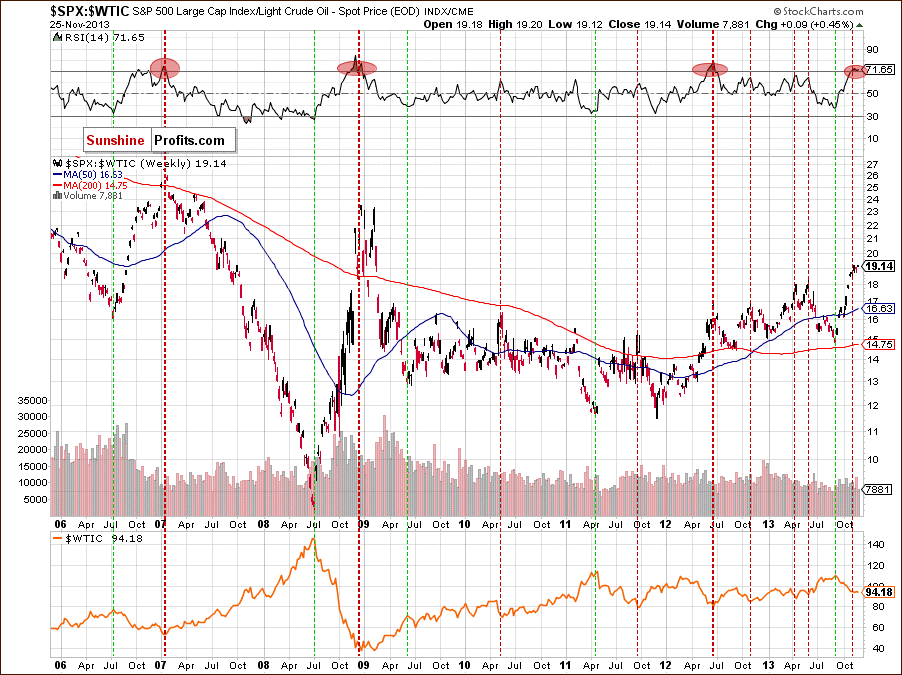
Looking at the above chart, we see the same price action – most of the ratio’s tops have corresponded to the crude oil’s lows. In this case, the ratio’s lows didn’t indicate crude oil’s lows precisely. However, major lows in 2008, 2009, 2011 and 2013 were in tune with major light crude’s tops.
When we take a closer look at the position of the RSI, we clearly see that the indiator has moved above the 70 level. We saw such situations in 2007, 2008 and again in 2012. Back then, such high readings on the RSI preceded moves down in the ratio and up in crude oil. If history repeats itself once again, we may see a move higher in crude oil in the near future.
Now, let’s check the short-term outlook.
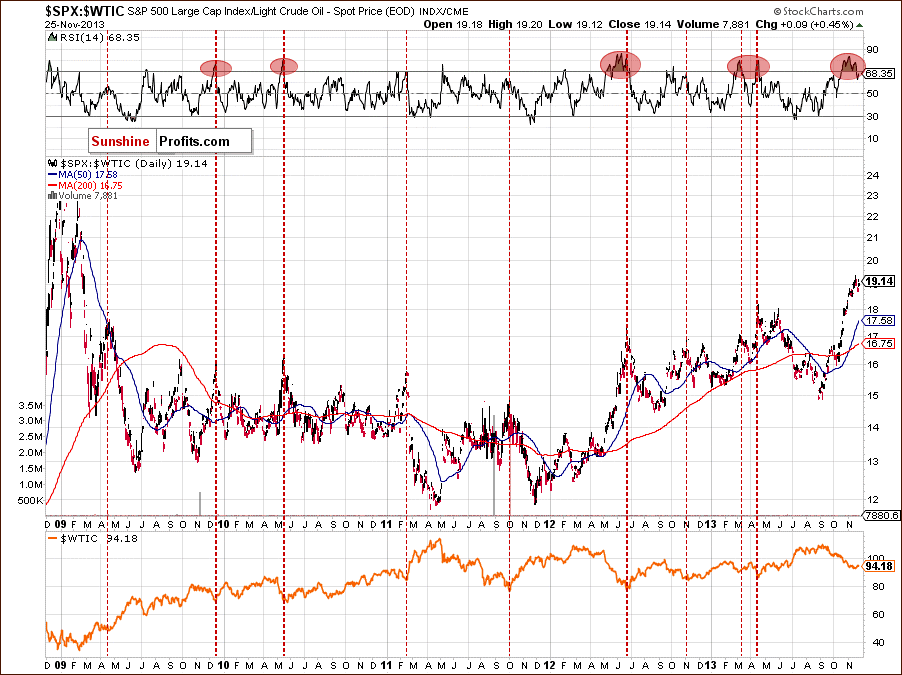
On the above chart, we see that the ratio has rallied since September, which is in perfect tune with declines in crude oil. At the beginning of the previous week, the ratio moved higher once again and hit a new 2013 high. Despite this increase, we didn’t notice a new high in case of the RSI. When we take a closer look at the above chart, we clearly see a negative divergence between the ratio and the position of the indictor.
At this point, it’s worth mentioning that there were similar situations in the past – for example in June 2012 and March 2013. Back then, such divergences preceded declines in the ratio and had a positive impact on crude oil.
Please note that lower readings on the RSI in May and August triggered downswings in the ratio and pushed the price of light crude higher. Taking the above facts into account, we can assume that a bigger pullback in crude oil is just around the corner.
Summing up, looking at the situation in the ratio we clearly see that the stocks-to-oil ratio confirms the conclusions of the analysis of the oil-stocks-to-oil ratio. Similarly to what we saw earlier, the stocks-to-oil ratio is also oversold (not only on a short-term basis, but also from the medium-term perspective) as indicated by the RSI. Therefore, we may see further deterioration in the ratio in the near future, which will likely trigger an upswing in light crude.
Thank you.
Nadia Simmons
Sunshine Profits‘ Crude Oil Expert
* * * * *
Disclaimer
All essays, research and information found above represent analyses and opinions of Nadia Simmons and Sunshine Profits’ associates only. As such, it may prove wrong and be a subject to change without notice. Opinions and analyses were based on data available to authors of respective essays at the time of writing. Although the information provided above is based on careful research and sources that are believed to be accurate, Nadia Simmons and his associates do not guarantee the accuracy or thoroughness of the data or information reported. The opinions published above are neither an offer nor a recommendation to purchase or sell any securities. Nadia Simmons is not a Registered Securities Advisor. By reading Nadia Simmons’ reports you fully agree that he will not be held responsible or liable for any decisions you make regarding any information provided in these reports. Investing, trading and speculation in any financial markets may involve high risk of loss. Nadia Simmons, Sunshine Profits’ employees and affiliates as well as members of their families may have a short or long position in any securities, including those mentioned in any of the reports or essays, and may make additional purchases and/or sales of those securities without notice.
“In investing, what is comfortable is rarely profitable.” — Robert Arnott
Valuations still matter.
Assuming that one is investing as opposed to speculating, initial valuation (i.e. the price you pay for the investment) remains the single most important characteristic of whatever one elects to buy.
And at the risk of sounding like a broken record, “initial valuation” in the US stock market is at a level consistent with very disappointing subsequent returns, if the history of the last 130 years is any guide.
Without fail, every time the US market has traded on a cyclically-adjusted P/E (CAPE) ratio of 24 or higher over the past 130 years, it has been followed by a roughly 20 year bear market.
The evidence for the prosecution is clear, especially for the peak years 1901, 1929, 1966 and 2000. And 2013? The CAPE ratio is more than 25 today.
But there is the stock market, and then there are individual stocks. We have no interest in the former, but plenty of interest in the opportunity set of the latter.
We’re just not that interested in the US market, given general valuation concerns, and the malign role of Fed policy in distorting the prices of everything. As purists and unashamed value investors, we have plenty of other fish to fry.
Probably the biggest of those fish is that giant part of the world economy known as Asia. The chart below shows the anticipated growth in numbers of the middle class throughout the world over the next two decades.

The solid green circle is the current middle class population (or as at 2009 to be precise); the wider blue-fringed circle represents the forecast size of this population in 20 years’ time.
The OECD definition of middle class is those households with daily per capita expenditures of between $10 and $100 in purchasing power parity terms.
Note that in the US and Europe, the size of the middle class is barely expected to change over the next two decades. The stand-out area is obvious: the emerging middle class in Asia is forecast to explode, from roughly 500 million to some 3 billion people.
In equity investing, the combination of a compelling secular growth story and compellingly attractive valuations is a very rare thing, the sort of investment opportunity that one might only see once or twice in a generation, if that.
But it exists, here in Asia, today. Once again, however, we have to abandon conventional financial thinking in order to exploit it.
Asian personal consumption between 2007 and 2012 – while the West was suffering from a little localised financial crisis – grew by 5% to 10% per annum. Industries likely to benefit from sustained growth in domestic consumption include food and beverages, clothes, cars, and insurance.
But the index composition of Asian equity index benchmarks leaves much to be desired.
Of the 10 largest companies in the MSCI Asia ex-Japan index, three are low margin exporters in Korea and Taiwan, one is a low margin Chinese telecoms business, three are state-run Chinese banks, one is an inefficient Chinese oil and gas producer, and one is an expensive Chinese internet business.
That doesn’t leave much for value investors to go on.
Asian equity funds more generally, tending to be index-trackers, are heavy in Chinese stocks of indeterminate value and clunky ‘old Asia’ exporters with far too much research coverage.
Or one can ignore index composition (‘yesterday’s winners’) entirely and focus instead on ‘best in breed’ businesses throughout the region on an unconstrained basis– especially those with favorable returns on equity, strong balance sheets, and low valuations.
As Greg Fisher of Adepa Asset Management wrote, amid a world of worries, “keeping the discipline of holding lowly valued, under-owned and unleveraged companies is likely to continue to protect our capital and earn us both income and capital appreciation over the longer term.”
Or to put it more plainly, and in the words of Warren Buffett, “price is what you pay; value is what you get.”
US stocks may be expensive, but you can get better economic fundamentals and cheaper valuations selectively throughout Asia.
And as insurance against the sort of disorderly currency moves that seem to be almost inevitable courtesy of so many central banks behaving badly, we still maintain you can’t do better over the medium term than gold.




-
I know Mike is a very solid investor and respect his opinions very much. So if he says pay attention to this or that - I will.
~ Dale G.
-
I've started managing my own investments so view Michael's site as a one-stop shop from which to get information and perspectives.
~ Dave E.
-
Michael offers easy reading, honest, common sense information that anyone can use in a practical manner.
~ der_al.
-
A sane voice in a scrambled investment world.
~ Ed R.
Inside Edge Pro Contributors

Greg Weldon

Josef Schachter

Tyler Bollhorn

Ryan Irvine

Paul Beattie

Martin Straith

Patrick Ceresna

Mark Leibovit

James Thorne

Victor Adair