
Timing & trends
 If you have children, you need to see these numbers
According to a recent survey by the Pew Research Center, just 33% of Americans think their children will have a better life than they did. On the other hand, 62% believe their children will be worse off.
They’re likely to be right. The typical American family has seen its real income (adjusted for inflation) fall for 5 consecutive years now, and it earns less in real terms that it did in 1989.
According to the Census Bureau, median household income fell in 2012, and it languishes 8.3% below the pre-crisis peak in 2007.
The Brookings Institution, meanwhile, calculates that real incomes for working-age men in the US have fallen by 19 per cent since 1970.
(Of course, if you’re fortunate enough to be a member of the super-rich who, thanks in large part to central bankers driving up asset prices, saw their real incomes rocket by 20% in 2012.)
In Europe things look even more dire. Just 28% of Germans think their children will be better off than they were. In the UK it’s 17%, in Italy 14%, and in France just 9%.
In Britain, research by the Financial Times shows that those born in 1985 are the first cohort to suffer a living standard worse than those born 10 years before them.
Contrast this gloomy picture with China, where 82% think their kids will have it better than they did. In Nigeria, the number is 65%. In India, 59%.
It’s blatantly obvious that the West is in decline. And most people seem to understand this.
But this isn’t a bad news story. Wealth and power has constantly shifted throughout history. Five hundred years ago, it was the West that was rising and Asia in decline. Today it’s the exact opposite.
As Jim Rogers has said so many times before, if you were smart in the 1700s, you went to France. If you were smart in the 1800s, you went to England. And in the 1900s, you went to the US.
Today, it’s the developing world. That’s where the long-term opportunity is– Asia, Africa, and South America.
What’s happening in the developing world is nothing short of remarkable. One billion people are being pulled from the depths of poverty into the middle class… bringing with them untold possibilities for business, employment, and investment.
That’s one of the reasons why I travel so much, and why I spend so much time in Chile. I’m constantly amazed at the tremendous opportunities I come across in this country (which is still largely off the radar of most people).
It’s also what I encourage my students to do each summer at our entrepreneurship camps—seek out opportunities in countries that are rising suns, not setting suns.
If you have children, this is a great direction to influence them. Encourage them to learn another language, travel, and apply what they want to do to how the world is going to be in the future.
As Wayne Gretzky said, skate to where the puck is going to be.

After 100 years of the US central bank, does it deserve another try…?
SO IT WILL be 100 years on December 23rd since the Federal Reserve was born.
The purpose in 1913 was to form a regulatory body to help stem the tide of bank failures in the United States of America. The Fed’s proponents, Senator Nelson Aldrich, Senator Owens, Congressman Glass and others, believed that if an agency controlled the flow of money and the banking institutions, it could prevent many of the economic collapses that plagued the early years of the US.
Whatever its faults 100 years on, has the Fed at least performed its charter well in actuality?
The establishment of such a power was in no way a unanimous decision. There were many in the government who opposed it, as G.Edward Griffin details in his history of the Fed, The Creature from Jekyll Island. The name itself, the Federal Reserve, was in part intented to address their concerns. Washington avoided calling it a “central bank”, because many of the congress were also opposed to the centralization of power, especially monetary control to one agency in the government. So those supporting the central bank concept had to devise a similar method of control, but avoiding the appearance of direct control. That idea gave birth to the Federal Reserve.
The institution created to obfuscate the appearance of a central bank has 12 Reserve Banks across the country, which report up to the higher authorities within the system. This higher authority is the nine member board of directors, of which six are appointed by the 12 district banks themselves and the remaining three are appointed by the Board of Governors.
This of course is a centralization of power. It is apparent that the Board of Governors is the controlling arm of the Federal Reserve. Where do they come from? The Board consists of seven members, appointed by the president of the United States and confirmed by the senate. Each member may hold this position for fourteen years (though the renewable terms are every two years). From among this board, the president also chooses the chairman and vice-chairman which are ultimately the final decision makers.
Voilà! We do have a central bank, yet it has only been recently that our government has openly admitted that the Federal Reserve is the “central bank” of the United States of America. This agency literally controls the entire banking system. They have the ability to turn on and off the spigot of cash that flows through the banking network.
Is that control a good or bad thing? Any benefits of the Federal Reserve System have as yet not been proven. Because if we take a look at the economic history of the United States of America over the last 100 years the picture “ain’t pretty” as Tony Soprano would say.

Since the inception of the Federal Reserve System 100 years ago we have been in contraction or prolonged slowdown 38% of the time. Some may say this is a good track record. But in almost half of those 38 years the US had negative growth in gross domestic product.
Thanks to Isaac Newton it is generally believed that what goes up must come down. This is a law of gravity, not economics. As the population grows the economy should grow as well, as these same new people need to eat but also produce. So why should they suffer such frequent economic decline? Greed and stupidity often are the real cause of most crises. But these two proclivities do not exist only in the purview of the private sector
Washington Mutual was the largest bank failure ever in the US, collapsing in 2008 with assets of over $300 billion. That represented a little over 2% of that year’s GDP. This and other notable failures such as Lehman Brothers would help drive the country into a deep recession that we have yet to climb out of. Where was the Federal Reserve before this occurred? The Fed got a lot of credit for rescuing the banking system after the fact. But why didn’t they see this coming? If it is their job to mop up during and after a crisis, is it not their job to prevent these calamities too?
This experiment we call our central bank is also now playing a game it never had before, and the Board of Governors knows it. The unbridled creation of numbers that represent money characterizes a new attempt at economic manipulation that had never been tried before. Many believe that quantitative easing is working. But others, such as Jim Rogers, believe this artificial growth will collapse around us.
The Federal Reserve System’s birthday is December 23rd, when it will be 100 years old. Yet it is still an experiment. Counterfactual history can’t bear such a length of time, but there is no real proof that the Fed’s existence has had any more positive effect than alternative outcomes. In fact, many such as the Cato Instituteblame Federal Reserve policies and government banking deregulation, on which the Fed was often consulted, for our current economic crisis. Contrary to the Fed’s charter, this not only affects millions of people in the USA but has caused a domino effect around the world.
But accepting the Fed and its power as status quo, the question for the individual becomes how does this system affect your investments or income moving forward? In a world where money is controlled by centralized agencies with ultimate power to create, and thus to destroy value, one might want to seek hard assets beyond their control. This year’s drop in gold and silver prices doesn’t undo their many thousands of years’ use as stores of value, far longer than the US Fed’s fiat Dollar. And with the odds basis historical data that there will be another economic crisis inside the next 10 years, many of us today should expect to live through a fresh recession despite the best intentions of the Federal Reserve System’s creators 100 years ago.
Miguel Perez-Santalla
BullionVault
Miguel Perez-Santalla is vice president of business development for BullionVault, the physical gold and silver exchange founded a decade ago and now the world’s #1 provider of physical bullion ownership online. A fierce advocate for retail investors, and a regular speaker at industry and media events, Miguel has over 30 years’ experience in the precious metals business, previously working at the United States’ top coin dealerships, as well as international refining group Heraeus.
(c) BullionVault 2013
Please Note: This article is to inform your thinking, not lead it. Only you can decide the best place for your money, and any decision you make will put your money at risk. Information or data included here may have already been overtaken by events – and must be verified elsewhere – should you choose to act on it.




Further Declines or Rally in Oil Stocks?
In our previous commentary, we examined the situation in oil stocks. Back then, we wrote in the summary:
(…) the outlook for oil stocks remains bullish and the uptrend is not threatened, however, taking into account the medium- and short-term sell signals, further deterioration should not surprise us.
Since that essay was published, we have seen a downward move which took the oil stock index below 1,440. Did this weakness change anything in the overall outlook? Before we try to answer this question, we’ll examine the NYSE Arca Oil Index (XOI) in different time horizons and find out if there’s something on the horizon that could drive oil stocks higher or lower in the near future. Let’s start with the long-term chart (charts courtesy by http://stockcharts.com).
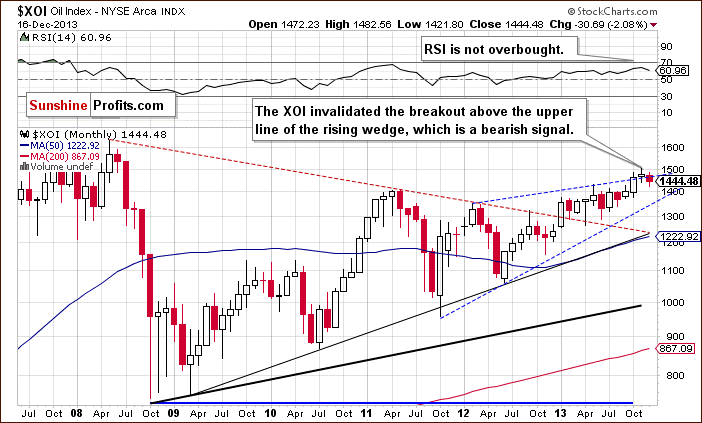
On the above chart, we see that the situation has deteriorated recently. The oil stock index extended its declines and dropped below the upper line of the rising wedge. From this perspective the breakout that we saw in October was invalidated, which is a strong bearish signal and we may see further deterioration.
To see the current situation more clearly, let’s zoom in on our picture and move on to the weekly chart.
In our last essay on oil stocks from Dec. 12, 2013, we wrote the following:
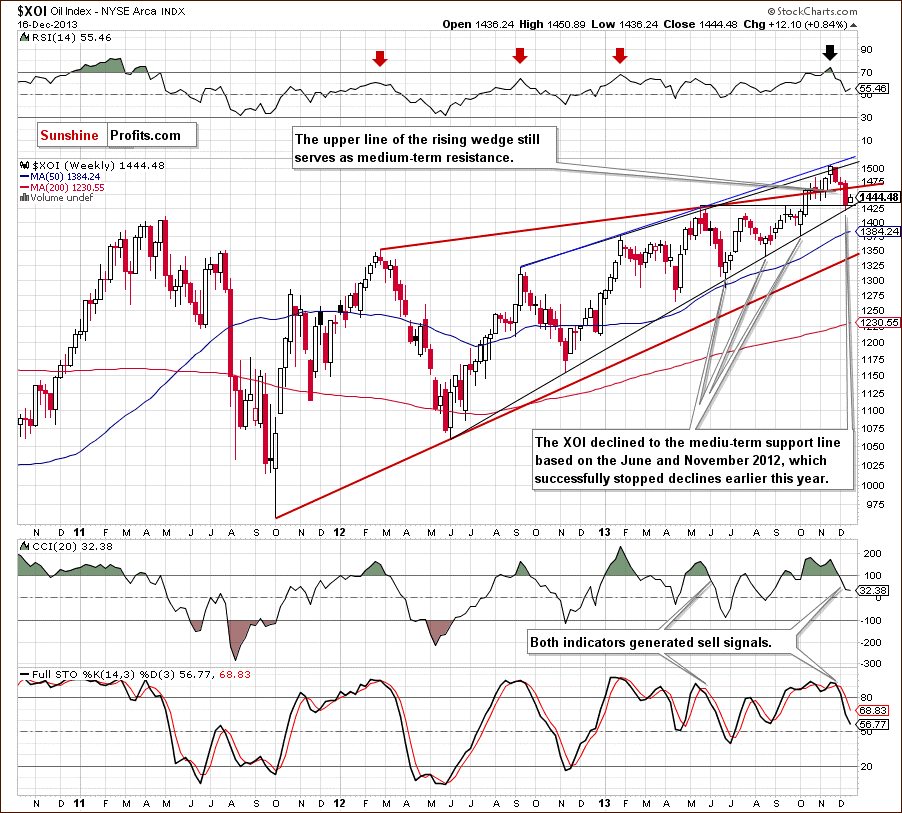
(…) the position of the RSI and the sell signals generated by two other indicators, encouraged sellers to act and triggered further deterioration this week. (…) the upper line of the rising wedge was broken, therefore, the first target for the sellers will be around 1,439, where the bottom of the previous correction is.
Looking at the above chart, we see that the XOI reached its target in the previous week. With this downward move, the oil stock index reached the medium-term support line based on the June and November 2012 lows, which had successfully stopped declines earlier this year. We saw such situations in June, August and also in October. From this perspective, if history repeats itself once again, we may see similar price action this (or next) week. Nevertheless, this time, before we see higher values of the XOI, the buyers will have to break above the upper line of the rising wedge, which serves as major medium-term resistance (currently around 1,463). If they manage to do that, we may see an upward move to at least 1,483 where the resistance level created by the previously-broken 2013 high is. The next upside target will be the psychological barrier of 1,500.
What could happen if the buyers fail? If the sellers push the XOI below the medium-term support line, we will likely see further deterioration and the downside target will be the psychological barrier of 1,400. If it’s broken, the next target will be around 1,376, where the bottom of the Sept.-Oct. correction is.
From the technical point of view, the medium-term uptrend remains in place at the moment, and the situation is still bullish.
Now, let’s turn to the daily chart.
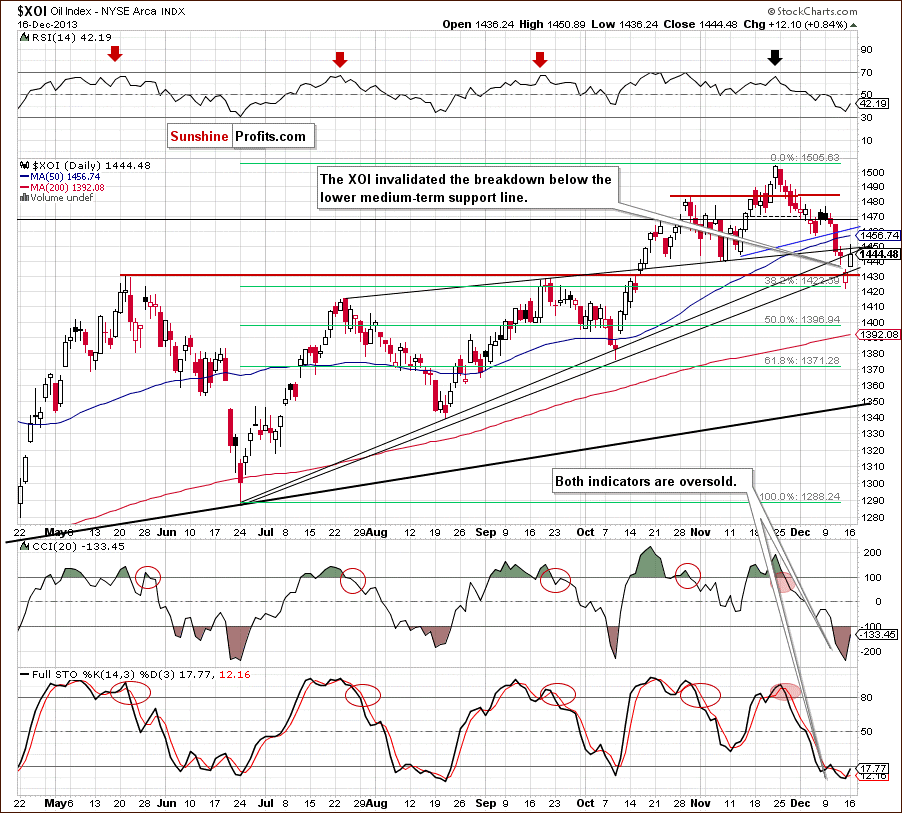
Looking at the above chart, we see that the XOI declined in the previous week once again and dropped below the bottom of the corrective move that we saw at the beginning of November (at 1,439). In this way, the oil stock index also slipped below the upper line of the rising wedge (marked with the black thin line) and two medium-term support lines (the upper one is based on the June and August lows and the lower one is created by the June and October lows). However, when we take a closer look at the chart, we see that the XOI reversed course after reaching the 38.2% Fibonacci retracement level based on the entire June-November rally. As you can see on the daily chart, this support encouraged buyers to act, and resulted in an upswing, which push the index above the May high.
Despite this growth, the combination of the previously-broken upper medium-term rising support line and the upper line of the rising wedge stopped further improvement and the XOI closed Monday below this resistance zone. If the buyers do not give up and the oil stock index comes back above this line, we may see an upward corrective move to at least 1,456-1,461 where the 50-day moving average and the previously-broken neck line of the head and shoulders pattern are. On the other hand, if the buyers fail, we will likely see a pullback to the lower rising support line (currently around 1,435) or even to the Friday low at 1,421.
Summing up, from the long-, medium- and short-term perspectives, the situation has deteriorated. We saw an invalidation of the long-term breakout (which is a bearish signal). On the other hand, oil stocks reached very a important medium-term support line based on the June and November 2012 lows, which had successfully stopped declines earlier this year. Additionally, the XOI reached the 38.2% Fibonacci retracement level based on the entire June-November rally, which suggests that the sentiment for oil stocks may turn positive in the near future.
Thank you.
Nadia Simmons
Sunshine Profits‘ Crude Oil Expert
These days a lot of macro discussions are focusing on rising interest rates. Will the Fed taper? When will they taper (seemingly next week)? And what will happen to markets when they do, in particular what will happen to equities?
Conventional wisdom says that rising rates are bad for equities. There are lots of justifications of this claim the main one (that we like and think makes sense) is that rising rates mean a higher “risk-free” rate which means higher interest rates on fixed income products from savings accounts to 30-year bonds (yield curve assumptions aside). Ultimately, the qualitative thought behind this argument is that as rates rise the average Joe will see higher yields in fixed income products and will opt to put more of his money into some kind of interest bearing account (savings, money market, CDs, notes, bonds, etc.). When that excess capital goes into the various interest bearing vehicles, the money will have to come out of whatever vehicles it was parked in. Conventionally, the thought is the money will come out of equities thus lowering stock market returns. This, of course, makes logical sense, if I can get a high yield with “no risk” why risk the volatility inherent in the stock market, especially against the often frightening macro backdrop offered these days. At the same time, higher yields will incentivize Joe to save not spend thus impacting the economy in a negative way.
However, despite this completely logical argument, we can make a counter claim, which is equally logical and convincing. The claim would be that if the Fed does taper and rates rise that means things are on the mend in the economy and that means companies are doing better and things are otherwise getting better. So if things are getting better we should probably expect equity markets to keep marching up indefinitely-better economy means better things for the companies which make up said economy means better sales>earnings>valuations.
While each of these arguments is compelling and could be used to justify action, we prefer to find out what lessons history tells, in particular what historical data tell us about the relationship and what we might expect going forward based on historical outcomes.
We examined monthly data on 2 and 10-year yields and the S&P 500 (SPY). We calculated simple percentage change returns, comparing this month’s S&P 500 return to last month’s 2 and 10-year yield change. We did this because we were trying to determine what happens to stock returns after rates rise. In order to determine what happened “after” rate changes historically, we would have to see what happened to the S&P 500 the month after the various rate changes. Below are two charts, which show the scatter diagram relationship including a simple linear regression line.
(click to enlarge)

….continue reading HERE


-
I know Mike is a very solid investor and respect his opinions very much. So if he says pay attention to this or that - I will.
~ Dale G.
-
I've started managing my own investments so view Michael's site as a one-stop shop from which to get information and perspectives.
~ Dave E.
-
Michael offers easy reading, honest, common sense information that anyone can use in a practical manner.
~ der_al.
-
A sane voice in a scrambled investment world.
~ Ed R.
Inside Edge Pro Contributors

Greg Weldon

Josef Schachter

Tyler Bollhorn

Ryan Irvine

Paul Beattie

Martin Straith

Patrick Ceresna

Mark Leibovit

James Thorne

Victor Adair