
Personal Finance
U.S. housing starts surged to their highest level in nearly six years in November, a sign of strength in the housing market that could give the Federal Reserve ammunition to start cutting back its bond purchases.
The Commerce Department said on Wednesday housing starts jumped 22.7 percent, the biggest increase since January 1990, to a seasonally adjusted annual rate of 1.09 million units.
That was the highest level since February 2008 and only the second time since the collapse of the housing market in 2006 that starts rose above a 1 million-unit pace.
The department also said groundbreaking increased 1.8 percent in October and slipped 1.1 percent in September. The release of housing starts data for September and October was delayed because of a 16-day shutdown of the federal government in October.
Economists polled by Reuters had expected starts to come in at a 950,000-unit rate in November and set a 915,000-unit pace in October.
The report was released as Fed officials met for a second day. The housing market had slowed in recent months, a development policymakers acknowledged at the October meeting.
Some economists expect the Fed to announce a reduction in its $85 billion monthly bond buying program later on Wednesday, although more believe it will wait until January or March.
A run-up in mortgage rates, in anticipation of the U.S. central bank tapering its monthly bond purchases, took some edge off the sector’s recovery earlier in the year, but not enough to halt the process as a steady increase in household formation from multi-decade lows props up demand.
Last month, groundbreaking for single-family homes, the largest segment of the market, soared 20.8 percent to a 727,000-unit pace, the highest level since March 2008.
Starts for volatile multi-family homes jumped 26.8 percent to a 364,000-unit rate.
Multi-family starts have risen strongly through the course of the housing recovery, buoyed by demand for rental apartments as still-high unemployment and stringent lending practices by bank price potential homeowners out of the market.
While permits to build homes fell 3.1 percent in November to a 1.01 million-unit pace, they were above economists’ expectations for a 990,000-unit pace.
The drop in permits last month is likely to be temporary. Homebuilder confidence rose in December, with builders upbeat on current sales conditions, future sales and prospective buyers, a report showed on Tuesday.
In addition, the stock of houses on the market remains lean and the inventory of homes under construction is at a 4-1/2 year low.
In November, permits were weighed down by a 10.8 percent drop in approvals for the multifamily sector. Permits for single-family homes rose 2.1 percent.
(Reporting by Lucia Mutikani; Editing by Krista Hughes)

Gold To Rally Year End As Traders Close Some Of Record Short Positions
Short positions are at multi year highs and if the Fed does not taper when it announces today (Ed Note: Wednesday at 2 p.m. EST), we will likely see a large short covering rally going into the New Year as shorts close out positions and balance books at year end.

Bearish bets by hedge funds and money managers in U.S. gold futures and options are close to a 7-1/2 year high, according to data from the Commodity Futures Trading Commission (CFTC).
SPDR Gold Trust, the world’s largest gold ETF, said its holdings fell 8.70 tonnes to 818.90 tonnes on Monday – its biggest outflow since Oct 21.
Holdings are at their lowest since January 2009 after more than 450 tonnes of outflows this year caused by traders and more speculative investors channelling money towards riskier assets such as equities and bonds which are at record highs in many countries.
Importantly, and little reported on is the fact that the ETF flows have been matched and greatly surpassed by physical gold in China and imports from Hong Kong into China alone.

Ed Note: White Bars are China Gold Imports From Hong Kong – Orange Bars are Monthly Change in Gold ETF Holdings
Gold has lost 25% of its value this year after 12 years of gains. There are credible allegations that the market was subject to price manipulation with banks manipulating prices lower through massive concentrated selling at times of low liquidity. Allegations that Chinese entities may be manipulating paper gold prices lower in order to buy physical gold on the cheap are gaining credence.
Whatever, the reasons for gold’s price fall it is a healthy development as it has led to the speculative hot money and weak hands being washed out of the market. Gold is on a much more sustainable footing now and is very much in strong hands now, which bodes well for gold in 2014 and 2015.
Download Protecting your Savings In The Coming Bail-In Era (11 pages)
Download From Bail-Outs to Bail-Ins: Risks and Ramifications – Includes 60 Safest Banks In World (51 pages)

Nostradamus predicted that a great nation would rise to unspeakable glory. And then see it all come crashing down.
Was he referring to the United States?
Because we may be on the verge of realizing “unspeakable glory.”
Goldman Sachs’ (GS) U.S. Equity Strategist, David Kostin, expects domestic GDP growth to hit 3% in 2014. That’s nearly double the 1.7% growth rate for this year.
That’s not the only shocking revelation in the market, though.
You see, unlike most leading economic indicators, there’s one that’s impervious to manipulation. It’s immune to sentiment, too.
Heck, it’s darn near the closest thing to an economic crystal ball we’ve got.
And it’s suggesting that incredible things are ahead in 2014. Not just for the United States, but for the entire global economy.
We’re Long Overdue
It’s been a long time since we checked in on the Baltic Dry Index (BDI).
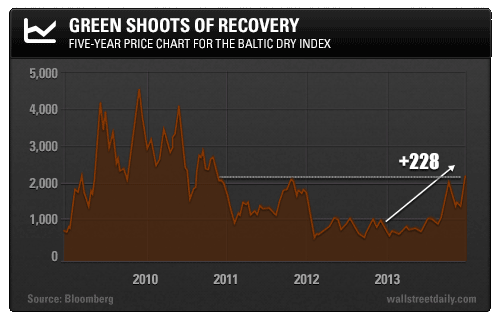
The Federal Reserve will decide on Wednesday whether the U.S. economy is finally resilient enough to withstand less policy support, or whether it is prudent to wait a bit longer.
With the world’s financial markets on edge, the U.S. central bank wraps up a two-day meeting with a highly anticipated policy announcement at 2 p.m. (1900 GMT), followed by Ben Bernanke’s last news conference as Fed chairman a half hour later.
Recent growth in jobs and retail sales, as well as a fresh budget deal in Congress, has convinced a growing number of economists the time is right for the Fed to trim its $85 billion in monthly bond purchases. The 15-month-old program is meant to put downward pressure on long-term borrowing costs in order to stimulate investment and hiring.
But many observers believe the central bank will wait until early in the new year, given persistently low inflation and the fact that the world’s largest economy has stumbled several times in its crawl out of the 2007-2009 recession.
“It is increasingly looking like a coin flip,” said Michael Feroli, JPMorgan’s chief U.S. economist.
Canada’s dollar is emerging as the Group of Seven currency with the most at stake as traders debate whether the U.S. Federal Reserve will announce a reduction in its unprecedented monetary stimulus as soon as today.
The loonie and U.S. 10-year Treasury notes yields are the most inversely correlated since August 2004, increasing faster in 2013 than any other G-7 peer apart from the U.S. dollar. That means any rise in U.S. yields should the Fed taper its $85 billion in monthly bond purchases may weaken Canada’s currency, which is already down 6.5 percent this year.
The Canadian dollar is particularly sensitive to Fed policy because the countries are each other’s largest trading partners. The correlation increased as the U.S. considered reducing stimulus and the Bank of Canada stepped back from a pledge to move interest rates higher.
“We’re in the process of seeing a divergence in monetary policy,” Paresh Upadhyaya, the Boston-based director of currency strategy at Pioneer Investment Management Inc., said in a Dec. 16 phone interview. “Canada can be expected to keep a very loose, accommodative monetary policy, in contrast to the Fed, which is set to start its tightening cycle.”
full article HERE


-
I know Mike is a very solid investor and respect his opinions very much. So if he says pay attention to this or that - I will.
~ Dale G.
-
I've started managing my own investments so view Michael's site as a one-stop shop from which to get information and perspectives.
~ Dave E.
-
Michael offers easy reading, honest, common sense information that anyone can use in a practical manner.
~ der_al.
-
A sane voice in a scrambled investment world.
~ Ed R.
Inside Edge Pro Contributors

Greg Weldon

Josef Schachter

Tyler Bollhorn

Ryan Irvine

Paul Beattie

Martin Straith

Patrick Ceresna

Mark Leibovit

James Thorne

Victor Adair