
Mike's Content
 I’ve completely changed my thinking on economics and investing since attending the World Outlook Financial Conference. Just a shame Engels and I didn’t know about it before publishing Das Kapital.
 The World Outlook analysts have been outperforming Berkshire shares by a country mile. I might have to hold our next shareholder meeting right after the 2014 Conference on Jan 31st & Feb 1st!
 The recommendations Michael’s speakers provided gave me fantastic returns in real estate, oil and gas and the currency markets.
 I may not be good at taking advice on my choice of husbands and tv offers – but I’ve benefited hugely from the advice I get at Michael Campbell’s World Outlook Financial Conference.

Since at least the 1980s, US policy has been to convince us to borrow as much as possible on pretty much anything we could think of. This worked brilliantly until 2008, when homeowners, consumers and businesses hit a wall and private sector defaults began to exceed new loans. Another Great Depression was imminent.
But instead of allowing this natural cleansing process to run its course, governments around the world stepped into the breach themselves, borrowing tens of trillions of dollars to replace evaporating private sector debt. The idea, to the extent that there was one, was to buy time for traumatized consumers and businesses to relax a bit and start borrowing again.
This appears to be happening. The latest Fed Z.1 report shows overall US debt growing again, with the private sector leading the way.
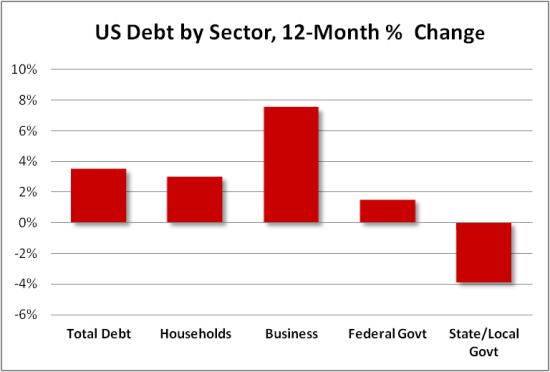
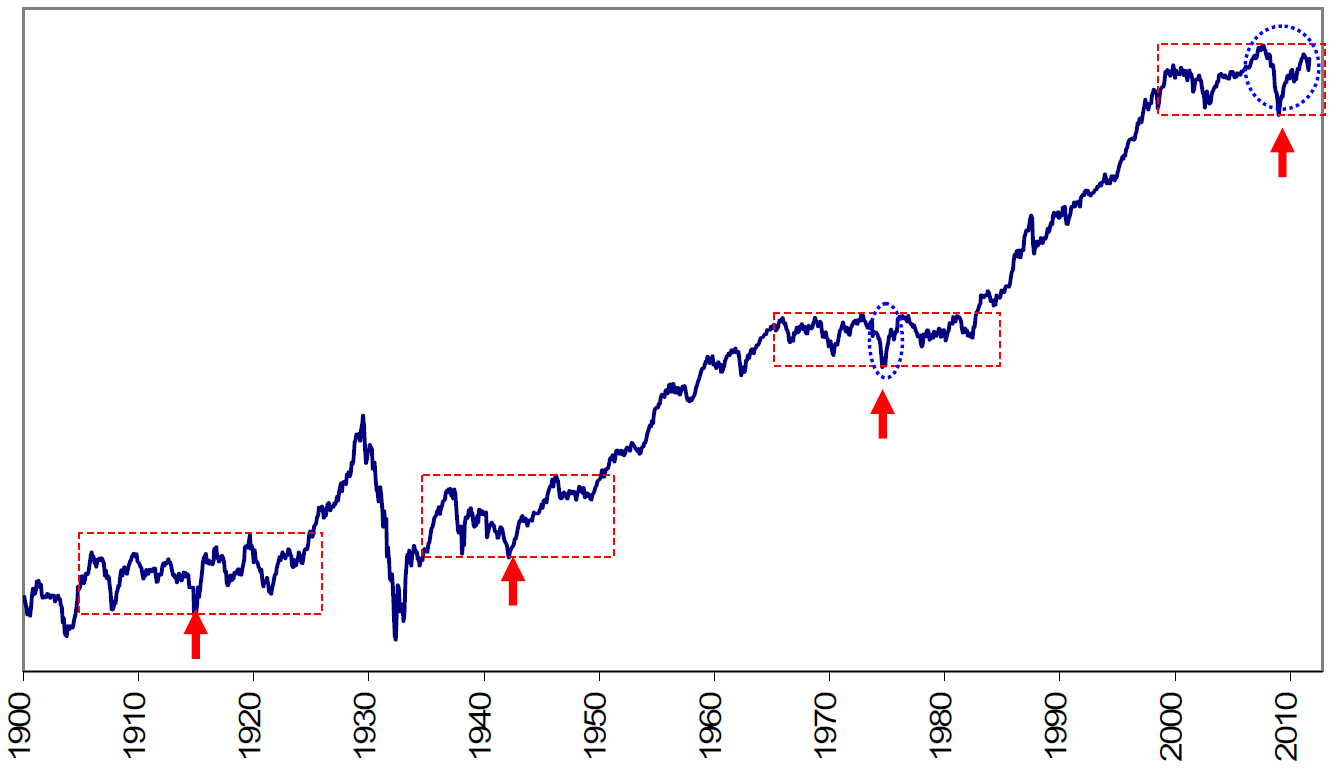
It’s not surprising that near-zero interest rates and trillions of dollars of newly-created currency would get people borrowing again. What is surprising is that anyone thinks this is a good thing. In 2013 total US debt, equity prices, household net worth, large-bank assets and derivatives books, and a long list of other debt-related measures pierced the records they set in 2007. In other words we’ve recreated the conditions that prevailed just before the world nearly fell apart.
Will the result be different this time? It’s hard to see how, especially since developed-world governments now have roughly twice as much debt as they did back then, so their ability to ride to the rescue will be limited.
As this is written the Fed is announcing that it will scale back its debt monetization to only $75 billion a month, or $900 billion a year. Its balance sheet, which just hit $4 trillion, will grow by nearly 25% in 2014, to nearly $5 trillion, which is a measure of how much new currency it is creating and pumping into the banking system.
The next stage of the plan is to get the banks to start lending this money, which would, through the magic of fractional reserves, produce loans in some large multiple of the original amount. So we might be on the verge of trading a nasty-but-comprehensible Kondratieff Winter for something a lot wilder.
continue reading& viewings HERE

U.S. stocks staged an explosive rally on Wednesday, driving the Dow and the S&P 500 to all-time closing highs after the Federal Reserve announced it would start to unwind its historic stimulus.
While the Fed’s move came as a surprise to many in the market, it confirmed that the U.S. economy was on firmer footing and put to rest the question of when the Fed would begin to scale back its bond-buying program, a relief to some investors, analysts said.
“This is a vote of confidence in the economy and represents the first step toward monetary policy normalization,” said David Joy, chief market strategist at Ameriprise Financial, in Boston.
The central bank said it would reduce its monthly asset purchases by $10 billion to $75 billion, while it also indicated that its key interest rate would stay at rock bottom even longer than previously promised. It said it “likely will be appropriate” to keep overnight rates near zero “well past the time” that the U.S. jobless rate falls below 6.5 percent.
Yet the decision to move now rather than later pointed to better prospects for the U.S. economy and the labor market. It also marked a turning point for the largest monetary policy experiment ever.
Stocks extended losses just after the announcement, but quickly turned higher and began rallying. The day’s move marked the biggest swing from the day’s high to the low for the S&P 500 in two years. All 10 S&P 500 sector indexes ended higher, with all but information technology .SPLRCT gaining more than 1 percent, and the S&P 500 financial index .SPSY rising 2.4 percent.
The Federal Reserve is trimming its monthly bond purchases to $75 billion from $85 billion, taking the first step toward unwinding the unprecedented stimulus that Chairman Ben S. Bernanke put in place to help the economy recover from the worst recession since the 1930s.
“Reflecting cumulative progress and an improved outlook for the job market, the committee decided today to modestly reduce the monthly pace at which it is adding to the longer-term securities on its balance sheet,” Bernanke said at a press conference in Washington today after a meeting of the Federal Open Market Committee.
- Fed Officials Lower Projections for Unemployment Rate Next Year
- Stocks Rally as Treasuries Fall, Dollar Gains After Fed

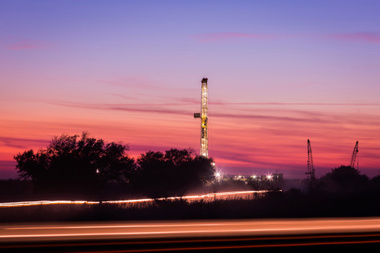 As we come to the end of 2013, it’s a good time to reflect on some of the biggest resources stories of the year. One that immediately comes to mind is the U.S. energy resurgence and its tremendous effect on oil (NYMEX:CLF14) and gas (NYMEX:NGF14).
Only a few years ago, we were contemplating the supply constraints facing the petroleum industry, as many major oil fields around the world were declining in production. Now, with thedisruptive technology in shale oil and gas, we may be looking forward to decades of drilling.
Two charts clearly illustrate the incredible growth in oil and gas. While there are many shale areas around the U.S., there are a few notable hot beds of activity. Regarding the domestic production of tight oil, most of the growth has been in the Eagle Ford area that’s outside of San Antonio, Texas, the Bakken formation in Montana and North Dakota, and the Permian basin in West Texas.
At the beginning of 2011, the selected shale areas shown below were producing less than 1 million barrels of tight oil per day. Now, production is nearing 2.5 million barrels per day.
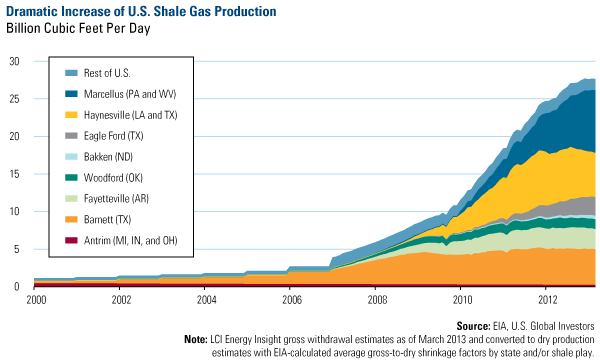
Shale gas in the U.S. has also taken off in recent years, with the Marcellus shale in Pennsylvania and West Virginia, Haynesville in Louisiana and Texas, and Barnett in Texas contributing to the majority of the growth, according to the U.S. Energy Information Administration (EIA). Since 2010, natural gas production among the many shale areas jumped from under 10 billion cubic feet per day to about 27 billion cubic feet per day.


-
I know Mike is a very solid investor and respect his opinions very much. So if he says pay attention to this or that - I will.
~ Dale G.
-
I've started managing my own investments so view Michael's site as a one-stop shop from which to get information and perspectives.
~ Dave E.
-
Michael offers easy reading, honest, common sense information that anyone can use in a practical manner.
~ der_al.
-
A sane voice in a scrambled investment world.
~ Ed R.
Inside Edge Pro Contributors

Greg Weldon

Josef Schachter

Tyler Bollhorn

Ryan Irvine

Paul Beattie

Martin Straith

Patrick Ceresna

Mark Leibovit

James Thorne

Victor Adair