
Timing & trends
14 page Report. Great Charts & Intelligent commentary.
S&P 500
Analysis: Still AHold
The market remains overbought on a weekly basis as discussed above BUT the most likely move from current levels is towards 1850 by year end.
Risk/Reward remains poor.



With respect to the US situation on the chart above, the stretch from late 2002 until mid-2006 should qualify as a bubble despite the “flat price” period not quite getting to 10 years. Historically, real-estate bubble graphs that include the full episode are very heavily skewed to the left. However, the recent case in the US creates an unusually symmetrical graph. Without the incredibly massive intervention by the Fed, my guess is that this “mother of all real-estate bubbles” would have kept skidding lower instead of abrupt bouncing and levelling in mid-2009. Without QE, we might be back to 2000 prices where they could have remained essentially unchanged for the next number of years, perhaps extending towards 2017-2018 before finally gaining some traction again.
______________________________________________________________________________________
From my previous post on My Definition of a Housing Bubble:
There aren’t really any universal definitions of how a bubble in housing should look or how it can be quantified.
That said, my sense is that a housing bubble is a rise towards a peak that will be significant enough that if one were to look at time elapsed between the equivalent prices on either side of the peak, it will be around a decade. I call this the “flat price” period.
“Flat prices” for a decade, whether it is real estate or securities, is enough to seriously impair the financial reality of people who are significantly exposed to the bubble. For most, life has enough twists and turns over a decade that financial flexibility is necessary. Losing that flexibility because of exposure to an asset price roller-coaster is deeply impacting to the point that it will likely have a permanent effect on a person’s investment psyche.
The opinions expressed in this report are the opinions of the author and readers should not assume they reflect the opinions or recommendations of Richardson GMP Limited or its affiliates. Assumptions, opinions and estimates constitute the author’s judgment as of the date of this material and are subject to change without notice. We do not warrant the completeness or accuracy of this material, and it should not be relied upon as such. Before acting on any recommendation, you should consider whether it is suitable for your particular circumstances and, if necessary, seek professional advice. Past performance is not indicative of future results.
Richardson GMP Limited, Member Canadian Investor Protection Fund.
Richardson is a trade-mark of James Richardson & Sons, Limited. GMP is a registered trade-mark of GMP Securities L.P. Both used under license by Richardson GMP Limited.

From the chart above, and according to my definition, Toronto has not had a real estate bubble over the past generation. However, the massive price spike from early 1988 to early 1990 probably felt like one since the eventual ascent above the nine-year “flat price” period was excruciatingly slow and the late 80’s peak was not regained until 2005.
From the previous post on My Definition of a Housing Bubble:
There aren’t really any universal definitions of how a bubble in housing should look or how it can be quantified.
That said, my sense is that a housing bubble is a rise towards a peak that will be significant enough that if one were to look at time elapsed between the equivalent prices on either side of the peak, it will be around a decade. I call this the “flat price” period.
“Flat prices” for a decade, whether it is real estate or securities, is enough to seriously impair the financial reality of people who are significantly exposed to the bubble. For most, life has enough twists and turns over a decade that financial flexibility is necessary. Losing that flexibility because of exposure to an asset price roller-coaster is deeply impacting to the point that it will likely have a permanent effect on a person’s investment psyche.
The opinions expressed in this report are the opinions of the author and readers should not assume they reflect the opinions or recommendations of Richardson GMP Limited or its affiliates. Assumptions, opinions and estimates constitute the author’s judgment as of the date of this material and are subject to change without notice. We do not warrant the completeness or accuracy of this material, and it should not be relied upon as such. Before acting on any recommendation, you should consider whether it is suitable for your particular circumstances and, if necessary, seek professional advice. Past performance is not indicative of future results.
Richardson GMP Limited, Member Canadian Investor Protection Fund.
Richardson is a trade-mark of James Richardson & Sons, Limited. GMP is a registered trade-mark of GMP Securities L.P. Both used under license by Richardson GMP Limited.

There aren’t really any universal definitions of how a bubble in housing should look or how it can be quantified.
That said, my sense is that a housing bubble is a rise towards a peak that will be significant enough that if one were to look at time elapsed between the equivalent prices on either side of the peak, it will be around a decade. I call this the “flat price” period.
“Flat prices” for a decade, whether it is real estate or securities, is enough to seriously impair the financial reality of people who are significantly exposed to the bubble. For most, life has enough twists and turns over a decade that financial flexibility is necessary. Losing that flexibility because of exposure to an asset price roller-coaster is deeply impacting to the point that it will likely have a permanent effect on a person’s investment psyche.
So, according to my definition, the chart above shows that Vancouver saw a real-estate bubble from late 1988 to early 1990 as the period of “flat prices” extended for 12 years around the initial peak. There was a secondary peak, but this one did not have a “flat price” period that was as long. Also, retracing a recent bubble upwards again over a short period of time does not constitute a 2nd bubble in my opinion. It was bounce that was merely an aftershock of the 1988-1990 bubble.
The opinions expressed in this report are the opinions of the author and readers should not assume they reflect the opinions or recommendations of Richardson GMP Limited or its affiliates. Assumptions, opinions and estimates constitute the author’s judgment as of the date of this material and are subject to change without notice. We do not warrant the completeness or accuracy of this material, and it should not be relied upon as such. Before acting on any recommendation, you should consider whether it is suitable for your particular circumstances and, if necessary, seek professional advice. Past performance is not indicative of future results.
Richardson GMP Limited, Member Canadian Investor Protection Fund.
Richardson is a trade-mark of James Richardson & Sons, Limited. GMP is a registered trade-mark of GMP Securities L.P. Both used under license by Richardson GMP Limited.

“In the year 1913, Congress gave the Federal Reserve the right to create and control US money. The Fed guards this power ferociously. The Fed prefers inflation, since it can easily control the rate of inflation. But the Fed is deadly afraid of deflation, since deflation can get out of control of the Fed.
Since 1980, the rate of debt has risen far past the growth in GDP. At some level, debt exerts a deflationary effect on the economy (GDP). We are past that point now, and deflationary pressures are bearing down on the US, this despite all the Fed’s money creation and manipulation of interest rates.
The question — How to reinflate the US economy? There is one method that was used in 1934 by the Roosevelt administration. That method is to devalue the currency against gold, the standard. This method was used by the US three times before. In 1934 the Roosevelt administration overnight re-set the price of gold from $20.67 dollars an ounce to $35 dollars per ounce.
Later, in 1971, the Smithsonian Agreement was reached which devalued the dollar from $35 an ounce to $38 an ounce. Again, and few people know this, in 1973 the US again unilaterally re-set the price of gold from $38 dollars an ounce to $42.22 dollars an ounce.
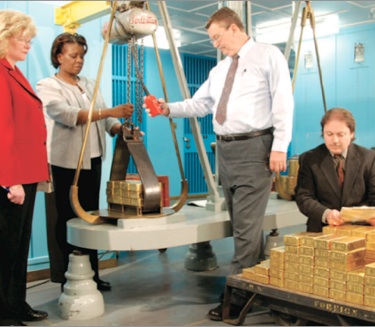
I believe that coming up we are going to see a fourth devaluation of the dollar against gold. By doing this the US Treasury will overnight have a vastly greater supply of wealth compared with its debt, putting its finances in a much healthier state.
How high might the US re-set the official price of gold? You pick a number — $5,000, $10,000 or $50,000, but the number should be high enough so that the price of gold won’t have to be re-set again in a hurry.
There are two problems with a re-set in the price of gold. (1) The government may decide to confiscate gold from its people. (2) There are arguments regarding how much gold the US Treasury actually owns. There have been no recent audits, and some of our gold may have been loaned out.
Question — If the dollar is to be devalued against gold, what might we do?
Answer — Many of the gold mines are now operating with thin margins as the cost of mining gold increases. If the price of gold is re-set higher, these thin-margin gold mines will explode higher in price. I doubt if the government would take over stock in the mines. But Congress could pass a law boosting taxes on mine profits.
Let me put it this way, I believe the government will re-set the official price of gold, but I don’t think there is a sure way, as an investor, to make a killing on a huge boost in the price of gold. Maybe the best recourse is to hold a small permanent position in position in GDX and GDXJ. Of course you can hold physical gold and keep it in an “out-of-the-way” place. Incidentally, I notice that some of the gold mining stocks are creeping higher, even on days when gold is lower.
You can be reasonably sure of one thing — certain insiders know what is being talked about and what is being planned. These may be the smart boys who are buying diamonds at $56 million and $125 million and great works of art at record prices. They are getting ready for a world of sky-high prices and hyperinflation.
… Now if all this could only help what’s left of the middle class. And if only the printers that print food stamps hold up. Get ready for massive changes in the year 2014 — And get ready for tremendous pressure to get rid of the Federal Reserve.”
To subscribe to Richard Russell’s Dow Theory Letters CLICK HERE.
About Richard Russell
Russell began publishing Dow Theory Letters in 1958, and he has been writing the Letters ever since (never once having skipped a Letter). Dow Theory Letters is the oldest service continuously written by one person in the business.
Russell gained wide recognition via a series of over 30 Dow Theory and technical articles that he wrote for Barron’s during the late-’50s through the ’90s. Through Barron’s and via word of mouth, he gained a wide following. Russell was the first (in 1960) to recommend gold stocks. He called the top of the 1949-’66 bull market. And almost to the day he called the bottom of the great 1972-’74 bear market, and the beginning of the great bull market which started in December 1974.
Letters are published and mailed every three weeks. We offer a TRIAL (two consecutive up-to-date issues) for $1.00 (same price that was originally charged in 1958). Trials, please one time only. Mail your $1.00 check to: Dow Theory Letters, PO Box 1759, La Jolla, CA 92038 (annual cost of a subscription is $300, tax deductible if ordered through your business).

-
I know Mike is a very solid investor and respect his opinions very much. So if he says pay attention to this or that - I will.
~ Dale G.
-
I've started managing my own investments so view Michael's site as a one-stop shop from which to get information and perspectives.
~ Dave E.
-
Michael offers easy reading, honest, common sense information that anyone can use in a practical manner.
~ der_al.
-
A sane voice in a scrambled investment world.
~ Ed R.
Inside Edge Pro Contributors

Greg Weldon

Josef Schachter

Tyler Bollhorn

Ryan Irvine

Paul Beattie

Martin Straith

Patrick Ceresna

Mark Leibovit

James Thorne

Victor Adair