

Gold & Precious Metals

Gold and Silver Precious Metals Forecast 2014

Yes folks, it’s that time of year again; but unlike old Khayyam who reflected bucolically on the continuing availability of wine, we must turn our thoughts to the dangers and opportunities of the coming year. They are considerable and multi-faceted, but instead of being drawn into the futility of making forecasts I will only offer readers the barest of basics and focus on the corruption of currencies. My conclusion is the overwhelming danger is of currency destruction and that gold is central to their downfall.

…read more HERE

Russell – Watch This History Unfold

“Sit back and watch history.  The chart below shows the Dow spurting out of a powerful base with a P&F projected target of 17,900.  They say that no tree grows to the sky, but this “tree” is attempting to negate this aphorism.  They also say that “the higher they rise, the greater they fall.”

KWN Russell II 12-31-2013

So I said, sit back and watch stock market history … I have this strong intuitive “feeling” that I should be OUT of the stock market.  Along these lines, I note that there are now 6 distribution days on the S&P and 5 on the NASDAQ.  Moreover according to Investor’s Intelligence 59.6% of advisers are bullish with only 14.1% bearish.  These are percentages seen at market tops, but they sometimes lead tops by a matter of weeks and even months.

I note that in early morning trading, the US dollar dipped briefly below 80 and then recovered.  Also TLT sank briefly by 12 ticks and then recovered.  Gold rose by 20 cents.  So there is a fierce battle in progress to hold the dollar up and to hold bonds up.

Thus, the Fed has it’s hands (computers) full in trying to hold this market together.  All in all, these are dicey markets that are skating on thin (and melting) ice, and I am just as happy watching the shennanigans from a distance.  If anything falls apart, I suspect it will be the dollar first.

History tells us that the owner of the World’s reserve currency is the country with the greatest military and the country that owns the largest hoard of gold. China is going all-out to build its military, particularly its navy, and China is accumulating gold as fast as it can.  

There is no doubt in my mind, that China wants its yuan (probably backed with gold) to be the world’s next reserve currency.  The US with its obscene level of debt is in no condition to keep the dollar as the world’s reserve currency.  Incidentally, I note that an increasing number of international commerce are now transacted in Chinese yuan.  The dollar is the Achilles heel of the US.

As I’ve been saying, the year 2014 will be a year of tectonic changes.  Bitcoin currency is becoming acceptable by an increasing number of organizations.  Bitcoin is a menace to the phony dollars that are pumped out by the Fed.  I know that the Fed wants to have a monopoly on the production of US money.  Therefore, Bitcoin is a menace and rival to the Fed “dollars.”  Therefore I expect the Fed to attempt to outlaw trading in Bitcoin. 

Pity the Fed, besieged by Bitcoin and Chinese yuan.  Bernanke will be happy to get back to South Carolina and out of DC … Will the Treasury have the nerve to re-set the price of gold to $10,000 an ounce?  And do we have enough gold to make a re-set worthwhile?  

If it turns out that the US doesn’t have the gold it claims to have.  We could be looking at the biggest scandal in economic history.  If we have all the gold we say we have, where’s the damn audit?

The chart below shows five years of the S&P.  You can see that around late-2011 the SPX began the pull away from its rising trendline.  This represents increasing enthusiasm and extreme bullishness.  As I said, we are now seeing what I believe will be stock market history.  It will be something to tell your grandkids about.  You know about the little moth who flitted too close to the flame.

KWN Russell III 12-31-2013

Late Notes — The Fed continues it’s vain fight against the forces of deflation.  To create inflation in one fell swoop, all the Treasury has to do (following FDR’s example during the Great Depression) is unilaterally re-set the price of gold to some high number.  Who would object?  Only the gold shorts and maybe the Fed since it would devalue the phony dollars that the Fed creates out of a computer.”


To subscribe to Richard Russell’s Dow Theory Letters CLICK HERE. 

About Richard Russell

Russell began publishing Dow Theory Letters in 1958, and he has been writing the Letters ever since (never once having skipped a Letter). Dow Theory Letters is the oldest service continuously written by one person in the business.

Russell gained wide recognition via a series of over 30 Dow Theory and technical articles that he wrote for Barron’s during the late-’50s through the ’90s. Through Barron’s and via word of mouth, he gained a wide following. Russell was the first (in 1960) to recommend gold stocks. He called the top of the 1949-’66 bull market. And almost to the day he called the bottom of the great 1972-’74 bear market, and the beginning of the great bull market which started in December 1974.

Letters are published and mailed every three weeks. We offer a TRIAL (two consecutive up-to-date issues) for $1.00 (same price that was originally charged in 1958). Trials, please one time only. Mail your $1.00 check to: Dow Theory Letters, PO Box 1759, La Jolla, CA 92038 (annual cost of a subscription is $300, tax deductible if ordered through your business).


  1. The Western super-crisis entered a lull period in 2013, and surging economic growth in America has become the main focus of most mainstream analysts.
  2. The stock market tends to lead the economy by about six months, so it’s likely that much of US economic growth in 2014 is already priced into the Dow.
  3. For the long term, I would focus more on Asian stock markets than Western markets, partly because population demographics show that the West has an ageing population, while most Asians are relatively young.
  4. Please click here now . While the US stock market is being carried higher by fewer and fewer stocks, the Chinese stock market (using the FXI-nyse proxy) appears to be verging on an upside breakout from an enormous symmetrical triangle pattern.
  5. While I’m totally out of the American Dow, I do own the Chinese market. I’m a buyer of more FXI on every 50 cent decline, using my “PGEN” (systematic risk capital allocator).
  6. Please click here now . After QE was unveiled in 2008, Western investors began to buy gold and related items with aggression. They believed that the Fed’s QE program would dramatically increase the money supply. As you can see from this chart, they were correct.
  7. Unfortunately, these investors didn’t understand that if a huge money supply has declining velocity, there is no meaningful inflation created, at least in the short term.
  8. By 2013, mainstream reports showed that inflation had still failed to materialize. Demoralized QE-focused investors began to liquidate their gold and related holdings, and booked substantial losses.
  9. Did they give up just as money velocity is about to reverse the downtrend? I think so. Please click here now . This M2 velocity chart shows the long term money velocity story; as the public surged into the stock market in the late 1990s, corporate executives began hoarding cash, and they have continued to do so.
  10. “For at least a decade and a half, cash has progressively increased its share of the American corporate balance sheet, to the point where U.S. quoted companies have turned into the Scrooges of the global economy…. Such is the scale of this cash pile that the U.S. corporate sector must have been partly responsible for the surge in demand for safe assets and the decline in interest rates that fueled the U.S. housing bubble.” – John Pender, Financial Times, December 31, 2013.
  11. Powerful investors like Carl Icahn are suddenly putting a lot of pressure on companies, to put their hoarded cash to work. I believe that corporate profit gains from cost cutting are peaking, and further gains will only come by increasing revenues.
  12. The probability of a turn up in money velocity in 2014 is growing, because corporate spending is likely to grow. Please click here now . This M1 velocity chart shows the collapse in velocity that has occurred since the QE program began.
  13. QE tapering will force investors to move away from mortgage securities and T-bonds. They will likely invest those funds in the stock market and private equity funds. Their substantial liquidity flows will boost M1 velocity.
  14. I predict that M1 velocity will not simply rise, but begin to surge, as QE is tapered all the way to zero in 2014.
  15. If the stock market is correctly anticipating that economic growth will increase nicely over the next six months, demand for base metals should soon overwhelm supply, creating higher prices.
  16. Please click here now . This is an interesting long term (quarterly bars) chart for copper. From a technical perspective, the 2008 collapse took the price precisely to a key trend line in the $1.50 area, but most of the trading since 2006 has taken place in what I call, the “Asian growth zone”.
  17. If a rise in M2 velocity occurs as the Chinese stock market breaks out upside, that could raise the price of copper above five dollars a pound, into what I call the “inflation zone”. Institutional alarm bells would begin to ring, and they would begin to buy commodity markets with a fair bit of size.
  18. Please click here now . That’s the daily copper chart, and there’s a key bullish breakout in play.
  19. The price of gold may have numerous rallies in 2014, but a reversal in M2 combined with five dollar copper could set off much bigger buying of all inflationary hedges.
  20. Please click here now . That’s the daily uranium chart, using the U-TSX proxy. Note the rare triple bottom in play. Gold bullion is my largest holding, and it always will be, but moving a small amount of capital from gold bullion to uranium, copper, and palladium, is probably a prudent action to take now.
  21. Those three markets will likely be the first commodities to react to a reversal in M2 and M1 velocity, and the simple fact is that the early bird gets the biggest worm!
  22. Please click here now . Double-click to enlarge. This weekly GDX:GLD ratio chart covers about five years of the price action of gold stocks against gold. Almost every technical indicator on that chart is flashing a bullish non-confirmation signal.
  23. Also, please note the stunning volume that has occurred over the past few months in gold stocks compared to gold. There has been some dilution of shareholders, but the bulk of this volume is likely related to a “changing of the guard” event. There is also “wedgification” beginning to appear on that chart, where one large bullish wedge morphs into smaller bullish wedges. That’s also very bullish.
  24. Strong hands understand that accelerating money velocity creates inflation. Accelerating the velocity of a money supply that was dramatically expanded in size by QE, could unleash an inflationary monster, and create a dramatic 2014 outperformance of gold stocks against gold!

Dec 31, 2013
Stewart Thomson
Graceland Updates
website: www.gracelandupdates.com
email for questions: stewart@gracelandupdates.com 
email to request the free reports: freereports@gracelandupdates.com

American consumers turned more confident in December as hiring picked up, brightening the outlook for spending heading into 2014.

The Conference Board said its sentiment indexclimbed to 78.1 from 72 in November, exceeding the median forecast of economists surveyed by Bloomberg and the strongest year-end reading since 2007. Other reports showed home pricesclimbed at the fastest pace in more than seven years and manufacturing was in a sustained expansion.

The biggest employment gain in eight years, the rebound in housing and record stock values are boosting household wealth, which will help support spending in the new year. Companies from Ford Motor Co. (F) to Apple Inc. (AAPL) are pledging to expand operations in the U.S. as demand improves, a sign the world’s biggest economy will strengthen in 2014.

“We’re ending 2013 with good momentum,” said Stephen Stanley, chief economist at Pierpont Securities LLC in Stamford,Connecticut, and the second-best forecaster of consumer confidence over the past two years, according to data compiled by Bloomberg. “We’ve seen progress in the labor market. The rise in home values along with the run-up in equity prices is a big element of why people are feeling better.”

U.S. stocks rose, with the Standard & Poor’s 500 Index poised for its biggest annual advance since 1997, as data showed an improving economy. The S&P 500 climbed 0.3 percent to 1,846.72 at 12:13 p.m. in New York.

Fracking, Uranium & Solar – Growth & Innovation

A more profitable outcome often requires a new way of doing things. The Energy Report profiled some of the most innovative stories in the energy space in 2013. Our experts talked about everything from developments in hydraulic fracturing techniques to new ways of finding and processing natural resources. As we look forward to exciting new opportunities in 2014, let’s revisit some stories our experts shared last year.

COMPANIES MENTIONED: BABCOCK & WILCOX CO. : CONTINENTAL RESOURCES INC. : CUB ENERGY INC.ENERGY FUELS INC. : FISSION URANIUM CORP. :MADALENA ENERGY INC. : MAGELLAN PETROLEUM CORP. : SUNPOWER CORP. : URAVAN MINERALS INC. : WAVEFRONT TECHNOLOGY SOLUTIONS INC. RELATED COMPANIES : DNI METALS INC. MIDLAND EXPLORATION INC.


Oil & Gas: Enhanced Recovery


Nothing catches the market’s attention like cushy profit margins. Technologies that enable oil producers to drill more for less money were a notable theme for the experts featured in The Energy Report in 2013.


As Jim Letourneau commented, “Reducing drilling time by 20–40% is an easy sell, and the enhanced oil recovery business has a huge market in the field.”


In an August 2013 interview titled “Smart Fracking: Jim Letourneau on Enhanced Oil Recovery with Competitive Costs,” the Big Picture Speculator editor said, “There are a lot of technological tricks for increasing well productivity with minimal costs: A producer can re-enter wells or stimulate wells or fracture older wells. It can enhance oil recovery with pulsed injection of water or chemicals by utilizing a tool installed in the wells that injects fluids in pulses—pumping like a heart pumps. Think of putting a kink in a garden hose. Pressure builds up and when the kink is released there is a strong pulse of water. This technology is efficient and companies can make money doing enhanced oil recovery with pulsed injection.


One such company is Wavefront Technology Solutions Inc. (WEE:TSX.V), which provides pulsing tools to operations all over the world. It has a couple new business lines with fantastic growth rates. In well stimulation, a chemical (usually acid) is injected into a formation to clean up the area around the well bore so that more oil and gas can flow. By using pulsing, the acid is placed more uniformly and better flow rates are achieved after the stimulation. This part of Wavefront’s business is growing very quickly and now accounts for roughly half of the company’s revenue.”


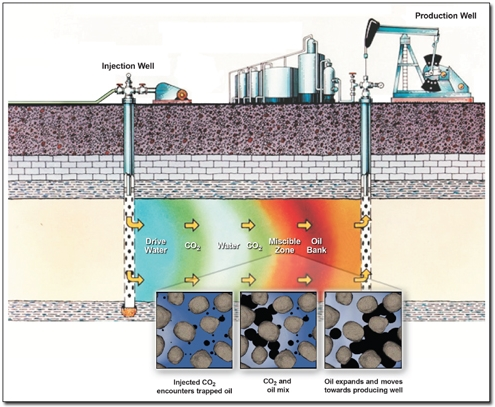
C. K. Cooper & Co. Analyst Darren Odenino was more impressed with CO2 Enhanced recovery, a method wherein CO2 is piped to oil fields, where it is injected via injection wells into the oil reservoir. [See infographic below.] The Department of Energy’s Office of Fossil Energy notes that about 114 active commercial CO2 injection projects are underway in the U.S., and together they could produce a collective additional 280,000 barrels of oil per day (280,000 bbl/d).


Among the higher-profile projects is Magellan Petroleum Corp.’s (MPET:NYSE) Poplar Field in Roosevelt County, Montana. In his May 2013 interview titled “How to Spot Oil and Gas Takeout Targets,” Odenino commented, “The exciting catalyst for Magellan is the opportunity to test its CO2-Enhanced Recovery project in the Poplar field’s Charles formation. If that proves successful, Magellan should be headed for a lot of growth.” Magellan has already reached several milestones for this pilot project. With funding secured for a two-year trial run and five wells drilled, Magellan is scheduled to begin CO2 injection this very month.

Click HERE of on image for larger view:

InjectionWell

Evan Smith, co-portfolio manager of U.S. Global Investors’ Global Resources Fund, sees producers moving toward a manufacturing-like process in the coming year with multi-well pad drilling. In an interview earlier this month titled “Producers that Can Pump at $60/bbl Oil,” he commented, “The rig count has declined by more than 50% over the last two years, and yet we continue to see a steadily increasing supply of natural gas. It’s a testament to the technology that has been developed by the industry to drill faster and more efficiently and to unlock and produce more reserves with less input.”

“I think in 2014, people in the field will have delineated most of their acreage and are going to turn these things into a pure manufacturing process with pad drilling. Continental Resources Inc. (CLR:NYSE) is testing 16 wells per pad in the Williston Basin in North Dakota. The company will repeat that pattern and drive costs down. We’ve seen a big shift to multi-well pad drilling in 2013, but I think it’s going to become much more standardized in 2014. The efficiencies that we’ve seen, which have led to more productivity with fewer rigs, will probably remain and perhaps even accelerate in 2014.”

North American oil and gas industry innovation is a force that is turning the global production profile upside down as companies explore new oil and gas reserves around the world that were thought all but unrecoverable. As Edison Investment Research Analyst Peter Dupont commented in his recent interview, “Has Shale Broken OPEC’s Grip?,” North American companies with shale tech know-how are poised to unlock reserves around the world, especially in South America.

“Some of these companies have first-mover advantage.,” says Dupont. “Madalena Energy Inc. (MVN:TSX.V) [is one of] the most obvious examples. . . Madalena has working interests ranging between 35–90% in three blocks in the Neuquén Basin comprising a sizeable 135,000 net acres. Contingent and prospective recoverable resources are estimated by Madalena at 2.9 Bboe, of which 45% are oil and NGLs. There is a mixture of conventional and unconventional plays. Small quantities of oil are presently obtained from the conventional Sierras Blancas formation in the Coiron Amargo Block, where horizontal drilling technology is being applied. Madalena’s key focus presently is to secure a joint venture partner for the appraisal and development of the Vaca Muerta and Agrio shale formations. Securing a partner or partners would be a critical catalyst for the stock.”

Canaccord Genuity Research Director Christopher Brown saw shale tech sweeping the old world, especially in Ukraine. In his November interview, “Four International O&G Juniors for a Globe-Sweeping Shale Revolution,” Brown commented, “On the Ukrainian side, Cub Energy Inc. (KUB:TSX.V)has done well at introducing new technologies to the country. Cub has received the approvals to bring in this new technology and apply it. It’s going to be a slow process, but as the company continues to unlock value, there’s no denying that its region and fiscal terms are very good and provide a lot of incentive to keep on working hard to grow the production base. Turkey hosts a more difficult unconventional basin. The Anatolia Basin is still in its earlier stages, whereas the Ukrainian assets have some proven opportunities. In the Anatolia Basin, you do have some majors that are tentatively playing around the edges, but there has not yet been anything that’s really unlocked that basin. But it didn’t cost Cub much to enter the basin and the Turkey play provides shareholders with potential future value, which they don’t pay for at Cub’s current share price.

“. . .History has proven Ukraine has access to significant volume. That’s why Cub is in this country: It believes it can unlock more value. . .through its ownership in a separate private holding company (Pelicourt Ltd.), management holds a major position in Cub Energy, and recently it decided to put in additional dollars to show confidence in the future of Cub. As of its last statement in October 2013, it owns 39.54% of the shares outstanding. That’s provided a decent amount of market support.”

As the oil and gas sector continues to transform worldwide, keep tuning in for Streetwise interviews that shed light on promising oil and gas explorers that are poised to deliver shareholder value.

Uranium: Fundamental Changes

With the Megatons to Megawatts program officially coming to a close, investors are shifting focus to North American uranium producers that can help meet U.S. needs. John Kaiser‘s October interview, “10 Strategies for Success in a Flat Commodity Price Market,” was filled with fresh approaches to mining. In light of the small number of domestic uranium producers and the high capital costs of resource delineation and mine development, an innovative new sampling method caught Kaiser’s attention.

He comments,”A junior explorer, Uravan Minerals Inc. (UVN:TSX.V), has developed an interesting geochemical sampling method it is using on projects in the Athabasca Basin. . .Uravan has spent the last five to six years developing its geochemical sampling method in collaboration with Queens University’s Kurt Keyser, which looks for the lead isotope decay products of a uranium deposit. These get absorbed by vegetation and clay particles. The company takes tree core samples at surface to find evidence of a resource that may be 1,000–1,500m deep. You still can’t tell the size of it or the grade, but at least you know you’re going to hit something once you drill down there.

“This approach opens up a much deeper portion of the basin that has been largely out of bounds because of the difficulty in finding these deposits, which almost always are right at the unconformity between the basement rocks and the overlying sandstone rocks in association with graphite. The conventional targeting tool is a geophysical survey that looks for conductors representing these graphite beds. But deeper than 450m, these conductors become fuzzy just as drill holes that need to pinpoint the target become expensive. This is problematic because most of the graphite beds at the Athabasca Basin unconformity do not host a uranium deposit. Uravan’s radiogenic isotope based sampling tool allows the junior to see evidence of a uranium deposit at substantial depth from the surface. A case study done this summer apparently demonstrated that Cameco’s 850m deep Centennial deposit shows up as a well-constrained geochemical anomaly. Theory says that in the Athabasca Basin, the thicker the sandstone cover, the bigger and richer the potential uranium deposit at the unconformity. Uravan now has a tool that enables it to stalk super-elephants in uncharted territory.”

Kaiser continued, “Uravan can also perform this research as a service to companies that have claims in the Athabasca Basin and then earn a royalty or a small interest in exchange for generating the geochemical part of the target that you need to justify raising money for a high-stakes drill program.” Earlier this month, Uruvan completed another surface geochemical study on the Centennial depositbased on the earlier survey.

The Abasca Basin is in the spotlight more than ever this year, as superstar company Fission Uranium Corp. reported countless startling results. As Kaiser noted, “A big discovery event in the past year is the Patterson Lake South discovery in the Athabasca Basin by Fission Uranium Corp. (FCU:TSX.V) and Alpha Minerals Inc. This is a classic high-grade unconformity type of uranium deposit with grades of up to 20% uranium. The size of this discovery is stimulating interest in the potential for a new Athabasca Basin area play.”

Of course, other domestic near-term uranium producers are raising eyebrows among energy analysts, especially those who expect a uranium price comeback in the coming year. Cantor Fitzgerald Canada Metals and Mining Analyst Robert Chang highlighted Energy Fuels Inc. (EFR:TSX; EFRFF:OTCQX; UUUU:NYSE.MKT) in his September interview, “Uranium Price Headed for $50 in 2014, Taking Stocks Higher.” Chang commented, “We cover Energy Fuels, which is the second largest producer of uranium in the U.S. and probably has the best story leveraged to the uranium price. It currently produces only about 1 Mlb/year, by design, with several mines that can be turned on relatively quickly. We estimate that it could quickly turn on anywhere between 2–5 Mlb more in annual production once prices get to attractive levels. On top of that, it also has the White Mesa mill that it acquired from Denison, located in Blanding, Utah, which is the only conventional mill in the U.S. Having mill access is extremely important because you effectively cannot produce your final product without it. Energy Fuels has a monopoly position with a conventional mill and it can even make money by processing material on a toll basis for other producers. We believe that this is a very attractive company for those who believe that the uranium price will head higher.”

Meanwhile, the way that we consume nuclear power could completely change over the coming decades. In his recent interview, “Why Uranium and Coal Rank high for Energy Return on Energy Invested,”Thomas Drolet commented on a coming shift to smaller units: “Standard nuclear reactors being built today are gigantic units. Over the next decade we’re going to see a shift to smaller units—small modular reactors (SMR)—for good and valid reasons of schedule and because the utilities want them. Babcock & Wilcox Co. (BWC:NYSE) and NuScale Power LLC in the United States are being funded or potentially funded by the U.S.DOE to bring on these smaller reactors.”

What’s particularly exciting about stories like these is that they are larger than a single company. They have the potential to galvanize an entire sector and make a particular energy source more viable, period. Keep tuning in next year for more investment advice about uranium producers.

Alternative Investments

Alternative energy as a sector is built on technological innovation, but in order for the market to take notice, these innovative feats need to create a compelling bottom line. Rodney Stevens took notice of an innovative solar energy business model in his July interview, “A Short-Seller’s Investment Guide to Obama’s Climate Change Initiatives.

Stevens commented, “We like SunPower Corp. (SPWR-A:NASDAQ; SPWR-B:NASDAQ) because not only does it manufacture the solar panels, but it also has a leasing program for the retail space, similar to SolarCity. SunPower has one of the best products available on the market and it should benefit from the incentives utility companies have to add renewable sources of energy to their business. SunPower could play a big role in the utility space, but also grab the retail markets. It should benefit from the growth in solar and also it has an international base, although its operations are primarily in the U.S. . .I think decent quarterly results drove the stock. Its revenues beat expectations and its losses have narrowed. Going forward, SunPower is staged for further growth and profitability. I think that’s been the main catalyst driving the share price. We expect that revenue growth to continue. “

House Mountain Partners founder

Chris Berry made a strong point in his June interview, “Transformative Energy Technologies.” As Berry notes, “With population increasing globally, becoming more interconnected, and set to live a more commodity-intensive lifestyle, sustainability and efficiency in our progress as a society will be of paramount importance. I just do not believe that you can have as much intellectual capital and financial capital all working toward next-generation technologies and not have breakthroughs that provide compelling investment opportunities and also leave our children a lasting legacy.”

From production technical advances to futuristic visions of mega-efficient energy delivery systems, the energy investment space is vast, varied and tremendously exciting. And if you’ve ever watched a company start small and grow into a major market force, you understand the power of ideas. We hope you’ll keep checking in with us for energy investment discussions from esteemed experts in the field, and let us know what you’d like to see more of from The Energy Report. Happy holidays, and many happy returns!

Related Articles

Want to read more Energy Report interviews like this? Sign up for our free e-newsletter, and you’ll learn when new articles have been published. To see a list of recent interviews with industry analysts and commentators, visit our Interviews page.

From time to time, Streetwise Reports LLC and its directors, officers, employees or members of their families, as well as persons interviewed for articles on the site, may have a long or short position in securities mentioned and may make purchases and/or sales of those securities in the open market or otherwise. Each reader is encouraged to consult with his or her individual financial professional and any action a reader takes as a result of information presented here is his or her own responsibility. By opening this page, each reader accepts and agrees to Streetwise Reports’ terms of use and full legal disclaimer.

 

test-php-789





