Currency

The Canadian Dollar futures plunged to 92.81 this morning, the lowest mark since May 25th 2010! We are now at 3 1/2 year lows.

The dollar was driven lower this morning by a combination of weak trade data and a disappointing Ivey PMI number. That added fuel to the fire of speculators taking a huge bearish bet of over 5.5 billion against the loonie. Most of the big banks in Canada have a Q1 target of around 90 cents for the loonie showing that we may have more room to go.


Drew Zimmerman

Investment & Commodities/Futures Advisor

604-664-2842 – Direct

604 664 2900 – Main

604 664 2666 – Fax

800 810 7022 – Toll Free

dzimmerman@pifinancial.com

  1. The world’s largest political risk consulting firm is Eurasia Group. In an interview with CNBC news yesterday, company president Ian Bremmer predicted that in 2014, oil could easily fall to $80, or much lower. For more information on Eurasia Group, please click here now.
  2. “Even without an Iranian deal, the Saudis are going to have to reduce production just to maintain a price floor above $80 [a barrel] by the end of first quarter,” Bremmer said. If an Iran deal happens, we’re going well under that. The Saudis won’t be able to keep that going….” – CNBC news, Jan 6, 2014.
  3. Barring a black swan event, lower oil prices are quite likely in 2014, and that should be viewed as very good news for gold investors!
  4. Lower oil is good news because oil imports are the main cause of the Indian current account deficit (CAD). The current Indian government has done nothing substantial to reduce oil demand and transportation costs for its poor, so only lower oil prices in the market can affect the CAD.
  5. The Indian government has, unfortunately, engaged in vicious attacks on the world’s largest gold jewellery businesses, and impoverished millions of goldsmiths. That has indirectly hurt Western gold stock stakeholders. In a page probably taken from a “bizarre and surreal actions” handbook, the current Indian government has begun openly discussing the idea of regulating the amount of gold an individual Indian bride can receive at her wedding! This type of freedom-restriction is not economic progress.
  6. Indian government gold import restrictions risk creating a “gold jewellery stone age”, where Indian mobsters take total control of the world’s largest gold market. Until the restrictions bombshell exploded, Indians were the main end users of gold produced by Western mining companies.
  7. Demand drives price. With demand taken off the table, it’s difficult for the price of mining stocks to rise significantly.
  8. Gold ETPs (exchange traded products) are bought mainly by Western investors. They buy gold as a “flight to safety” trade.
  9. Unfortunately, in the big gold demand picture, the amount of gold these Western investors need to buy, to make up for current lost Indian demand, is far beyond anything they are likely to purchase, unless there is a new and extremely dire financial crisis.
  10. Another financial crisis that threatens the existence of the financial system will almost certainly occur, but it could be many years away.
  11. For the sake of all gold market stakeholders around the world who want realistically higher prices, it’s critical to get the Indian import restriction yoke off the global gold market’s back, permanently.
  12. Quite frankly, neither a temporary import rule change, nor a blip in ETP buying, are medicinally strong enough, to heal the gold price patient.
  13. Luckily there is a potential white knight, dressed in real golden armour. India’s opposition leader Narendra Modi is pro-gold. He’s now the leader in national election polls, and is keenly endorsed by India’s most powerful bullion and jewellery associations. His home state of Gujarat has a population of about 60 million people, and a stunning unemployment of only about 1%.  
  14. To better understand the economic miracle this gold-endorsing corruption fighter oversees, please click here now.
  15. If oil prices are dropping under $80, as “Modi Man” gets elected, he’s likely to take quick and decisive action to end import restrictions, and boost employment in the gold jewellery sector. So, I’m not selling any gold stocks. I’m buying them!
  16. There’s more good news for gold and gold stock enthusiasts. From a technical perspective, oil also looks to be headed quite a bit lower.
  17. Please click here now. That’s the daily oil chart. A significant head and shoulders top is in play, and it could morph into the head of a much bigger top pattern, with very bearish implications.
  18. Beginning with lower oil prices, a sea change in Indian demand for gold mined by Western mining companies could produce much higher gold stock prices in 2014.
  19. On that note, please click here now. This GDX daily chart shows significant volume since April, and now there’s a potential bullish wedge pattern breakout in play.
  20. A two-day close above $22.75 is likely to attract momentum traders, and many individual issues are moving strongly higher already.
  21. Please click here now. That’s the GDXJ daily chart. The technical action of junior gold stocks is much more bullish than for senior stocks. The wedge pattern is shaped better (the lines converge more), and the breakout is not tentative or potential. It’s solid!
  22. Having said that, note the position of my stokeillator (14,7,7 Stochastics series) at the bottom of the chart. The lead line is now at about 78. Traders should be booking light profits here. My suggestion is to hold those profits in a gold ETP, rather than in US dollars.
  23. If the rally continues, traders will still make some profits against the dollar, and if it ends, they can likely buy more stock than they sold, because gold bullion tends to decline more modestly than gold stocks do.
  24. If oil rises in 2014, it’s likely to be related to the nuclear situation in Iran going out of control, and that’s good for gold. More likely, oil falls hard in 2014, and that’s also good for gold, and great for junior gold stocks!

Special Offer For Website Readers: Send me an Email to freereports4@gracelandupdates.com and I’ll send you my “Silver Doesn’t Tarnish In 2014!” report. I’ll show you what key stocks I’m focused on in the silver sector, and the price scenario I see for silver against gold, in 2014.

Thanks!

Cheers

St

Stewart Thomson

Graceland Updates

Note: We are privacy oriented. We accept cheques. And credit cards thru PayPal only on our website. For your protection. We don’t see your credit card information. Only PayPal does. They pay us. Minus their fee. PayPal is a highly reputable company. Owned by Ebay. With about 160 million accounts worldwide.  


Written between 4am-7am. 5-6 issues per week. Emailed at aprox 9am daily.

www.gracelandupdates.com

www.gracelandjuniors.com

www.gutrader.com

www.guswinger.com

Email: stewart@gracelandupdates.com

Or: stewart@gutrader.com

Rate Sheet (us funds):

Lifetime: $799

2yr: $269 (over 500 issues)

1yr: $169 (over 250 issues)

6 mths: $99 (over 125 issues)

Get Ready for the Next Bullish Move in Gold Stocks

There’s another bullish setup happening in the gold sector. 

Yes… it pains me to write that as much as it does for you to read it. We’ve seen several bullish gold-stock setups fizzle out over the past year – including one from last November

But that doesn’t mean we should ignore today’s setup. It just means we should be a little more patient and wait for the proper price action before making the trade.

Take a look at this chart of the Market Vectors Gold Miners Fund (GDX) plotted along with its 50-day moving average (DMA)… 

Tv-52543125 XGPJ4EQLFA

The 50-DMA was a solid resistance level for GDX for nearly all of 2013. The only time GDX managed to get above its 50-DMA was in mid-August, after the Federal Open Market Committee surprised everyone by not tapering its quantitative easing program. Even then, the rally was short-lived. GDX dropped back down below its 50-DMA and has hardly attempted to challenge resistance since then. 

Until now. 

GDX has been in a low-level consolidation pattern for the past five weeks – bouncing back and forth between support at about $20.50 per share and resistance at about $22.30. That action has given the 50-DMA time to decline toward the resistance line of the consolidating pattern. 

If GDX manages to pop above $22.50 per share, it will take out both the resistance line of the pattern and the longer-term resistance of the 50-DMA. This should be enough to kick off at least a short-term rally in the gold sector. 

Traders can buy GDX on a move above the 50-DMA and then look to take profits as GDX approaches the next resistance line near $26.50. 

Best regards and good trading, 

Jeff Clark

“Fantastic Growth Rates” In Fracking, Uranium & Solar, Oh My!: Growth and Innovation in 2013

A more profitable outcome often requires a new way of doing things. The Energy Report profiled some of the most innovative stories in the energy space in 2013. Our experts talked about everything from developments in hydraulic fracturing techniques to new ways of finding and processing natural resources. As we look forward to exciting new opportunities in 2014, let’s revisit some stories our experts shared last year.

COMPANIES MENTIONED: BABCOCK & WILCOX CO. : CONTINENTAL RESOURCES INC. : CUB ENERGY INC.ENERGY FUELS INC. : FISSION URANIUM CORP. :MADALENA ENERGY INC. : MAGELLAN PETROLEUM CORP. : SUNPOWER CORP. : URAVAN MINERALS INC. : WAVEFRONT TECHNOLOGY SOLUTIONS INC.MIDLAND EXPLORATION INC.

Oil & Gas: Enhanced Recovery

Nothing catches the market’s attention like cushy profit margins. Technologies that enable oil producers to drill more for less money were a notable theme for the experts featured in The Energy Report in 2013.

As Jim Letourneau commented, “Reducing drilling time by 20–40% is an easy sell, and the enhanced oil recovery business has a huge market in the field.”

In an August 2013 interview titled “Smart Fracking: Jim Letourneau on Enhanced Oil Recovery with Competitive Costs,” the Big Picture Speculator editor said, “There are a lot of technological tricks for increasing well productivity with minimal costs: A producer can re-enter wells or stimulate wells or fracture older wells. It can enhance oil recovery with pulsed injection of water or chemicals by utilizing a tool installed in the wells that injects fluids in pulses—pumping like a heart pumps. Think of putting a kink in a garden hose. Pressure builds up and when the kink is released there is a strong pulse of water. This technology is efficient and companies can make money doing enhanced oil recovery with pulsed injection.

One such company is Wavefront Technology Solutions Inc. (WEE:TSX.V), which provides pulsing tools to operations all over the world. It has a couple new business lines with fantastic growth rates. In well stimulation, a chemical (usually acid) is injected into a formation to clean up the area around the well bore so that more oil and gas can flow. By using pulsing, the acid is placed more uniformly and better flow rates are achieved after the stimulation. This part of Wavefront’s business is growing very quickly and now accounts for roughly half of the company’s revenue.”

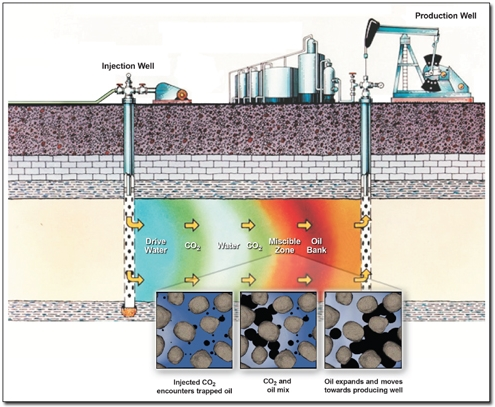
C. K. Cooper & Co. Analyst Darren Odenino was more impressed with CO2 Enhanced recovery, a method wherein CO2 is piped to oil fields, where it is injected via injection wells into the oil reservoir. [See infographic below.] The Department of Energy’s Office of Fossil Energy notes that about 114 active commercial CO2 injection projects are underway in the U.S., and together they could produce a collective additional 280,000 barrels of oil per day (280,000 bbl/d).

Among the higher-profile projects is Magellan Petroleum Corp.’s (MPET:NYSE) Poplar Field in Roosevelt County, Montana. In his May 2013 interview titled “How to Spot Oil and Gas Takeout Targets,” Odenino commented, “The exciting catalyst for Magellan is the opportunity to test its CO2-Enhanced Recovery project in the Poplar field’s Charles formation. If that proves successful, Magellan should be headed for a lot of growth.” Magellan has already reached several milestones for this pilot project. With funding secured for a two-year trial run and five wells drilled, Magellan is scheduled to begin CO2 injection this very month.

InjectionWell


Evan Smith, co-portfolio manager of U.S. Global Investors’ Global Resources Fund, sees producers moving toward a manufacturing-like process in the coming year with multi-well pad drilling. In an interview earlier this month titled “Producers that Can Pump at $60/bbl Oil,” he commented, “The rig count has declined by more than 50% over the last two years, and yet we continue to see a steadily increasing supply of natural gas. It’s a testament to the technology that has been developed by the industry to drill faster and more efficiently and to unlock and produce more reserves with less input.”

“I think in 2014, people in the field will have delineated most of their acreage and are going to turn these things into a pure manufacturing process with pad drilling. Continental Resources Inc. (CLR:NYSE) is testing 16 wells per pad in the Williston Basin in North Dakota. The company will repeat that pattern and drive costs down. We’ve seen a big shift to multi-well pad drilling in 2013, but I think it’s going to become much more standardized in 2014. The efficiencies that we’ve seen, which have led to more productivity with fewer rigs, will probably remain and perhaps even accelerate in 2014.”

North American oil and gas industry innovation is a force that is turning the global production profile upside down as companies explore new oil and gas reserves around the world that were thought all but unrecoverable. As Edison Investment Research Analyst Peter Dupont commented in his recent interview, “Has Shale Broken OPEC’s Grip?,” North American companies with shale tech know-how are poised to unlock reserves around the world, especially in South America.

“Some of these companies have first-mover advantage.,” says Dupont. “Madalena Energy Inc. (MVN:TSX.V) [is one of] the most obvious examples. . . Madalena has working interests ranging between 35–90% in three blocks in the Neuquén Basin comprising a sizeable 135,000 net acres. Contingent and prospective recoverable resources are estimated by Madalena at 2.9 Bboe, of which 45% are oil and NGLs. There is a mixture of conventional and unconventional plays. Small quantities of oil are presently obtained from the conventional Sierras Blancas formation in the Coiron Amargo Block, where horizontal drilling technology is being applied. Madalena’s key focus presently is to secure a joint venture partner for the appraisal and development of the Vaca Muerta and Agrio shale formations. Securing a partner or partners would be a critical catalyst for the stock.”

Canaccord Genuity Research Director Christopher Brown saw shale tech sweeping the old world, especially in Ukraine. In his November interview, “Four International O&G Juniors for a Globe-Sweeping Shale Revolution,” Brown commented, “On the Ukrainian side, Cub Energy Inc. (KUB:TSX.V)has done well at introducing new technologies to the country. Cub has received the approvals to bring in this new technology and apply it. It’s going to be a slow process, but as the company continues to unlock value, there’s no denying that its region and fiscal terms are very good and provide a lot of incentive to keep on working hard to grow the production base. Turkey hosts a more difficult unconventional basin. The Anatolia Basin is still in its earlier stages, whereas the Ukrainian assets have some proven opportunities. In the Anatolia Basin, you do have some majors that are tentatively playing around the edges, but there has not yet been anything that’s really unlocked that basin. But it didn’t cost Cub much to enter the basin and the Turkey play provides shareholders with potential future value, which they don’t pay for at Cub’s current share price.

“. . .History has proven Ukraine has access to significant volume. That’s why Cub is in this country: It believes it can unlock more value. . .through its ownership in a separate private holding company (Pelicourt Ltd.), management holds a major position in Cub Energy, and recently it decided to put in additional dollars to show confidence in the future of Cub. As of its last statement in October 2013, it owns 39.54% of the shares outstanding. That’s provided a decent amount of market support.”

As the oil and gas sector continues to transform worldwide, keep tuning in for Streetwise interviews that shed light on promising oil and gas explorers that are poised to deliver shareholder value.

Uranium: Fundamental Changes

With the Megatons to Megawatts program officially coming to a close, investors are shifting focus to North American uranium producers that can help meet U.S. needs. John Kaiser‘s October interview, “10 Strategies for Success in a Flat Commodity Price Market,” was filled with fresh approaches to mining. In light of the small number of domestic uranium producers and the high capital costs of resource delineation and mine development, an innovative new sampling method caught Kaiser’s attention.

He comments,”A junior explorer, Uravan Minerals Inc. (UVN:TSX.V), has developed an interesting geochemical sampling method it is using on projects in the Athabasca Basin. . .Uravan has spent the last five to six years developing its geochemical sampling method in collaboration with Queens University’s Kurt Keyser, which looks for the lead isotope decay products of a uranium deposit. These get absorbed by vegetation and clay particles. The company takes tree core samples at surface to find evidence of a resource that may be 1,000–1,500m deep. You still can’t tell the size of it or the grade, but at least you know you’re going to hit something once you drill down there.

“This approach opens up a much deeper portion of the basin that has been largely out of bounds because of the difficulty in finding these deposits, which almost always are right at the unconformity between the basement rocks and the overlying sandstone rocks in association with graphite. The conventional targeting tool is a geophysical survey that looks for conductors representing these graphite beds. But deeper than 450m, these conductors become fuzzy just as drill holes that need to pinpoint the target become expensive. This is problematic because most of the graphite beds at the Athabasca Basin unconformity do not host a uranium deposit. Uravan’s radiogenic isotope based sampling tool allows the junior to see evidence of a uranium deposit at substantial depth from the surface. A case study done this summer apparently demonstrated that Cameco’s 850m deep Centennial deposit shows up as a well-constrained geochemical anomaly. Theory says that in the Athabasca Basin, the thicker the sandstone cover, the bigger and richer the potential uranium deposit at the unconformity. Uravan now has a tool that enables it to stalk super-elephants in uncharted territory.”

Kaiser continued, “Uravan can also perform this research as a service to companies that have claims in the Athabasca Basin and then earn a royalty or a small interest in exchange for generating the geochemical part of the target that you need to justify raising money for a high-stakes drill program.” Earlier this month, Uruvan completed another surface geochemical study on the Centennial depositbased on the earlier survey.

The Abasca Basin is in the spotlight more than ever this year, as superstar company Fission Uranium Corp. reported countless startling results. As Kaiser noted, “A big discovery event in the past year is the Patterson Lake South discovery in the Athabasca Basin by Fission Uranium Corp. (FCU:TSX.V) and Alpha Minerals Inc. This is a classic high-grade unconformity type of uranium deposit with grades of up to 20% uranium. The size of this discovery is stimulating interest in the potential for a new Athabasca Basin area play.”

Of course, other domestic near-term uranium producers are raising eyebrows among energy analysts, especially those who expect a uranium price comeback in the coming year. Cantor Fitzgerald Canada Metals and Mining Analyst Robert Chang highlighted Energy Fuels Inc. (EFR:TSX; EFRFF:OTCQX; UUUU:NYSE.MKT) in his September interview, “Uranium Price Headed for $50 in 2014, Taking Stocks Higher.” Chang commented, “We cover Energy Fuels, which is the second largest producer of uranium in the U.S. and probably has the best story leveraged to the uranium price. It currently produces only about 1 Mlb/year, by design, with several mines that can be turned on relatively quickly. We estimate that it could quickly turn on anywhere between 2–5 Mlb more in annual production once prices get to attractive levels. On top of that, it also has the White Mesa mill that it acquired from Denison, located in Blanding, Utah, which is the only conventional mill in the U.S. Having mill access is extremely important because you effectively cannot produce your final product without it. Energy Fuels has a monopoly position with a conventional mill and it can even make money by processing material on a toll basis for other producers. We believe that this is a very attractive company for those who believe that the uranium price will head higher.”

Meanwhile, the way that we consume nuclear power could completely change over the coming decades. In his recent interview, “Why Uranium and Coal Rank high for Energy Return on Energy Invested,”Thomas Drolet commented on a coming shift to smaller units: “Standard nuclear reactors being built today are gigantic units. Over the next decade we’re going to see a shift to smaller units—small modular reactors (SMR)—for good and valid reasons of schedule and because the utilities want them. Babcock & Wilcox Co. (BWC:NYSE) and NuScale Power LLC in the United States are being funded or potentially funded by the U.S.DOE to bring on these smaller reactors.”

What’s particularly exciting about stories like these is that they are larger than a single company. They have the potential to galvanize an entire sector and make a particular energy source more viable, period. Keep tuning in next year for more investment advice about uranium producers.

Alternative Investments

Alternative energy as a sector is built on technological innovation, but in order for the market to take notice, these innovative feats need to create a compelling bottom line. Rodney Stevens took notice of an innovative solar energy business model in his July interview, “A Short-Seller’s Investment Guide to Obama’s Climate Change Initiatives.

Stevens commented, “We like SunPower Corp. (SPWR-A:NASDAQ; SPWR-B:NASDAQ) because not only does it manufacture the solar panels, but it also has a leasing program for the retail space, similar to SolarCity. SunPower has one of the best products available on the market and it should benefit from the incentives utility companies have to add renewable sources of energy to their business. SunPower could play a big role in the utility space, but also grab the retail markets. It should benefit from the growth in solar and also it has an international base, although its operations are primarily in the U.S. . .I think decent quarterly results drove the stock. Its revenues beat expectations and its losses have narrowed. Going forward, SunPower is staged for further growth and profitability. I think that’s been the main catalyst driving the share price. We expect that revenue growth to continue. “

House Mountain Partners founder

Chris Berry made a strong point in his June interview, “Transformative Energy Technologies.” As Berry notes, “With population increasing globally, becoming more interconnected, and set to live a more commodity-intensive lifestyle, sustainability and efficiency in our progress as a society will be of paramount importance. I just do not believe that you can have as much intellectual capital and financial capital all working toward next-generation technologies and not have breakthroughs that provide compelling investment opportunities and also leave our children a lasting legacy.”

From production technical advances to futuristic visions of mega-efficient energy delivery systems, the energy investment space is vast, varied and tremendously exciting. And if you’ve ever watched a company start small and grow into a major market force, you understand the power of ideas. We hope you’ll keep checking in with us for energy investment discussions from esteemed experts in the field, and let us know what you’d like to see more of from The Energy Report. Happy holidays, and many happy returns!

Want to read more Energy Report interviews like this? Sign up for our free e-newsletter, and you’ll learn when new articles have been published. To see a list of recent interviews with industry analysts and commentators, visit our Interviews page.

From time to time, Streetwise Reports LLC and its directors, officers, employees or members of their families, as well as persons interviewed for articles on the site, may have a long or short position in securities mentioned and may make purchases and/or sales of those securities in the open market or otherwise. Each reader is encouraged to consult with his or her individual financial professional and any action a reader takes as a result of information presented here is his or her own responsibility. By opening this page, each reader accepts and agrees to Streetwise Reports’ terms of use and full legaldisclaimer.

 

The Historical Gold-Oil Ratio Forecasts A Much Higher Price For Gold

While many analysts on Wall Street forecast gold to head lower in 2014, they fail to realize that its historic ratio to oil points to a much higher price.  It seems like everything today is based on financial wizardry rather than fundamentals of a physical economy.

The economy has moved so far away from the fundamentals that it no longer has any idea how to function without total market rigging.  The Fed and central banks believe they can continue to control the markets, however the weight of all that paper crap will overwhelm them at some point in time.

I recently wrote the article, Silver To Hit New Highs As The Quality Of Analysis Sinks To New Lows.  In the article I provided information on how the historic Oil-Silver Ratio would relate to a much higher price of silver today.

For example, the price of silver would be $92.67 today based on the average Oil-Silver ratio during 1961-1970.  For quick reference here is the table from the article:

Present Silver Value At Prior Silver-Oil Ratios (based on $111.30 Brent crude oil)

1981-2000 (3.8 ratio) = $29.30

1971-1980 (2.1 ratio) = $52.95

1961-1970 (1.2 ratio) = $92.67

Some of my readers asked me how the historic Gold-Oil ratio would impact the price of gold today.  So I decided to look at the data and put this article together.

From 1961-1970 the price of gold behaved similar to silver — basically flat compared to price of oil.  Of course this was due to the fact that the Fed & Central Banks had to manipulate the gold market through the London Gold Pool to keep the price fixed at $35 an ounce.

However, the London Gold Pool fiasco started to get into trouble by the end of the decade as the price of gold increased to $41.39 in 1969… shown in the chart below:

image001

If we consider the average Gold-Oil ratio for 1960’s decade it was 20 to 1.  Which means one ounce of gold could buy 20 barrels of oil when gold was still functioning as a monetary metal.

After Nixon dropped the Dollar-Gold peg in 1971, all hell started to break loose in the gold market as the price of the yellow metal shot up to $97.32 by 1973.  You will notice that the Gold-Oil ratio increased substantially in 1973 compared to 1971.

The reason for this was due to the fact that the price of gold (1971-$40.80, 1973-$97.32) increased to a much larger degree than oil (1971-$2.24, 1973-$3.29).   This is shown in the next below:

image003

As the price of oil nearly quadrupled in 1974 to $11.58 from the impact of the Arab Oil Embargo, the Gold-Oil ratio fell to 13.8.  Even though the price of gold declined a bit in 1976, it moved higher in tandem with the price of oil by the end of the decade.

After the Dollar was no longer pegged to gold, the average Gold-Oil ratio during 1971-1980 declined to 15.9 compared to 20 in the previous decade.

When I crunched the numbers for the Gold-Oil ratio for the years 1981-2000, I was quite surprised that the average was higher than the previous time period.

image005

You will notice that from 1986 to 1999, the gold price trend line was above the oil price line.  Thus, we had very high Gold-Oil ratios during this time period.

The reason for the lower price of oil is that several new large fields came online.  We had the North Sea Oil Field come into production, Alaska Prudhoe Bay and a ramp up of the Gulf of Mexico.

Interestingly, gold was valued higher to oil than I assumed… even higher than the 1971-1980 time period when it reached a record of $850 an ounce.

The lower price of oil is what pushed the average Gold-Oil ratio higher to 18.6 in 1981-2000 compared to 15.9 in the prior time period.

Now… let’s look at what took place since 2000.  Here we can see a few noticeable trends.  First, during the majority of this time period, the oil price line was higher than gold.  Second, the average Gold-Oil ratio is much lower than in any of the previous time periods.

image007

If we disregard the 2009 Gold-Oil ratio as it was a huge anomaly and focus on 2010 and 2012, the price of gold valued in oil terms was at its highest.  Furthermore, even though the price of gold hit a record in 2011, the average price of gold was 2012 was higher.

Average Gold Price

2010 = $1,225

2011 = $1,572

2012 = $1,669

2013 = $1,411

So, when the price of gold was attempting to break-out above $1,800 in September of 2012 and surpass its 15 to 1 Gold-Oil ratio, the Fed & member banks came into the markets and decided enough was enough (shown by the nice Red Arrow).

This was also true with Silver:

image009

(NOTE:  the chart should read Oil-Silver ratio)

An interesting factor as it pertains to energy and gold can be seen in the table below.  I have been compiling data for diesel consumption in the top gold miners.  Not only is the amount of diesel consumption per ounce of gold produced increasing… so is the price of diesel.

image012

The majority of the diesel used by these mining companies is in the extraction of the gold ore.  A small percentage of overall diesel consumption is used in construction of mine sites as well as a source of electric generation in remote locations when electricity is not available.

In 2010, the top 5 gold miners produced 24.7 million oz of gold consuming 18.7 gallons of diesel per ounce to do so.  If we go by the U.S. price of a gallon of diesel in 2010 ($2.99), these top gold miners spent $1.38 billion for this fuel cost.  Thus, it took approximately $55.91 in diesel-fuel costs per ounce of gold to extract the ore.

If we make some conservative assumptions based on past trends, the estimated cost of diesel to extract gold in 2013 will more than double to $113.68 an ounce.  This is quite interesting once we consider that the current price of gold is $1,227 compared to the average of $1,224 in 2010.

The figures in the table are used as a form of reference.  Diesel prices throughout the world are higher or lower than the average shown in the U.S.,  but, at least it gives us a basic idea of just how much fuel costs are rising in the production of gold.

The gold miners are consuming more energy than ever to produce gold today, however Wall Street believes the price of gold needs to fall below $1,000 in 2014.  So it goes… as Wall Street becomes more insane, so do the markets.

Getting back to the Gold-Oil ratios, let’s look at what the gold price would be today based on the past ratios:

Present Gold Value At Prior Gold-Oil Ratios (based on $111.70 Brent crude oil)

1981-2000 (18.6 ratio) = $2078

1971-1980 (15.9 ratio) = $1,776

1961-1970 (20.0 ratio) = $2,234

If we go by the 1961-1970 historic Gold-Oil ratio when gold was a monetary metal, than the price of gold would be worth $2,234 today.  Of course this does not consider all the other factors such as the upcoming collapse of the global fiat currency system, U.S. Treasury Market and the majority of paper assets.

With the current price of Brent crude at $110 and gold at $1227, the Gold-Oil ratio is 11.1, lower than the 12.6 average for 2013 and 11.6 average for the decade.

As the Fed & Wall Street continue to delude the public that the proper value for the price of gold is to head lower, the energy fundamentals are pointing to a much higher figure.  Financialization and Bull Excrement rule the day in the economy.

Fortunately, those few who still adhere to the fundamentals will benefit tremendously when the $100’s of trillions of paper claims falls under the weight of Newton’s Law of Gravity.

At the SRSrocco Report, we will be releasing some Reports in the future on various subjects. However, one Report will focus on the coming Economic Collapse including what I believe is a Bomb Shell to precious metal community.


test-php-789