
Stocks & Equities
U.S. stocks fell, with the Standard & Poor’s 500 Index retreating from a record as bank earnings disappointed investors. Treasuries climbed and nickel advanced a fifth day while Turkey led declines in emerging-market shares.
The S&P 500 lost 0.1 percent to 1,845.89 by 4:30 p.m. in New York, leaving the gauge down 0.1 percent this year. Ten-year Treasury yields fell for the first time in three days. Turkey’s benchmark gauge slid almost 2 percent after the lira weakened to a record low and the Stoxx Europe 600 Index slipped from a six-year high. Nickel capped the biggest five-day rally since 2011 and U.S. natural gas rose to a three-week high while gasoline, Brent crude oil and copper led commodity decliners.
….for more details on Earnings Analysis, U.S. Inflation, Emerging Bonds, Commodity Markets, European Moves & specific stocks go HERE

Marc Faber told Bloomberg TV in an interview that, “I prefer physical gold and silver, platinum to bitcoin. How do you value a bitcoin? I can value gold to some extent and compare say gold to the quantity of money that is floating around the world, to the wealth increase, and to the monetary base increase, to the credit increase, and so forth and so on, and to the production costs. So I have an idea of where gold should be.”
….watch the full interview HERE



I’ve told you before about the enormous number of high-yielding stocks abroad. If you remember, my research team and I found only 25 profitable U.S. companies were paying yields of more than 12%… compared to 93 overseas.
Although the numbers fluctuate daily, that means roughly 79% of the world’s highest yields are found outside of U.S. markets. To me, the amount of high-yield international dividend-payers out there is one of the market’s biggest secrets.
But there’s another big potential benefit to investing in international companies that most investors fail to consider.
This simple move could make investors extra gains of 10% or more — even in a single year. It doesn’t require any extra effort… in fact, it happens automatically when you invest in international companies.
Here’s how it works…
Say five years ago you took the trip of a lifetime to Australia. Back then, $1.00 Australian was worth roughly $0.65 U.S. dollars. That means a hotel room priced at $100 Australian dollars only cost about $65 U.S. dollars thanks to a favorable exchange rate.
 But today, the Australian dollar has increased while the U.S. dollar has plummeted in value. Just $1.00 Australian is now worth $0.91 U.S. dollars. That $100 room in Australian dollars will now cost you $91 U.S. dollars — a 40% increase, even though the hotel’s rate didn’t change.
What does this have to do with increasing dividends? Well, what’s bad news for your vacation is great news for your international income investments.
Say you bought an Australian company five years ago that paid a dividend of $10 Australian dollars each year. Back then, you would have earned $6.50 in U.S. dollars after conversion.
But today, that same $10 Aussie dollar dividend would be worth $9.10 in the U.S. — or40% more.
The bottom line is if the U.S. dollar weakens against other major foreign currencies, then your dividends will increase over time… even if the company you invest in keeps its dividend payment the same.
The best news is that I see this trend continuing for at least the next two or three years.
And I’m not the only one noticing this. In fact, the numbers are staggering…
“The dollar’s decline over the past 30 years has been far greater than most Americans realize. It has lost almost half its value against other major currencies since 1985 and is down 33% in the past 11 years alone.”
— Time.com, March 20, 2013
But it’s not just dividends that benefit from a falling dollar when you invest abroad. Every dollar you invest sees the effects as well.
Recognizing this trend years ago — and investing alongside it — has already given international income investors a major boost.
You can see for yourself how the falling dollar has helped score some great returns in international markets for investors…

| This table makes it easy to see how a falling dollar actually helps… if you’re invested abroad.
There’s even a good chance to make gains this way if the foreign market index you’re invested in falls. For example, when the New Zealand market declined 21.6% over a five year period (from August 2006 to August 2012) when measured in New Zealand dollars, it actually showed a gain of 2.5% for U.S. investors when you factor in the falling U.S. dollar. Now keep in mind, if the dollar were to rally, the opposite would happen. Your returns and dividends would lessen by the amount the dollar strengthens. And while the dollar has rallied recently — for a variety of reasons I won’t bore you with today — I think the U.S. dollar will continue to lose value in the coming years. That gives income investors plenty of time to take advantage of this unique opportunity. And in my opinion, there’s no easier way right now to boost your profits. Especially since you can own many of the world’s highest yielders without even leaving the U.S. markets. For more on international dividend-payers, I invite you to watch my latest presentation. I’ve included names and ticker symbols of 10 American companies that yield more than 12% (some yielding over 20%) and several high-yield international plays. Visit this link to watch now. Good investing, Michael Vodicka
|
| To ensure that you receive these emails, please add us to your address book.
Disclosure: StreetAuthority does not own shares of any of the securities mentioned in this article. In accordance with company policies, StreetAuthority always provides readers with at least 48 hours advance notice before buying or selling any securities in any “real money” model portfolio. Members of our staff are restricted from buying or selling any securities for one week after being featured in our advisories or on our website, as monitored by our compliance officer. StreetAuthority, LLC is a publisher of financial news and opinions. StreetAuthority, LLC is not a securities broker/dealer or an investment advisor and we do not recommend or endorse any brokers, dealers or investment advisors. This work is based on SEC filings, current events, interviews, corporate press releases and publicly available information which may contain errors. All information contained in our newsletters and/or on our website(s) should be independently verified with the companies or sources mentioned. You are responsible for your own investment decisions and should always conduct your own research and due diligence and consider obtaining professional advice before making any investment decision. This message was sent by an automated message delivery platform. Please do not reply to this email address. Any messages sent to this address will be automatically deleted. We sincerely hope that you benefit from your subscription to this complimentary newsletter, and we’re willing to do whatever it takes to keep you as a satisfied subscriber. You may contact our customer service department by visiting this link. To update your subscription preferences, please click here. Copyright (c) 2014 StreetAuthority, 4601 Spicewood Springs Road, Austin, TX 78759. All rights reserved. Any reproduction or redistribution in whole or in part without StreetAuthority approval is prohibited. |
There is no need to beat around the bush. Junior mining stocks have bottomed. The bear market is over. Sure we could be wrong. We’ve been wrong before and will be again. However, the evidence is too compelling and is growing by the day.
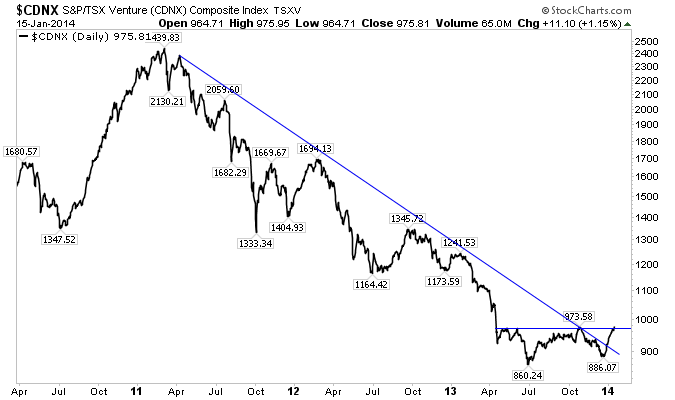
The TSX Venture (CDNX) is the market for juniors in Canada. The market consists of exploration companies focused on precious metals and other minerals, energy companies and some technology companies. It’s not a perfect indicator for the junior mining industry but it’s good enough for the experts. On Thursday the CDNX closed at a nine month high. No, that is not a misprint. The junior market reached a nine month high. It bottomed in late June, made a higher low in December and has surged 10% since.
Click HERE or on chart for larger view:
For an American, GDXJ is the proxy for junior gold stocks or junior miners. I like to think of GDXJ as the “senior” or established juniors. The CDNX consists of many stocks trading under $1 and a $100M market cap while GDXJ is mostly comprised of companies in the $100M to $500M market cap range.
GDXJ declined 81% from its April 2011 peak to its December 2013 bottom. As we noted several weeks ago, GDXJ tried to penetrate its December low three times and failed. The market has since rallied back above the previous (June) low. Given the severity of the bear in terms of price and time, extreme negative sentiment and recent bullish price action I believe it is highly likely that the bottom is in.

Our frame of reference for the bear, the gold stock bear analogs chart continues to suggest that the bear market in senior gold stocks is all but over.
Click HERE or on chart for larger view:
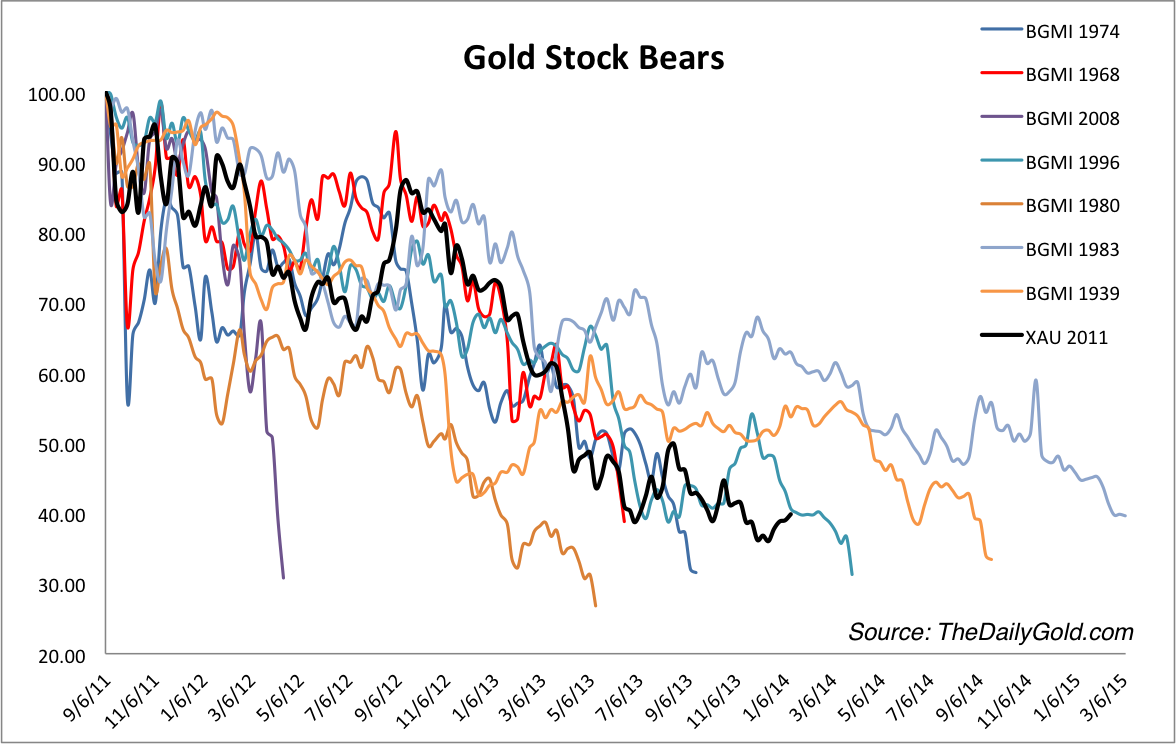
The juniors (both CDNX and GDXJ) peaked in April or five months before the senior gold producers. Hence, it makes sense that the juniors would bottom first. The assertion from the analogs chart (that the seniors may have bottomed or are very close) gives us further confidence that the juniors have bottomed.
Most of the stocks that we follow bottomed in June. The following chart, which was sent to premium subscribers is an equal weighted index of 15 of our favorite gold and silver stocks. The index bottomed in late June 2013 and made a strong higher low in December. It would have to decline 26% to test the June low.
Click HERE or chart for larger view:
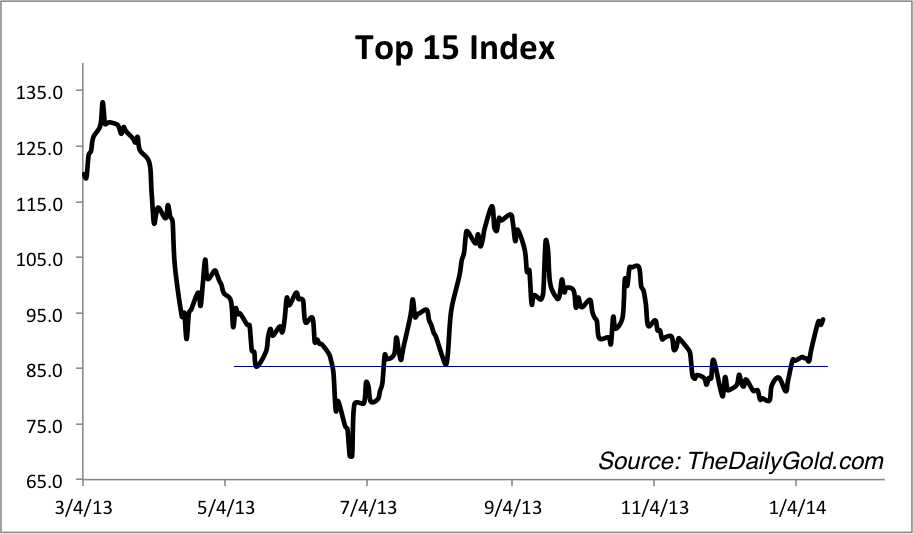
Extreme bearish sentiment, compelling valuations and an extreme oversold condition can create a compelling contrarian opportunity. However, that opportunity can remain far fetched without some positive price action. We now have the positive price action that allows us to call a bottom in the mining stocks and strongly so in the junior gold stocks. The CDNX looks to have made a real double bottom and closed at a nine month high. GDXJ reversed course after failing to continue a breakdown when the time was ripe. Moreover, as evidenced by our top 15 index, the stronger and higher quality companies are showing leadership. The risk has shifted from getting caught in a final plunge to missing out on the rebound. If you’d be interested in learning about the companies poised to rocket out of this bottom then we invite you to learn more about our service.
Good Luck!
Jordan Roy-Byrne, CMT


-
I know Mike is a very solid investor and respect his opinions very much. So if he says pay attention to this or that - I will.
~ Dale G.
-
I've started managing my own investments so view Michael's site as a one-stop shop from which to get information and perspectives.
~ Dave E.
-
Michael offers easy reading, honest, common sense information that anyone can use in a practical manner.
~ der_al.
-
A sane voice in a scrambled investment world.
~ Ed R.
Inside Edge Pro Contributors

Greg Weldon

Josef Schachter

Tyler Bollhorn

Ryan Irvine

Paul Beattie

Martin Straith

Patrick Ceresna

Mark Leibovit

James Thorne

Victor Adair