
Gold & Precious Metals

I have pilfered from him before, and I will no doubt pilfer again. For Mark Twain is an excellent source of inspiration. Apparently, he said something along the lines of ’reports of my death have been greatly exaggerated‘ in relation to a misinformed newspaper article about one of his relatives. Regardless, it has been ringing in my ears recently as I have been reading about coal. For despite the anthracitical fuel being the red-headed stepchild of the energy complex, talk of its demise would appear misplaced. I present my case henceforth.
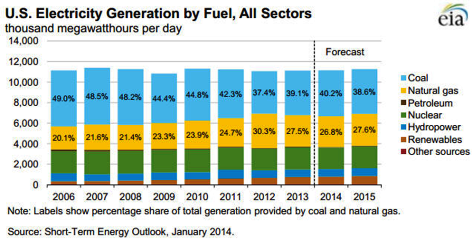
1) Coal has historically been, and is currently, the leading fuel in the US power generation mix. It is also expected to play a leading role for many years to come:

OTTAWA (Reuters) – Canada bluntly told the United States on Thursday to settle the fate of TransCanada Corp’s proposed Keystone XL pipeline, saying the drawn-out process on whether to approve the northern leg of the project was taking too long.
The hard-line comments by Foreign Minister John Baird were the clearest sign yet that Canada’s Conservative government has lost patience over what it sees as U.S. foot-dragging.
Baird also conceded that Washington might veto the project, the first admission of its kind by a Canadian government minister.
The 1,200-mile (1,930-km) pipeline would carry 830,000 barrels a day from the Alberta tar sands in western Canada to the U.S. Gulf Coast. Ottawa strongly backs Keystone XL, which it says would create jobs and provide a secure supply of oil to Canada’s closest ally and trading partner.
“The time for Keystone is now. I’ll go further – the time for a decision on Keystone is now, even if it’s not the right one. We can’t continue in this state of limbo,” Baird said in a speech to the U.S. Chamber of Commerce.
Although the State Department is responsible for ruling whether the pipeline meets the national interest, President Barack Obama has made clear he will make the final decision.
Obama is under heavy pressure from environmental activists to veto the northern leg, and Washington seems in no hurry, despite the growing irritation in Ottawa. Canada is the largest single supplier of energy to the United States.
The State Department issued a largely favorable initial environmental impact assessment in March 2013, which was followed by a public comment period. On paper, at least, the department should have issued an updated impact assessment and then a final recommendation by the end of 2013.
….read page 2 HERE
(Reuters) – U.S. industrial output rose at its fastest clip in 3-1/2 years in the fourth quarter as factory activity closed out the year on a strong note, a sign of the economy’s brightening prospects.
Manufacturing production rose a stronger-than-expected 0.4 percent in December after an out-sized 1.0 percent increase the prior month, a Federal Reserve report on Friday showed.
That helped push overall output at the nation’s factories, mines and utilities up 0.3 percent. Economists polled by Reuters had expected factory output to rise 0.3 percent, while the gain in overall industrial production matched forecasts.
For the fourth quarter as a whole, industrial production advanced at a 6.8 percent pace, the largest quarterly increase since the second quarter of 2010.
A separate report from the Commerce Department showed groundbreaking for new homes dropped 9.8 percent to a seasonally adjusted annual rate of 999,000-unit pace.
It was the largest percentage decline since April, but housing starts were coming off a multi-year high reached in November and the decline was smaller than economists had expected. In addition, cold weather appeared to be a factor.
For all of 2013, starts increased 18.3 percent to an average of 923,400-units.
“Despite the expected drop in housing construction activity in December, due to the unwind of the unsustainable strength in November and weather effects, the overall tone of this report was quite encouraging suggesting that the sector ended the year on fairly strong footing,” said Millan Mulraine, deputy chief U.S. economist at TD Securities in New York.
Groundbreaking for single-family homes, the largest segment of the market, fell 7.0 percent to a 667,000-unit pace in December. Starts for the volatile multi-family homes segment declined 14.9 percent to a 332,000-unit rate.
Starts in the Midwest, which experienced unseasonably colder weather, tumbled 33.5 percent, suggesting the weather might have weighed on home building in the region last month.
Residential construction has been on the rise after a brief lull last year in the wake of a run-up in mortgage rates.
Increasing household formation and a tight supply of houses has been boosting home building, which in turn is supporting the labor market.
Permits to build homes fell 3.0 percent in December to a 986,000-unit pace. It was the second straight month of declines. They were weighed down by a 4.8 percent drop in permits for single-family homes. Multifamily sector permits were flat.
For all of 2013, permits increased 17.5 percent to an average of 974,700-units.
The report on industrial output showed that industry employed 79.2 percent of its capacity in December – the most since June 2008. Still, capacity use remained 1 percentage point below its long-run average, the Fed said.
(Reporting by Lucia Mutikani; Additional reporting by Tim Ahmann; Editing by Paul Simao)

Michigan Sentiment Index Decreased to 80.4 in January
Consumer confidence in the U.S. unexpectedly declined in January, a sign spending may take time to accelerate early this year.
The Thomson Reuters/University of Michigan preliminary index of sentiment fell to 80.4 from 82.5 in December. Economists in a Bloomberg survey called for a reading of 83.5, according to the median estimate.
The report follows figures last week showing employment rose in December at the slowest pace in almost three years. While more job opportunities would help lift spirits, higher property values and rising equity prices are boosting household wealth and will keep consumers spending.
“There probably are some people who could have lost confidence based on what they read but I think the bigger driver is what people see day to day,” Jim O’Sullivan, chief U.S. economist at High Frequency Economics Ltd. in Valhalla, New York, said before the report.
Estimates of the 67 economists in the Bloomberg survey ranged from 78 to 88. The index averaged 89 in the five years before December 2007, when the last recession began, and 64.2 in the 18-month contraction that ensued.
The Michigan sentiment survey’s current conditions index, which measures Americans’ view of their personal finances, fell to 95.2 in January from 98.6 a month earlier.
The index of expectations six months from now decreased to 70.9 from 72.1 last month.
….you can read more on Bloomberg Sentiment HERE (scroll down)


-
I know Mike is a very solid investor and respect his opinions very much. So if he says pay attention to this or that - I will.
~ Dale G.
-
I've started managing my own investments so view Michael's site as a one-stop shop from which to get information and perspectives.
~ Dave E.
-
Michael offers easy reading, honest, common sense information that anyone can use in a practical manner.
~ der_al.
-
A sane voice in a scrambled investment world.
~ Ed R.
Inside Edge Pro Contributors

Greg Weldon

Josef Schachter

Tyler Bollhorn

Ryan Irvine

Paul Beattie

Martin Straith

Patrick Ceresna

Mark Leibovit

James Thorne

Victor Adair