
Gold & Precious Metals
INSTITUTIONAL ADVISORS
FRIDAY, JANUARY 24, 2014
BOB HOYE
PUBLISHED BY INSTITUTIONAL ADVISORS
The following is part of Pivotal Events that was
published for our subscribers January 16, 2014.
Cyclical Bull for Gold

Perspective
It has been an interesting week.
On Monday, the S&P tanked on a bearish report from Goldman. It also accomplished an Outside Reversal, showing signs of uncertainty and diminishing liquidity. Yesterday, the stock market jumped on good news on the Empire State Manufacturing number and mortgage applications. And then there was a bullish report from Goldman.
Similar ups and downs are seen in lower-grade bonds and credit spreads. As mentioned, spreads declined (widened) below the 50-day moving average which had provided support on each dip over the past year.
Crude oil declined to the lowest low since last summer and yesterday’s pop was a plus for the stock market.
This is near-term noise.
The key conditioner since October has been the “Springboard Buy” of October 9th. The extreme overbought is the new condition to reckon with and this is indelible. The tattoo machine does not have an eraser.
Getting off of the highs for sentiment and momentum will not be easy. We should recognize that these readings are only seen at cyclical highs.
And then there is the economy. In the usual business cycle, the stock market leads the economy by around 12 months. At the end of a great bubble stocks and the business cycle turn down at the same time.
This worked for us in 2007 and it was likely that when the panic ended in March 2009 that the economy would turn up with the stock market. The delay was two months.
It seems appropriate to have good economic reports with stock market highs. Quite likely, both will roll over at virtually the same time.
As noted above, technical action in spreads gave an alert. This was mainly due to the spirited rally in treasuries. To make it more meaningful, lower-grade yields should be increasing.
In the meantime junk and the high-yield continued to rally. The Daily RSI on JNK has soared to 81. The last time it reached 81 was in early May. As Ross notes in today’s ChartWorks, this is accompanied by a Sequential Sell.
Lower-grade bonds are poised for a selloff. The rally has had little regard for risk. The decline in price and rise in yields could be substantial.
The reversal in May was seasonal and initially severe – severe enough to force Bernanke to talk about tapering, in order to look in charge of rising rates. The ending hammered the RSI which was distressful enough to prompt Bernanke to ease worries about the taper.
The point is that in May a seasonal reversal overwhelmed the Fed buying program. JNK plunged from 40.30 to 36.89 as the RSI swung from 81 to only 22.
JNK has rallied with only minimal setbacks from August to this week.
JNK/TLT (junk vs treasuries) violated the 50-day moving average, traded slightly above
it yesterday.
Often the bond market can rally through Christmas and into January and reverse – seasonally.
Accounts could begin to lighten up on low-grade issues.
The treasury bond future declined for eighteen months to a low of 127.35 and a Weekly RSI of 30 at Christmas. The rally has made it to 131 last week. This seems to be part of the rotation from high-flyers to no-flyers. It has further to run, but we don’t see a cyclical bull market.
Issuance of treasuries has been absurd and the rally in commodities could also limit the action.
This week’s resumption of the rally in base metal miners (SPTMN) has been outstanding. The low was 704 in early December and at 855 it is through resistance at 849 set in September and October. The Daily RSI is up to 78 which suggests a brief consolidation.
With this, Cameco (CCJ) has also jumped above its resistance at the 21 level.
Uranium, the oxide, set its big high at 73 in March 2011, which with base metals, reversed on the signal from our Momentum Peak Forecaster. We expected a cyclical bear market.
Uranium set a key double bottom at 34.5 in October and at the end of the year. At 35, breaking above 36.4 would set the uptrend.
In November, we began to look for an important rotation whereby the resource sector could bottom and turn up.
Base metals (GYX) rallied from 330 at the first of December to 355 late in the month. The correction was to 339 and this week’s excitement has driven it to 360. This is the resistance level and a rest is due.
Crude oil declined to 91.77 in late December and joined the action in base metals. The initial rally to 100.75 was fast – too fast. The decline to 91.24 last week was rather quick. The recovery to 94.20 needs a pause, but 100 seems possible.
On the longer term, since 2008 crude has been in a secular bear market.
The Dollar Index is again trying to get through the 81 level.
The key low was 79 in October and rising through 82 will extend the uptrend.
This seems likely. As lower-grade bonds roll over it will inhibit the Fed’s ability to depreciate the dollar.
The rotation from high-flyers to the resource and materials sectors seems to be working out.
A cyclical high for the senior indexes at around now needs confirmation with a distinctive break. Taking out the December low of S&P 1768 would do it.
It is worth noting that the long bear market in base and precious metals did not impair the action in the hot sectors. Perhaps the base metal sector can continue to rise as the senior stock indexes roll over.
In olden days, when coming out of a cyclical bear market for golds the seniors would be the first to rally. Then after a while, mid-sized companies would rally and much later the juniors would participate in the bull market.
No longer, as they all turn up at the same time.
Of interest is that the seniors (GDX) have rallied 10%, the middling companies (GDXJ) have rallied 20% and the juniors (GLDX) have jumped 24%.
This is good.
Continuation will require silver to outperform gold. So far, the silver/gold ratio increased from 154 (leaving out decimals) in early December to 166.
At 162 now, rising through 166 will set the uptrend.
If there is a day when silver does a serious plunge relative to gold we will review our policy.
A cyclical bull market for precious metals is developing, but there could be volatility on the way.
Link to January 17, 2014 Bob Hoye interview on TalkDigitalNetwork.com:
http://talkdigitalnetwork.com/2014/01/lower-grade-bond-sales-going-nuts/
BOB HOYE, INSTITUTIONAL ADVISORS
E-MAIL bhoye.institutionaladvisors@telus.net
WEBSITE: www.institutionaladvisors.com
PIVOTAL EVENTS – JANUARY 16, 2014

On the colored charts below… Its a lot of red and green but these are the most understood colors for knowing what ranges means (bullish or bearish). CANT SEE THE CHARTS? View Online:
This was a very emotional week for traders. The strong selling Thursday and Friday has traders and investors running for the door and panicking out of positions. While I did close out our long SP500 swing trading on Thursday to lock in a profitable trade, I do feel as though we can re-enter next week a better price.
The only ones feeling pain today are those who do not have enough self-discipline to create rules and trade by them. Again this is talked about in GREAT DETAIL in my new book. If this is you, I recommend buying my book and reading it this weekend as it’s a quick and simple read. There is a paperback version or instant PDF download available: Get Book.
Without self-discipline no amount of courses are trading services will make you a successful trader.
Let’s get technical and jump into the charts…
Momentum Index – The Intraday Extreme Overbought/sold indicator
This is an indicator I follow daily to understand how strong the selling is. If it is broad based or sector related. The last two sessions clearly shows is broad based and that the market has moved to quickly in one direction and is primed for a knee jerk reaction bounce.

Swing Trading Cycles : 3-8 Weekly Overbought/Sold Market Cycles
This is a fantastic tool for timing key pivot lows and highs in the broad market. We are nearing another key pivot low but there is still room for more selling next week.
 c
c
Options Traders Are Fearful of Continued Selling
If you don’t know what the put/call ratio is, in simple terms it tells us when the majority of traders are buying put options (expecting stocks to fall, ratio of 1.0+), and when they are overly bullish (expecting stocks to rise, ratio below 0.60).
The chart below shows everyone is leaning towards more selling in the stock market. I use this as a contrarian indicator.

The Fear Trade – Shorting Fear with an Instrument that Naturally Loses Value: VXX
There is a lot of interesting way to trade the stock market and once way it through shorting the VXX ETF during bull markets. Instead of buying a long position in stocks, you could simply short the VXX fund. This thing loses value over time because of the way it’s managed/constructed. So logic says, shorting it on bounces can be very rewarding during times when fear is high.
Keep in mind this fund and its underlying index moves FAST with 20-30% percent swings… Trade small position sizes if you ever touch this thing…

Weekly Technical Trading Report Conclusion:
In short, (pardon the pun) I feel the stock market is setting up for another big bounce. The technicals and longer term trend remains bullish. I trade with the trend until proven wrong. Only then will I change the direction and trade with the new trend.
Get These Reports Free Each Week: www.GoldAndOilGuy.com
Chris Vermeulen

Junior venture companies in Canada are finally seeing a significant lift.
In early January, the S&P/TSX Venture Composite Index rose above the 200-day moving average for the first time in three years. The index is also very close to experiencing a golden cross, which is when the shorter-term 50-day moving average crosses above the 200-day moving average. Historically, traders see this cross as extremely bullish.
You can see on the chart that there have been few occurrences of golden crosses over the past five years, with one in 2009 and another in 2011. Following these crosses, the index saw a spectacular increase.
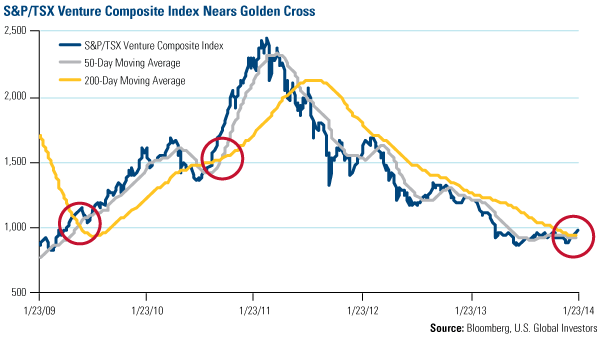
The Canadian venture index holds 372 micro-capitalization securities that trade on the S&P/TSX exchange. It’s a resources-heavy index, with more than 80 percent of the holdings in the energy and materials sector. Making up the top 10 by weight are energy companies including Africa Oil, Mart Resources, Americas PetroGas and Madalena Energy.
Materials stocks such as Atico Mining, Balmoral Resources, Chesapeake Gold, Energold Drilling, Gold Standard Ventures, Rye Patch Gold, and Santacruz Silver Mining are also constituents.
These stocks will be familiar to the shareholders of the World Precious Minerals Fund (UNWPX), as they are representative of the fund’s holdings. Historically, we’ve found that these junior mining companies outperformed their larger counterparts.
As resource investors, we’re particularly encouraged by this “golden cross,” but what makes us even more optimistic is further data supporting the cyclical areas of the market.
….continue reading & viewing the further data in this extensive and thorough analysis HERE

In short: Opening a speculative short position (half of the regular position) in gold, silver and mining stocks might be a good idea right now.
Yesterday, gold rallied significantly, mining stocks rallied less significantly (didn’t close higher than on Tuesday) and silver moved higher very insignificantly. Let’s see how much changed (charts courtesy of http://stockcharts.com).
HERE or on Chart for Larger Image

From the long-term perspective, not much changed. The move that we saw on Thursday was significant on a daily basis (as you can see on the chart below), but from the long-term perspective, it didn’t cause significant changes. In fact, there were barely any changes to speak of. Yes, gold closed above the rising long-term support line, but the move above it was so insignificant from this perspective, that it’s not even clear if it really happened. Obviously, we would need to see gold close above this line for at least 2 more trading days, but taking into account the significance of the resistance line discussed, we might need to see something more before we view the breakout as confirmed.
Please note that there is another major resistance quite close to where gold is now. We would still need to see the 38.2% Fibonacci retracement level being taken out (a confirmed breakout) before we can really discuss a change in the medium-term trend, which still remains down.
HERE or on Chart for Larger Image

On the above chart, we have a bullish sign – a move above the previous January high that happened on significant volume. Such action is quite likely to be followed by another daily upswing (it doesn’t have to be significant). However, this seems to be the end of positive news.
The move didn’t take gold above the declining medium-term resistance line (black line) and neither did it result in a breakout above the declining short-term resistance line (red, dashed line).
Combining the implications from the two above paragraphs, we get a picture in which gold would be likely to rally on Friday or on one of the following days, but this rally would take gold only to the declining medium-term resistance line (approximately to $1,275) and after that the yellow metal would be likely to decline once again.

Taking the Dow to gold ratio into account, we see a post-breakout correction. It’s worth noting that the correction has begun sort of “by itself” – without reaching any significant resistance line. This makes it more likely that the move is just a correction and not a real decline in the ratio (meaning a rally in gold).
Moving on to the silver chart, we see something much less bullish.
HERE or on Chart for Larger Image

Silver moved significantly lower earlier this week and the situation didn’t really improve yesterday. Silver moved only slightly higher and it is still down $0.31 for the week. The trend clearly remains down as there was no breakout above both rising long-term support/resistance lines.
Meanwhile, gold stocks moved higher, but not that significantly.
HERE or on Chart for Larger Image

Gold miners moved higher recently, but not to the extent that would suggest the medium-term trend is already up. Yes, we saw a very small (!) move above the declining resistance line, but just as it was the case with gold, we would need to see a confirmation of this move.
This is particularly the case because we saw something similar right before the final part of the plunge in 2008. History repeats itself to some degree and the current decline is in our opinion most similar to the only other major decline that we saw since the beginning of this bull market. Back then there was one major correction within the decline (we saw one in mid-2013) and then one small one. We have a small breakout right now.
So, how bullish is it, really? „Mildly“ is our best answer at this time.
What about silver stocks?
HERE or on Chart for Larger Image

Silver stocks remain in a downtrend.
They corrected to the first of the classic Fibonacci retracement levels, the 38.2% retracement, and declined afterwards (there was an intra-day breakout on Thursday, but the move didn’t hold and silver miners closed below the retracement). This means that the trend remains down and all that what we saw was a correction.
The declining resistance lines (for silver stocks, and for their ratio to silver, which you can see in the lower part of the chart) were not broken and the trend remains down also from this perspective.
There is no doubt that a significant, counter-trend daily slide in the USD index was one of the factors contributing to higher precious metals prices on Thursday.

The USD Index but declined right to the horizontal support level created by the June 2013 low. The medium- and long-term trends are up, so it’s quite likely that the big surprises will be to the upside – please note that overall it’s been the case since late October 2013. Will the USD Index rally immediately? At this time the situation is unclear, but things may change quite soon.
On a side note, you may wonder how it is possible for the US dollar to be in a long-term uptrend since there is an open-ended QE in place (and the taperie was very small). The reason is that the USD Index is a weighted average of currency exchange rates, and each rate compares USD to another fiat currency. If these other currencies decline faster than the US Dollar (remember the massive money-printing program by the Bank of Japan?), then the USD Index will rally.
The last, but definitely not the least important chart for today might seem a bit complicated at first, but please take some time to examine it.

The above chart features the Dow Jones Transportation Average and its values relative to the Dow Jones Industrial Average.
The ratio has moved sharply higher recently, which means that while the DJIA didn’t move much higher, the DJTA did. At this point, you may be asking yourself, why should you – a precious metals investor – bother with such ratio. The answer is: because you are probably interested in estimating when a local top in gold, silver and mining stocks is forming, and a sharp rally in the presented ratio has signaled 6 out of 6 times a top materialized since mid-2011.
Of course, 6 cases don’t prove anything, but it seems that there is a quite significant tendency and we should not ignore it. Naturally, not all moves higher in the DJTA to DJIA ratio will have this effect – the above chart suggests that only the most significant moves are that meaningful. Smaller rallies don’t have the same effect (or at least it’s not that strong).
In the middle of the chart you can see the ratio (green line) and the Rate of Change indicator plotted on it – when this indicator is high, the rally is sharp, which is exactly why we used it.
Summing up, taking all of the above into account, based on Thursday’s closing prices we got the same final result we got after analyzing two first charts dedicated to gold. The very short term (the next few days) was still rather unclear with a bullish bias, but the medium term seemed to be still down. However, since gold moved very close to the declining resistance line today and miners declined heavily, it seems that opening small speculative short positions in the sector is justified from the risk/reward perspective.
To summarize:
Trading capital: Short position (half) in gold, silver and mining stocks
Long-term capital: No positions.
As always, we’ll keep our subscribers updated should our views on the market change. We will continue to send them our Gold & Silver Trading Alerts on each trading day and we will send additional ones whenever appropriate. If you’d like to receive them, pleasesubscribe today.
Thank you.
Sincerely,
Przemyslaw Radomski, CFA
Founder, Editor-in-chief
Tools for Effective Gold & Silver Investments – SunshineProfits.com
Tools für Effektives Gold- und Silber-Investment – SunshineProfits.DE
* * * * *
Disclaimer
All essays, research and information found above represent analyses and opinions of Przemyslaw Radomski, CFA and Sunshine Profits’ associates only. As such, it may prove wrong and be a subject to change without notice. Opinions and analyses were based on data available to authors of respective essays at the time of writing. Although the information provided above is based on careful research and sources that are believed to be accurate, Przemyslaw Radomski, CFA and his associates do not guarantee the accuracy or thoroughness of the data or information reported. The opinions published above are neither an offer nor a recommendation to purchase or sell any securities. Mr. Radomski is not a Registered Securities Advisor. By reading Przemyslaw Radomski’s, CFA reports you fully agree that he will not be held responsible or liable for any decisions you make regarding any information provided in these reports. Investing, trading and speculation in any financial markets may involve high risk of loss. Przemyslaw Radomski, CFA, Sunshine Profits’ employees and affiliates as well as members of their families may have a short or long position in any securities, including those mentioned in any of the reports or essays, and may make additional purchases and/or sales of those securities without notice.

 Canada’s main stock index recorded its biggest single-day drop in seven months on Friday and investors should not be surprised. Here is a news flash; nothing goes up in a straight line. With the S&P TSX and S&P 500 running largely unabated for 6 and 15 months respectively, a 2% daily drop, although it gets your attention, it should not send shockwaves around the world.
The reasons today were fear over growth in China, expectations that the U.S. Federal Reserve will scale back its stimulus program next week, and other financial and currency concerns in emerging-market assets. Mix them all together and you have a dent in what has been overly positive investor sentiment.
The fears about how developing markets will handle the Fed rollback, combined with soft economic data from China, pushed down the prices of some commodities, including oil and copper. In turn, the resource-sensitive Toronto Stock Exchange benchmark index fell for a second straight session and ended the week 1.2% lower. The index also hit its weakest level in a week.
Of course, ahead of Friday’s selloff, the TSX had been gaining steadily since the start of the year and hit a 2-1/2-year high on Thursday. Perhaps more importantly, broader valuations should not be considered cheap and in order for a rally to continue, growth would have to exceed expectations which may be difficult in the near term.
So what should the average investor do – run and hit the sell button? In a couple of the stocks you own, this may be a prudent option but it should be based on the individual outlook and valuations of that individual stock not a potential currency crisis in an emerging market or a 2% broader drop in a given day. That type of thought process will kill your investment returns overtime.
Timing the broader market is a fool’s game. It is time in the market with good, undervalued growth stocks that will help you succeed long term. There will be correction – mini and major overtime. Expect them but take a deep breath and do not react to them or the potential of them in the moment. Stick to your plan and buy great stocks when they are on sale and hold or sell them when they achieve rich valuations over a 1-10 year period.
Small-Caps – The Next Big One
Every investor dreams of finding the next big one.
Take well known investor favourite Starbucks (NASDAQ:SBUX) for example. Since the company’s initial public offering in 1992, the stock has delivered a 25% compounded annual return for its shareholders. A $10,000 investment that year would be worth $1.08 million today.
But you didn’t have to get in on the ground floor to earn a good return. Even investors that were late to the party have profited handsomely. The secret to earning up to two…5…even 10 times your original investment is to identify great businesses trading at low valuations, with solid long-term growth prospects and great management teams.
Of course with a market capitalization north of CDN$60 billion, Starbucks’ big gainer years are likely behind it – the cat is out of the bag on this company. But there are other companies right here in Canada that could potentially generate excellent returns for your portfolio both in 2014 and beyond.
So which stocks make our Small-Cap Research list? Make 2014 the year you start begin to employ our simple strategy of buying quality unknown cash rich stock in your portfolio.
|
KeyStone’s Latest Reports Section |
Special VIP Small-Cap Membership Offer – 1 Year Platinum Level 3 Research Service
Level III : Platinum Membership Includes:
- Monthly 8-16 page publication summarizing all new buy reports, company updates with current ratings, our latest market commentary, and educational inserts
- New buy reports
- Flash update reports
- Market commentary with quick top buys
- Archived research history (annual membership)
- Current “Focus BUY” List > Top Quarterly Small Caps
- Access to our highly popular “Analyst Hosted Weekly Chat Sessions”
- Updated “Recent SELL” List
One Year Platinum Level III Membership Offer
Regular Price: $799
You Save: $300
Your Price: $499 (plus applicable taxes)
SPECIAL RATE CODE: SCR4
To Subscribe, you can visit our website: www.keystocks.com, click the subscription link (located on the right hand side of the web page) and choose the Level III Buy Annual Subscription – $799.00/year. Once you have confirmed your information, on the next page there will be a box where you can apply rate code: SCR4 and click submit. The price will adjust accordingly and then you may click proceed, located at the bottom of the webpage.
Disclaimer | ©2014 KeyStone Financial Publishing Corp.
Regards,
Jenny McConnell,
Administrative Assistant/Office Manager

-
I know Mike is a very solid investor and respect his opinions very much. So if he says pay attention to this or that - I will.
~ Dale G.
-
I've started managing my own investments so view Michael's site as a one-stop shop from which to get information and perspectives.
~ Dave E.
-
Michael offers easy reading, honest, common sense information that anyone can use in a practical manner.
~ der_al.
-
A sane voice in a scrambled investment world.
~ Ed R.
Inside Edge Pro Contributors

Greg Weldon

Josef Schachter

Tyler Bollhorn

Ryan Irvine

Paul Beattie

Martin Straith

Patrick Ceresna

Mark Leibovit

James Thorne

Victor Adair