
Personal Finance

Mortgage Terms – Fixed Vs. Variable – Consider penalty implications.
This would be a simpler topic if we were unemotional beings. Spock would select variable rate every time.
Personally I have found that my life is Variable, therefore so is my mortgage product.
Definitions;
Fixed rate mortgage – just like it sounds; your interest rate is fixed for the length of the term chosen. This is perceived as ‘safe’.
Variable rate mortgage – also much like it sounds; the interest rate is predicated on the Bank of Canada’s Prime lending rate and has the potential to go three directions at any one of the eight BoC meetings per year; either up, down, or remaining constant. The component of a variable rate mortgage that is guaranteed is the premium or discount from Prime that is established at the outset of the mortgage term.
Let’s confirm a few facts about the variable rate product before we go any further;
- The interest rate cannot ‘spike randomly’. In fact there are eight pre-scheduled Bank of Canada meetings at which the decision is made whether to move the Prime lending rate or not.
- The interest rate will not ‘double overnight’. In fact the interest rate is unlikely to move by more than .25% following any given meeting. The Bank of Canada has not moved prime since September of 2010 as of this printing.
- The payment will not ‘double overnight’. Certain lenders offer a ‘fixed payment’ option – whereby no matter where Prime moves your payment remains constant for the 60 month term. (this can be an especially effective product for an investment property, or in the case of the client holding a second property which they’re trying to sell.)
Statistically, for the past 40 yrs of history (see 20yrs here) the variable rate mortgage has been the correct choice for reduced interest expense. At any point when one locked into a 5yr fixed mortgage rate they effectively entered into a losing proposition.
Over the past few years many clients walked into my office adamant that they wanted a 5 yr fixed rate mortgage and nothing else. I understand this mind-set, after all I did the same thing with my first mortgage. I made the mistake of listening to my Parents, who had made the mistake of listening the bank, without understanding the banks motives were shareholder profit driven, not looking out for my Mom & Dad’s kid driven.
Prepayment Penalties.
Easily overlooked in the heat and excitement of a first time purchase is the question of prepayment penalties.
6 out of 10 Canadians will break their current mortgage at an average of 38 months.
In the case of a 5yr fixed rate product a prepayment penalty equivalent to ~3% of the mortgage balance will be triggered. ~$3,000.00 per $100,000.00 of mortgage money.
It would be incorrect to suggest that any of these mortgages are broken due to the availability of lower rates as lenders structure prepayment penalties to negate any savings from a simple refinance to a new lower rate. Rather, mortgages are broken for a number of other reasons including marriage, divorce, employment or health issues or the desire to leverage capital from the property.
A variable rate mortgage, with its guaranteed prepayment penalty of three months interest (only), is a wiser choice for many. Currently this equates to ~.70% of the mortgage balance, or a prepayment penalty of ~$700.00 per $100,000 of mortgage balance.
The short version is that clients currently in five-year fixed rate mortgages with 30-24 months left in their term are being hit with a prepayment penalty five times higher than clients in variable rate mortgages. This after paying a higher interest rate all the way along as well.
Moving forward if interest rates remain constant, as many (including myself) expect them to, these penalty figures will also remain constant.
A few reasons mortgages are broken;
- Marriage (keeping both properties is not always an option)
- Divorce (in many cases neither spouse is able to carry the property on their own)
- The appearance of more children than expected in your household (congrats – triplets)
- Employment issues, both positive and negative – i.e. transfers, promotions or layoffs.
- Health issues
- A variety of social issues
- The desire to leverage capital from the property – again for a variety of reasons;
- To start a business
- To fund an existing business
- To pay out high-interest consumer debt
- To cover the failure of the business – without being forced to sell the home
- To raise capital to help a family member purchase real estate or otherwise
- **an important note for workers who have the potential to be transferred to different parts of the province or country, be sure your mortgage is placed with a National lender. Otherwise you may be forced to pay a stiff penalty to a local lender if you are transferred out of province. RCMP in particular have to be concerned about lenders that are willing to write mortgages in rural Canada.
As you can imagine this list goes on. All of these things and more are what we call ‘Life’ and at some point some of this touches all of us, both the good and the bad.
For many of my clients at least one of these items may have been on the horizon at the time we were discussing their mortgage, and so either a shorter term fixed rate product – or even a variable rate product ( due to its guaranteed lower penalty ) has made better sense than a five-year fixed.
At this point I will reiterate a thought that I put out there regularly;
Ask your banker or your broker what they have done with their own personal mortgage(s) and why.
In the interests of full disclosure it should be pointed out that brokers and bankers alike are compensated more generously for clients who lock in for longer terms at higher rates.
If I were to make an argument in favor of my client locking into the 10 year fixed rather than a two year fixed my paycheck triples. However I cannot make that argument as I personally do not believe in it at this time. Instead I prefer to take the time to run the calculations and demonstrate to clients the tremendous advantage of making 10yr sized payments on a variable or even a 2yr fixed term mortgage (1 and 2 yr fixed are like ‘slow motion’ variables). The extra dollars flow directly to the principal, lowering their mortgage balance faster.
Most people’s lives change a fair bit every three years, I know that mine has… since birth.

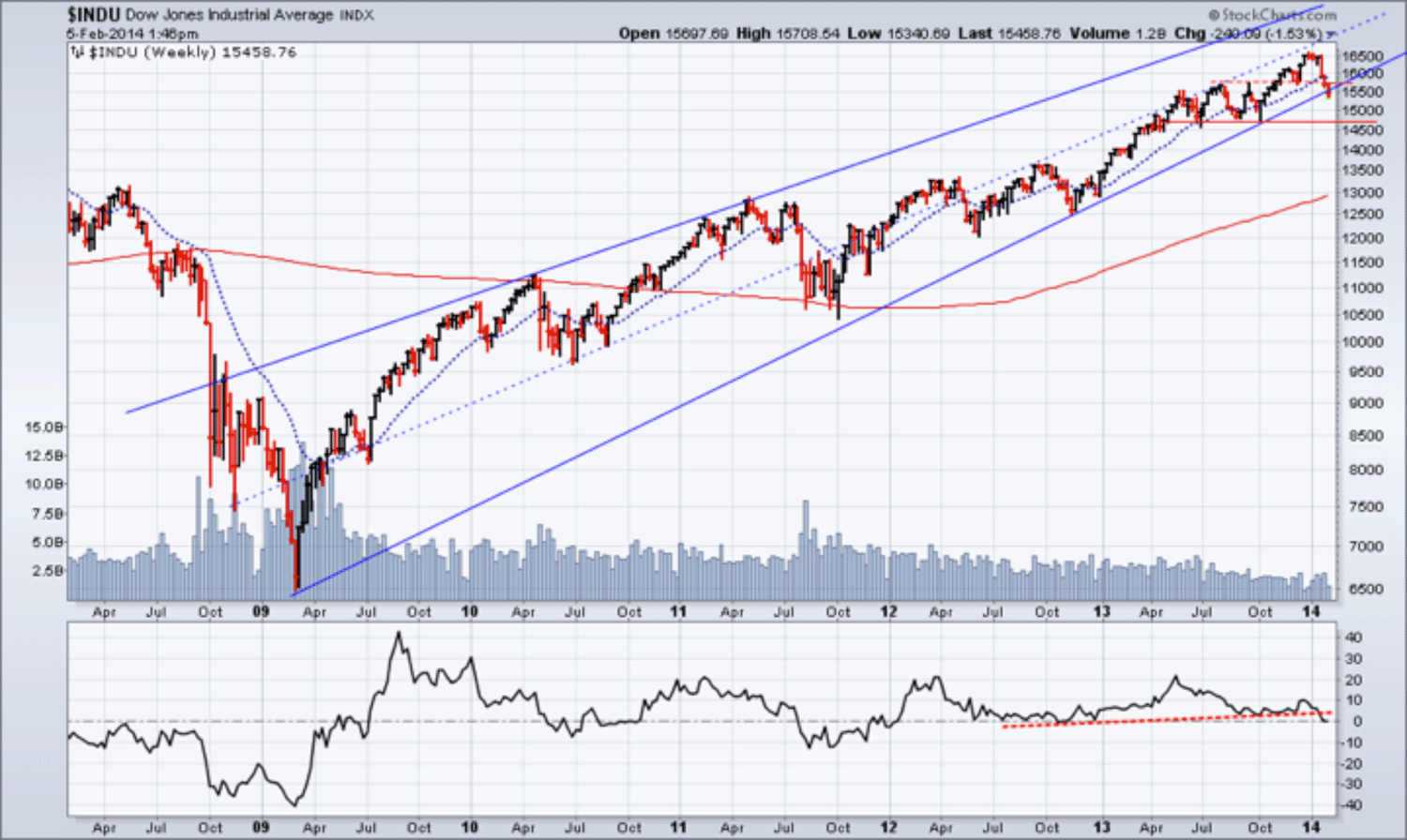
Our Blog started to recommend short positions on select stock market sectors starting on Jan 16 through Jan 23, because we believed that a shift was taking place that would reverse existing trends that have been in place since 2011, and possibly even 2009. Our premise finally starts being acknowledged by a few at the beginning of February, although a lot of analysts are still suggesting the bull market will continue after a required period of correction. We beg to differ and we will use the three popular Dow charts – Industrials, Transports and Utilities – to demonstrate our thoughts on this matter.
First, the Dow Jones Industrials in the weekly chart below has developed a large bearish wedge pattern (as have most other market indexes) beginning back in 2009 from where this cyclical bull market began. You will note that the trendline from that 2009 bottom has been broken during the recent decline, as well as a minor horizontal support level at 15,800, that now becomes resistance. More importantly, the underlying momentum in the second panel of the chart failed to confirm the Dec 2013 new high, and it formed a head and shoulders top pattern that has now broken below the red dotted signal neckline. This implies that the Dow Industrials will move down to the next support neckline on the price chart, which currently sits around the 14,700 level. After that, I would expect at least 3~4 months of consolidation as we develop a right shoulder of what looks like will be another head and shoulders pattern that takes us even lower.
(Click on images to enlarge)
….two more charts & commentary HERE
Payrolls in the U.S. rose less than projected in January as retailers cut back after the holidays and government hiring fell. The unemployment rateunexpectedly declined to 6.6 percent.
The 113,000 gain in employment followed a revised 75,000 increase the prior month, Labor Department figures showed today in Washington. The median forecast of economists in a Bloomberg survey called for a 180,000 advance. The unemployment ratedropped to the lowest level since October 2008 even as more Americans entered the labor force.
Retailers and government agencies cut payrolls by the most in more than a year, while construction firms and manufacturers boosted employment. Broad-based improvement in job growth is needed to help generate bigger wage gains and spur the consumer spending that accounts for almost 70 percent of the economy.
“It’s another disappointment, but it’s not anything disastrous,” said Julia Coronado, New York-based chief economist for North America at BNP Paribas and a former Federal Reserve economist, who accurately forecast the jobless rate. “We’re still in muddle-along territory rather than take-off mode. There isn’t the kind of momentum in hiring.”
Stock-index futures rose as investors weighed the report. The contract on the Standard & Poor’s 500 Index expiring next month climbed 0.6 percent to 1,777.3 at 8:57 a.m. in New York.
Today’s report showed 262,000 Americans were not at work because of inclement weather in January, little changed from the same month last year, suggesting conditions played a more limited role than in December. In the Jan. 10 release of the prior month’s data, the Labor Department had said poor weather kept 273,000 people from work, the most for any December since 1977.

In the past years, the Federal Reserve dropped many inflationary bombs on the markets. Inflationary in the purely monetary sense by supplying money in almost ridiculous amounts, especially base money figures. During this process some commentators believed that the dollar would soon evaporate, that investors will run away in favor of the euro (like the EBC had not been printing euros for their banks), or maybe in favor of the yen (like the Japanese central bank was not that inflationary), or who knows maybe even the yuan. The dollar was supposed to be either dropped by international investors, or killed from within by internal inflationary rates (or possible by those two factors combined together). None of this happened. How are we to explain this if the Fed went almost crazy in monetary creation?
Has Fed printed all this money or not?

As the above chart suggests, a lot of “something” was created in the past years and this trend accelerated in 2008.
This nice looking green hockey stick is about base money. Base money is the money, which builds the monetary economy, but it does not complete it to its full extent. Many transactions in the economy are not conditioned by movements of this monetary aggregate. Base money consists of actual paper notes and coins, and money stored at the central bank (which actually could be changed into paper notes, since the central bank itself produces those two things). It sometimes can be called as “outside money”, meaning that it is money outside of the banking system – it is “exogenously” supplied from outside of the financial markets, and not generated by banking decisions. It is produced by political, or quasi-political means, through the tools of the central banks. This perfectly explains why so much of it could be created within the time span of five years. On a side note, the gold supply cannot be expanded at this pace (a bad feature of gold for past rulers and sufficient rationale for them to demonetize it).
We’ve already seen this green hockey stick so many times in so many places; but despite some Armageddon predictions the end of the dollar seems far away. Why is the dollar thriving if in five years there is four times more of it? Why are inflation rates not four times higher than they were at times before the crises? If the money supply is being printed at such a pace, surely it should boost the prices, shouldn’t it?
That is the usual monetarist story. Unfortunately, or maybe gladly, we should say it is not true; or more precisely not true in this case. The important fact about money printing, which has to be remembered in any analysis, is that it all depends upon how the “printing” is done, and where the money goes. As the old saying goes, follow the money, and it should lead to you answers you are searching for.
Paper notes and coins are being spent in the market for sure. Money placed at the central bank belongs to commercial banks and is not directly spent as paper notes are (sorry – individuals are not allowed to have accounts at the central bank, even on the Internet; it is a special right exclusively reserved for commercial banks). Nevertheless any bank is happy to have such money in its account at the national central bank. The graph above depicts precisely this type of adjustment that happened due to the Fed’s actions. Electronic money was “magically” produced and transmitted into the commercial banks. As you may reasonably expect, they were more than happy to accept this precious gift from the Fed. Especially in the light of the fact that “collateral” for this fresh money could be made out of junk paper related to a dying real estate market.
The point is that if one wants to be detailed, it is at least misleading to describe monetary creation as money printing. It sounds really nice, dramatic and appealing, one has to admit. Yet the truth is that this money is created not with ink and paper, but by pressing the button and producing computer zeroes in electronic books and accounts. Here is where the trick begins and here is why this tremendous electronic printing did not cause either an inflationary spike, or a run away from the dollar.
The banks are glad to accept any pile of money. Either from the government (fiscal policy), or from the central bank (by monetary policy), or also by more voluntary means, by accepting deposits, or additional equity from the investors. Yet whenever they receive this money, the profit for them is not really to just spend the money. The profit for them comes from possibility of lending this money at interest, and this is not something they absolutely have to do.
Consequently, base money creation does not necessarily have to translate into a quick plunge in the value of the US dollar, or to have massive inflationary implications. In this way, money can be created, but without immediate consequences that one would expect. In other words, in this way, the money “printing” can exist and be absent at the same time.
Thank you.
Matt Machaj, PhD
Sunshine Profits‘ Market Overview Editor
Gold Market Overview at SunshineProfits.com
* * * * *
Disclaimer
All essays, research and information found above represent analyses and opinions of Matt Machaj, PhD and Sunshine Profits’ associates only. As such, it may prove wrong and be a subject to change without notice. Opinions and analyses were based on data available to authors of respective essays at the time of writing. Although the information provided above is based on careful research and sources that are believed to be accurate, Matt Machaj, PhD and his associates do not guarantee the accuracy or thoroughness of the data or information reported. The opinions published above are neither an offer nor a recommendation to purchase or sell any securities. Matt Machaj, PhD is not a Registered Securities Advisor. By reading Matt Machaj’s, PhD reports you fully agree that he will not be held responsible or liable for any decisions you make regarding any information provided in these reports. Investing, trading and speculation in any financial markets may involve high risk of loss. Matt Machaj, PhD, Sunshine Profits’ employees and affiliates as well as members of their families may have a short or long position in any securities, including those mentioned in any of the reports or essays, and may make additional purchases an


-
I know Mike is a very solid investor and respect his opinions very much. So if he says pay attention to this or that - I will.
~ Dale G.
-
I've started managing my own investments so view Michael's site as a one-stop shop from which to get information and perspectives.
~ Dave E.
-
Michael offers easy reading, honest, common sense information that anyone can use in a practical manner.
~ der_al.
-
A sane voice in a scrambled investment world.
~ Ed R.
Inside Edge Pro Contributors

Greg Weldon

Josef Schachter

Tyler Bollhorn

Ryan Irvine

Paul Beattie

Martin Straith

Patrick Ceresna

Mark Leibovit

James Thorne

Victor Adair