Bonds & Interest Rates

Update: Still bullish on bonds (low yields) thanks to the Feds lack of clothes

BlackSwan“But money is not neutral in the present monetary regime. It is obvious that monetary policy has had very significant effects on the allocation of productive resources in the long run-up to the crisis. It is perhaps less obvious that it has also affected the distribution of income. But I believe it has.”


                   Axel Leijonhufvud, Professor UCLA and University of Toronto

Jack Crooks

Black Swan Capital

Major Markets Coppock Curve Charts Analysis

Ed Note: Click on each title for the video analysis

Gold $1278 Breakout in Play Charts Analysis


Gold Stock Bull Flag Charts Analysis


Silver Stocks Lead Silver Bullion Charts Analysis


Thanks,

Morris


Unique Introduction For Web Readers: Send me an email toalerts@superforcesignals.com and I’ll send you my special video “Precious Metals Stocks Versus Precious Metals Bullion”. I’ll also send you 3 of my next Super Force Surge Signals free of charge, as I send them to paid        

subscribers. Thank you!

The Super Force Proprietary SURGE index SIGNALS:

25 Super Force Buy or 25 Super Force Sell: Solid Power.

50 Super Force Buy or 50 Super Force Sell: Stronger Power.

75 Super Force Buy or 75 Super Force Sell: Maximum Power.

100 Super Force Buy or 100 Super Force

Sell: “Over the Top” Power.

Stay alert for our Super Force alerts, sent by email to subscribers, for both the daily charts on Super Force Signals at www.superforcesignals.com and for the 60 minute charts at www.superforce60.com  

About Super Force Signals:

Our Super Force signals are created thru our proprietary blend of the highest quality technical analysis and many years of successful business building. We are two business owners with excellent synergy. We understand risk and reward.   Our subscribers are generally successful business owners, people like yourself with speculative funds, looking for serious management of your risk and reward in the market.

Frank Johnson: Executive Editor, Macro Risk Manager.

Morris Hubbartt: Chief Market Analyst, Trading Risk Specialist.

Email:

trading@superforcesignals.com

trading@superforce60.com

Mail:

SFS Web Services

1170 Bay Street, Suite #143

Toronto, Ontario, M5S 2B4

Canada

A House Built On Sand

As a general rule, the most successful man in life is the man who has the best information

Warning, I’m not a licensed financial planner, a broker, an analyst, a geologist nor an economist. And I’m also not, as you so often tell me in your e-mails regarding my articles, an English professor. I’m also not a doom and gloomer nor am I a gold bug.

I’m just an investor who believes precious metals are the only financial safety net worth owning and need to be the cornerstone of any generational wealth building program.

Everyone should own gold and silver bullion in the form of coins and bars.

The Incas believed gold was the “Sweat of the Sun” and silver was “Tears of the Moon.”

Sweat of the Sun

Early Greeks thought gold was a combination of water and sunlight.

In ancient Egypt, gold was considered the skin or flesh of gods, in particular the Egyptian sun god Ra. Gold was unavailable to anyone but the pharaohs. The Egyptian word for gold was “nub,” taken from gold-rich Nubia – shown on the Turin Papyrus as a major gold producer in antiquity.

The first true coins in Western civilization were issued, about 640 B.C., by King Ardys of Sardis. They were small round lumps comprised of electrum (a naturally occurring amalgam of silver & gold) – they were not of any standard weight & purity of metal or size.

The Greeks would not accept the electrum coins in trade so the coins were outlawed by King Croesus (560-546 B.C.) and gold or silver coins were issued. When the Lydians were captured by the Persians in 546 B.C., the use of gold coins began to spread.

“Gold, measured out, became money. Gold’s beauty, scarcity, unique density and the ease by which it could be melted, formed, and measured made it a natural trading medium. Gold gave rise to the concept of money itself: portable, private, and permanent. Gold (and silver) in standardized coins came to replace barter arrangements, and made trade in the Classic period much easier…

A monetary standard made the world economy possible. The concept of money, (i.e., gold and silver in standard weight and fineness coins) allowed the World’s economies to expand and prosper.

Money had been invented. Its name was gold.” ~ A brief History of Gold, onlygold.com

There are more than 400 references to gold in the Bible, including specific instructions from God to cover furniture in the tabernacle with “pure gold.”

“By the late 13th century it was the city state of Venice that controlled trade throughout the Mediterranean. And the Venetians knew that if they wanted to consolidate and further increase their power and influence that they needed a coin that would be accepted by all nations. For such a coin would allow trade to flow freely and easily and greatly facilitate payment for goods.

Many references list Giovanni Dandolo as the originator of the Venetian ducat in 1284. But it was actually in 1274 when the Doge of Venice, Lorenzo Tiepolo, began minting a gold coin with the image of the Doge kneeling before St. Mark on the obverse and the figure of Christ on the reverse – and thus the gold ducat was born. It was a coin weighing 3.5 grams and struck in .986 gold. These specifications for the ducat would remain the same for the next 700 plus years. It continues to be struck even today. Not since the Roman Empire, had a coin of gold been struck that would capture the trust of all nations and be as enduring as the ducat.

The popularity of this coin quickly spread throughout Europe and even beyond to most areas of the Middle East and including India, Egypt and Africa. For here, at last, was a coin that allowed any nation of the world to trade with another and have a uniform method of payment. In all cases, the specifications of the coin were the same – 3.5 grams of .986 gold. In later years, the ducat was also struck in fractions and multiples – from as small as 1/32 ducat to as large as the extremely rare 100 ducats…

Today, the US dollar is the currency that is accepted worldwide; and before the dollar it was the British pound. But the gold ducat stands out above all other coins as having achieved acceptability over the known world based on its reputation and specifications. For centuries the ducat held the position of being the world’s currency. No other coin can make that claim.” ~ The Ducat, Doug Prather winsociety.org

The world’s first hallmarking system, scrutinizing and guaranteeing the quality of precious metal, was established in 1300 at Goldsmith’s Hall in London – where London’s Assay Office is still located today.

In 1422 the Venice Mint struck a record 1.2 million gold ducats using 4.26 tonnes of gold from Africa and Central Asia.

Gold was one of the gifts of the Magi and almost all of the gold that has ever been mined still exists.

Sixty-five percent of all gold in circulation has been extracted since 1950. Seventy-five percent of all gold in circulation has been extracted since 1910. Over 90 percent of the world’s gold has been mined since the California Gold Rush.

The annual worldwide production of gold is approximately 2,810 metric tons or 90 million troy ounces per year – the world pours more steel in an hour than it has poured gold since the beginning of recorded history.

U.S. Dollar Better Then Gold

In July 1944, delegates from 44 nations met at Bretton Woods, New Hampshire – the United Nations Monetary and Financial Conference – and agreed to “peg” their currencies to the U.S. dollar, the only currency strong enough to meet the rising demands for international currency transactions.

Member nations were required to establish a parity of their national currencies in terms of the US dollar, the “peg”, and to maintain exchange rates within plus or minus one percent of parity, the “band.”

What made the dollar so attractive to use as an international currency was each US dollar was based on 1/35th of an ounce of gold, and the gold was to held in the US Treasury. The value of gold being fixed by law at 35 US dollars an ounce made the value of each dollar very stable.

The US dollar, at the time, was considered better then gold for many reasons:


  • The strength of the U.S. economy
  • The fixed relationship of the dollar to gold at $35 an ounce
  • The commitment of the U.S. government to convert dollars into gold at that price
  • The dollar earned interest  
  • The dollar was more flexible than gold


There’s a lesson not learned that reverberates throughout monetary history; when government, any government, comes under financial pressure they cannot resist printing money and debasing their currency to pay for debts.

Lets fast forward a few decades…

The Vietnam War was going to cost the US $500 Billion. The stark reality was the US simply could not print enough money to cover its war costs, it’s gold reserve had only $30 billion, most of its reserve was already backing existing US dollars, and the government refused to raise taxes.

In the 1960s President Lyndon B. Johnson’s administration declared war on poverty and put in place its Great Society programs:


  • Head Start
  • Job Corps
  • Food stamps
  • Medicaid
  • Funded education
  • Job training 
  • Direct food assistance
  • Direct medical assistance


More than four million new recipients signed up for welfare.

During the Nixon administration welfare programs underwent major expansions. States were required to provide food stamps. Supplemental Security Income (SSI) consolidated aid for aged, blind, and disabled persons. The Earned Income Credit provided the working poor with direct cash assistance in the form of tax credits and welfare rolls kept growing

“The problem with Socialism is that eventually you run out of other people’s money.”Margaret Thatcher

Bretton Woods collapsed in 1971 when Nixon severed (known as the Nixon Shock because the decision was made without consulting the other signatories of Bretton Woods, even his own State Department wasn’t consulted or forewarned) the link between the dollar and gold – the US dollar was now a fully floating fiat currency and the government had no problem printing more money.

Tears of the Moon

In the time of the ancient Babylonians – long before the periodic table – there were seven sacred metals: gold, silver, copper, iron, tin, lead and mercury.

In Roman and Greek Mythology, the First Age was called Golden, the Second Age Silver. Apollo, the god of truth and light, and teacher of medicine, carried a silver bow.

The hieroglyph of Isis (Egyptian moon goddess) is a crescent and images of her are usually reproduced with her standing on the Crescent. This has also become the symbol for silver – on old maps a crescent shows the location of a silver mine.

Islamic alchemy gave silver an important place, alchemical procedures were defined in terms of silver – the silvering of other metals, the act of giving other metals silver like qualities.

We’ve long practiced the science (metallurgy) of separating silver from lead – the earliest known workings of any significant size were those of the pre-Hittites of Cappadocia in eastern Anatolia, the first sophisticated processing of lead-silver ore was attributed to the Chaldeans around 2500 B.C.

Silver metal was recognized as more precious than gold when bartering in ancient Egypt – this recorded as early as 930 BC. Silver’s use as money in coin form began around 2600 years ago. The Lydian (present day Turkey) Trite is considered by many experts to be one of the first coins used as money. It was made of “Electrum”, a silver and gold mixture. Egyptian silver in coin form began appearing around 300BC.

Crime of ’73

In 1873, the Fourth Coinage Act was enacted by the US Congress. Western silver miners labeled this measure the “Crime of ’73” because it stopped the printing of US silver dollars. The US had, unofficially, abandoned its bimetallic standard in favor of a monometallic one – gold.

The supply of silver not being used for coinage increased – European Nations had just gone from a silver to a gold standard, the US was no longer coining silver dollars and these two factors, when coupled with massive new silver discoveries in the American west, caused the price of silver to collapse.

Western miners, seeking the right to turn silver directly into money, mid-western grain and southern cotton farmers (who both had immense debts because of price deflation caused by overproduction) rallied to silver’s cause and the movement became known as Free Silver. The Populist Party had a strong Free Silver element and its merger with the Democratic Party moved Democrats from being in support of a monometallic gold standard to the Free Silver position.

Free Silver supporters were called “Silverites.”

Silverite’s argued that silver should continue to be part of the monetary standard with gold, their slogan was “16 to 1” – sixteen ounces of silver would be equal in value to one ounce of gold, using the ratio established in the Coinage Act of 1834.

Silverites also wanted “free coinage of silver” as authorized under the Coinage Act of 1792. Free coinage meant anyone who possessed uncoined gold could bring it to one of the United States Mints and trade it for its equivalent in gold coins, less a small deduction – Free Silver advocates wanted the mints to accept silver on the same principle. These inflationary measures would have increased the amount of money in circulation and helped debtors pay off their debts, while harming creditors and savers.

Opponents to the Free Silver movement were mostly the financial establishments of the Northeast – the moneylenders, creditors, banks, leaseholders, and landlords – they backed a monometallic gold standard – the expanding economy had constrained the money supply available on a gold only standard, this had made the dollar stronger and decreased prices, opponents of Free Silver wanted to keep it that way.

The Republican Party was against Free Silver, the party’s position being that the best way to national prosperity was “sound money.” Republicans favored a continued strong dollar, which rewarded savers and creditors.

Battle lines were drawn, on one side were the Free Silver proponents – miners, farmers, debtors and Democrats – who wanted a bimetallic standard, the free coinage of silver and inflation. On the other side of the line were the creditors and Republicans who wanted to keep a strong currency using a gold only standard.

Intense pressure caused the U.S. government to agree to the Bland-Allison Act of 1878, this act directed the Treasury to purchase silver at a high price. The Sherman Silver Purchase Act was enacted on July 14, 1890. It didn’t authorize the free and unlimited coinage of silver that the Free Silver supporters wanted, but it did increase, by a large amount, the amount of silver the government was required to purchase every month.

Using a special issue of Treasury Notes that could be redeemed for either silver, or gold, the US government became the second largest silver buyer in the world – after the government of India.

By 1893 the US was in one of the worst depressions in American history and people were turning in the new Treasury Notes for gold and depleting the government’s gold reserves. President Grover Cleveland (R) forced the repeal of both the Bland-Allison and Sherman Silver Purchase Acts.

Conclusion

“Jesus ends the Sermon on the Mount (Matthew 5-7) with a parable everyone should heed. He says a man built his house and considering the good and bad times, the calms and the storms, he built it upon a rock. And when the wind blew, the waters rose and the floods came, it was able to survive the storms for he built on a firm foundation. Jesus then tells of another man who built his house on sand. The winds blew, the rains fell, the floods came and washed away that man’s home.

Aesop passed on a fable from ancient Greece that implied the same thing. He tells of three little piggies who went out to face the world. One built his house with straw, another with sticks and the other with bricks. When the wolves came, they easily destroyed the straw house and the house built with sticks. Children’s faces light up at the end of the fable. The last, wise pig built his house out of brick. The big bad wolf came and “huffed and puffed” trying to blow the house down. The wolf then climbed the roof and came down the chimney, only to find the wiser pig had built a fire under a boiling cauldron and the wolf fell in and the pig ate the wolf instead of the wolf eating the pig.” Bob Cuttino, ‘Weathering the storms of life’

image002The history of fiat money has always been one of failure. Every fiat currency since the Romans started diluting the silver content of their denarius has ended in devaluation and eventual collapse of both the currency and of that particular economy.

Silver and gold have stood the test of time, as a medium of exchange, a storehouse of value and a safe haven in times of turmoil.

For the very first time in our history, all money, all currencies, are now fiat – the US dollar use to be gold backed and it was the rock all the worlds currencies were anchored to – when the US dollar became fiat, all the worlds currencies became fiat.

Thankfully, using history as our guide we know all about the benefits of owning gold. Gold and silver act as the go to safe haven. Gold and silver will preserve our purchasing power throughout whatever wickedness comes our way – they are the rocks upon which our families future generational wealth has to be built on.

Politicians always dilute for war and favor, as a consequence every fiat currency throughout history has failed the test of time. The big bad wolf is never long off the hunt. Are gold and silver on your radar screen?

If not, they should be.

Richard (Rick) Mills

Richard lives with his family on a 160 acre ranch in northern British Columbia. He invests in the resource and biotechnology/pharmaceutical sectors and is the owner of Aheadoftheherd.com. His articles have been published on over 400 websites, including:

WallStreetJournal, USAToday, NationalPost, Lewrockwell, MontrealGazette, VancouverSun, CBSnews, HuffingtonPost, Beforeitsnews, Londonthenews, Wealthwire, CalgaryHerald, Forbes, Dallasnews, SGTreport, Vantagewire, Indiatimes, Ninemsn, Ibtimes, Businessweek, HongKongHerald, Moneytalks, SeekingAlpha, BusinessInsider, Investing.com and the Association of Mining Analysts.

Please visit  www.aheadoftheherd.com

If you are interested in advertising on Richard’s site please contact him for more information,rick@aheadoftheherd.com

 ***

Legal Notice / Disclaimer

This document is not and should not be construed as an offer to sell or the solicitation of an offer to purchase or subscribe for any investment.

Richard Mills has based this document on information obtained from sources he believes to be reliable but which has not been independently verified.

Richard Mills makes no guarantee, representation or warranty and accepts no responsibility or liability as to its accuracy or completeness. Expressions of opinion are those of Richard Mills only and are subject to change without notice. Richard Mills assumes no warranty, liability or guarantee for the current relevance, correctness or completeness of any information provided within this Report and will not be held liable for the consequence of reliance upon any opinion or statement contained herein or any omission.

Furthermore, I, Richard Mills, assume no liability for any direct or indirect loss or damage or, in particular, for lost profit, which you may incur as a result of the use and existence of the information provided within this Report.


Food, Water & Fuel Are Necessary to Life & Investors: Bob Moriarty

Likening central banks to “your crackhead cousin” running loose with your American Express platinum card, Bob Moriarty sees serious economic threats in the future. This leads the owner of 321energy to look at resources like food, water and energy for protection and profit. He tells The Energy Report where energy opportunities exist, and why Chinese demand for everything will set prices in the future.

Screen Shot 2014-02-14 at 8.10.37 AMThe Energy Report: In your Gold Report interviewlast fall, you said that the two biggest reasons for the erosion of the middle class are peoples’ inability to save money due to low interest rates or low wages, and higher taxes, especially the hidden taxes we end up paying.

Bob Moriarty: Yes. I think there are 37 taxes on a loaf of bread. Taxes have increased dramatically over the last 20 years, including what are called the “unclaimed taxes.”

In an article James Gruber wrote on peak oil last month, he made the point that debt is actually a future call on energy. Under the General Agreement on Tariffs and Trade, when you owe money, you’ve already spent the energy. He argues that the economy is an energy system, not a monetary system. He’s absolutely correct, in my view.

The enormous increase in wealth we’ve seen worldwide over the last 150 years has stopped. There will be no more growth. From a mathematical point of view, you cannot increase growth. Energy consumption per capita has to go down, and that means wealth goes down. All the debt we’ve accumulated is a noose around the neck of society.

TER: Gruber also wrote, “Deflation is winning the battle over inflation.” His argument is that excessive debt has to be deleveraged and in that deleveraging process, asset values will plummet. Central banks are doing whatever it takes to create inflation in an environment where deflation is really the underlying tide. What do you have to say about that?

BM: Deflation is actually good for society. As consumers, we know this. Think about what you paid for a computer 20 years ago. Today, computers are much, much cheaper. That’s deflation, and that’s a good thing.

But for central banks working under a fractional reserve system, deflation is a ticking time bomb. They can’t cope with it.

With $694 trillion ($694T) in derivatives outstanding, I’m hard pressed to see how you can have inflation over the long term, because you have to get rid of debt. The only way that will happen is for it to blow sky high. What we’re seeing in Argentina, Egypt, the Ukraine, Venezuela, Thailand and Turkey is all related to the global debt level.

TER: One of Gruber’s scenarios, citing the example of 2008, is global deflationary shock in which all asset prices fall hard. As they begin to fall, the central banks will print even more money. Quantitative easing (QE) on a grander scale will put us at the risk of not inflation, but hyperinflation.

BM: I believe that’s true. Late last month, Fed Chair Janet Yellen announced $10 billion of QE tapering, as promised. Eventually, the risk is that the Fed will decide to increase QE to respond to a deflation scare. When that happens, the system will blow sky high. The Fed painted itself into a corner and can’t get out.

We need to get rid of the debt, of the $694T in derivatives. Every government has to recognize there are limits to how much money it can spend.

All of this goes back to central banks. The Bank of England, the world’s oldest continuously operating central bank, was formed in 1594 as a way for kings to finance their wars. Central banks make it possible for governments to spend unlimited amounts of money. It’s like you giving your Platinum American Express card to your crackhead cousin.

TER: How do investors prepare for the moment when the piper gets paid? How do they plan for hyperinflation, inflation, deflation?

BM: I can make a very convincing argument for deflation and very convincing arguments for inflation or hyperinflation. I’m not sure which will happen.

People should be extremely conservative. Looking at investments as a way to make money is foolish right now. I consider gold, silver, rhodium, platinum and palladium as insurance policies against total financial chaos. I would put money into resources, and I would expand resources to include food, fuel and water. Resources will have some value when other assets have none.

TER: Let’s talk more about your expanded definition of resources: fuel, food and water. How do you define fuel?

BM: Fuel is everything from coal to nuclear energy. I am very bullish on all forms of fuel, except nuclear energy. I am biased against nuclear energy. The industry doesn’t have nuclear power under control. Nuclear disasters like Fukushima have the potential to be extinction events. I would only be in favor of nuclear power if the industry gets safety under control.

Tim Morgan’s book, Life After Growth?, presents a brilliant way of looking at energy and monetary systems in a new way. He makes a very convincing argument that everyone’s standard of living is going to decrease over the next 10 years. He predicts socioeconomic crises for the next 10 years, one after another. There have been half a dozen brushfires in Africa alone—Somalia, Mali, Libya, Kenya. Everybody acts like they’re different brushfires, but they’re all the same thing; they’re all connected.

TER: Your definition of fuel is broad, but the energy sector seems to be focused on oil. Is that the total sum of the sector? And how do you play oil producers versus explorers?

BM: The U.S. is almost at the point where it’s self-sustaining in terms of energy because of the Bakken. But the Bakken field has become an economic disaster. We put $1.6T into exploration, and we’re not going to get $1.6T out of it.

Morgan’s book makes a very good point: In 1914, if it cost you the equivalent of 1 barrel (1 bbl) oil to drill a well, you got 100 bbl out of it. If you drill a well today, it costs you 1 bbl to drill it, and you get 20 bbl oil out of it. In the Bakken, you put 1 bbl oil into it, and you get 5 bbl out of it. That simply will not work from an economic point of view.

Natural gas has doubled in the last year. In the new normal, the oil price is $90–100/bbl. Any form of oil is worth looking at: producers, explorers and refiners.

Solar and wind power also play a role, although I see them as 3% of the solution, at best.

TER: I recently interviewed Porter Stansberry, who expands his energy investment viewpoint to include drilling, liquefied natural gas (LNG) plants, pipelines, infrastructure, even tankers. Is your view that broad?

BM: He’s absolutely correct. There are enormous amounts of natural gas in Indonesia, both in coal bed methane (CBM) and conventional natural gas. But you have to liquefy it before shipping. You need LNG plants, shipping facilities and ports.

TER: What are some opportunities related to food as a resource?

BM: When the food crisis comes, all fertilizers will double, triple or quadruple in real dollar terms. We have to get more food out of the ground in the future, and we need fertilizer to do that.

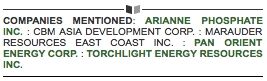
Arianne Phosphate Inc. (DAN:TSX.V; DRRSF:OTCBB; JE9N:FSE) in Canada has the largest, undeveloped phosphate project in the world. Its market cap is 5% of net present value (NPV). In this space, takeovers are generally done at 35–50% of NPV. This is a stock that could go up seven to tenfold, based on today’s prices.

TER: It seems to me that agriculture in North America is maximized in terms of using fertilizers. Are you saying that when the food crisis occurs, even North America will need to use more fertilizer than today?

BM: Everybody will. Besides, phosphate can be moved easily by ship. A lot of land in South America, Russia and Eastern Europe is underutilized for agriculture. I would look very closely at any potash or any phosphate.

TER: Arianne Phosphate has a number of warrants due Feb. 1. Are the warrants affecting the stock price?

BM: I just wrote an article on that. At that time, the stock was $1.26. The warrants are at $1.24. Management was hoping it could get the price up. I added about 1.5 million (1.5M) shares in the last week or 10 days. I suspect the company will get about $5M in cash from the warrants. When those warrants expire, I see the stock going back to its recent highs of $1.68–1.70.

TER: Back to oil and gas and natural gas. Which companies in those sectors interest you?

BM: Marauder Resources East Coast Inc. (MES:TSX.V) is a total crapshoot. It’s on the north island of New Zealand, where it is surrounded by TAG Oil Ltd. (TAO:TSX.V). Marauder is letting TAG carry the burden. TAG has drilled a well, and while the company has been very quiet about the results, they appear to be exceptional. Marauder has a $5M market cap. It will either go to $0 or to $500M. Only time will tell.

TER: What timeframe would you put on that $0 to $500M scenario?

BM: Over the next year or two.

TER: Any others?

BM: There’s a company in Indonesia called CBM Asia Development Corp. (TCF:TSX.V) that I’ve covered many times. The company has outlined 1 trillion cubic feet (1 Tcf) of coal bed methane. Unfortunately, every time the company raised money, its brain-dead president spent 150% of what it took in. Finally, it blew up in his face and he was fired. The last placement was done at $0.18, and then $0.10. Now, it has a $0.04 stock, and it’s all due to really exceptionally poor management. This is an asset that somebody will make a lot of money on. I just don’t think it will be CBM Asia.

TER: Is CBM Asia a takeover target?

BM: I think someone is going to steal CBM Asia. The total market cap is $7M, and the company recently lost a lawsuit that will cost it $1.4M.

TER: Indonesia, New Zealand and Texas also have nice shale deposits. Tell us more about opportunities in those locations.

BM: Torchlight Energy Resources Inc. (TRCH:NASDAQ) has a bunch of projects in Texas. It plans to drill 90 exploitation wells this year. It has a ton of money in the bank and will be cash flow positive in September 2014. This is a $5 stock that could easily go to $10 or $15.

TER: How long can Torchlight exploit its 90 wells?

BM: They’re relatively shallow wells, and they’re long-life wells. Conventional wells range anywhere from 2–100 years. The payoff is probably 20:1.

Shale has about a 40% decline in the first year, so they are 1.5–2-year wells; you have to make your money right away.

Pan Orient Energy Corp. (POE:TSX.V) is a company that has protected itself by being in three totally different environments—Canada, Thailand and Indonesia. It’s all conventional, heavy oil in Thailand and Canada.

TER: If a worldwide recession occurs, I can see North America continuing as a consumer market for oil, but will Thailand and Indonesia continue to consume?

BM: When I went to Papua New Guinea in December 2013, we flew from Port Moresby to Misima Island. From the plane we saw 17 ships. Those going north were carrying coal to China and coming back south empty. Our field of view was probably 50 miles. If you extrapolate that to cover the 2,000–3,000 mile leg from Australia to China, there are probably 200, 300 or 400 coal ships doing nothing but taking coal to China from Australia.

In the U.S., we consume 33 bbl oil per person per year. In China, they use 2 bbl oil per person per year. If we decrease our use to 20–25 bbl per person, it will make a dramatic change in our standard of living. But the Chinese are going to go from 2 to 5 or 10 bbl per person. The Chinese are going to demand energy regardless of their economic situation.

TER: But China is one of the world’s largest coal producers. To what extent is oil part of the energy mix there?

BM: The Chinese are voracious consumers of energy in all forms, including oil. That’s good for New Zealand shale oil and gas. It’s good for CBM and conventional gas from Indonesia. It’s good for coal from Australia and Indonesia. The Chinese actually control pricing for all commodities. This is true of everything from coal to gold.

TER: Why do you say all commodities? China is not yet the world’s largest consumer.

BM: It doesn’t have to be. Do you understand the concept of a swing producer?

TER: No, please explain it.

BM: A swing producer in any commodity has control of its price structure. It can make money at $15/ton or at $5/ton. When it wants to expand the market, it charges $15/ton, allowing everybody to come in underneath its umbrella. When it wants to put people out of business, it charges $5/ton. If a competitor can’t produce at less than that, it goes out of business.

Less well known is the swing consumer. The Chinese are the swing consumers of everything in the world. If the Chinese had not consumed record amounts of gold in 2013, gold would be $800/oz, not $1,250/oz. Chinese demand for everything sets the price.

TER: So Pan Orient is well positioned in two hotbeds of oil consumption in the Chinese South Seas area and in North America. What is the lifespan on its wells?

BM: Pan Orient has an extremely expansive program this year. It will announce new partners on its fields in Indonesia. It is advancing its deal in the North American oil sands. It will be financing more drilling in Thailand.

Pan Orient is going to remake itself in the next two years. In the oil business, a $100M company is tiny company; the equivalent of a $2–3M gold company. Decent-sized oil companies are worth $1–2B. I think Pan Orient is an easy tenbagger.

TER: Any other suggestions for investment in the broader resource definition you gave us—food, energy and water?

BM: There are obvious investments in food, but I hope to see more work in the next 10 years on water and agriculture. Food, energy and water are, today, where gold was in the summer of 2001. All of them will increase more than anything else that I know of, including gold and silver, which are more fully priced even today. No matter what happens to the stock market, food, energy and water are going to be a lot more valuable in the future.

TER: Bob, thank you for your time and your insights.

Bob and Barb Moriarty brought 321gold.com to the Internet over 10 years ago. They later added321energy.com to cover oil, natural gas, gasoline, coal, solar, wind and nuclear energy. Both sites feature articles, editorial opinions, pricing figures and updates on current events affecting both sectors. Previously, Bob was a Marine F-4B and O-1 pilot with more than 820 missions in Vietnam. He holds 14 international aviation records.

Want to read more Energy Report interviews like this? Sign up for our free e-newsletter, and you’ll learn when new articles have been published. To see a list of recent interviews with industry analysts and commentators, visit our Interviews page.


DISCLOSURE: 
1) Karen Roche conducted this interview for The Energy Report and provides services to The Energy Report as an employee. She or her family own shares of the following companies mentioned in this interview: None. 
2) The following companies mentioned in the interview are sponsors of The Energy Report: Pan Orient Energy Corp., Torchlight Energy Resources Inc. and Arianne Phosphate Inc. Streetwise Reports does not accept stock in exchange for its services or as sponsorship payment. 
3) Bob Moriarty: I or my family own shares of the following companies mentioned in this interview: Marauder Resources East Coast Inc. and CBM Asia Development Corp. I personally am or my family is paid by the following companies mentioned in this interview: None. My company has a financial relationship with the following companies mentioned in this interview: Marauder Resources East Coast Inc. and Arianne Phosphate Inc. I was not paid by Streetwise Reports for participating in this interview. Comments and opinions expressed are my own comments and opinions. I had the opportunity to review the interview for accuracy as of the date of the interview and am responsible for the content of the interview. 
4) Interviews are edited for clarity. Streetwise Reports does not make editorial comments or change experts’ statements without their consent. 
5) The interview does not constitute investment advice. Each reader is encouraged to consult with his or her individual financial professional and any action a reader takes as a result of information presented here is his or her own responsibility. By opening this page, each reader accepts and agrees to Streetwise Reports’ terms of use and full legal disclaimer
6) From time to time, Streetwise Reports LLC and its directors, officers, employees or members of their families, as well as persons interviewed for articles and interviews on the site, may have a long or short position in securities mentioned and may make purchases and/or sales of those securities in the open market or otherwise.


Gold not likely to sustain gains as appetite for riskier assets improves: analyst

  • Permalink
     
  • Facebook
  • Twitter
  • Expand/Collapse

Gold futures rise for the eighth straight session and are poised for gain of roughly 4% for the week on a combination of physical demand and economic jitters. Holdings in the world’s largest gold-backed exchange-traded fund rise.

Predicting a pullback

Some analysts predicted that gold will soon see a pullback in prices.

Aslam expects prices to fall back below $1,300 at some stage next week.

“The resistance of $1,327 and $1,355 are imposing a threat for the price,” he said, and if prices go above the $1,400 mark, “demand may start fading for a while.” – full article HERE

test-php-789