Timing & trends

Putin, Ukraine, World War III & Einstein’s Warning

UnknownAlbert Einstein“I know not with what weapons World War III will be fought, but World War IV will be fought with sticks and stones”

Today the top trends forecaster in the world spoke with King World News about Putin, Ukraine, World War II and Albert Einstein’s warning.  Below is what Gerald Celente, founder of Trends Research and the man considered to be the top trends forecaster in the world, had to say in this remarkable interview.

 Celente:  “When you read the headlines, ‘Putin Puts Forces On Alert,’ you should take them seriously.  As I see it, this is just one more intervention by the United States and the European Union into a country and destabilizing it with ‘no exit strategy.’….

….continue reading the Gerald Celente interview HERE 

“A Bull Market is Like Sex…….it Feels Best Just Before it Ends.” – Barton Biggs

So where do we go from here ? That’s the question that Eddy Elfenbein of Crossing Wall Street  attempts to answer his analysis below. He outlines why he thinks the Housing Market Holds the Key, and includes his  Buy List, which has an 8 year compounded gain of 124.76% vs the S&P 500’s 8 year compounded gain of 75.62%. Please note if you are interested in any of Eddy’s “Buy List Stocks” be sure to read his disclaimer before you do as it outlines the risks involved in purchasing any of the stocks on the list Money Talks
 
CWS Market Review – February 28, 2014

“A bull market is like sex. It feels best just before it ends.” – Barton Biggs

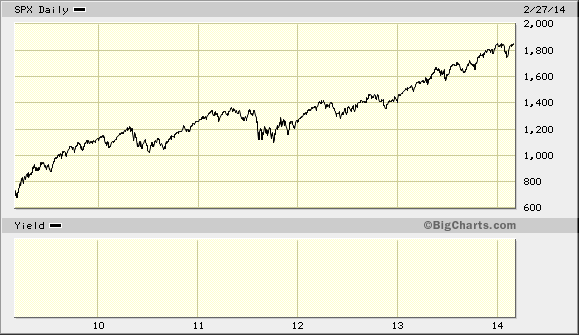
The fourth time’s a charm! For three days in a row, the S&P 500 rallied above 1,850 and was ready to make a new all-time record close, but each time, the bears arrived late in the day to pull us back down. On Thursday, it looked like it was going to happen for a fourth time, but this time, the bulls prevailed, and the S&P 500 closed at 1,854.29—a new record close.

We’re coming up on the fifth anniversary of a generational low for stocks. The climate back then was dreadful. On Friday, March 6, 2009, the Labor Department reported that the unemployment rate had hit a 25-year high and the economy had lost a staggering 651,000 non-farm payroll jobs the previous month. That morning, the S&P 500 touched an evil-sounding intra-day low of 666.79, which was the index’s lowest point in more than 12 years. The Dow was in even worse shape. Adjusted for inflation, the Dow was back to where it had been 43 years before.

The closing low came the following Monday, March 9, when the S&P 500 finished at 676.53. That was nine years to the day after the Nasdaq Composite first closed above 5,000. Now it was roughly one-quarter of that. The following day, Ben Bernanke told the Council on Foreign Relations that he thought we should review our mark-to-market accounting rules, and a few weeks later, the FASB agreed. That gave a huge boost to the rally. Five years on, the S&P 500 has gained 174%. Including dividends, it’s up 205%. In plainer terms, investors have tripled their money in five years. This is one of the greatest rallies in Wall Street history.

big02282014a

So where do we go from here? In this week’s CWS Market Review, we’ll take a look at the economy and how it could impact our portfolios. I’ll also highlight some good news from our Buy List. An entertaining battle of billionaires is helping our position at eBay. The stock just touched an all-time high. Also, Ross Stores just announced that it’s raising its dividend by 17%. This is the 20th year in a row that Ross has increased its payout. Not many stocks can make that claim. But before we get to that, let’s look at some recent economic news and what it means for us.

Why the Housing Market Holds the Key

On Thursday, new Federal Reserve chair Janet Yellen told Congress that it’s possible the Fed would hold off on its tapering plans if there were a “significant change” in the economic outlook. Frankly, that’s not really news; the Fed has consistently held this line. But this time, investors are taking it more seriously since the economic news has been less favorable. Eric Rosengren, the president of the Boston Fed, who incidentally was the only FOMC member in favor of cutting rates in September 2008, said the Fed should be “very patient” in cutting stimulus. Lousy weather has been a convenient scapegoat for poor numbers, but it’s pretty hard to separate out what’s been caused by the weather and what hasn’t.

On Thursday, the Commerce Department said that orders for durable goods fell 1% last month. But on closer inspection, there were bits of good news in this report. If you exclude transportation, which can be very volatile, durable-goods orders actually rose 1.1% last month. That was the biggest increase since May. Economists were expecting a decline of 0.3%.

On Wednesday, the Census Bureau said that new-home sales rose to a five-year high. The housing situation is critical in determining where the economy goes from here. Even though new-home sales are up, the current level is still near the low point of previous cycles. That tells you just how crazy the housing boom was. It created a massive, gigantic oversupply of homes. All those empty homes weren’t incinerated. Instead, it’s taken us this long to work off the inventory. Only now is housing inventory back to normal.

This is why I’m optimistic on housing. We’ve finally burned off that excessive inventory, and people are going to need more new homes. Normally, housing leads a recovery, and we didn’t get that this time. As a result, we got a sluggish recovery—and for many folks, there was no recovery at all. In fact, I think we could have very easily dropped back into a recession in 2011-12 if not for the assistance of the Federal Reserve. Budget-cutting from the government was a major drag on the economy. (Please note I’m not saying whether I approve of this or not, just that government austerity was a big factor.)

It’s true that mortgage rates have risen. The average rate for a 30-year fixed mortgage jumped from 3.35% last May to 4.33% now. While higher mortgage rates have crushed the refi market (Wells Fargo just announced more layoffs in their mortgage unit), they don’t appear to be holding back new buyers. The simple fact is that we’ll need more new homes. Despite the poor weather, the economy is slowly gaining steam. That’s why I strongly doubt we’ll see the Fed shelve its tapering plans this year.

Let me also touch on the consumer end of the economy. Retail stocks got off to a terrible start this year. That was reflected on our Buy List with bad performances from Ross Stores and Bed Bath & Beyond, but they weren’t alone. Nearly everyone from Walmart on down had a lousy quarter. The retail sector came back to life this week; even troubled retailers like J.C. Penney and Target saw big gains this week.

I suspect that the bad times for retailers have passed. The facts are clear. Consumers have paid down their debts. The great enemy of consumer spending, the price at the pump, is below its average of the last three years. Lastly, the labor market has improved, though at a very leisurely rate.

The Perils of Complacency

One of the concerns I have is the unintended consequences of the Federal Reserve’s policies. No matter how you feel about QE, and I do think it’s been a plus for stocks, massive bond buying distorts the market’s gauging of risk and reward. In short, the Fed has encouraged more risk-taking. That was understandable when everyone was terrified, but what about now?

I’ll give you an example of some possible distortions we’re seeing. Since February 3, the most-shorted stocks, meaning those with the most bets against them, have done the best. The hated stocks have doubled the return of the rest of the market. Tesla is a perfect example. Shorts make up an astounding 37% of their shares, yet the stock has skyrocketed. Shares of Tesla got to $265 this week; a year ago, they were at $35.

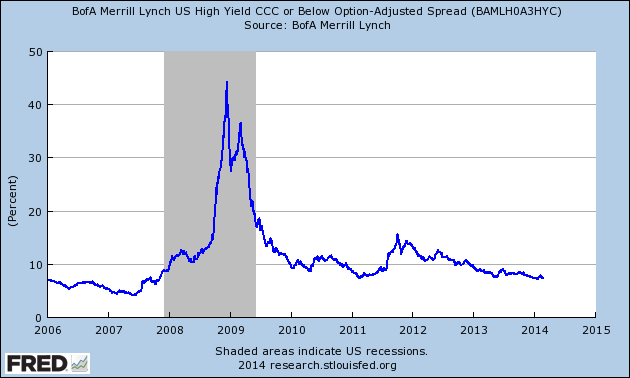
Another example is in the biotech sector. In the last ten weeks, the biotech index is up 25%, yet one-third of the companies don’t turn a profit. Facebook broke $71 per share this week, which is more than 90 times last year’s earnings. Some folks are claiming that the rash of big-ticket M&A deals is due to non-existent returns from sitting on cash. Also, everyone’s favorite alternative asset, gold, is having a good year so far (after a very rough 2013). Or we can look at the bond market. The yield spread between junk debt and Treasuries narrowed to its lowest level in six years (see below).

fredgraph02282014

These are all signals that investors are willing to shoulder more risk. On one hand, that’s a good thing. The danger comes when investors become complacent and feel they have little reason to worry. Consider that investors have become programmed to buy every dip. Since the bull market began five years ago, there have been 19 nervous breakdowns of 5% or more. Every single one was turned back.

The problem with risk is the things we don’t know we don’t know. Let’s look at what’s been happening in China’s economy. The growth of their “shadow banking” system has been alarming. No one truly knows its size. What if there’s a major default in China and that ignites a panic? What’s interesting is that growth from China has helped ease our pain from the Great Recession.

I don’t have a specific worry that I see looming on the horizon. Rather, it’s that I see investors becoming sloppy. I’m not so concerned about a large-scale bubble; I worry about small things like poorly thought-out acquisitions. (Peter Lynch has referred to this as the “Bladder Theory” of corporate finance.) The key for investors is not to be tempted by easy gains or to feel the need to chase stocks for fear of being left behind. Frustrated investors are bad investors. Now let’s look at a long-term strategy that works.

Our Buy List Is up for the Year

I’m happy to report that our Buy List is up slightly for the year, and we’re leading the market. Of course, it’s still very early, but through Thursday, our Buy List is up 0.45% this year, while the S&P 500 is up 0.32% (not including dividends). Bear in mind that only a few weeks ago, we were down nearly 6%. Our Buy List has beaten the S&P 500 for the last seven years in a row. Now let’s look at some recent news from our Buy List stocks.

Just after I sent you last week’s CWS Market ReviewExpress Scripts ($ESRX) had a rough day on the market. Shares of ESRX dropped 4% last Friday. This was despite reporting earnings that were in line with estimates, and they offered a good guidance for this year. I’m a little baffled by the market’s sour reaction, as there was little in this report that anyone should find surprising. The company said it’s aiming to return 50% of its cash flow to investors as dividends or buybacks. I still like Express Scripts and think it’s a good buy up to $83 per share.

Shares of eBay ($EBAY) had a good week, and we have our friend Carl Icahn to thank. The multi-gazillionaire released three open letters this week. In them, he’s reiterating his call for eBay to spin off their very lucrative PayPal business. The company has made it abundantly clear that they’re not interested.

The battle between Icahn and eBay’s board is getting ugly. Icahn doesn’t like the fact that Scott Cook and Marc Andreessen are on the board. Cook founded Intuit which competes against PayPal, and Andreessen’s company bought Skype from eBay and then sold it to Microsoft.

Pierre Omidyar, eBay’s chairman and founder, shot back and said that Icahn’s views are “false and misleading.” I love it when billionaires fight, especially when it helps our stock. Thanks to the high-profile kerfuffle, shares of eBay rallied above $59 on Thursday and took out the all-time high from 2004. Now Icahn has challenged eBay to a public debate, which sounds a bit nutty. The irony is that ever since Icahn went on the warpath, Omidyar has made $450 million from the eBay rally. My take: I think it’s clear that the board isn’t going to budge. Meanwhile, I’m raising my Buy Below on eBay to $62 per share.

This is actually a lull period for Buy List earnings reports. Our only earnings report for the next several weeks will be Oracle ($ORCL), which should report sometime in mid-March. I’m expecting another good report from them. Oracle tested our patience last year, but I think it’s starting to pay off. For Q3, Oracle sees earnings coming in between 68 and 72 cents per share. On Thursday, the shares broke above $39 for the first time since Bill Clinton was president. Oracle remains a very good buy up to $41 per share.

Ross Stores Announces Big Dividend Increase

After the closing bell on Thursday, Ross Stores ($ROST) reported Q4 earnings of $1.02 per share. This is for the crucial holiday shopping quarter. In November, the deep-discount retailer spooked Wall Street when it said that Q4 earnings would be below forecasts. The Street had been expecting $1.09 per share; Ross said to expect between 97 cents and $1.01 per share.

Overall, Ross is doing quite well. For the entire year, Ross earned $3.88 per share which was a nice increase over the $3.53 from 2012. The fiscal year for 2012 was 53 weeks which added 10 cents per share to that year’s earnings.

Michael Balmuth, Ross’s CEO, said, ”Our fourth-quarter sales performed in line with our guidance, with earnings that were slightly better than expected, primarily due to above-plan merchandise gross margin. Despite a very promotional retail environment throughout the holiday season, customers responded favorably to the compelling bargains we offered on a wide assortment of fresh and exciting name-brand fashions and gifts.”

Now for some guidance. For Q1, Ross sees earnings coming in between $1.11 and $1.15 per share. Wall Street had been expecting $1.20. For all of 2014, Ross sees a range of $4.05 to $4.21 per share. The Street was at $4.34 per share. That’s a disappointing forecast, and the shares were weak in the after-hours market.

But there is good news. Ross announced a 17.6% dividend increase. The quarterly payout will rise from 17 cents to 20 cents per share. This is Ross’s 20th year in a row of raising its dividend. At 80 cents per share for the full year, that works out to a yield of 1.1%. I’m raising my Buy Below on Ross to $76 per share.

That’s all for now. Next week, we get several important economic reports. On Monday, the ISM report comes out. Last month’s report was surprisingly weak, so it will be interesting to see if this was a temporary move or the start of a larger trend. The Fed’s Beige Book comes out on Wednesday, followed by the productivity report on Thursday. Then on Friday is the big jobs report for February. The last two jobs reports were noticeably subdued, and it appears that the weather excuse has outlived its welcome. Be sure to keep checking the blog for daily updates. I’ll have more market analysis for you in the next issue of CWS Market Review!

– Eddy

Posted by  on February 28th, 2014 at 7:47 am


The information in this blog post represents my own opinions and does not contain a recommendation for any particular security or investment. I or my affiliates may hold positions or other interests in securities mentioned in the Blog, please see my Disclaimer page for my full disclaimer.


Image
Named by CNN/Money as the best buy-and-hold blogger, Eddy Elfenbein is the editor of Crossing Wall Street. His free Buy List has beaten the S&P 500 for the last seven years in a row. This email was sent by Eddy Elfenbein through Crossing Wall Street.

A Pair of Top Picks, a Risky Pair & an Ace in the Hole

Salman Partners Analyst Justin Anderson walks The Energy Report  through the risks and returns of the game. Find out how this particular gentleman plays his hand and see what he has to say about 5 Stocks he recommends and the risks and expected rewards involved in each.- Money Talks

Since its inception in 2007, the Salman Partners’ Top Pick Index has made a 251% return. The index is a huge pot for investors in the international oil and gas space to bet on, but it’s not for the untutored.  
Screen Shot 2014-02-28 at 6.10.37 AMThe Energy Report: Justin, welcome. Tell us about Salman Partners Top Pick Index. Why was it established?

Justin Anderson: Top Pick Index was established to contrast the performance of our company’s favorite investment ideas against a Canadian benchmark of general stocks and to see how those investment ideas performed. Analysts look at the stocks under their coverage and then they try to pick one or two stocks that they think are going to be the best performers in that group over the next 12 months.

TER: What’s the track record? Do Top Picks generally perform as advertised?

JA: So far it’s been a really good track record. Since inception in 2007, the Top Pick Index of Salman Partners has had a 251% return versus the benchmark index, which has returned 30%. Over the last two years, the Top Pick portfolio has returned 38% versus 21% in the general S&P Index.

TER: Canacol Energy Ltd. (CNE:TSX) just earned the Top Pick recommendation in December. How did that happen?

JA: Over the last half of last year, Canacol was increasingly interesting for us, especially when it made a discovery called Labrador in the Llanos Basin of Colombia. That was an important discovery, not just for the intrinsic value of the discovery itself and the potential long-term cash flow that it would add to the company, but also because it meant that Canacol was going to be able to get to the finish line with respect to some of its other assets. What I mean by getting to the finish line is that Canacol has built up a very impressive Middle Magdalena basin unconventional position, very sensitive to time and funding. This conventional discovery at Labrador unlocked some less noticeable value in its Middle Magdalena position. That got us very interested. Then, when it made an additional discovery in the Llanos Basin called Leono, that discovery by itself looked really good, but the compounding benefit to the rest of the portfolio was very strong, so we upped it to a Top Pick.

TER: What are the most exciting positives about Canacol?

JA: To use a baseball analogy, I think Canacol is not really looking for the solid base hit. It’s looking to hit a home run. This company really wants to go big. That’s exciting, when you have a management team that is aggressively looking to make a multiple big return for its shareholders. The reason it’s in that position, as I said, is that it built up this large unconventional position in Colombia. It’s a position that, in terms of acreage, is second only to Ecopetrol SA (ECP:TSX; EC:NYSE), the national oil company there. Should the unconventional Colombia space ever take off, look out. This is a company that will perform extremely well if that happens.

TER: What’s the biggest concern?

JA: I think it’s the other edge of the same sword. If the unconventional Colombian space never does take off, if some of the initial well results are not that great, then you could get in a situation where that acreage becomes less important overall. I think that’s actually the biggest risk to the company as well. The nice thing about Canacol is that it has a very robust conventional portfolio that gives you a lot more downside protection in that scenario than some other companies that may be so exposed.

TER: South America is not the most stable operating environment. What are the political and security conditions in Canacol’s main operational areas of Colombia and Ecuador?

JA: For Canacol, I think the main issue is in its heavy oil portfolio. That’s in the center of Colombia; it has a bunch of heavy oil blocks. Those blocks are very close to some previous FARC strongholds, FARC being the organization that has been agitating through violence in the country to cause a communist revolution. Because of that proximity, people have been dissuaded from ramping up development activity in the area. It has affected Canacol’s heavy oil exploration appraisal work. I think that’s the biggest risk that it’s exposed to. On the plus side, I don’t think stockholders really care about its heavy oil position at this point, and it’s of tertiary concern to the market.

TER: What about Ecuador?

JA: Ecuador is much more of a basket case than Colombia. Ecuador is problematic because it’s not just lingering terrorist groups; the government itself is the issue. That being said, the contract Canacol signed with the government of Ecuador is one that provides much lower netbacks. It is a direct service agreement with the government. It’s an isolated issue for the company; I don’t really see any risk there.

TER: You created an unconventional portfolio for the Middle Magdalena unconventional play. Why?

JA: Unconventional positions, especially in the international locations, are extremely sensitive to initial results. You might have a very large position, but the fracking response, the geology and the capex/opex of the initial wells are going to have a major impact on the long-term development of the play—then slap political risk on top of that. We wanted to look at unconventionals in a unique way, rather than value all of that acreage in one blow. We built a stochastic or Monte Carlo model to try to capture the range of scenarios that those sensitive initial conditions could provide. That’s why we set up this separate unconventional portfolio. The effect that you get is a much more tailing effect: Either things go very poorly and you get no value or things go extremely well and you get a huge amount of value. There isn’t really much of a middle ground for these emerging unconventional plays.

TER: Why was it necessary to separate the unconventional portfolio from the other parts of your portfolio?

JA: A conventional prospect is more independent. If you have five conventional blocks, it makes sense to value them separately and then aggregate the results of those valuations, whereas with an unconventional position, you might have the same five blocks, but in this case they’re either all going to work or none of them will work. It’s much more common to see significant correlations between the successes or the failures, as opposed to a conventional portfolio, where it’s completely normal for, say, two of the five blocks to work out.

TER: Outside North America, shale development has an uneven record. Why is Canacol’s holding of 545,000 net acres of Colombian shale a positive thing?

JA: If you asked people in North America 10 years ago what would be the status of the Eagle Ford or the Montney or the Bakken, I think people would probably have been very skeptical about how those plays would perform. Ten years later, we’re seeing massive growth in these resource plays. There’s absolutely no reason why some of the best quality resources around the world won’t see the same kind of activity that those plays have seen. We’ve seen it in North America first simply because we’ve got the most stable political environment, but the rocks are the same around the world and you’re going to see the same booms in other countries.

The question simply becomes, where are we going to see the next boom? The answer to that question is, you’ve got to have great-quality rocks. We see some of that in Colombia. We see some of that in Argentina. We see some of that in places in Africa, India and China. Then the next question you have to ask is, considering those most prospective areas, where is the most likely place to see near-term capital flows? That’s really a political question. In this department, Colombia actually shines for its relative stability. Combine quality rocks with good political environment, and Colombia starts to look pretty attractive. Obviously there’s still a lot of uncertainty as to which way the tail will go in this one, but I think it’s a pretty good speculative bet.

TER: One of the problems that has affected the viability of shale oil and gas outside the U.S. is that the quality of the rocks is different in new areas, like Poland, for example, than what they were anticipating.

JA: It depends on the location. I would argue that the best rocks in the world for unconventionals outside of North America are probably in Argentina, in the Vaca Muerta. That is an extremely high-quality resource. I would say that Colombia is comparable in quality to Argentina and the Eagle Ford. It’s not as big, but the quality’s likely there. Arguably the quality is actually a more important factor for early-stage development than quantity alone.

TER: Is Canacol management looking for a buyout?

JA: I think they’re open to it. One of the great things about Canacol is its management is very down to earth. They’re there to return money to shareholders, as opposed to some companies where we see them establishing a corporate kingdom. Canacol is focused on shareholder value. If a company comes in that offers that, I think they would go for it.

TER: Parex Resources Inc. (PXT:TSX.V) is another Top Pick. Why?

JA: Parex is an interesting company. It’s a company that has a very undervalued production stream. It’s trading at multiples far below comparable companies in Canada and the U.S. Nearly all of its acreage is in the Llanos Basin of Colombia. The Llanos Basin is known for high decline rates, quick payout times and light oil.

What happens is, investors are very focused on the near-term reserve number, and they do the calculation against production and say, oh, this is a short reserve life. Then they apply a significant multiple discount to the company. The problem is you can’t just look at the reserves; in some cases you have to look at acreage as well. Parex has enough acreage where reserve adds are a foregone conclusion. It has built up such a robust position of acreage that it is going to book new reserves in the future.

Not all exploration acreage is equal. This company is sitting on exploration acreage that will become reserves. I think the market is not giving it any value for that when in fact it should be. That’s the source of the opportunity with Parex, where the actual reserves in the future will be much more than the current reserves, but you’re only paying depressed current reserve multiples to get access to the stock.

TER: The Parex stock has trended up since July of last year. You recently reiterated your Top Pick recommendation and raised your target from CA$9.30 to CA$10/share. What is the driver here?

JA: The strategy’s working. We got really excited about this name mid-2013, when Parex had some drilling success, started to diversify its portfolio and also made some acquisitions to expand its acreage running room. All of this put the company in a position to apply its operational expertise to these different plays and take advantage of that.

What we’ve been seeing over the course of the last nine months is the company executing on the strategy, adding reserves. We just saw a great reserve number recently. The stock has climbed. That’s being partially driven by reserve adds that the market seemed surprised to see.

TER: Parex is indexing its oil price to Brent instead of to West Texas Intermediate. What’s the significance of that?

JA: It probably just underscores even further the ridiculousness of the low multiple that it’s trading at because its production is more valuable than a lot of the Canadian domestic production, which is getting more depressed realized prices. When you look at the production multiples you just say, how is this possible when the company’s selling its crude to Brent prices? It just exaggerates the opportunity that much more.

TER: Africa Oil Corp. (AOI:TSX.V) is not a Top Pick; it’s a Hold. Is that because of the risky neighborhood it’s in?

JA: There are two major issues there. One overriding issue is, will it see development anytime soon of some of the impressive discoveries that it has made over there? Africa Oil is not far from Uganda, where there have been significant discoveries that no one has been able to monetize, and Africa Oil’s nearby discoveries are newer. Yes, the company is in Kenya. It’s a little bit closer to the market, but at this point, there’s still not as much oil discovered there as in Uganda. It is earlier stage. It’s going to take more time to appraise it. There’s still a lot of risk that it won’t find enough oil there to justify a major development and pipeline project.

The other issue is, it’s a really exciting stock. Africa Oil has done some incredible things in terms of exploration. Unfortunately, an analyst doesn’t necessarily look at how well the company is performing. We look at how we think it will perform in the future relative to the expectations, which are reflected in the stock price. From that perspective, I see a company that could go one of two ways: It’s either going to perform very well if it’s able to make some more discoveries, perhaps extend the trend a little further north and find well over a billion barrels in that basin. Alternatively, if it’s unable to open up any other basins in the area and there’s a risk of stranded oil discoveries, then the stock could get killed. A buyer of the stock is going to go one of those two ways, big upside or big downside. The question then becomes, what price are you willing to pay? The current price just doesn’t give me a compelling reason to say it’s a good bet.

TER: When do you think you’ll have a clearer picture of its prospects?

JA: I think it’s going to be over the next six months. It’s doing a ton of drilling this year, which is exciting, both in the Lokichar, where it’s had its discoveries, and outside the basin. I think the Lokichar wells are far less important than the wells outside the basin. It’s drilling on Block 9, for example, in a different basin. It’s drilling north of its discoveries and it’s also doing some work in Ethiopia. If any one of those three other play concepts that it’s tinkering around with turns out to be successful, then it’ll be an excellent story. We should know that in the next six months, but I think that all three of those other plays are very risky. Investors are taking on a big risk. If all three do not work then you could be in a tough situation with the stock.

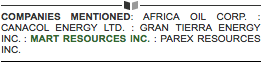
TER: Mart Resources Inc. (MMT:TSX.V) is another hold and also another African operator. What’s the status of its Umugini pipeline?

JA: It’s under construction. It’s been unfortunately delayed by forces beyond the company’s control. Estimates are that it should be completed midyear 2014.

TER: How will the pipeline’s completion benefit Mart’s stock price?

JA: I think people appreciate that the company needs the pipeline to make the operation more robust. That is probably reflected in the stock. I don’t actually see a huge potential from the pipeline completion alone. I think the more important thing will be production. If everything goes perfectly, the pipeline gets commissioned, production goes past 20,000 barrels/day through the line and the losses are cut to under 10% or 5%, that would be a positive thing for the stock, there’s no question. It’s certainly a possible scenario. The greatest concern for me is how much capacity is behind the pipe. How much can Mart ramp up production once the pipeline is installed?

Talking to investors who hold the stock, I think there are a lot of high expectations for how much capacity is behind the pipe. If you compare that to the reserve numbers, I’m a little skeptical over how much it will be able to push through there. The other issue I have is regarding the Pioneer tax status that has come to an end for the company. It started this year. Once it chews through all the tax credits, that will start to affect the cash flows in a material way as well.

TER: How will Mart ensure the Umugini pipeline will be more secure than the one it’s using now?

JA: It will have to do the same things it’s doing now, trying to make agreements with the government about the losses. It is encouraging see recent news that it’s talking to the government and establishing a committee to review the losses. Just having two export options will be a good thing for the company. That, more than specific details of what it’s going to do to protect the pipeline, is important.

TER: You have a lot more companies than those four under coverage. What are you really excited about right now?

JA: The other one to highlight would be Gran Tierra Energy Inc. (GTE:TSX; GTE:NYSE.MKT). It has been our Top Pick for a long time. Just recently, we rated it a Buy only because we felt Parex and Canacol were even more compelling stories, but Gran Tierra remains a very exciting story. It’s made major discoveries in Peru and it’s a long-term, value-player’s dream because it’s getting a very cheap multiple on its reserves right now and has a lot of extra-exciting exploration in Peru.

TER: Justin, you’ve given us a lot to think about. I appreciate your time.

JA: Thank you.

Justin Anderson joined Salman Partners in December 2011 as an oil and gas investment analyst. He is the founder of the research company Xedge, which specialized in rigorous stochastic analysis of oil and gas exploration portfolios. Previously, he worked for the investment banking energy group at BMO Capital Markets, after having worked on energy company strategy and valuations at McKinsey & Co. Anderson completed a Bachelor of Science in mechanical engineering and a Bachelor of Science in Russian studies at the University of Calgary. He then completed a Master of Science in aeronautical engineering at MIT, with his research and thesis focus on energy economics. While at MIT, Justin founded and commercialized a high-tech company called Waybe and was an executive chair of the MIT Energy Club.

Read what other experts are saying about:

Want to read more Energy Report interviews like this? Sign up for our free e-newsletter, and you’ll learn when new articles have been published. To see a list of recent interviews with industry analysts and commentators, visit our Interviews page.

Related Articles


DISCLOSURE: 
1) Tom Armistead conducted this interview for The Energy Report and provides services to The Energy Report as an independent contractor. He or his family owns shares of the following companies mentioned in this interview: None.
2) The following companies mentioned in the interview are sponsors of The Energy Report: Mart Resources Inc. Streetwise Reports does not accept stock in exchange for its services or as sponsorship payment.
3) Justin Anderson: I or my family own shares of the following companies mentioned in this interview: Canacol Energy Ltd. I personally am or my family is paid by the following companies mentioned in this interview: None. My company has a financial relationship with the following companies mentioned in this interview: We seek to do business with all of the companies mentioned (other than Ecopetrol) but have never done any business with them in the past. I was not paid by Streetwise Reports for participating in this interview. Comments and opinions expressed are my own comments and opinions. I had the opportunity to review the interview for accuracy as of the date of the interview and am responsible for the content of the interview. 
4) Interviews are edited for clarity. Streetwise Reports does not make editorial comments or change experts’ statements without their consent. 
5) The interview does not constitute investment advice. Each reader is encouraged to consult with his or her individual financial professional and any action a reader takes as a result of information presented here is his or her own responsibility. By opening this page, each reader accepts and agrees to Streetwise Reports’ terms of use and full legal disclaimer
6) From time to time, Streetwise Reports LLC and its directors, officers, employees or members of their families, as well as persons interviewed for articles and interviews on the site, may have a long or short position in securities mentioned and may make purchases and/or sales of those securities in the op


Thought Provoking Gold Sentiment

TECHNICAL SCOOP CHART OF THE WEEK:

1

With the improvement in gold prices and the gold stocks since the beginning of 2014 there has also been an improvement in sentiment. The above chart illustrates the improvement in the gold sentiment as a ratio chart with the global stock market. It tells an interesting story given that the above chart goes back to 1984.

First some definitions. The global sharemarket index is an index compiled from market indices around the world. The index has 17 components and is arithmetically averaged in order to give them equal weighting. The 17 components are the – Dow Jones Industrials (DJI), Dow Jones Transportations (DJT), Dow Jones Utilities (DJU), NYSE, S&P 500, NASDAQ, Russell 2000, Hong Kong HSI, Japan Nikkei 225, Singapore STI, Australian AORD, TSX Composite 300, Mexico IPC, FTSE 100, Paris CAC, German DAX, and, Swiss SMI. The index is used to show global sentiment towards the world’s stock markets. As can be seen global sentiment towards stocks has been rising and has now exceeded peaks seen in 2000 and 2007.

Similarly the gold sentiment index has been compiled from a number of datasets of precious metals, gold indices, gold stocks and gold mutual funds from four primary gold producing regions including – USA, Australia, Canada and South Africa. Oddly, the world’s largest producer, China, is not included. Precious metals included are – gold, silver and platinum; indices included are – XAU, HUI, GOX, CRB, GSCI, GPX, TGD, Oz Gold, and, SA Gold; stocks included are ABX, AU, GFI, GG (G in Canada), KGC (K in Canada), and NEM; and, mutual funds included (all US funds) – BGEIX, FSAGX, LEXMX, USERX, and, USAGX. As with the stock index the 29 components are arithmetically averaged to give them equal weighting. Global gold sentiment has been falling since peaking in 2011 although it has recently perked up.

What is interesting is when they are shown as a ratio. It is fiat/gold ratio as it is a comparison between stock market sentiment (fiat) and gold sentiment (gold). The recent peak in the ratio was close to the peak seen in 2001 when gold was trading near $250. This was in some ways surprising as the ratio was fairly steady throughout the 1980’s and until 1996 when the ratio rose sharply as the dot.com bubble took off.

After falling from 2000 to 2002, the ratio was relatively steady throughout most of the decade and not far off the levels seen from 1984 to 1997. There was a small spike during the financial crash of 2008. The ratio really took off in 2013 when the gold market and the stock markets went in opposite directions. Since peaking at the end of 2013, the ratio has been falling although it does not yet appeared to have broken the uptrend. A breakdown under 50 on the ratio would probably indicate that the market has swung more in favour of gold over stocks. The ratio is certainly worth keeping an eye on.

The second chart is not so much a sentiment index for gold as a measurement of gold’s relative value. The James Turk Fear Index was developed by James Turk www.fgmr.com back in the 1980’s as a measurement of gold’s relative value. The Fear Index compares the amount of gold held by a country’s central bank times the current gold price with the money supply of the country. The chart presented below is the Fear Index for the US Dollar.

The US gold reserves are are held by the Federal Reserve in Fort Knox (or least that is what is advised as being held). The Federal Reserve no longer reports M3 but the numbers are available through Shadow Stats www.shadowstats.com.  M3 is composed of M1 – notes and coins in circulation, and demand deposits of banks; plus M2 – M1 plus savings accounts and time deposits less than $100,000, money market deposit accounts; plus large time deposits over $100,000,institutional money market funds, short term repurchase agreements and other large liquid assets.

When the Fear Index is rising, there is concern about the safety and stability of the country’s monetary and banking system. When there is confidence, the Fear Index falls. The Fear Index has been in an uptrend since 2001. Interestingly the current correction in gold has taken the Fear Index back to the rising trendline. If the Fear Index were to break back under the rising trendline then it might be signaling the end of the gold bull. However, if the Fear Index rises off the trendline then the index could rise to new highs as was seen in 1977 following a somewhat similar sharp correction in the index.

The Fear Index is an interesting measurement of gold’s value and its trend. It is different from the sentiment indicators but it is one worth keeping an eye on for clues as the future price of gold.

2

Source: www.sharelynx.com

Charts and commentary by David Chapman

26 Wellington Street East, Suite 900, Toronto, Ontario, M5E 1S2

Phone (416) 604-0533 or (toll free) 1-866-269-7773 , fax (416) 604-0557

david@davidchapman.com

dchapman@mgisecurities.com

www.davidchapman.com


Copyright 2014 All rights reserved  David Chapman


General disclosures

The information and opinions contained in this report were prepared by MGI Securities. MGI Securities is owned by Jovian Capital Corporation (‘Jovian’) and its employees. Jovian is a TSX Exchange listed company and as such, MGI Securities is an affiliate of Jovian. The opinions, estimates and projections contained in this report are those of MGI Securities as of the date of this report and are subject to change without notice. MGI Securities endeavours to ensure that the contents have been compiled or derived from sources that we believe to be reliable and contain information and opinions that are accurate and complete. However, MGI Securities makes no representations or warranty, express or implied, in respect thereof, takes no responsibility for any errors and omissions contained herein and accepts no liability whatsoever for any loss arising from any use of, or reliance on, this report or its contents. Information may be available to MGI Securities that is not reflected in this report. This report is not to be construed as an offer or solicitation to buy or sell any security. The reader should not rely solely on this report in evaluating whether or not to buy or sell securities of the subject company.


The S&P 500 closed at its highest level ever today at 1854.


Drew Zimmerman

Investment & Commodities/Futures Advisor

604-664-2842 – Direct

604 664 2900 – Main

604 664 2666 – Fax

800 810 7022 – Toll Free

dzimmerman@pifinancial.com

test-php-789