
Bonds & Interest Rates
 Everyone agrees that the winter just now winding down (hopefully) has been brutal for most Americans. And while it’s easy to conclude that the Polar Vortex has been responsible for an excess of school shutdowns and ice related traffic snarls, it’s much harder to conclude that it’s responsible for the economic vortex that appears to have swallowed the American economy over the past three months. But this hasn’t stopped economists, Fed officials, and media analysts from making this unequivocal assertion. In reality the weather is not what’s ailing us. It’s just the latest straw being grasped at by those who believe that the phony recovery engineered by the Fed is real and lasting. The April thaw is not far off. Unfortunately the economy is likely to stay frozen for some time to come.
Over the past few weeks, I have seen just about every weak piece of economic news being blamed on the weather. First it was lackluster retail sales that were chalked up to consumers being unable or unwilling to make it to the mall. (This managed to ignore the fact that online sales were similarly weak – which would be unexpected for a nation of snowed in consumers). Then came the weak auto sales that were ascribed to similarly holed up potential car buyers. However, this ignores that while GM and Chrysler sales were way down, sales for luxury cars like BMW, Mercedes and Maserati, surged to record high levels (more on that later). No one offered a reason why wealthier motorists were able to brave the cold. A number of other data points, such as lower GDP, productivity, ISM and factory orders were also ascribed to the elements.
Analysts also blamed the weather for weak housing sales and mortgage applications, which both hit multi-year lows. The idea being that hibernating buyers could not get to real estate open houses or to the bank to process loans. This idea ignores the fact that the weakest home sales over the last few months have come from the states west of the Rockies, where temperatures have been above average.
Of course the biggest weakness ascribed to the snow and ice has been the very disappointing employment reports over the last few months. Analysts faced a very difficult task in squaring these reports, which showed fewer than 187,000 new jobs created in December and January combined, with the accepted narrative that the recovery was firmly underway and that the economy was no longer dependent on the Fed’s monetary support.
For these desperate economists the weather was a godsend. Mark Zandi had virtually guaranteed that job creation was being deferred by the weather and that hiring would come roaring back once the mercury started rising. The weather has become such a handy and versatile tool for economic apologists that we may expect that financial news stations will start featuring meteorologists more heavily than financial analysts. Move over Jim Cramer, hello Al Roker.
The weather continued to be horrible in February and as a result, there were wide expectations that today’s February jobs report would be similarly bleak. But this morning’s release detailed a slightly better than expected 175,000 new jobs, thereby convincing economists that the economy was so strong that it is overcoming the drag created by the weather. This lays aside the fact that 175,000 jobs should not be causing any optimism. After years of sub-par job growth, I believe a recovering economy would be expected to create more than 300,000 jobs per month in order to make a real dent in underemployment. Those levels, once routine in past decades, seem untouchable today. But weather-related pessimism had caused economist to ratchet down their predictions to just 150,000 jobs in February. Based on that, today’s numbers were seen as a win.
But economists are ignoring the likelihood that the weather was never a major factor. Take the cold out of the equation and you would be left with a mediocre February number following two consecutive monthly disasters. This does not change the downward trajectory. In fact, the number may be revised lower in future months, as has been the norm in the years since the economic crisis began.
Drilling deeper into the report will provide little reason for optimism. The labor force participation rate stayed at a generational low and the unemployment rate edged up. On the other hand, the long-term unemployed (those out of work for more than 27 weeks) increased by 203,000 to 3.8 million. Furthermore, over half of the jobs created were low-paying or part-time jobs in education, health care, leisure and hospitality, government, and temporary services. Higher paying information jobs declined by another 16,000 following last month’s 8,000 loss, and manufacturing added a scant 6,000 jobs.
The report also contained data that shows how older workers are coming out of, or postponing retirement. This trend is likely caused by inadequate savings rates, low interest rates, and increases in the cost of living that are rising faster than official CPI numbers. Not only does this point to falling living standards, but the jobs being taken by these older workers would normally be filled by younger, less skilled workers, who are left unemployed, buried beneath a pile of student debt and living in their parent’s basements.
In truth, economic activity persists in good weather and bad. Winter is largely predictable. It comes around once a year, basically on schedule. Consumers are used to the patterns and know how to deal with them. But don’t tell this to today’s economists.
A much more plausible explanation to me is that the economy has been weak recently because it is weak fundamentally. The data deterioration corresponds not just to unseasonably low temperatures but also to the diminishment of monthly QE from the Federal Reserve. If you recall the highly anticipated “taper” finally began in mid- December. From my perspective the Quantitative Easing has become the sunshine that drives our phony economy. Diminish that sunshine and the economic winter spreads.
But the sad fact is that QE can push up prices in stocks and real estate, but can do very little to affect positive change in the real economy. That’s why I believe that BMW’s are selling like hotcakes even as Chevies sit on the lot. Our current policies help the wealthy at the expense of everybody else. Unfortunately, I don’t think the economy will improve as long as the QE keeps us locked into a failing model. What’s worse, once the weather warms and the economy does not, look for Janet Yellen to first taper the taper, then to reverse the process completely.
Subscribe to Euro Pacific’s Weekly Digest: Receive all commentaries by Peter Schiff, John Browne, and other Euro Pacific commentators delivered to your inbox every Monday!
To order your copy of Peter Schiff’s latest book, How an Economy Grows and Why It Crashes – Collector’s Edition, click here.
For in-depth analysis of this and other investment topics, subscribe to Peter Schiff’s Global Investor newsletter. CLICK HERE for your free subscription.

First, the market DID confirm its breakout last week which requires an increase in portfolio models back to full equity allocations. The breakout has confirmed that the bullish trend remains in place and we must honor that trend for now.
There is also mounting evidence that market exuberance is getting extreme. I had a long talk with a money manager in California who works for a major firm who laid out 10 basic issues with the markets that has him concerned.
Raising Portfolio Allocations To Equities
The ongoing bull market was confirmed last week at stock prices not only moved above the previous resistance levels, but also sold off last Tuesday retesting support and then broke out a second time. The chart below is a weekly chart showing the breakout above resistance.

This breakout above resistance confirms that the ongoing bull market trend remains intact for the time being.

Regardless that markets are overly extended, overly bullish and excessively complacent which increases investment risk substantially, as I will discuss below, it does not mean that a crash is imminent.
 …continue reading the full 17 page report HERE

Nihilo ex nihilo fit. Out of nothing, nothing comes. First put forward by ancient Greek philosopher Parmenides in the 5th century BC, Thomas Aquinas and St. Augustine later used this axiom to prove that the universe needed a “first mover,” to get things going.
Even if the whole thing began with some kind of “Big Bang” moment, it still needed a banger to bang it.
Who? God, of course.
We don’t know. But our jaw dropped when we saw how the bangers over at the Federal Reserve have helped add $20 trillion in US household wealth since 2009 – setting yet another new record. The Wall Street Journal reports:
American’s wealth hit the highest level ever last year, according to data released Thursday, reflecting a surge in the value of stocks and homes that has boosted the most affluent US households.
Ex nihilo? Who cares. It’s there. It’s spendable.
And yet… what kind of wealth comes from nothing? Is it solid and real, like the earth, the moon and the stars? Or is it something else?
It is clearly something else. But what?
The Great Fed Wealth Transfer
Let’s begin by looking at where all that new wealth comes from. Not from the hand of the Almighty, of course…
We are led to believe that the Fed’s policies are designed to produce a general prosperity; the Fed keeps rates near zero so the entire economy benefits.
But it isn’t true. Only some prosper. Even the headline in the WSJ says so: “US Wealth Rises, But Not All Benefit.”
The Fed’s activist policies distort and corrupt the economy. First, prices are bent. Then, taking their cues from bad prices, bad decisions are made. Before you know it, everything is twisted in one direction or another.
As we noted on Friday, the Fed is largely to blame for the dinosaur houses we see all over the US. Low rates and rising prices tricked Americans into believing that the more house you had the more money you would make.
We didn’t mention it last week, but factories in China can also trace their genesis to the Fed’s low-down interest-rate policy. Americans were lured to borrow and spend; Chinese manufacturers benefited.
Record high earnings, record high margin accounts, record high junk bond issuance, record household wealth gains – all are products of Fed policies.
We quote from the book Paper Money Collapse: The Folly of Elastic Money and the Coming Monetary Breakdown. The author, Austrian School economist and former Wall Streeter Detlev Schlichter, was kind enough to send us an advance copy. Says Schlichter,
[The financial authorities] can never enhance all economic activity evenly or‘stimulate‘ the economy in some all-encompassing, general way. Every injection of new money must lead to changes in resource used, to a redirection of economic activity from some areas to others, and change income and wealth distribution. Inflows of new money inevitably change the economy and must create winners and losers.
That $20 trillion in new wealth I alluded to earlier is in the hands of America’s winners. It added little to US GDP… or to Americans’ incomes. It was merely a transfer of wealth. Owners of stocks and houses got richer. Wage earners and savers got poorer.
Take Your Money off the Table
We have some advice for those on the receiving end of the stock market bonanza: Take your money off the table before it disappears.
After all, it is only a claim on wealth, not wealth itself. And that claim will expire worthless when the Fed changes its policies. The Fed giveth, and the Fed taketh away.
Either the Fed will taper… ending the bonanza. Or it will lose control of interest rates. And when they rise, all the broken records we have been citing become like broken bottles in a street fight. Somebody is gonna get hurt.
For the moment, the 12 members of the policy-setting Federal Open Market Committee are more powerful than God. Since the beginning of the universe, it took about 13,798,000,000 years for the market value of all the world’s assets to reach $20 trillion. The Fed’s “Big Bang” accomplished the same trick in only six years – start to finish.
That does it for us. No more worshipping a guy who has been dead for 2,000 years… or his dad, for that matter. In this Lenten Season, we bow to no man. But for the lady who runs the Fed, the entire economy bends in whatever direction She commands.
Regards,
Bill
From the desk of Chris Hunter, Editor-in-Chief, Bonner & Partners
Another effect of the Fed-driven economy is something Bill alluded to last week: the big rally in high-yield, or “junk,” corporate bonds.
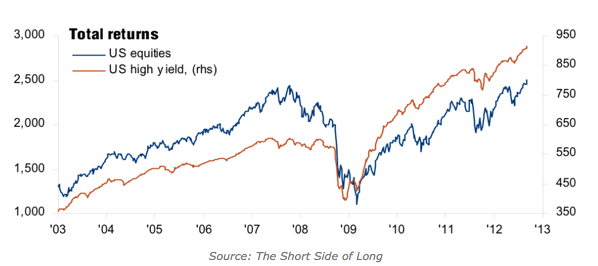
Over the last 10 years the high-yield bond market has returned 131%. This compares to a return of 69% for investment-grade corporate bonds.
In fact, as you can see from the chart below, junk bonds have been more or less in line the US equities since 2003.
And with the Fed now leaning heavily on Treasury bond yields, fresh funds are pouring into the high-yield bond sector.
According to data from Lipper, $559 million flowed into high-yield funds and ETFs for the week ending February 26. That came hot on the heels of $804 million in inflows in the previous week… and $1.45 billion the week before that.
All that money is chasing an average “junk” yield of just over 5% – or about two percentage points over the benchmark 10-year T-note yield of 2.79%.
This big influx of money into the junk-bond market is happening at the same time as corporate default rates are on the rise. Ratings agency Standard & Poor’s estimates a 2.5% default rate by the end of this year – up from a default rate of 1.7% at writing.
That’s not extreme (the long-run average is about 4.5%), but the direction of travel is a concern.
And just like the rally in US stocks, the rally in junk bonds is heavily dependent on the Fed keeping Treasury yields low. After all, it’s the lack of yields available on relatively safe government bonds (by historic standards at least) that is pushing so many investors out on the risk spectrum in search of yield in the junk-bond market.
Junk bonds are a popular trade right now. But just like US stocks, much of the easy money has already been made. And a 5% yield, from our perch at least, is poor compensation for the risks involved.
Think twice before you join the crowd pouring money into junk bonds. Mom and Pop are big buyers. And just like stocks, this is a highly distorted market… and therefore unsuitable for prudent investors.
 With continued chaos and uncertainty in global markets, today KWN is publishing an incredibly powerful piece that was written by a 60-year market veteran. The Godfather of newsletter writers, Richard Russell, is now becoming more vocal about the the United States government lying to its people. He also discussed major moves by the Chinese, why the stock market will crash, and what is happening with gold, and particularly silver.
…read the full article and view charts on Silver HERE

 This is a Junior Mining Company that Bob Moriarty of 321Gold thinks is both undervalued and highly valued by sopisticated investors.
Specifically, Soltoro Ltd has 77 million ounces of silver in the ground at its El Rayo project, which works out to 1.1 ounces of silver per share or about $.15 an ounce for silver in the ground. As for sophisticated investors, a major Mexican billionaire controls over 14% of the stockm Directors and management control over 7% and Coeur D’Alene Mines owns about 7% of this company – Money Talks
Read more about the Company and its prospects HERE
Although Bob Moriarty thinks this company is positioned to go much higher, keep in mind that it is still an exploration company and not yet a producing company. In short this is a high risk situation.

-
I know Mike is a very solid investor and respect his opinions very much. So if he says pay attention to this or that - I will.
~ Dale G.
-
I've started managing my own investments so view Michael's site as a one-stop shop from which to get information and perspectives.
~ Dave E.
-
Michael offers easy reading, honest, common sense information that anyone can use in a practical manner.
~ der_al.
-
A sane voice in a scrambled investment world.
~ Ed R.
Inside Edge Pro Contributors

Greg Weldon

Josef Schachter

Tyler Bollhorn

Ryan Irvine

Paul Beattie

Martin Straith

Patrick Ceresna

Mark Leibovit

James Thorne

Victor Adair