Gold & Precious Metals

Breakout in Gold and Gold Miners!

Lately we’ve been writing about why we expected the rebound in precious metals to continue without any serious setbacks. After a major low, sentiment can remain muted for several months even in contrast to the improving market action. Yet, a look at history shows that rebounds from major lows can continue unabated and unscathed for more than a year. The rebound in precious metals thus far appears to be following this script. It has received a further boost with the breakout in Gold yesterday and as of now, the breakout in the gold miners.

First, let’s take a look at Gold. The chart below highlights the importance of $1350-$1360 which was major trendline resistance since April 2013 and November 2012. With the breakout past $1360, the next key target is $1420. Gold has weekly resistance at $1400 so keep that in mind as well. If Gold can takeout $1420 convincingly on a weekly basis then it could have legs to $1500.

mar13edgold

Today we have the gold miners, both GDX and GDXJ breaking out of their consolidations. For several weeks both markets held in tight consolidations which appear to bullish flag continuation patterns. GDX’s upside target is $31 while GDXJ could reach $53. The 400-day moving averages could intersect with these targets to form strong resistance.

mar13edminers

The gold stock bull analog chart shows that this current recovery in the HUI Gold Bugs Index is very much in-line with historical recoveries. The current recovery is in blue.

mar13huibulls

Last week we wrote:

It is incredibly difficult to buy at this juncture but, as we noted in our last editorial, the evidence favors doing so. Pullbacks, until we see much larger gains should be brief and should be used as an opportunity. ETFs such as GDX, GDXJ, and GLDX have spent the last 11 days consolidating and digesting gains.

When the market evolves according to your thesis you don’t do anything. You sit tight until you decide to take profits or something changes. Considerable near-term upside potential remains in play for the gold stocks. Silver and the silver stocks have lagged in recent weeks but they will perform well if this breakout is sustained as we expect. As the previous chart shows, there is potentially a lot more upside in play for the balance of the year. Be long, sit tight and have an exit strategy (to limit losses) in case things play out differently. If you’d be interested in learning about the companies poised to outperform the sector, then we invite you to learn more about our service.

Good Luck!

Jordan Roy-Byrne, CMT

Jordan@TheDailyGold.com

Ed Note: Go HERE and scroll down to the bottom where you can enter your email address and receive 2 Free Reports, News and Premium Samples. 

Main Principle Guiding your Investment in Mining Companies

imagesAs the gold and silver markets turn the corner and move back to the uptrend, mining companies are recovering quite nicely. Ahead of the ‘credit crunch’ in 2007, the common belief was that almost any mine was a good investment. Since then, many investors have learned a salutary lesson on the subject often seeing his investment fall to a level far below the price he paid.

Each investor has his favourite gold shares and may continue to believe his chosen vehicle will reward him the most. Nevertheless, it’s good to review what a gold or silver share is and what principle should govern an investor’s selection of shares over all other principles.

What are your investing objectives?

Each investor usually has an investment objective, whether it is short-term profit, capital gain, dividend flow or the broad concept of ‘total return’ (capital and income returns added together). Which one do you fall under?

The most successful investors have the advantage of being able to reinvest their income flow from investments getting the joys of compound returns. This means that they have invested with shareholders in mind. When looking at an investment, one has to define it carefully, particularly in gold, silver mining companies.

After all, a mine is not gold and silver; it’s a derivative of the metals, in that it relies on the prices of both gold and silver for its success. But it remains a corporation run by fallible people facing many corporate risks. A great deal has to happen in this structure for the individual shareholder to benefit from the gold or silver prices.

Main Investment Principle

The first rule of investing in precious metal companies is to look for a company that is focussed on rewarding shareholders. This means that the cash flow they receive is targeted at paying dividends to shareholders. Some companies do this by formalizing an agreement to pay shareholders a percentage after tax cash flow. They also define what costs they will be spending their capital on, including exploration costs. As a shareholder you can relate your investment potential to gold and silver prices. Without this, how will you know the gold share will benefit from a rising gold price?

This was highlighted in the publication of Australian gold production in the December quarter. Remarkable on a low gold price, gold production had risen. At 74 tonnes, gold production was the highest it had been since June quarter of 2003. Why?

Gold producers are treating less low-grade material, which results in higher output and reduced costs. Lower prices forced a switch from lower grade ores to higher grade ores because of the need to maintain a particular level of profitability. The cut in reserves being seen among producers all over the world has the effect of shortening the life of the mine while production rises. Producers usually aim to maintain profitability, not necessarily to increase it. So if the gold price rises, we expect production to drop as miners return to lower grade material –this extends the life of the mine, but is it in the interests of shareholders? Of course not!

The days of pre-2007 –when shareholders were content to see mining company share rise in price—all long gone. The uncertainties of the financial world demand a specific return on the shareholders’ capital employed. In other words, the investor needs to maintain a cash flow that justifies the capital value placed on their shares.

What’s important to investors is that the companies behind the shares are not companies who extend the life of mines at the expense of shareholder cash flows.

Be Certain of Company Policies!

Gold and silver producers who link their profits to dividends irrevocably, reward shareholders. Investors should look for these companies. Such policies should be encapsulated in Mission Statements that define their approach to rewarding shareholders. A mining share will only reflect moves in the gold price, if the path to shareholder rewards is spelled out. If it isn’t, then the link to gold is muddied, and risks are heightened.

IDEAL GOLD, SILVER PRODUCERS FOR INVESTORS

Of course, the gold company that keeps increasing the size of its gold reserves faster than it uses these to produce gold, is the one that extends its life no matter the gold, silver price. The rate of production is then defined by its capacity and ability to produce. This number divided into the reserves is what defines its life. This is the mining company to choose.


Hold your gold in such a way that governments and banks can’t seize it!

Visit: www.stockbridgeMgMt.com And Enquire @ admin@StockbridgeMgMt.com

Subscribe @

www.GoldForecaster.com

www.SilverForecaster.com

Legal Notice / Disclaimer

This document is not and should not be construed as an offer to sell or the solicitation of an offer to purchase or subscribe for any investment.  Gold Forecaster – Global Watch / Julian D. W. Phillips / Peter Spina, have based this document on information obtained from sources it believes to be reliable but which it has not independently verified; Gold Forecaster – Global Watch / Julian D. W. Phillips / Peter Spina make no guarantee, representation or warranty and accepts no responsibility or liability as to its accuracy or completeness. Expressions of opinion are those of Gold Forecaster – Global Watch / Julian D. W. Phillips / Peter Spina only and are subject to change without notice. Gold Forecaster – Global Watch / Julian D. W. Phillips / Peter Spina assume no warranty, liability or guarantee for the current relevance, correctness or completeness of any information provided within this Report and will not be held liable for the consequence of reliance upon any opinion or statement contained herein or any omission. Furthermore, we assume no liability for any direct or indirect loss or damage or, in particular, for lost profit, which you may incur as a result of the use and existence of the information, provided within this Report.

Mike Breard: Buy Small for Deep Profits

With Oil dropping sharply the last few days these stocks are on sale. It happened as Josef Schacter forecasted at Money Talks World Outlook Conference, and his expectation that further weakness can be expected some of the companies described below have likely been on sale the past few days.  For longer term investors, Hedging Strategies are also worth understanding as explained in an article today which explains the strategy in HEDGING A SHORT CRUDE POSITION: 2 STOCKS TO CONSIDER. Given the analyst Mike Beard below is advising smaller Oil & Gas companies that have excellent prospects, the Hedging Strategy explained in the article leaves open the upside for big profit on the higher potential juniors as well as a strategy to reduce some of that Junior stock risk in the stocks described below – Editor Money Talks

Mike Breard: Buy Small for Deep Profits

The Street’s eyes may be on North Dakota, but Mike Breard also keeps an expert eye focused on smaller oil and gas companies drilling elsewhere. In this interview with The Energy Report, the Hodges Capital analyst discusses several companies drilling excellent wells in Texas, Oklahoma and the Gulf of Mexico. Breard, a veteran oil and gas analyst, knows the first names of some of the sharpest managers in the industry. Stick with the winning teams, he advises, even when they change firms.

Screen Shot 2014-03-13 at 7.04.11 AMThe Energy Report: How do you choose the energy names in your coverage list?

Mike Breard: I look for managers with great track records. For example, I attended the annual meeting ofMatador Resources Co. (MTDR:NYSE), and there were 150 people there. Normally, only maybe 20 people attend the annual meetings of the junior energy companies, but these folks had been investing with the current managers of Matador in private deals for 30 years. They were so eager to get in on the newest venture of these guys that Matador stock has tripled during the past year.

TER: What is driving Matador’s success?

MB: Attention to detail. Matador does not control the most acreage in a play; they want the best acreage. The company studies an area for quite a while before deciding what leases to go after. Then, it does all kinds of additional technical studies on the leasehold before drilling—such as microspectrometry, which is taking pictures of the cores under a strong microscope to identify channels that will allow the oil to flow. It is drilling now in the Eagle Ford and the Delaware Basin portion of the Permian Basin.

Frankly, I do not care for small firms that invest in a dozen different plays all over the country—stretching their assets and manpower too thin. I prefer companies that stay in two or three regions and concentrate on developing the assets on hand.

TER: How is Matador stock doing?

MB: It was under $8.00 last March then hit a high of $24.25 in late November. When the price of oil dropped, the stock went down to $16. Recently it was over $25 and it could go a lot higher as people get used to thinking about oil staying in the high-$90s/low $100s. Matador has a lot of gas in the core area of the Haynesville. As gas prices rise, Matador could drill some profitable wells there too.

TER: How important are factors like debt:equity ratios and other types of metrics when you decide whether or not to invest in a junior energy firm?

MB: In the last few years, those metrics have not been as important. Large investors are just throwing money at the oil business. A company will announce a $500M debt offering and two days later, they sell $750MM. Money is the easiest thing to get in the energy industry right now. Of course, I do look closely at the debt situation, and I want a firm to have enough liquidity to drill wells and make acquisitions. But there are different ways of doing this. Take Comstock Resources Inc. (CRK:NYSE), for instance: it has not sold any new stock in years. It treats its shares as a precious commodity, while some companies do a stock or bond offering every year or two.

TER: Why is money so free right now?

MB: Cash is nearly worthless in terms of getting a return. Investors are seeing the large profits flowing from the Bakken, the Eagle Ford, the Permian, etc. Investors want in on that seemingly easy money. Energy is a growth industry.

TER: What are the top oil and gas plays in the U.S. for 2014?

MB: The Permian Basin is the hottest area right now. Drillers have been active here since the Santa Rita No. 1 well began producing in 1923, and numerous formations are productive. The Bakken, the Eagle Ford, the Marcellus, the Wattenberg, the Mississippi Lime, etc. are all good areas. More drilling is being done in the Utica and the Tuscaloosa Marine Shale, and these areas could blossom in 2014—2015.

One issue to consider, however, is that in some of the older plays, the core areas have been identified and firms are exploring the fringe portions. Now, as far as Wall Street is concerned, the older regions do not have much glamour left. Some hedge funds are insisting on a minimum leasehold of 100,000 acres and 1,000-barrel-a-day (bbl/d) wells or they are not interested. Size is not the only factor though. The reality of it is that if a firm drills a well for $0.5M and produces 50 bbl/d, the well can pay out in a few months, and the rest is pure profit. Those types of small, profitable operations are running well below the radar on The Street—which can make them good buys.

The oil stocks can be volatile, not based on what they are actually doing, but based upon the perceived price of oil and Wall Street’s cyclical fears. In November, many on Wall Street became convinced that the price of oil was going to fall to maybe $60/bbl. Oil stocks dropped substantially—even though the price of oil did not plummet. Now, many of these Wall Street seers are thinking “Oil is $100! We missed out; it is time to start buying!”

TER: What other firms do you like in the junior space?

MB: EPL Oil & Gas Inc. (EPL: NYSE) is now being managed by Gary Hannah, who has been in the business for 30 years. EPL was formerly called Energy Partners Ltd. Gary studied its assets, took over the company and paid off the notes in 2009. He is working in the shallow waters offshore in the Gulf. EPL made a big acquisition several years ago. It spent $15 million ($15M) the first year on technical studies, and $150M the next year on drilling and tripled the reserves. This is its business model. EPL is in the giant shallow water fields that were discovered 40 years ago, when we did not have the advanced seismic technology to properly assess the true potential. Now, EPL is finding all kinds of smaller reserves around these old fields and there is plenty of infrastructure in place. Zones between 12,000 and 20,000 feet have rarely been drilled. EPL has begun a $45M Full Azimuth Nodal seismic program to better understand the deeper water formations.

TER: Is there a lack of competition in the shallow basin area?

MB: There is a lack of interest. People are putting their money into the shale areas onshore and are shying away from the shallow waters. But the Gulf has ample production facilities and pipelines in place, and it really does not cost that much more to drill a shallow water well than it does to drill a Bakken well.

EPL is conducting studies and making acquisitions in this space. In 2012, EPL bought Hilcorp assets for $550M. They spent 2013 studying the prospect and will spend over $100M this year to explore and develop.

TER: How is the EPL share price performing?

MB: EPL’s high was about $43 last fall. When energy stocks generally declined, it dropped down. Then there was a storm in the Gulf that shut down some high producing wells. When EPL tried to bring them back on, it did not get production back as high as it was, which was disappointing. The stock fell to around $25 and has recently been back up over $30.

TER: What other juniors are you focused on?

MB: Comstock Resources Inc. was a big gas producer in the Haynesville when that region was hot. When the gas price fell, Comstock went looking for oil on property that it already owned in the Eagle Ford. It also bought property in the Permian Basin. But when it came time to drill the development wells, gas was at $2 per thousand cubic feet ($2/Mcf). Comstock realized that it could not afford to develop both properties. It sold the Permian Basin properties for $824M, which was a $231M profit in about a year. Then it paid down debt, started to buy back stock and began to pay a dividend, which is very rare for a small producer. The yield is now 2.5%.

Comstock then put $100M into exploring the East Texas Eagle Ford, primarily in Burleson County. It plans to drill 10 wells there this year on 21,000 net acres. It also bought 51,000 net acres in the Tuscaloosa Marine Shale, where the wells cost quite a bit more to drill. Comstock management plans to drill a couple of wells there in 2014, but it is waiting to follow the lead of nearby producers before stepping up drilling in 2015.

TER: Do you buy all these types of stocks on a short-term basis or are you a long-term holder?

MB: We have held some stocks for four or five years. It depends on how they perform. If a stock doubles in a week, we may sell it. If something bad happens, we may also sell it. But, generally, we’re looking for the longer-term plays.

TER: What other picks do you have for us today?

MB: Torchlight Energy Resources Inc. (TRCH:NASDAQ) is a small company with a property in the Eagle Ford that provides cash flow. It plans to sell that asset, if it can get a high enough price, because it is going more into the Hunton play in Central Oklahoma with a private operator, Husky Ventures Inc. Husky has drilled 35—40 wells in the Hunton after spending a lot of money on technical work to find the right spots to drill and has been very successful. Torchlight has four areas of mutual interest with Husky. Torchlight has two other properties in Kansas, where it can drill low-cost, low-risk oil wells. Torchlight is currently drilling in one Kansas play with Ring Energy Inc. (REI:NYSE).

Not too many people have heard of Ring, but it is run by the same managers that built Arena Resources and sold it to SandRidge Energy (SD: NYSE) for $1.6 billion ($1.6B). Arena drilled 850 shallow, low-cost wells with high rates of return in the Central Basin Platform of the Permian Basin. Ring is drilling the same type of wells in the Central Basin, but it also got into a similar shallow oil play in Kasnas. These wells will cost around $0.65M to drill and the payout can come in less than a year.

TER: How is Torchlight financing these activities?

MB: It sold $7M in equity recently. It is also looking at a mezzanine financing package or a line of credit. It has already set aside $6M to gain a half-interest in the Ring Energy play in Kansas and has put up its share for at least two more months of drilling with Husky.

TER: Do you have an interest in international energy sectors?

MB: We buy blue chips, including BP Plc (BP:NYSE; BP:LSE) and Exxon Mobil Corp. (XOM:NYSE). They pay decent dividends.

TER: Do you have any interests in the alternative energy sector?

MB: I have all I can handle with following conventional energy. I have, however, talked with managers at wind turbine companies. They have gas generators on the side to supply electricity when the wind dies down. Ironically, the alternative energy sector has created additional demand for natural gas.

TER: Do you have any other companies that you want to talk about today?

MB: Helmerich & Payne Inc. (HP:NYSE) is a drilling company that was the first to build modern AC rigs that they called FlexRigs. These are not like the old mechanical rigs with the dirty, dangerous drilling floor. In a computerized FlexRig, the operator sits high up in an air-conditioned cockpit guiding the drill bit while looking at computer screens that tell him the weight on the bit, how fast it is turning, etc.

A decade ago, the company’s competitors laughed, claiming that no one was going to pay extra for such a fancy rig. Now, HP has half the AC rig market share. The rigs are super efficient and made for pad drilling. The footage rate has increased by 10% in each of the last two years. While an average rig may drill a well in 30 days, an HP rig can drill it in 18–20. It charges more per day, but it is cheaper per well because the wells are drilled faster.

The company can build its rigs for $1–2M less than the competition and can charge 15% more. This provides a superior profit margin. It has been building two new rigs per month, and is going to three per month in April. And it is well-managed. The Helmerich family has been running the company since it was started in 1920. Hans Helmerich has just stepped down as CEO but he will still chair the board.

TER: Is the stock cheap?

MB: HP stock has been hitting all-time highs lately, and it has raised its dividend quite a bit. It is yielding 2.5%. It has the potential to go higher. Building three new rigs a month should add around $0.90/share on an annual basis.

In general, offshore drilling stocks have been way oversold, and they will likely be good performers later this year.

TER: Thank you very much for your time, Mike.

MB: Cheers.

Mike Breard graduated from Rice University in 1963 and got an MBA from Stanford in 1965. His first job was with Standard & Poor’s in New York. He later worked with Goodbody and Walston in NYC before moving back to Dallas. He worked for several brokerage houses in Dallas, including Eppler, Guerin & Turner and Schneider, Bernet & Hickman, as an energy analyst and institutional salesman before joining Hodges Capital in 1997.

Want to read more Energy Report interviews like this? Sign up for our free e-newsletter, and you’ll learn when new articles have been published. To see a list of recent interviews with industry analysts and commentators, visit our Streetwise Interviews page.


DISCLOSURE: 
1) Peter Byrne conducted this interview for The Energy Report and provides services to The Energy Report as an independent contractor. He or his family own shares of the following companies mentioned in this interview: Torchlight Energy Resources Inc.
2) The following companies mentioned in the interview are sponsors of The Energy Report: Torchlight Energy Resources. Streetwise Reports does not accept stock in exchange for its services or as sponsorship payment.
3) Mike Breard: I or my family own shares of the following companies mentioned in this interview: CKR, EPL, HP, MTDR, TRCH I personally am or my family is paid by the following companies mentioned in this interview: None. My company has a financial relationship with the following companies mentioned in this interview: BP, CKR, HP, MTDR, TRCH, XOM. I was not paid by Streetwise Reports for participating in this interview. Comments and opinions expressed are my own comments and opinions. I had the opportunity to review the interview for accuracy as of the date of the interview and am responsible for the content of the interview.
4) Interviews are edited for clarity. Streetwise Reports does not make editorial comments or change experts’ statements without their consent. 
5) The interview does not constitute investment advice. Each reader is encouraged to consult with his or her individual financial professional and any action a reader takes as a result of information presented here is his or her own responsibility. By opening this page, each reader accepts and agrees to Streetwise Reports’ terms of use and full legal disclaimer
6) From time to time, Streetwise Reports LLC and its directors, officers, employees or members of their families, as well as persons interviewed for articles and interviews on the site, may have a long or short position in securities mentioned and may make purchases and/or sales of those securities in the open market or otherwise.



Income: 10 Top Ranked High Yield Canadian Real Estate Stocks

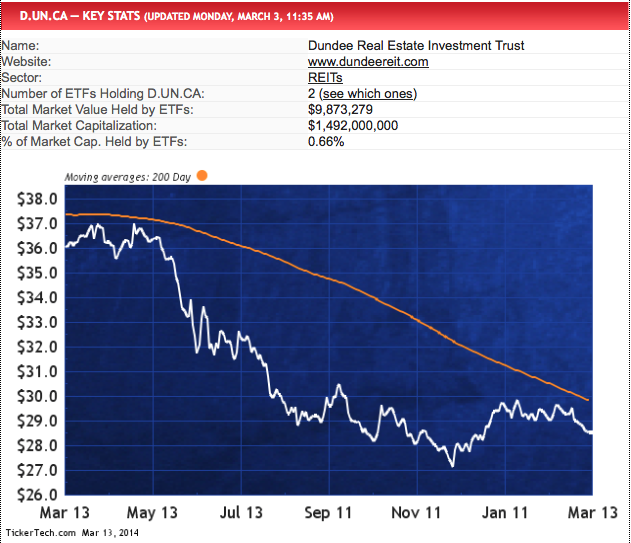
Yielding from 4.8% – 8.7% these 10 mostly Real Estate Investment Trusts. So if you are in need of income and a fan of Real Estate, this collection of investments sought out by the Canada Stock Research Staff are something to take a look at in an environment where you can barely get any return at all on money sitting in a savings account. As you can see the first example is selling significanly cheaper (thus yielding more) than it was a year ago – Editor Money Talks

(1) Dundee Real Estate Investment Trust (TSE:D.UN.CA) — 7.8% YIELD

Dundee Real Estate Investment Trust is an open-ended investment trust. The trust is engaged in the provision of business premises and management services to its tenants and other businesses in Canada. As of Dec 31 2010, Co. owned a diversified portfolio of 111 office and industrial properties offering approx. 12,300,000 sq. ft. of gross leasable area.

Screen Shot 2014-03-13 at 6.07.07 AM


Screen Shot 2014-03-13 at 6.08.09 AM

Sellers Exhausted, Inventories Low, Physical Demand is Rising

Charles Oliver: Gold to 5,000 within a few Years

Charles Oliver joined Sprott Asset Management LP in January 2008. He focuses on gold and silver investments as a portfolio manager for the Sprott Gold & Precious Minerals Fund and the Silver Equities Class.

When I spoke to Mr. Oliver last summer, he said the weakness in the gold price in the face of unprecedented money printing from the Fed had taken him by surprise.

Have we passed a decisive point since then? Is gold heading up?

“I believed throughout 2013, with the price of gold coming down, the fundamentals were only getting better,” he answered. “During that time, the Chinese bought like mad and the Fed printed another trillion dollars through QE. Nonetheless, heavy selling took the gold price down.

“Today, the difference is that the sellers are exhausted, and physical demand is catching up. One of the numbers we are looking at is the quantity of registered inventories on the COMEX for gold. That’s the amount of physical gold that is available when someone asks for physical delivery instead of a cash settlement.”

In the following chart from Bloomberg, we can see inventories of physical gold on the COMEX (in ounces) have declined dramatically, falling by around 30% in the past year:

image001

Please note these are total eligible reserves, which can become registered by the banks in order to settle futures contracts for physical delivery. 

Mr. Oliver continues: “One day, we might see someone try to break the market on the physical side, by demanding delivery of more tons than can be supplied – hence driving the price up.

“Because of this threat, I would tell investors in the metals to stick to ‘fully-allocated’ products, where you have a claim to a specific amount of metal that is physically held in a vault, not lent out or hypothecated.”

So have we reached a point where physical demand will drive the price of gold up?

“The demand coming from China boggles the mind. Imports of gold through Beijing were somewhere on the order of 100 tons a month last fall.1 Assuming this trend continues, China might import 1,200 tons or more this year. That is nearly half of the world’s annual mine production of around 2,600, whereas 5 years ago, they hardly imported any. I believe a good portion of the 800 tons2 that were sold from ETF holdings subsequently were shipped to Asia.”

Gold and associated stocks have attracted value-oriented investors to the space, he adds.

“I’ve noted interest from the ‘big money’ in the U.S., partly because gold stock valuations are the cheapest they have been in 25 years. Last fall, big mining companies were paying dividends as high as 5% according to my numbers, whereas they usually paid under 1% — if anything — a decade ago. Price appreciation and companies cutting their dividends have brought them back to lower levels generally since then.

“Asian entities have been eyeing gold companies for the last decade. Last year we saw the Chinese make a few acquisitions in the Australian market, and they continue to show interest in gold companies in many different jurisdictions. And of course, Sprott itself recently launched two important partnerships with major sovereign and semi-sovereign funds in South Korea and China.”

Could gold head lower in the near-term?

“As far as the price going down again, we already saw gold bounce off from $1,180 in December, which represented a 39 % retracement from the peak – a significant number from a technical perspective. Certainly another powerful support level would be around $1,000. There were several times before 2008 when gold hit that level and came back. I believe that would be a very firm support level for gold if it dropped again.”

Where is gold headed a few years out?

“In 1980, when the gold price peaked at $800, it took 1 ounce of gold to buy the Dow Jones Index. After 1980, financial assets took the lead over hard assets. In 1999, it took 44 ounces of gold to buy the Dow Jones, at a gold price of $250. If gold were to regain the position it held in 1980, we could easily see a 3:1 ratio – gold at $5,000 given the current level of the Dow Jones, or even $15,000 if gold returns to the 1:1 level.

“Ultimately, I believe that the gold price could reach $5,000 within a few years, and perhaps go well beyond. Deficits and rising debts, exacerbated by demographic issues, are here to stay. And money printing and higher gold demand along with them.”

P.S.: Want to discuss investing with someone from the Sprott team? For U.S., and all non-Canadian investors, contact us at contact@sprottglobal.com, or call 1.800.477.7853. Canadian residents may contact Michael Kosowan at MKosowan@sprottwealth.com.

Charles Oliver joined Sprott Asset Management LP in 2008. He is Lead Portfolio Manager of the Sprott Gold & Precious Mineral Fund and co-manager of Sprott Silver Equities Class. Charles combines a big picture approach with a bottom-up process, and focuses on strong management teams with sound strategy.

1 http://www.bloomberg.com/news/2014-01-27/china-s-gold-imports-from-hong-kong-climb-to-record.html

2 http://www.mineweb.com/mineweb/content/en/mineweb-gold-analysis?oid=221870&sn=Detail

WE CANNOT ACT UPON, AND WILL NOT ACCEPT, ANY TIME-SENSITIVE ELECTRONIC MESSAGES, SUCH AS TRADES OR TRANSACTION ORDERS BY EMAIL AND ANY SUCH MESSAGES WILL BE ACCEPTED ON A “BEST EFFORTS” ONLY BASIS. ALSO, FOR YOUR PROTECTION, PLEASE DO NOT SEND ANY IDENTIFYING INFORMATION, SUCH AS ACCOUNT NUMBERS OR SOCIAL SECURITY NUMBERS, THROUGH THE INTERNET. 
This communication is for informational purposes only. It is not intended as an offer or solicitation for the purchase or sale of any financial instrument or as an official confirmation of any transaction. All market prices, data and other information are not warranted as to completeness or accuracy and are subject to change without notice. Any comments or statements made herein do not necessarily reflect those of Sprott Global Resource Investments Ltd, Sprott Asset Management USA, Resource Capital Investment Corporation, its subsidiaries and affiliates. This transmission may contain information that is privileged and confidential. If you are not the intended recipient, you are hereby notified that any disclosure, copying, distribution, or use of the information contained herein (including any reliance thereon) is STRICTLY PROHIBITED. Please notify the sender immediately if this message was transmitted in error. Although this transmission and any attachments are believed to be free of any virus or other defect that might affect any computer system into which it is received and opened, it is the responsibility of the recipient to ensure that it is virus free and no responsibility is accepted by of Sprott Global Resource Investments Ltd, Sprott Asset Management USA., Resource Capital Investment Corporation, its subsidiaries and affiliates, as applicable, for any loss or damage arising in any way from its use. If you received this transmission in error, please immediately contact the sender and destroy the material in its entirety, whether in electronic or hard copy format.


test-php-789