
Gold & Precious Metals
 Summary:
- Gold & silver prices are consolidating for a couple of weeks.
- Central Fund of Canada & Central Gold Trust offer a better discount than last month.
- Trying to arbitrage this discount might not be a good idea.
Gold is in correction mode for two weeks, and silver for one month. Seasonality is not supportive any more for precious metals (read here). The fundamental picture remains unclear: inflation stays low, production prices are not a safe way to estimate a bottom, and the concentration of future contracts by a few major players has not changed. Miners are following the move down (GDX, GDXJ). I wrote here in February that it was a bit premature to call for the end of the precious metals bear market. One month later, gold is still above its 200-day simple moving average, but silver fell back below.
My aim here is not to make a prediction, but to show investors where they can find the best value for their money. It might be or not a good time to invest in precious metals, however there is no bad time to buy reasonable amounts as insurance. The next table shows discounts, premiums and real metal allocated for some Canadian funds on 3/24/2014. They are an alternative to ETFs likeGLD, SLV, PPLT, PALL.
|
Data: 3/24/2014 on close |
Tickers |
+Premium -Discount |
Annual Fees |
% of NAV in bullion* |
|
Central Fund of Canada |
NYSE:CEF TSX: CEF.A |
-6.4% |
0.45% |
99.3% (gold 58.4%, silver 40.9%) |
|
Central Gold Trust |
NYSE:GTU TSX: GTU.UN |
-5.6% |
0.35% |
97.8% |
|
Sprott Physical Gold Trust |
NYSE:PHYS TSX: PHY.U |
-0.29% |
0.35% |
99.3% |
|
Sprott Physical Silver Trust |
NYSE:PSLV TSX: PHS.U |
+1.9% |
0.45% |
99.4% |
|
Sprott Physical Platinum & Palladium Trust |
NYSE:SPPP TSX: PPT.U |
+2.95% |
0.5% |
100% |
*complement is in certificates and cash assets.
CEF and GTU discounts are up since last month, providing an additional safety margin in case metal prices fall lower. Sprott funds are less attractive. An arbitrage, for example buying GTU and shorting GLD, is not a so good idea. Discounts in CEF and GTU have been oscillating between 4% and 8% for two years. At the end, borrowing costs might eat the profit and possibly more.
About Fred Piard
In his first book Quantitative Investing (Harriman House), Fred explains how you can build yourself robust portfolios with simple and powerful strategies. A book on statistical fundamental analysis is planned for Q4 2014 (same editor).
Fred shares his portfolio positions and market outlook in a weekly newsletter (ypafi.com).
He holds a PhD in computer science, an MSc in software engineering, an MSc in civil engineering, and is self-taught in finance. For two decades, Fred has been a consultant for companies and public agencies in various sectors and countries.

A conservative investor, a follower of Benjamin Graham’s & David Dodd’s philosophy that the better the bargain the lower the risk, summarizes what a lower risk investor should be doing in these markets.
When reading some might want to bear in mind that another very successful conservative investor Warren Buffett, has been quoted saying that if he never sold a single stock he’d bought he’d have made more money than he has.
That said we all know it is very difficult to sit through a 30-40% decline and taking “some chips off the table” certainly opens the opportunity to reload at significantly lower prices. The author makes a detailed case below. For those in a hurry click HERE and scroll down for his conclusion – Editor Money Talks
Time To Sell This Bull Market?
Summary
- The bull market is in the latter stage of the business cycle.
- Certain indicators suggest an overheated market.
- What to do during this time in a bull market.
“A bull market is like sex. It feels best just before it ends.” – Barton Briggs
With the S&P 500 near all-time highs, inquiring minds want to know whether this bull market is about to end or will there be more market gains to come?
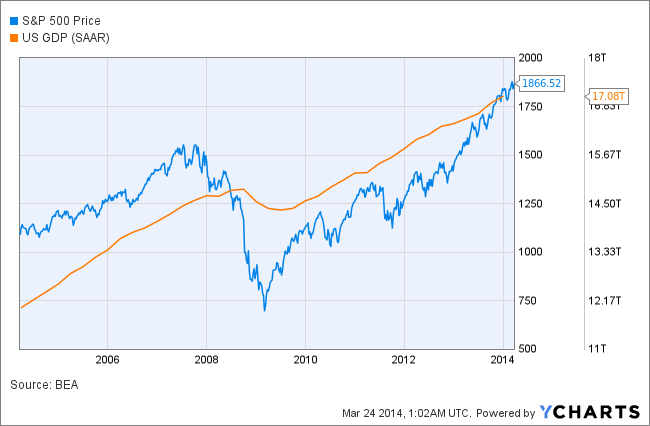
….continue reading HERE

The red flags contained in the national and global headlines that have come out thus far in 2014 should have spooked investors and economic forecasters. Instead the markets have barely noticed. It seems that the majority opinion on Wall Street and Washington is that we have entered an era of good fortune made possible by the benevolent hand of the Federal Reserve. Ben Bernanke and now Janet Yellen have apparently removed all the economic rough edges that would normally draw blood. As a result of this monetary “baby-proofing,” a strong economy is no longer considered necessary for rising stock and real estate prices.
But unfortunately, everything has a price, even free money. Our current quest to push up asset prices at all costs will come back to bite all Americans squarely in the pocket book. Death and taxes have long been linked by a popular maxim. However, there also exists a similar link between debt and taxes. The debt we are now incurring in order to buttress current stock and real estate will inevitably lead to higher taxes down the road. However, don’t expect the taxes to arrive in their traditional garb. Instead, the stealth tax of inflation will be used to drain Americans of their hard earned purchasing power.
I explore this connection in great length in my latest report Taxed By Debt, available for free download at www.taxedbydebt.com. But diagnosing a problem is just half the battle. I also present investing strategies that I believe can help Americans avoid the traps that are now being laid so carefully.
The last few years have proven that there is no line Washington will not cross in order to keep bubbles from popping. Just 10 years ago many of the analysts now crowing about the perfect conditions would have been appalled by policies that have been implemented to create them. The Fed has held interest rates at zero for five consecutive years, it has purchased trillions of dollars of Treasury and mortgage-backed securities, and the Federal government has stimulated the economy through four consecutive trillion-dollar annual deficits. While these moves may once have been looked on as something shocking…now anything goes.
But the new monetary morality has nothing to do with virtue, and everything to do with necessity. It is no accident that the concept of “inflation” has experienced a dramatic makeover during the past few years. Traditionally, mainstream discussion treated inflation as a pestilence best vanquished by a strong economy and prudent bankers. Now it is widely seen as a pre-condition to economic health. Economists are making this bizarre argument not because it makes any sense, but because they have no other choice.
America is trying to borrow its way out of recession. We are creating debt now in order to push up prices and create the illusion of prosperity. To do this you must convince people that inflation is a good thing…even while they instinctively prefer low prices to high. But rising asset prices do little to help the underlying economy. That is why we have been stuck in what some economists are calling a “jobless recovery.” The real reason it’s jobless is because it’s not a real recovery! So while the current booms in stocks and condominiums have been gifts to financial speculators and the corporate elite, average Americans can only watch from the sidewalks as the parade passes them by. That’s why sales of Mercedes and Maseratis are setting record highs while Fords and Chevrolets sit on showroom floors. Rising prices to do not create jobs, increase savings or expand production. Instead all we get is debt, which at some point in the future must be repaid.
As detailed in my special report, when President Obama took office at the end of 2008, the national debt was about $10 trillion. Just five years later it has surpassed a staggering $17.5 trillion. This raw increase is roughly equivalent to all the Federal debt accumulated from the birth of our republic to 2004! The defenders of this debt explosion tell us that the growth eventually sparked by this stimulus will allow the U.S. to repay comfortably. Talk about waiting for Godot. To actually repay, we will have few options. We can cut government spending, raise taxes, borrow, or print. But as we have seen so often in recent years, neither political party has the will to either increase taxes or decrease spending.
So if cutting and taxing are off the table, we can expect borrowing and printing. That is exactly what has been happening. In recent years, the Fed has bought approximately 60% of the debt issued by the Treasury. This has kept the bond market strong and interest rates extremely low. But a country can’t buy its own debt with impunity indefinitely. In fact the Fed, by winding down its QE program by the end of 2014, has threatened to bring the party to an end.
Although bond yields remain close to record low territory, thanks to continued QE buying, we have seen vividly in recent years how the markets react negatively to any hint of higher rates. That’s why any indication that the Fed will lift rates from zero can be enough to plunge the markets into the red. The biggest market reaction to Yellen’s press conference this week came when the Chairwoman seemed to fix early 2015 as the time in which rates could be lifted from zero. That possibility slapped the markets like a frigid polar wind.
Janet Yellen may talk about tightening someday, but she will continue to move the goalposts to avoid actually having to do so. (Or as she did this week, remove the goalposts altogether). As global investors finally realize that the Fed has no credible exit strategy from its zero interest policy, they will fashion their own exit strategy from U.S. obligations. Should this happen, interest rates will spike, the dollar will plunge, and inflation’s impact on consumer prices will be far more pronounced than it is today. This is when the inflation tax will take a much larger bite out of our savings and paychecks. The debt that sustains us now will one day be our undoing.
But there are steps investors can take to help mitigate the damage, particularly by moving assets to those areas of the world that are not making the same mistakes that we are. In my new report, I describe many of these markets. Just because the majority of investors seem to be swallowing the snake oil being peddled doesn’t mean it’s wise to join the party. I urge you to download my report and decide for yourself.
Peter
Subscribe to Euro Pacific’s Weekly Digest: Receive all commentaries by Peter Schiff, John Browne, and other Euro Pacific commentators delivered to your inbox every Monday!
For in-depth analysis of this and other investment topics, subscribe to Peter Schiff’s Global Investor newsletter. CLICK HERE for your free subscription.

 It’s amazing how quickly China went from being the world’s savior to its biggest danger. To recap:
When the developed world stepped off a cliff in 2008, China responded by borrowing about $15 trillion and spending most of it on infrastructure. Roads, bridges, skyscrapers, power plants, whole cities went up around the country. The resulting demand for everything from iron ore to wind turbines helped offset contractions in the US and Europe, turning an incipient global Depression into nothing more than a severe recession.
But government-directed growth on this scale produces a mountain of misallocated capital which eventually comes back to haunt its owner. Lately, Chinese manufacturing has begun to contract:
China Output Contracts at Quickest Pace in 18 Months
The HSBC Flash China Manufacturing PMI shows Output Contracts at Quickest Pace in 18 Months. The overall PMI index, new orders, and production were all lower.
Key points
• Flash China Manufacturing PMI™ at 48.1 in March (48.5 in February). Eight-month low.
• Flash China Manufacturing Output Index at 47.3 in March (48.8 in February). Eighteen-month low.Commenting on the Flash China Manufacturing PMI survey, Hongbin Qu, Chief Economist, China & Co – Head of Asian Economic Research at HSBC said: “The HSBC Flash China Manufacturing PMI reading for March suggests that China’s growth momentum continued to slow down. Weakness is broadly-based with domestic demand softening further.
And mass defaults are looming:
….continue reading HERE

A Short Sale on Gold & Silver was recommended on March 18th by this author, depending or if you put a trade on that day, at a point roughly $45 higher in Gold & $1 higher in Silver. Because his recommendation has turned out to be very accurate, it would be a very good idea to follow this man’s work for the point at which he would cover his short sale. At that point of covering the shorts, those wanting to add to their Gold & Sliver would find that a reasonable point to add to their positions or for those wanting in for the first time to take a position/. In the meantime, those with Short Term speculative money, Przemyslaw Radomski continues to lay out the case for making money on a decline , and protecting your capital with stops he lists below – Editor Money Talks
Gold & Silver Trading Alert: Confirmation of a Breakdown
Briefly: In our opinion short speculative positions in silver (half) and mining stocks (full) are justified from the risk/reward perspective.
Friday was generally a calm day in the precious metals market and for the currency indices. The initial moves higher (in the early part of the session) were mostly invalidated later on and overall not much changed at the first sight. On second look, the lack of rally confirmed the breakdown in mining stocks. Let’s take a look (charts courtesy ofhttp://stockcharts.com):
(click on chart for larger view)

Interestingly, we can summarize the above chart in the same way that we did previously, because the daily move that we saw on Friday didn’t change anything overall:
Gold moved lower once again [on Thursday, but basically it didn’t do anything on Friday]but still not low enough to break below the rising support line. Gold is still outperforming silver and mining stocks (taking this month into account), but now the extent of the outperformance is much smaller. Still, with the situation in Ukraine still being tense, gold might hold up relatively well even if the rest of the precious metals sector declines.
At this time we see that gold’s reaction to the events in Ukraine has been very limited. When markets don’t react to factors that should make them move in a certain direction, they will likely move in the opposite direction relatively soon. In this case, it seems that gold will move lower.
The move below the rising support line (marked in red) could symbolize the start of another big downleg regardless of the geopolitical tensions. For now, the price of gold is already close to this support, but not yet below it.

Silver declined more than 5% last week. It moved below the rising support lines and closed there on Friday, which is a bearish indication. The situation in silver is oversold, but only on a short-term basis. Consequently, we could still see a corrective upswing here before the decline continues. Miners confirmed their breakdown, but there was no short-term breakdown in gold, so it’s not that clear whether the precious metals sector – including silver – will move lower immediately. It could be the case that miners while decline while metals will pause for a few more days.
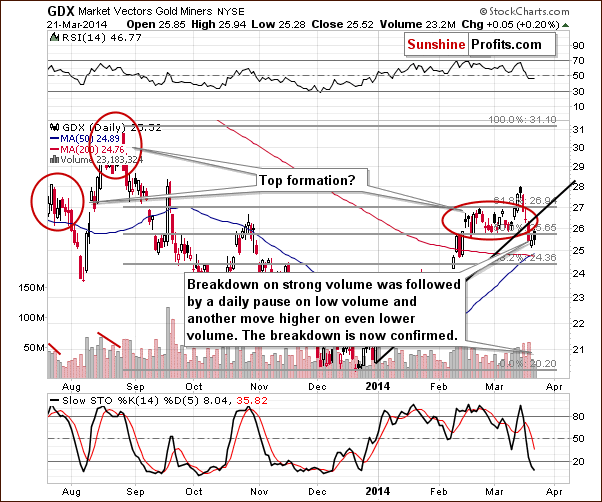
The GDX ETF closed below the rising support line and the 50% Fibonacci retracement level for the third consecutive trading day and the breakdown is now complete. If we hadn’t mentioned the extra short position in miners previouly, we would suggest it today. Please note that the small move up that we saw in the past 2 trading days materialized on low volume after a huge-volume decline. This suggests that the real move is down and that miners simply took a breather.

The HUI Index closed the week without a meaningful move back up, and the sell signal from the Stochastic indicator along with its implications remain in place. We previously commented on it in the following way:
We saw a big downswing also in the HUI Index and it resulted in a major sell signal from the Stochastic indicator. In the past 3 years all cases (and many cases before 2011) when we saw this signal were followed by major downswings.
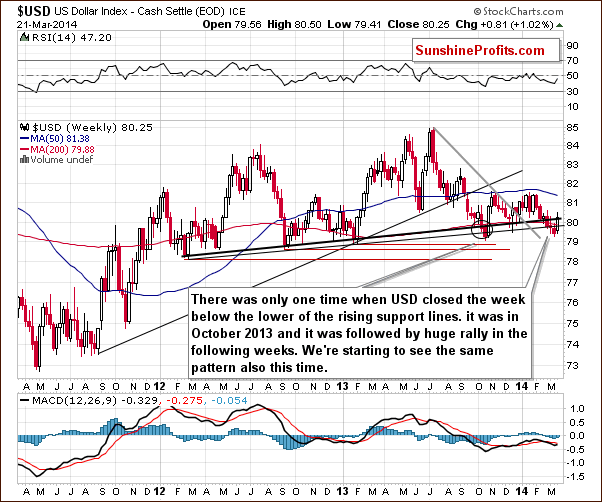
The USD Index finally rallied last week and it seems that this year’s decline is over. There are no sure bets in any market, but this week’s rally looks very similar to what we saw in October 2013. Back then the currency was also a little below the rising support lines only to come back with a vengenace. We saw this type of action last week and the outlook was bullish.
All in all, we can summarize the current situation in the precious metals market in the same way we have been summarizing it for the last couple of days:
It seems that the precious metals sector will move lower in the coming weeks, but just in case the situation in Ukraine deteriorates, we are keeping half of the long-term investment position in gold. In fact, gold has been outperforming both silver and mining stocks since Russian troops entered Crimea.
The technical picture for silver and – especially – for mining stocks is bearish, so in our opinion short positions here are justified from the risk/reward perspective. We might add to the short position in silver and open one in gold relatively soon – we will keep you informed.
It seems to us that if it weren’t for the events in Ukraine, the precious metals sector would be already declining and perhaps testing the 2013 lows or moving below them. This could still take place and it’s quite likely to happen once the situation in Ukraine stabilizes.
To summarize:
Trading capital (our opinion): Short positions: silver (half) and (full) mining stocks.
Stop-loss details:
– Silver: $22.60
– GDX ETF: $28.9
Long-term capital (our opinion): Half position in gold, no positions in silver, platinum and mining stocks.
Insurance capital (our opinion): Full position
Thank you.
Przemyslaw Radomski, CFA
Founder, Editor-in-chief
Tools for Effective Gold & Silver Investments – SunshineProfits.com
Tools für Effektives Gold- und Silber-Investment – SunshineProfits.DE
* * * * *
Disclaimer
All essays, research and information found above represent analyses and opinions of Przemyslaw Radomski, CFA and Sunshine Profits’ associates only. As such, it may prove wrong and be a subject to change without notice. Opinions and analyses were based on data available to authors of respective essays at the time of writing. Although the information provided above is based on careful research and sources that are believed to be accurate, Przemyslaw Radomski, CFA and his associates do not guarantee the accuracy or thoroughness of the data or information reported. The opinions published above are neither an offer nor a recommendation to purchase or sell any securities. Mr. Radomski is not a Registered Securities Advisor. By reading Przemyslaw Radomski’s, CFA reports you fully agree that he will not be held responsible or liable for any decisions you make regarding any information provided in these reports. Investing, trading and speculation in any financial markets may involve high risk of loss. Przemyslaw Radomski, CFA, Sunshine Profits’ employees and affiliates as well as members of their families may have a short or long position in any securities, including those mentioned in any of the reports or essays, and may make additional purchases and/or sales of those securities without notice.

-
I know Mike is a very solid investor and respect his opinions very much. So if he says pay attention to this or that - I will.
~ Dale G.
-
I've started managing my own investments so view Michael's site as a one-stop shop from which to get information and perspectives.
~ Dave E.
-
Michael offers easy reading, honest, common sense information that anyone can use in a practical manner.
~ der_al.
-
A sane voice in a scrambled investment world.
~ Ed R.
Inside Edge Pro Contributors

Greg Weldon

Josef Schachter

Tyler Bollhorn

Ryan Irvine

Paul Beattie

Martin Straith

Patrick Ceresna

Mark Leibovit

James Thorne

Victor Adair