
Stocks & Equities
Ben Bernanke, Janet Yellen, and Alan Greenspan have explicitly stated within the last few months that stock markets are not in a bubble.
History shows their track record on such predictions is embarrassing, which has left both Greenspan and Bernanke grasping for excuses after previous bubbles burst on their watch.
Soon it will be Janet Yellen’s turn to backpedal, as there is simple-yet-compelling evidence that stock markets are indeed right now in an unsustainable growth pattern.
Yup, it’s a bubble.
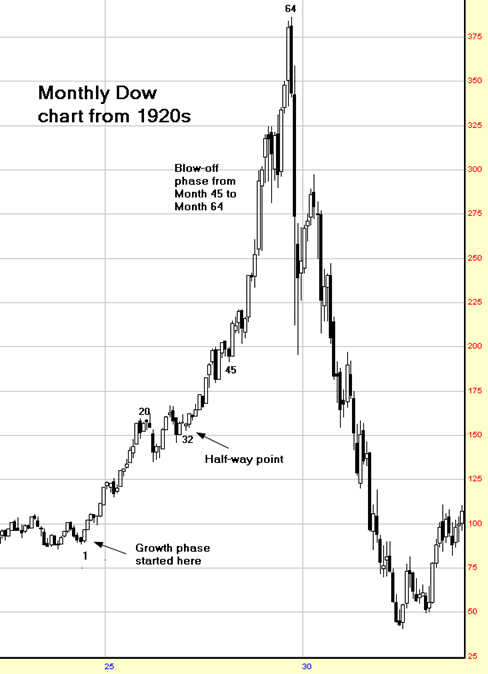
In what may come as a surprise to Fed Chairs and Nobel Laureates everywhere, it turns out the most valuable skill needed to identify a bubble in financial markets is the ability to count to 64.
All the “name-brand” market bubbles in history have lasted 64 months from initial growth to blow-off top. This includes the 3 biggest bubbles in modern market history:
– the Dow into the 1929 peak
– the Nikkei into the 1989 peak
– the Nasdaq 100 into the 2000 peak
This also includes more recent bubbles, such as home-builders into 2005, and crude oil into 2007.
If it’s an unsustainable growth pattern heading for a crash, it carries this 64-month time signature.

As an interesting aside, the famous stock market crash in October 1987 had a slightly different — but equally interesting — time signature. The top in 1987 came at Month 61, with Month 64 turning out to be the post-crash low.
This pattern was different in that it turned out to be a sustainable pattern, with prices recovering fairly quickly to keep pushing relentlessly higher. It was just a hiccup — or maybe a dry heave — on the way to the epic bull market in the 1990s.
So why 64 months? Why that specific number?
That answer is beyond the scope of a short web post but the sound-bite explanation is because this is aligned with the fractal scaling constant that can be observed in all facets of human life on planet earth. It is not a coincidence that the retirement age is 65 years, or that there are 64 – 65 trading days in 3 calendar months (one season). These patterns work across all timeframes. A 64-day growth pattern is seen frequently during strong market uptrends, and it can also be readily observed on hourly charts, and even 5 minute charts.
It’s fractal scaling. It’s there to be observed by simply counting.
There is good news and bad news for the bulls on this current 64-month pattern.

The bad news is time is almost up on this pattern. The energy is set to flip to the downside in June, or possibly July of this year if the timing extends out to Month 65, which sometimes happens.
The good news for the bulls is often the end-stage of a bubble pattern brings on a huge upside explosion. So even though Month 64 arrives in just a few months there is still plenty of time for more gains — even amazing gains.
There are some nuances to how these patterns play out during the end stages. Frequently there is a broad double top, and the configuration of timing of this particular 64-month growth pattern does suggest a double top is in store.
That could create a highly unstable and volatile environment for stock prices between now and July. I have been discussing the various scenarios for the end-stage of this pattern in my daily reports as there are straightforward ways to analyze this in real-time.
Interestingly, one of the individual stocks that is sure to become a cautionary tale about this particular bubble has already hit its 64 month high.

One final note: I have been tracking the growth in bitcoin for quite some time, well before the bubbly price behavior that has emerged over the past year in this emerging decentralized medium of exchange. I am purposely not calling it a currency as that carries connotations that seem to distract people from really examining the magnitude of this breakthrough in network design.
The really intriguing thing about Bitcoin is you can “buy stock” in the entire emerging ecosystem simply by owning some bitcoin. There was never a way to “buy SMTP” or “buy HTTP” or “buy WiFi” like there is now with Bitcoin.
There are classic timing signatures of a 64-month bubble pattern in the bitcoin chart, with the surges and corrections happening on schedule. The main difference is the scale of the price moves, which are unlike any previous growth pattern. The potential of this pattern is really quite staggering. I have just added a new section to my daily reportsto discuss bitcoin, to keep subscribers up to date on this unprecedented bubble pattern.

“putting your money where the market is”
Here’s an Unexpected Vote For Coal
There’s a lot of money to be made spotting market bottoms in commodities. Buying producers and projects at ultra-low valuations, before the inevitable uptick in a sector.
Market commentaries are a key indicator in this regard. With bottoms usually being marked by “irrational apathy”–illogical reasoning from market bears who’ve simply been spooked by falling valuations in unloved sectors.
There’s been a lot of such sentiment lately in coal.
I was particularly struck by one comment the last few weeks. From a high-profile market analyst, who noted that Asian coal demand can be written off as a market driver. Because no one in this part of the world wants to build new coal-fired power plants.
It’s striking how such analysis flies in the face of actual events on the ground. In fact, just this week we got news of one high-profile energy consumer that’s actively looking to add more coal power to its supply mix.
That’s Tokyo Gas, Japan’s largest municipal natural gas utility. Whose managers told a major power conference that the firm has “strong interest” in building new coal-fired power plants in order to diversify energy supply.
The comments came from Tokyo Gas executive officer and senior general manager Kunio Nohata. Who told the Gastech conference in Goyang, South Korea that his company “may have a coal-fired power plant in the future or at least, we may buy electricity from coal-fired power plants.”
The move comes as Japanese utilities come under increasing pressure to cut fuel costs. With prices for alternative fuels like LNG still running at very high levels here compared to other parts of the world.
At the very least, this shows that big players are still receptive to coal. At the most, it could signal a wave of increasing coal demand as power producers increasingly come to rely on this cheap and reliable baseload fuel.
We’re seeing the same story in India, East Africa and Southeast Asia. If analysts are saying otherwise, it might be time to be looking for a bottom in this sector.
Here’s to putting your money where the market is,


For some further perspective on the current state of the stock market, today’s chart presents the long-term trend of the S&P 400 (mid-cap stocks). As the chart illustrates, the S&P 400 rallied from late 2002 into the mid-2007 and then gave most of that back during the financial crisis. However, the S&P 400 rebounded well by recouping all losses incurred during the financial crisis and making new record highs in a mere two years. Over the past couple of years, the S&P 400 has continued to trend strongly to the upside. In fact, the S&P 400 has gained over 230% since its financial crisis lows and remains well within the confines of a steep upward sloping trend channel.

Quote of the Day
“Happiness is a direction, not a place.” – Sydney J. Harris
Events of the Day
April 01, 2014 – April Fool’s Day
April 07, 2014 – NCAA men’s basketball championship
April 08, 2014 – NCAA women’s basketball championship
Stocks of the Day
— Find out which stocks investors are focused on with the most active stocks today.
— Which stocks are making big money? Find out with the biggest stock gainers today.
— What are the largest companies? Find out with the largest companies by market cap.
— Which stocks are the biggest dividend payers? Find out with the highest dividend paying stocks.
— You can also quickly review the performance, dividend yield and market capitalization for each of the Dow Jones Industrial Average Companies as well as for each of the S&P 500 Companies.
Notes:
Where should you invest? The answer may surprise you. Find out right now with the exclusive & Barron’s recommended charts of Chart of the Day Plus.

“When a government is dependent upon bankers for money, they and not the leaders of the government control the situation, since the hand that gives is above the hand that takes. Money has no motherland; financiers are without patriotism and without decency; their sole object is gain.” –Napoleon Bonaparte

…read the entire article” THE FOURTEEN YEAR RECESSION

Two months ago, Incrementum Liechtenstein released its chartbook entitled “Monetary Tectonics” which illustrated the raging war between inflation and deflation in 40 charts. Meantime, the authors of the chartbook have launched the “Austrian Economics Golden Opportunities Fund,” a fund that takes investment positions based on the level of inflation. The key tool in their investment decisions is the “Incrementum Inflation Signal” (also referred to as the “monetary seismograph”), a continuing measurement of how much monetary inflation reaches the real economy based on a series of market-based indicators.
The Incrementum Inflation Signal started showing rising inflationary momentum after a period of 19 month of disinflation. Is Inflation making a comeback just as the consensus worries about deflation risk? That was the subject of Incrementum’s first Advisory Board in which much respected names have a seat, including James Rickards, Heinz Blasnik, Rahim Taghizadegan, and Zac Bharucha. The Board was led by Ronald Stoeferle, managing director of Incrementum Liechtenstein, and its partner, Mark Valek. This article summarizes Incrementum’s Advisory Board meeting. The full transcript is at the bottom of this article.
The direction of inflation is important in Incrementum’s Inflation Signal, not the absolute figure. At the moment, especially central bankers and mainstream economists are scared of deflation. Further easing by central bankers could be expected going forward. Related to the Fed’s policy, Rickards expects a pause in the taper by July and perhaps increased asset purchases later this year. “They tapered into weakness. They should have not tapered in December by their own metrics, specifically inflation, employment and a few other things. I expect the sequence as follows: I think they will taper another $10 billion in April, pause in June and July, and then probably increase asset purchases later in the year (maybe August or September). That should be bullish for equities but also signal to commodity investors that inflation is on the way, because it just says that the Fed will do whatever it takes to get inflation.”
In particular the commodity complex shows a significant divergence: industrial metals (especially copper) are weak while agriculturals are very strong, just like precious metals and aggregate commodities. Heinz Blasnik points to China for a better understanding of the industrial metals weakness. “Broad money supply in China (M2) is now growing at 13.2%. That is at the low end from the range of the post decade. M1 has actually collapsed to 1.5% growth from almost 40% in 2009. I think that is where the weakness of industrial metals is coming from. It’s definitely China, because money supply growth is declining and also bank-lending and total lending are declining. It actually seems that house prices are beginning to turn down as well.”
The interesting thing about this breakup in commodities is that “nobody” is talking about it. This seems very reminiscent of the commodities rally that started in 2000-2002.
Related to these inflationary signals, the usefulness of the CPI as a decision making tool is highly questionable. Ronald Stoeferle compares today’s situation with the 70ies when Paul Volcker had the mandate to kill inflation, which is in contrast to today’s central planners who are desperate to create inflation. Their comfort zone is the official CPI inflation rate between 1.5% – 2.5%. They will do whatever it takes to create this inflation.
CPI statistics are not used in Incrementum’s Inflation Signal; the inflation data are market based indicators. The usefulness of the CPI is highly questionable because it cannot measure anything. Central bankers, however, care about it. They would be willing to keep an even higher CPI of 2%.
Rickards believes the CPI will continue to be used by the Fed until such time as nominal rates are normalized, although he thinks we are years away from a normalization of nominal rates. “In other words: If you actually got the Fed-funds-rate to 2.5% – 4%, they would not use quantitative easing as a tool; they would use the policy rate and they would like very much to get back to that world. The problem is that they cannot get back to that world. For so long as the policy rate is zero, they will use quantitative easing. But here is the problem: The global problem in the world today is that we are in a depression. You can have growth in a depression. When you have growth in a depression it is not a recovery. That’s the difference between a depression and a recession. The reason why this is an important distinction is that depressions are structural. When you have a structural problem you need structural solutions. You cannot solve it with monetary solutions because it is not a monetary problem.”
Incrementum’s Advisory Board sees a lot of strength in the current gold price action. In addition, Zac Bharucha points to the recent “independence” in gold. “It has been a sort of risk on, risk off trade. A lot of people have bought gold a couple of years ago because of an Armageddon scenario. And the Fed has postponed Armageddon for now. So a lot of gold got liquidated, and there was great temptation to pile into the rallying stock market. But now you are getting gold at a big discount from where it was selling 3 years ago.” Some people could be looking at gold’s $700 decline from its highs and consider it as a (cheap) insurance.
Stoeferle believes the strength in gold miners provides a confirmation for the metals. Just two months ago, the consensus was $1300 for the end of 2014, which was in significantly different from Stoeferle’s target of $1480. Interestingly, the reversal in gold basically started when the Fed started tapering. “My view is that perhaps, in the last couple of months, the price of gold was already discounting tapering, and perhaps now it is kind of discounting the tapering of taper. So perhaps the gold price is already telling us that there is something boiling.”
The problem for gold, however, is the opportunity cost with all kinds of other assets which are more a beneficiary of this inflationary politics. It could be the main reason of falling gold prices. It even looks like as if the inflationary politics had a deflationary effect on the economy by sucking a lot of funds into financial assets and out of the real economy.
Is the stock market topping? Is it in a bubble? Following indicators raise a yellow flag.
- The sentiment indicators in the US markets shows a very low cash in the mutual funds, just 3.3% cash, which is a historically very low level.
- Sentiment of advisors sits at the highest level since the 87 crash. So sentiment-wise the market looks very stretched.
- There is some of loss of participation in the stock markets but the breadth is still good in the US. Even if the market is turning, US leading stocks will still continue to outperform.
With the prospects of extremely low real interest rates in the foreseeable future, there are almost no profitable alternatives next to stocks, given the explosion in house prices and sky high bond prices. That is exactly what the Fed is aiming for. They want investors to go to long duration assets.
The advance since the 2009 low looks exactly like the bubble model from Sornette. The volatility declines more as the stock market goes higher. These are typical bubble characteristics.
According to Heinz Blasnik, domestic US money supply growth is the decisive factor for US stocks. “The latest year-on-year growth is +7.75% which is below the 10% of 2012. So it is slowing down. But 7.75% year-on-year money supply growth is still quite a lot historically. So we have this strange situation where we have got a market which is overbought, and has extremely bullish sentiment readings. Still the market is going up and the only explanation that I can come up with is that money supply growth is still strong enough to push stocks higher. But there is a limit somewhere. The problem is that we don’t know where that limit is. In 2007, it was 2.6% year-on-year growth. That was enough to burst the real estate bubble and the stock market bubble at the same time. I believe that this time around this demarcation is going to be higher. The reason for believing so is because the underlying economy is much weaker. I would expect that, if money supply growth fall to say 4,5% year-on-year growth, it would be a very big warning sign.”

At the same time, velocity is going down as quickly as money supply is going up. So the question is not: “When does the money supply grow but rather when does velocity pick up?” When the velocity curve turns – that is the point when inflation comes in very rapidly. The problem is that this is a psychological threshold not a monetary threshold.

When velocity turns, it means nominal GDP is beginning to rise, and that probably means prices for other goods are starting to go up.
In addition, the following chart shows that when money supply is expanding and the central bankers are printing a lot of money and suppress interest rates, then money is flying to higher orders of production stages of the economy. It results in more investments in capital, and fewer investments in consumer goods production. Shortly before recessions begin, this process starts to turn over. Right now, it is kind of stalling out. Blasnik is not sure if that points to something meaningful, but if it were the case, it would tie in with the expectation that taper will produce later on this year much weaker economic numbers. This chart is supporting that contention (courtesy of www.acting-man.com)

In closing, there is an important point to be made about Crimea’s potential impact to the financial and monetary system. Rickards sees another nail in the coffin of the role of the US dollar as a reserve currency. One should consider the following. President Obama has more or less anointed Iran as the regional hegemon in the Middle East. This is a stab in the back to Saudi Arabia which for several decades has supported the dollar by insisting that oil has to be priced in dollars. The quid pro quo is that the US would in fact insure the national security of Saudi Arabia. By backing Iran, the US has undermined the national security of Saudi Arabia and therefore Saudi Arabia has less reason to support the dollar.
At the same time, the US is about to impose financial sanctions to Russia. The Russians have reacted by saying they would not pay their dollar loans, and begin to dump US Treasury bills.
We already know what China is doing with gold. Saudi Arabia has less reason to hold dollars because of Iran. Russia has less reason to support the dollar because of the Ukraine.
This is financial warfare on a scale never seen before. Putting all this together, a large part of the world is working very hard to get out of the dollar system. That is going to be bad for the dollar, and it is going to be good for gold.

-
I know Mike is a very solid investor and respect his opinions very much. So if he says pay attention to this or that - I will.
~ Dale G.
-
I've started managing my own investments so view Michael's site as a one-stop shop from which to get information and perspectives.
~ Dave E.
-
Michael offers easy reading, honest, common sense information that anyone can use in a practical manner.
~ der_al.
-
A sane voice in a scrambled investment world.
~ Ed R.
Inside Edge Pro Contributors

Greg Weldon

Josef Schachter

Tyler Bollhorn

Ryan Irvine

Paul Beattie

Martin Straith

Patrick Ceresna

Mark Leibovit

James Thorne

Victor Adair