
Currency

“Nothing in the world can one imagine beforehand, not the least thing, everything is made up of so many unique particulars that cannot be foreseen.”
Nostradamus
Friday Ramble: Do I believe in cycles?
I was asked if I believe in the cycle stuff: The cycles of war, business cycles, investment cycles, etc. My answer was: The more and more I look and study this world and investment stuff—the more and more I believe in the cycle stuff. The seeming irrationality of investors and world “leaders” suggests to me there are a lot more forces operating on human psyche than our Western-educated cause and effect minds can comprehend.
When I talk about technical analysis, to people such as my father in law, they usually consider it some type of black magic, because to them it is all about the fundamentals. Give me hard reasons. In short, people use fundamentals to forecast the future. The problem: What is fundamental today can be farcical tomorrow.
Who in 1913 would have forecasted the horrors ahead starting in 1914?
[I am reading Christopher Clark’s brilliant book, “The Sleepwalkers: How Europe went to War in 1914.” And I recently finished “1913: The year before the storm,” by Florian Illies; interesting anecdotes set chronologically during 1913. One comes away thinking just how wonderful life was in Europe before the folly of war; and asking just how the politicos could screw it up so royally. If you want a good recent rumination of some growing dangers, I suggest today’s article by Phillip Stephens, columnist for the Financial Times, “How the best of times is making way for the worst.”]
I often pontificate about global macro events and what it will mean for a specific investment class. Sometimes I am right about how these events play out. But even then, my investment idea may end up moving in exactly the opposite direction I anticipated. And of course, the better outcome is when my event forecasting proves horribly wrong, but the investment idea attached (cause and effect of course) proves perfectly right.
So how much confidence should I really have in this process of relying on global macro thematics to predict how investments will react? I would submit any confidence level should be very far away from 100%.
I thought this summary from Robert Prechter’s book, “The Wave Principal of Human Social Behavior,” was an excellent criticism of macroeconomic fundamental analysis:
“Economists devise today’s macroeconomic formulations under the presumption that people act like billiard balls following physical laws. Unlike physics formulae, though, the concepts represented by the variables in these equations are often imprecise. Many that are considered precise are not because they ignore the varying mental states of people. Often, the equations do not relate very well to the real world.
“…The biggest flaw is macroeconomic formulations is their underlying assumption that the ‘billiard ball’ has a fixed mental state. However, the mental states of people vary, so their ‘reaction’ to a ‘cause’ will be different at different times.”
[Keep in mind this is Keynesian stuff Mr. Prechter is talking about. The Austrian School of Economics advanced by von Mises makes it very clear equations have little value in the field of economics; it is about human action and subjective valuation; thus, the namesake for von Mises’ masterpiece–“Human Action.”]
This is why when I am asked on occasion: Are you sure X will fall or Y will rally? My short answer is this: I am sure about nothing in the future. What I am most sure about, because I hate to exercise and love to eat and drink, is that I will most likely be as fat tomorrow as I am today. But God-forbid I contract some horrible disease; it will throw me off my routine and I might lose weight. So, what I tend to be most certain about is uncertain. I am forecasting myself enjoying a single-malt today—10-year Glenmorangie—once the market closes. Cheers if I get there.
In the investment world, the only thing we can be somewhat sure about is how much risk we choose to take to bet on a particular idea. [Granted this doesn’t ensure our risk will be limited: Can you say Lehman Brothers, MF Global, and Peregrine Futures? Incidentally, all of which I have had some working relationship in the past. Now there is an interesting correlation.]
My growing lack of faith in forecasting is why I have developed a particularly strong B/S filter when it comes to all those wizards out there who are able to talk about this stuff with such certainty; it is equivalent of the sound of fingernails against a blackboard for me. Here is what I mean…
If you listen to one of the legendary investor types (the real deals) on television, or at a conference, where he is asked to express his market view, you will notice he likely stutters and hesitates and clarifies and questions his own views and sites other plausible scenarios as reasons why he might be wrong. In comparison, the charlatan always appears certain about his market views.
I think the legendary investor type understands he cannot forecast. This is not to say he doesn’t have a tried and true system (edge) he confidently trades. But it is to say he knows, in the end, this game of investing and trading is nothing more than a simple probability bet whether you are using fundamentals or technicals or a combination of the two. And if the legendary type sees it this way, why do we think those who believe in the cyclical nature of collective human behavior to support investment ideas are nuts?
“Our idea is to avoid interference with things we don’t understand. Well, some people are prone to the opposite. The fragilista belongs to that category of persons who are usually in suit and tie, often on Friday’s: he faces your jokes with icy solemnity, and tends to develop back problems early in life from sitting at a desk, riding airplanes, and studying newspapers. He is often involved in a strange ritual, something commonly called “a meeting.” Now, in addition to these traits, he defaults to thinking that what he doesn’t see is not there, or what he does not understand does not exist. At the core, he tends to mistake the unknown for the nonexistent.
“… Because of such delusion, he is what is called a naïve rationalist, a rationalizer, or sometimes just a rationalist, in the sense that he believes that the reasons behind things are automatically accessible to him.”
Nassim Taleb, Antifragile
So, do I believe collective human action often is expressed in a cyclical fashion, which represents repeating patterns? Yes. I would add most of these cycles are non-linear in nature (chaos if you will), but cyclical nonetheless.
I am working on Part II of this Friday ramble and will send to you next week to help clarify my growing cycle view of markets and events with some specific examples.
Happy Friday!
Regards,
Jack Crooks
Black Swan Capital
Phone: 772-349-6883

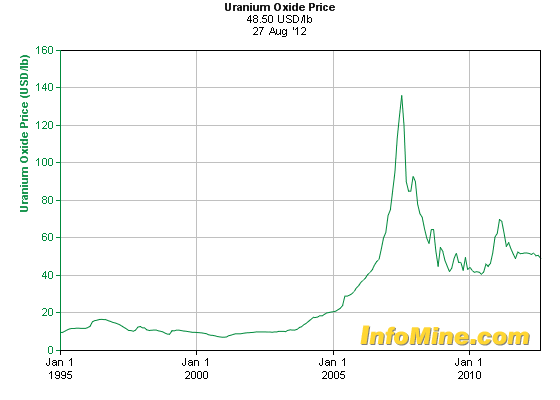 Who will benefit from uranium’s revival?
Global fuel stocks are insufficient, and unmet demand for uranium is growing so it doesn’t take a Ouija board to predict a rebound in the price of uranium In this interview withThe Energy Report, David Sadowski, a mining research analyst at Raymond James, explains the forces that will push the price of uranium, and the companies that are likely to benefit. Being selective, he says, will provide the greatest rewards.
The Energy Report: David, the uranium price remains below the cost of production for many producers and the forecasts for uranium production are flat. Why are you optimistic about the uranium space?
David Sadowski: In the current price environment, supply won’t be able to keep up with demand growth. That’s really the core to the uranium investment thesis. The cost of uranium production spans a pretty wide range, from the mid- to high-teens per pound for the cheapest in-situ leach mines in Kazakhstan, to $50–60/pound ($50–60/lb) for some of the lower-grade, conventional assets in Africa, Australia and East Asia. So we’re looking at about $40 to produce your average pound of uranium. That number is climbing on cost inflation and depletion of the best mines.
The current spot price is under $36/lb, so many operations are underwater right now. That’s why we’ve seen numerous deferrals of projects and even shutdowns of existing mines, the most significant of which was Paladin Energy Ltd.’s (PDN:TSX; PDN:ASX) Kayelekera at the beginning of February. That’s on top of operations that are at risk for other reasons. In just the last few months, we’ve seen four of the world’s largest mines owned by Rio Tinto Plc (RIO:NYSE; RIO:ASX; RIO:LSE; RTPPF:OTCPK) and AREVA SA (AREVA:EPA) shut down on operational and political hiccups. Then you look at where the supposed growth is coming from over the next several years— Cameco Corp.’s (CCO:TSX; CCJ:NYSE) Cigar Lake and China’s Husab. Those are technically very challenging, too. All of this is occurring in a world no longer benefitting from a steady 24 million pounds per year (24 Mlb/year) supply of uranium from downblended Russian warheads. In short, the supply side is a basket case.
Yet demand growth keeps chugging along. European Union (EU) and North American growth perhaps isn’t what it was a couple of decades ago. Pressure from competing energy sources like liquefied natural gas (LNG) in the U.S. is causing some operators to switch off their older, smaller reactors. But reactor retirements are being more than offset by new reactor construction not only in the U.S. and EU, but much more important, in Asia and in Russia. China, India, Korea and Russia are collectively constructing 70 reactors right now.
TER: Japan and the United Arab Emirates (UAE) just announced a program to cooperate in developing nuclear technology. What’s the market significance of that?
DS: There is a push toward nuclear in many of these nations in the Middle East. Not only do they have pretty strong population growth and urbanization, thus electricity growth is strong, but some of those oil-rich nations have cited a preference to sell their petroleum into the international markets rather than domestically. The UAE is a very large potential source of demand growth. It is constructing two nuclear power plants at the moment and is imminently going to break ground on two more. There are an additional 41 new nuclear reactors on the drawing board in the Middle East. So in the context of 434 operable reactors today, that’s a very meaningful amount of growth potential.
Demand growth remains resilient, and supply is lagging behind. In just a few years, we think this will lead to a deficit that will quickly grow to crisis levels. That’s why we’re bullish. Uranium prices have to go higher to incentivize more supply to meet this looming supply gap.
TER: Why hasn’t that happened yet?
DS: There are just a few forces working against the price. Since the Fukushima accident in Japan, there has been a supply glut in the marketplace. There has been a decrease in demand, with a lower level of buying by some countries, like Germany, Switzerland and, of course, Japan. Additionally, some extra supply was coming out of the U.S. government. There is an extra amount coming from enrichment underfeeding. If you add all that up, there has been essentially more supply than is required, and that puts downward pressure on prices. It’s caused the utilities to take a step back from the market.
TER: So do you think conditions in the market itself will materially improve? What will that look like?
DS: For us, it comes down to when the utilities start getting involved again. While the utilities have been sitting on the sidelines over the last couple of years, high-fiving each other for not buying uranium in a declining price environment, their uncovered requirements in the future have actually risen quite dramatically. At some point, they have to resume long-term contracting to cover all those needs. Japan is a key catalyst.
Japan’s reactors were slowly shut down after the Fukushima accident. Right now, none of them are operating. The country’s inventories have piled up to probably around 100 Mlb. Many of these utilities have asked their suppliers to delay deliveries of fresh uranium. That material ends up in the marketplace one way or another, so it’s having a price-dampening effect. In late February, however, the Japanese government announced its final-draft energy plan. Japan will restart at least some of its reactors to stop spending a ludicrous amount of money on imported fossil fuels. There are other economic and environmental benefits, but it’s the country’s trade balance that is really driving the restart push.
It’s these restarts that we think will spur global utilities outside Japan to resume buying. The signal will be sent that Japan won’t be dumping its inventories, it won’t be deferring deliveries anymore and, by the way, there is not enough supply to go around in just a few years so you better start contracting again. That’s what we think is going to support prices.
TER: That basic energy plan in Japan is a draft, but there is a lot of public opinion against it. You do think its prospects are good?
DS: Consensus is that the plan is going to be approved by the cabinet by the end of March. The opposition is highly regionalized, and many pockets of the country are actually very pronuclear. Nuclear, obviously, provides a lot of jobs and generates a lot of tax revenue in these regions.
TER: Raymond James has revised its uranium supply-demand balance and anticipates a growing supply deficit beginning in 2017. What is the case for investing in the industry today with a payoff so far in the future?
DS: A shortfall beginning in 2017 doesn’t mean prices don’t move until 2017. In fact, in a healthy market, they should have moved already. But, again, it comes back to the utilities. They view the nuclear fuel market and their own fuel requirements as a game of risk management.
Today, many utilities are sitting on near-record piles of material, so there’s not a great deal of risk to the utilities with respect to supply availability over the next couple of years. However, as these groups start to look out beyond that period to 2017, 2018 and so on, they’ll realize that it could become more challenging to get the uranium they need. Given that the utilities typically contract three to four years in advance, we’re very close to that window where we expect buying to ramp up again and prices to move upward. Again, critically, we expect Japanese restarts to be an important catalyst in that resumption of buying. We expect first restarts in H2/14 with a half-dozen units online by Christmas. So from an investor’s point of view, we’re already seeing the benefit of this outlook. That’s been driving the uranium equities upward over the past couple of months.
TER: You’re forecasting spot uranium prices averaging $42/lb in 2014, but three months into the year, the price is still struggling to break $36. What will drive it over $42? When do you expect that to happen?
DS: We think the move this year is likely to happen toward the end of this year, as Japanese restarts spark a return of normal buying levels by utilities. The uranium price should really start moving in 2015.
TER: What indicators should investors look for in watching the uranium price trend?
DS: One of the best indicators is Uranium Participation Corp. (U:TSX). Since the fund’s inception, this stock has been a remarkably accurate predictor of where the uranium spot price is headed. When Uranium Participation’s share price is above its net asset value (NAV), the market is baking a higher uranium price into its valuation of the stock because the NAV is calculated at current uranium prices. For even more precision, you can divide the company’s enterprise value by its uranium holdings for a rough dollar/pound estimate on what the market is ascribing. So right now, we calculate the fund is implying $40/lb, and that’s over $4 above the current spot price. This is by no means a bulletproof measure, but absent a black swan event, history tells us that this could be the destination for the price in the near future.
TER: You have said you see $70/lb as the price that will incentivize new mining. What should investors do while they’re waiting for the price to reach that level?
DS: Buy uranium equities. It’s that simple. We think prices are going higher, so buy uranium stocks well ahead of the upswing.
TER: Do you have a target time that you expect the price to reach that level?
DS: We’re looking for the price to reach $70/lb in 2016. We forecast prices flat forward at $70 from that year onward.
TER: Which mining companies are the best investment prospects in this environment? Which are the weaker ones?
DS: They say a rising tide floats all boats. We think all the uranium stocks are probably going higher, or at least the vast majority of them. But we also believe being selective will provide the greatest rewards. Most investors should be looking at names with quality assets, management teams and capital structures.
Among producers, our preferred companies are focused on relatively high-grade projects with solid balance sheets and fixed-price contracts that can buffer them against near-term spot price weakness. After all, we think the spot price could remain weak for most of the balance of 2014.
On the explorer and developer side, the theme is the same—companies with cash and meaningful upcoming catalysts and, again, in good jurisdictions. But if you can tolerate an increased level of risk, I’d be looking at companies with lower-grade assets in Africa. Those are probably the highest-leveraged names out there.
TER: What other favorites can you suggest?
DS: Our top picks at the moment in the space are Fission Uranium Corp. (FCU:TSX.V) and Denison Mines Corp. (DML:TSX; DNN:NYSE.MKT).
Fission has been a top pick in the space for some time. We have a $2/share target and a Strong Buy rating. We view Patterson Lake South as the world’s last known, high-grade, open-pittable uranium asset. It has immense scarcity value. There are not very many projects in the world that can yield a drill intersection of 117 meters (117m) grading 8.5% uranium, as hole 129 did in February. There is only one project in the world where you would find an interval like that starting at 56m below surface, and that’s Fission’s Patterson Lake South. It’s in the best jurisdiction, has a management team that has executed very well and has huge growth potential. We think that property probably hosts over 150 Mlb uranium. We would be very surprised if the company was not taken out at some point in the next two years.
Denison is another story we like a lot. We have a $2/share target and Outperform rating on the stock. Denison has the most dominant land holding of all juniors in the world’s most prolific uranium jurisdiction, the Athabasca Basin in Canada, the same region as Fission Uranium’s Patterson Lake South. The company will run exploration programs at 20 projects in Canada this year, including an $8 million ($8M) campaign at Wheeler River, the world’s third-highest-grading deposit, which continues to grow in size, and with a new understanding of its high-grade potential uncovered last year.
Denison has a stake in the McClean Lake mill, which is also one of its crown jewels. It’s the world’s most advanced uranium processing facility, and it’s located a stone’s throw from hundreds of millions of pounds of high-grade Athabasca uranium deposits. It’s a big part of the reason why we think Denison will get bought out at some point, particularly given that to permit and construct a new mill in the basin would be a herculean task. Denison has a very strong management team and cash position and, once again, big-time scarcity value. It’s one of the only three North American uranium vehicles exceeding a $0.5B market cap. Denison has been and will continue to be a go-to name in the space.
TER: What is another interesting name in your coverage universe?
DS: UEX Corp. (UEX:TSX) owns 49% of the world’s second-largest undeveloped, high-grade uranium asset in Shea Creek and 96 Mlb in NI-43-101-compliant resources. It’s the biggest deposit with that kind of junior ownership in the Athabasca Basin. It’s a strategic asset and the company’s main value driver. But with the uranium price where it is, the company is also focusing on shallower assets near what is now the southern boundary of the Athabasca Basin, closer to Fission’s Patterson Lake South. We’re really interested to see what comes of the Laurie and Mirror projects this year.
We have a $0.60 target price on shares of UEX.
TER: Is any of that influenced by the fact that it has a new CEO?
DS: The target price is not heavily influenced by the recent change in CEO. I think the outgoing CEO, Graham Thody, did an excellent job. I’m very hopeful that Roger Lemaitre will continue that trend. Under the new CEO, I would anticipate that the company may ramp back up the level of work intensity at Shea Creek, to build on the achievements of AREVA and the UEX team as well as Thody. But given Lemaitre ‘s background, including his experience as head of Cameco’s global exploration, I wouldn’t be surprised to see UEX extend its view beyond the Athabasca Basin as a potential consolidator in some other jurisdictions that may be lagging behind a bit on valuation.
TER: You raised your target for Cameco from $25/share to $26/share. Are you expecting the rise to continue there?
DS: Despite the recent run-up in shares, we think there’s a good chance of further strength. Cameco is the industry’s blue-chip stock. It’s the one everyone thinks of when they think of uranium. Given its size and liquidity, it is the only stock many of the big institutional fund managers can invest in. With that backdrop, we think it’s going to be the first stock for fund flows as the space continues to rerate, especially as we get more confirmatory news about Japanese restarts and as Cigar Lake passes through the riskiest part of its ramp-up. We think it should be a very good 24 months for the company.
TER: What other companies do you like in the uranium space?
DS: We recently upgraded Kivalliq Energy Corp. (KIV:TSX.V) to an Outperform rating. Our target price there is $0.50/share. The company has been a laggard in the last few months, but it has Angilak, a solid asset in Nunavut with established high-grade pounds and huge growth potential. Current resources stand at 43 Mlb, but we think there is well over 100 Mlb of district-scale potential. The company is derisking the asset by moving forward with engineering work, like metallurgy and beneficiation, ahead of a preliminary economic assessment potentially later this year. We’re also excited to see what comes with the newly acquired Genesis claims that sit on the same structural corridor that hosts all the mines of the East Athabasca Basin.
We also like Ur-Energy Inc. (URE:TSX; URG:NYSE.MKT), on which we have an Outperform rating and $2.20/share target price. This stock has been on a major tear. We continue to expect great things from Lost Creek in Wyoming. Early numbers from the mine, which just started up in August, have been hugely impressive to us, a testament to the ore body and execution by management. And the financial results should be equally strong, given the company’s high fixed-price contracts. In all, it’s a solid, low-cost miner in a safe jurisdiction, which we think should be in a good position to grow production organically or, using cash flow, buy up cheap assets in the western U.S., a region ripe for consolidation of in-situ leach uranium assets.
TER: Do you have any parting words for investors in the uranium space?
DS: I would just say we think the uranium price is going higher over the next 12–24 months. So in anticipation of that upswing, we recommend investors take a hard look at high-quality uranium stocks today.
TER: You’ve given us a lot to chew on. I appreciate your time.
DS: It’s my pleasure, as always.
David Sadowski is a mining equity research analyst at Raymond James, and has been covering the uranium and junior precious metals spaces for the past seven years. Prior to joining the firm, David worked as a geologist in western Canada with multiple Vancouver-based junior exploration companies, focused on base and precious metals. David holds a Bachelor of Science in Geological Sciences from the University of British Columbia.
Want to read more Energy Report interviews like this? Sign up for our free e-newsletter, and you’ll learn when new articles have been published. To see a list of recent interviews with industry analysts and commentators, visit our Streetwise Interviews page.
DISCLOSURE:
1) Tom Armistead conducted this interview for Streetwise Reports LLC, publisher of The Gold Report, The Energy Report, The Life Sciences Report and The Mining Report, and provides services to Streetwise Reports as an independent contractor.
2) Streetwise Reports does not accept stock in exchange for its services.
3) David Sadowski: I was not paid by Streetwise Reports for participating in this interview. Comments and opinions expressed are my own comments and opinions. I had the opportunity to review the interview for accuracy as of the date of the interview and am responsible for the content of the interview. This interview took place on February 28, 2014. All ratings, facts and figures are reflective of the date of the interview.
4) Interviews are edited for clarity. Streetwise Reports does not make editorial comments or change experts’ statements without their consent.
5) The interview does not constitute investment advice. Each reader is encouraged to consult with his or her individual financial professional and any action a reader takes as a result of information presented here is his or her own responsibility. By opening this page, each reader accepts and agrees to Streetwise Reports’ terms of use and full legal disclaimer.
6) From time to time, Streetwise Reports LLC and its directors, officers, employees or members of their families, as well as persons interviewed for articles and interviews on the site, may have a long or short position in securities mentioned. Directors, officers, employees or members of their families are prohibited from making purchases and/or sales of those securities in the open market or otherwise during the up-to-four-week interval from the time of the interview until after it publishes.
Streetwise – The Energy Report is Copyright © 2014 by Streetwise Reports LLC. All rights are reserved. Streetwise Reports LLC hereby grants an unrestricted license to use or disseminate this copyrighted material (i) only in whole (and always including this disclaimer), but (ii) never in part.
 A significant Price Decline for Oil and Energy Stocks Expected Over Next Two Quarters- SELL
Also in this very detailed report from Josef, who was one of the most profound & popular speakers at the World Outlook Conference Feburary 1st/2014:
The High Impact Drilling Watch List
Research Updates:
Long Run Exploration Ltd. (LRE-T)
Sterling Resources (SLG-V)
Recommended Buy List
…..read this great report HERE
About Josef Schachter
The Schachter Asset Management Inc. team provides energy investment research to Maison Placements – an institutional investment firm – and their institutional clients. The research package includes overview and commodity analyses and forecasts as well as research coverage on Canadian domiciled domestic and international focused oil and gas companies. SAMI also provides energy industry presentations to various other industry related business groups.
The principal of Schachter Asset Management Inc., Josef Schachter, CFA, CMA, has over 35 years of experience in oil and gas investment management. Previously, from 1991 to 1996 Mr. Schachter was with Richardson Greenshields where he was a Director, Chief Market Strategist and a member of its investment policy committee. Josef is a regular commentator on BNN TV as well as various radio shows.

Gold Fibonacci Arc Bull Confirmation Charts Analysis
Silver Perfect Pullback Charts Analysis
US T-Bond Monthly Charts Analysis
Gold Stock Trade Strategy Charts Analysis
“Our main format is now video analysis…”
Above are today’s videos
Thanks,
Morris
Ed Note: One of the reasons this analysis is so clear comes from the full page Big Charts you see when you click on each link above. Below is an example of a chart in a smaller form. Morriis walks you through the analysis in a very clear and thorough manner – Editor Money Talks


The strategy I’m writing about today is one of my favorite, guaranteed moneymakers. These are trades we can all easily make, requiring no capital outlay and guaranteed to make a profit or you don’t make them. What’s the catch? We might occasionally find ourselves lamenting how much more money we might have made.
Experienced investors have likely figured out that I’m talking about a stock option called a “covered call.” Buying options is for speculators, and that’s not what I’m talking about today. I want to show you the one and only option trade that meets my stringent criteria for comfort.
Covered calls:
- Are easily understood;
- Are easy to implement;
- Require no market timing to make your predetermined profit; and
- Require minimal time for investors to manage.
In addition, you can calculate your profit clearly at the time of the trade (if there’s no hefty gain, you pass on it); the risks are financially and emotionally manageable; and the upside potential is excellent with covered calls. Let’s begin with the boilerplate stuff first before we discuss strategy.
There’s an options market that allows people to buy and sell options on stocks. Speculators have made millions of dollars trading options without owning a single share of stock. That’s the wrong place to be with your retirement nest egg. I’m going to show you how an average investor with an online brokerage account can supplement his income in a safe, easy, responsible, and conservative manner.
Let’s start with a basic premise: money is consistently made on the sell side of the transaction. Selling one type of option is the only strategy that will meet our stringent criteria.
Before we proceed, here’s a need-to-know glossary for covered calls:
Stock option. An option is a right that can be bought and sold. There are markets for trading options in an orderly manner. Two transactions may occur between the buyer and seller. The first is the transaction when the right (option) is sold. The second transaction is “optional” and at the discretion of the buyer. If the buyer exercises his right (option), the seller is required to complete an agreed-upon stock transaction. Today we’re focusing on covered call options.
Covered Calls. When you sell a covered call, the buyer purchases the right to buy a certain number of shares of stock which you own, at an agreed upon (strike) price, at any time before the option expires (known as the expiration date). The option buyer is not obligated to buy your stock; he has the right to do so. You’re obligated to sell the stock if the buyer exercises the option. The term for this is your stock gets “called away.” Regardless, you keep the money you were paid when you sold your option.
There are four elements to an option transaction:
- the price of the option in the market (what you can buy or sell it for);
- the number of contracts (each contract is 100 shares);
- the price of the underlying stock (referred to as strike price); and
- the expiration date.
Option price. This is the price the option is bought or sold for. This changes as the price of the underlying stock moves in the market and the time frame moves closer to the expiration date. Readers will see that there are two prices: “bid” and “asked,” just like stocks. When you sell an option, this completes the first part of the transaction. The money changes hands and is yours to keep, regardless of what happens later. Cha-ching!
Strike price. This part of the transaction is agreed upon when the option is bought/sold. Let’s assume the buyer purchased a call (a right to your stock) at a strike price of $55/share. Should the buyer choose to exercise his option, the buyer pays you $55/share, and you (through your broker) deliver the stock, regardless of the current market price of the stock.
Expiration date. Options generally expire on the third Friday of every month. When looking at the options trading platform on any major stock, you’ll find options available for several months in advance. You’ll notice that the longer the remaining time, the higher the price of the option.
At the time the stock option is bought/sold, all of the elements above are agreed upon. The buyer has until the expiration date to exercise his option. The numbers of shares and selling price have already been determined. If your stock is called away, you’ll see the cash come in to your brokerage account, and the shares will automatically be delivered to the buyer.
Never sell a call option without owning the underlying stock; it’s much too risky for your retirement nest egg.
Option contract. An option contract is for 100 shares of the underlying stock. Options are sold in contracts, and the prices are quoted per share. For example, if you see an option price of $1.15, the contract will cost $115 ($1.15 x 100 shares). If a buyer/seller wants to have an option on 500 shares, he buys five contracts.
There are two types of options: puts and calls. We’re going to discuss the only option strategy that meets our stringent, conservative criteria: selling a covered call.
Why would an investor buy a call option? Buyers of call options are generally speculators who believe that a stock will appreciate above the strike price before the option expires. If they guess right, they can make a lot of money.
The vast majority of call options expire worthless. The rules are simple. Don’t sell an option unless you own the underlying stock. (This is referred to as a “naked call”.) Don’t buy options—period!
A Savvy Strategy
We’ll use a fictional company – ABC Products – for an example. Say we bought the stock in October 2012 for $40; the market price one year later (in November 2013) was $55/share. Why would we want to sell a covered call?
In November, ABC was $55/share. We’ll say its current dividend is $0.55/share. The March call option at a strike price of $57 is selling for $1.10/share—twice as much as the current dividend.
Assume that on December 20, you either called your broker or went online and brought up ABC in your trading platform. You would have seen the current bid and asked prices. Assume it sold for $1.10/share.
Now, one of four things could have happened:
- The stock didn’t go over the $57 strike price, so the stock was not called away. In approximately 90 days, you’d have received $0.55/share in dividends, plus $1.10 for the option, for a total of $1.65. You just added more than double the dividend to your yield without spending a penny more of your investment capital. What do we do when the option expires? Look for another juicy opportunity for the June options and do it again!
- Let’s take the worst-case scenario: the market tanked. You had a 20% trailing stop in place. You got stopped out at $44—$11/share lower than the November price. But wait a minute, what about the covered call? The value of the option would also have dropped and sold for mere pennies. If you got stopped out of the stock, you could have bought back the option at the same time. For the sake of illustration, say you bought it back for $0.04. You netted $1.06/share profit. Instead of losing $11/share, your loss became $9.94. If you didn’t buy back your option, you’d have had huge risk exposure should the stock jump back up. It isn’t worth the risk, so you’d spend the few pennies it takes to close out your position.
- You wanted to exit your position before the expiration date. If the stock rises above the strike price of the option, generally the price of the option will move right along with it. If the stock moved to $59/share, you would “buy to close.” The market price should be close to $2/share; however, that would be offset by the fact that you sold your stock for $59.00 share.
If the stock remained stagnant or started to drop and you wanted to exit your position, the market price of the option would decline more rapidly. You’d likely buy back your option at a profit.
- The most difficult situation emotionally is when the stock rises well above the strike price and gets called. Let’s assume that in March, ABC has appreciated to $59/share. Your option is called at $57 (the strike price). You make a profit of $2/share from the time you sold the option, plus the $1.10/share for the option and the $0.55 dividend, for a total of $3.65/share. For the 90-day time frame, you earned 6.3% on your money ($55/share), or 24.9% on an annualized basis, net of brokerage commission. Yet we’ll lament the fact that you could have made more.
In each case, you haven’t invested any more capital. You make 100% profit on the call in two cases. The worst case is you generally break even on the options should you want to exit early. In the vast majority of cases, selling covered calls is straight profit on top of your dividends.
Here are some guidelines:
- Sell covered calls for stocks you own and would gladly keep.
- Sell covered calls to expire after the dividends are paid.
- Sell covered calls at a strike price above the current market price of the stock, referred to as “out of the money.”
- Don’t lament the times your stock gets called. You took a nice profit, and there are plenty more opportunities out there.
- Use stocks that are heavily traded, as they are more liquid.
- To calculate gains for any stock and option price combination, please use ouroption calculator, which you can download here.
Selling selected covered calls is a great way to turbocharge yield without any additional investment. At the same time, it will mitigate a bit of risk. If you have a 20% trailing stop in place and the stock gets stopped out, your 20% will be offset by the profit you made on the option sale. While most investors are starved for yield, you can find yield in the safest and easiest manner possible.
Each month, we look at the Miller’s Money Forever portfolio and recommend and track covered calls on some of our positions. If you’re not a current subscriber, I highly recommend taking advantage of our 90-day, no-risk offer. Sign up at the current promotional rate of $99/year, and download my book and all of our special reports—really take your time and look us over. If within the first 90 days you feel we’re not for you, feel free to cancel and receive a 100% refund, no questions asked. You can still keep the material as our thank-you for taking a look. Click here to subscribe risk-free today.
About the Author

Over the course of his career, Dennis Miller has consulted with many Fortune 500 companies, training hundreds of executives to effectively communicate the value of their company’s products to their customers. Among his many multi-national clients are: GE, Mobil, Shell, Schlumberger, HP, IBM, Corning Glass, Eastman Kodak, AC Nielsen, and Johns-Manville.
An active international lecturer for 40 years, Dennis wrote several books on sales and sales management. He was a contributor to… read more

-
I know Mike is a very solid investor and respect his opinions very much. So if he says pay attention to this or that - I will.
~ Dale G.
-
I've started managing my own investments so view Michael's site as a one-stop shop from which to get information and perspectives.
~ Dave E.
-
Michael offers easy reading, honest, common sense information that anyone can use in a practical manner.
~ der_al.
-
A sane voice in a scrambled investment world.
~ Ed R.
Inside Edge Pro Contributors

Greg Weldon

Josef Schachter

Tyler Bollhorn

Ryan Irvine

Paul Beattie

Martin Straith

Patrick Ceresna

Mark Leibovit

James Thorne

Victor Adair