
Gold & Precious Metals
Briefly: In our opinion short speculative positions in gold (half), silver (half) and mining stocks (full) are justified from the risk/reward perspective. (this is for agressive traders – Editor Money Talks)
Generally, everything that we wrote in our previous alerts remains up-to-date – precious metals are likely to move lower in the coming weeks – and the thing that we would like to emphasize today is that even if we see an upward correction, it will likely not be anything more than just that – a correction. Let’s take a look at the mining stocks chart (charts courtesy of http://stockcharts.com).
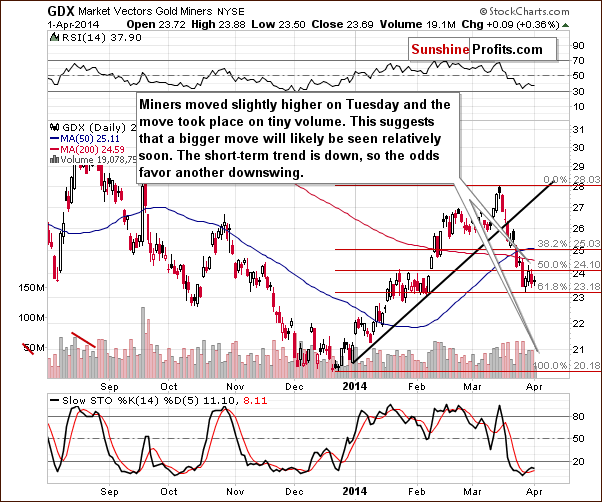
Miners bounced after moving to the 61.8% Fibonacci retracement level and no wonder – the preceding decline had been quite sharp. We could have written that they paused, as the move higher was rather small. Tuesday’s small upswing took place on very low volume, which suggests that we are right before a more significant move – the question is what direction miners will take.
The preceding short-term move was down, so based on the above chart it’s more likely that the next move will be to the downside as well. However, even if we see a move to $25 or so in the coming days, it will still look like a correction.
Why could we see a temporary move higher here?
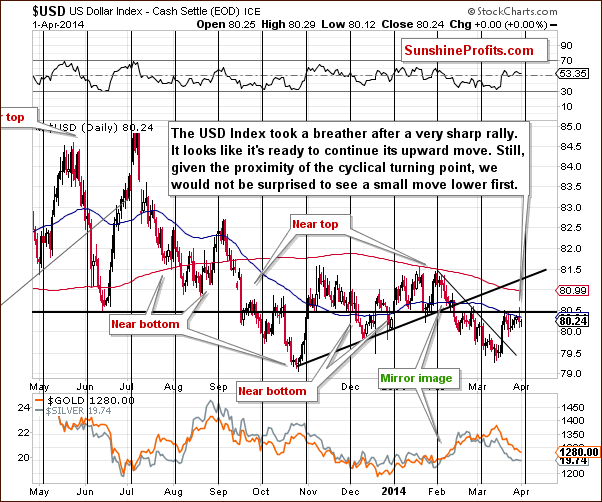
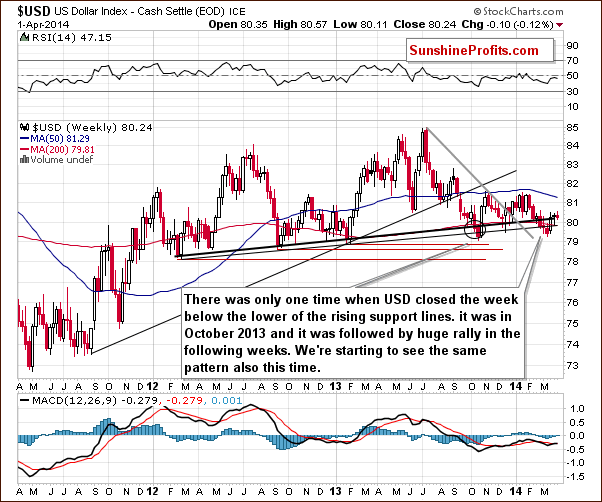
The USD Index is about to reach its cyclical turning point. It’s a tough call to determine the short-term action based on it, as the most recent move was horizontal – the USD Index has been consolidating in the second half of March.
The move that preceded the consolidation had been up, so the next move is also likely to be up, especially that we are after a long-term, medium-term, and short-term breakouts. However, on a very short-term basis, we can’t rule out a dip based on the turning point alone.
As mentioned previously, the situation in the precious metals market and in the USD Index is just as it was in the previous days. The USD index is likely to move higher (even if it declines a bit in the first part of April) as it already paused after a short-term breakout and when it does rally, we will be likely to see another slide in the precious metals sector.
To summarize:
Trading capital (our opinion): Short positions: gold (half), silver (half) and (full) mining stocks.
Stop-loss details:
– Gold: $1,342
– Silver: $20.85
– GDX ETF: $25.6
Long-term capital (our opinion): No positions
Insurance capital (our opinion): Full position
You will find details on our thoughts on gold portfolio structuring in the Key Insights section on our website.
As always, we’ll keep our subscribers updated should our views on the market change. We will continue to send them our Gold & Silver Trading Alerts on each trading day and we will send additional ones whenever appropriate. If you’d like to receive them, please subscribe today.
Thank you.
Przemyslaw Radomski, CFA
Founder, Editor-in-chief
Tools for Effective Gold & Silver Investments – SunshineProfits.com
Tools für Effektives Gold- und Silber-Investment – SunshineProfits.DE
* * * * *
Disclaimer
All essays, research and information found above represent analyses and opinions of Przemyslaw Radomski, CFA and Sunshine Profits’ associates only. As such, it may prove wrong and be a subject to change without notice. Opinions and analyses were based on data available to authors of respective essays at the time of writing. Although the information provided above is based on careful research and sources that are believed to be accurate, Przemyslaw Radomski, CFA and his associates do not guarantee the accuracy or thoroughness of the data or information reported. The opinions published above are neither an offer nor a recommendation to purchase or sell any securities. Mr. Radomski is not a Registered Securities Advisor. By reading Przemyslaw Radomski’s, CFA reports you fully agree that he will not be held responsible or liable for any decisions you make regarding any information provided in these reports. Investing, trading and speculation in any financial markets may involve high risk of loss. Przemyslaw Radomski, CFA, Sunshine Profits’ employees and affiliates as well as members of their families may have a short or long position in any securities, including those mentioned in any of the reports or essays, and may make additional purchases and/or sales of those securities without notice.

Major Crisis Coming
 Investors should take every precaution right now to protect their money from a major market disaster that will destroy the economy and impoverish millions of Americans.
That’s according to legendary investor Jim Rogers, who delivered his frightening warning recently on Yahoo! Finance.
Rogers believes we’re heading for a massive collapse of the dollar which will cause interest rates to soar to record levels. He warned investors should stay clear of the dollar and other fiat currencies.
“There is no sound currency anymore, “Rogers stated.
“There’s no paper money in 2014 and 2015 that’s going to be worth much of anything,” he added.
According to Bloomberg, the U.S. dollar has indeed reached a startling two-year low – its weakest since November 2011 – with consumer confidence dropping like a rock.
And the U.S. dollar has lost 38.5% of its value since 2002.
“For the first time in recorded history we have all major banks and central governments around the world printing huge amounts of money,” Rogers said. “This has never happened in world history and so the world is floating on an artificial ocean… of lots and lots of printed money,” said Rogers.
Rogers noted that the situation will only get worse if the government continues to “kick the can down the road.”
“When the can goes over the road, we’re all going to go with it,” he said.
“The debt is going higher and higher. The money printing is going higher and higher. We’ve had 50 or 60 years of success in America,” he said. “You’ve got to pay the price someday whether you like it or not. The longer you delay the day of reckoning, the worse the day of reckoning is going to be. This is not going to be fun.”
He added that the problems will not be solved with the Federal Reserve intact.
“Abolish the Federal Reserve,” Rogers stated. “The world has gotten along quite famously and well without central banks for most of world history.”
“America has had three central banks in our history, the first two disappeared,” he said. “This one’s going to disappear too because they keep taking on huge amounts of debt… they keep leveraging up the balance sheet… they keep making mistake after mistake… they’re printing money, it’s going to self-destruct before it’s over.”
He argued, “We’d be better off with no central bank than this central bank.”
Finally, Rogers predicted that Americans will soon abandon the dollar for an alternative currency.
“Maybe it will be Bitcoins,” Rogers predicted referring to the digital currency that’s been taking the world by storm.
also:
While the dollar continues to lose value, this alternative currency has skyrocketed in popularity…and value.
Just a year ago it was trading under $20. Yet its price recently topped $1,200 for a single Bitcoin, turning many smart investors into instant millionaires.
Bitcoin has become so popular that Congress recently held hearings to determine if they were safe and legitimate.
They voted resoundingly YES. Ron Paul, the senior U.S. Representative from Texas, said, “Bitcoins are fantastic.”
Microsoft founder Bill Gates called Bitcoin a “Techno-tour-de-force.”
And Google executive chairman Eric Schmidt said point blank: “It’s changing society.”
The White House has also taken notice.
In October, President Obama summoned Google CEO Schmidt to the Oval Office and asked him if Bitcoin was “something he has to worry about.” Attending this meeting was an advisor to the Secretary of State, a Director of the International Crisis Group, and the Vice President of the Council on Foreign Relations.
They discussed this new form of money and how they believed it was “changing society.”
And judging from what is taking place in America and all over the world that is exactly what’s happening.
Already, 200,000 companies in the United States can currently pay their employees with it, while 700,000 American businesses accept them as payment, including Walmart, CVS, Lowe’s, and NIKE.
You can use Bitcoin to buy gold & silver…. Or even Domino’s pizza and have it delivered.
In Texas, a man who recently converted 1,200 U.S. dollars into this new money because of its rapid rise in value, turned around and bought a Porsche with it.
In New York, a luxurious condo in the exclusive, Trump Soho complex was recently listed for $1.9 million. But you couldn’t pay for it with dollars, a check or wire transfer. The seller would only accept Bitcoin.
In France, you can have your salary paid in it, in Finland, dentists will accept payment in it. And in New Zealand, one company will even let you pay for a private flight to outer space with Bitcoin.
It’s seems to be creating a new, international monetary system that some economists believe could solve all the problems we face with fiat currencies – including the kind of devastating collapse predicted by Jim Rogers.
The founders and financial backers of Facebook, Skype, Yahoo…Major players in natural gas and oil…As well as with AT&T and Fidelity… are all moving into Bitcoin.
Some eBay auctions are now being held in it. MoneyGram is using it to facilitate millions upon millions of dollars’ worth of financial transactions.
Western Union is beginning to assess the technology necessary to harness it.

Produced by McIver Wealth Management Consulting Group
Mark Jasayko, CFA,MBA, Portfolio Manager with McIver Wealth Management of Richardson GMP in Vancouver.


Commodity returns vary wildly, as experienced resource investors can attest and Frank’s popular periodic table illustrates. This inherent volatility spells opportunity for the adept & strong minded who are prepared to look past the mainstream headlines to identify hot spots.
Frank’s global resources expert, Brian Hicks, CFA, identified four they believe are revved up for a resources boom. These areas’s are fertile ground for everyone from an aggressive trader thru to conservative investors. For a remarkable 60-100 year look at some of the commodities (Oil, Gold, even Real Estate) involved be sure to click HERE at some point – Money Talks Editor
1. Plenty in the Tank for Energy Stocks
Because of the previously low expectations of global growth and oil demand, energy stocks have been shunned by investors and have languished in recent years. In fact, according to Goldman Sachs, oil equities held in the Energy Select Sector SPDR ETF have underperformed the broader market by 32 percent since 2008!
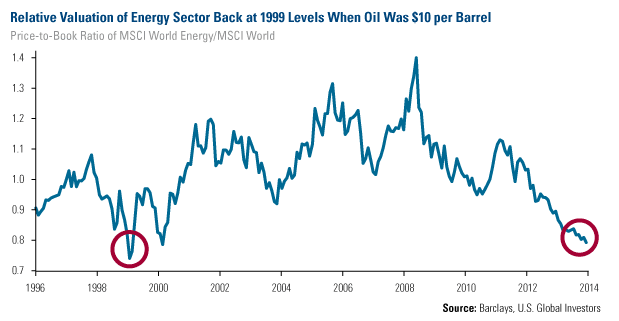
Global energy stocks have also suffered: In a comparison of the price-to-book valuations of the MSCI World Energy Index to that of the MSCI World Index, the ratio is at a level we haven’t seen since the late 1990s and early 2000s. Back then, crude oil plummeted to a very low price of $10 per barrel.
Today, with oil hovering around $100 a barrel and improved economic conditions in the U.S., energy stocks appear to be a tremendous bargain compared to overall stocks.
When it comes to natural gas, the cold, snowy winter has caused inventories of the commodity to rapidly decline. As the U.S. is experiencing the coldest winter in 13 years – some parts of the country have had the coldest weather in nearly three decades – natural gas inventories have been drawn down to levels we haven’t seen in 10 years.
Still, Old Man Winter hasn’t been persuasive enough for companies to respond with supply.
Based on data from the research firm IHS, 384 gas-directed rigs were online in the lower 48 states to refill storage and meet new demand coming online from the industrial sector in 2013. However, looking ahead over the next few years, the rig count is going to have to rise dramatically “as the gas market tightens in late 2014 and 2015,” which is a tremendous opportunity for investors, says IHS.
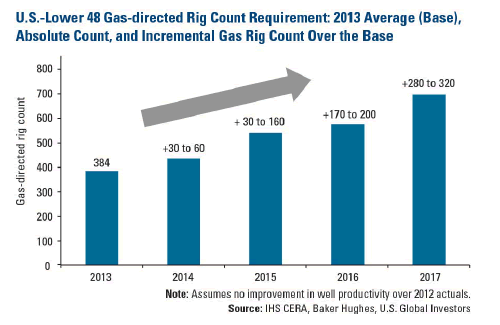
Before rig counts can increase, higher natural gas prices are needed to incentivize operators to invest in natural gas. Based on last quarter’s earnings reports, many major producers, such as EOG, Southwestern or Pioneer Natural Resources, are not planning on increasing their natural gas budgets. Bill Thomas, Chairman and CEO of EOG Resources, explained his reasoning that is part of the collective thought process across the industry:
“For the sixth year in a row we are not [trying to] grow EOG’s North American natural gas production. This is reflective of our view of low returns on natural gas investments. We won’t drill any dry gas wells in North America during 2014 because we don’t see a change in the gas oversupply picture until the 2017-2018 time frame.”
As we come out of this winter season, the complacency toward adding to rig counts may amplify the deficit in natural gas inventories.
2. U.S. Chemical Industry Has a Competitive Edge
One upside to the low natural gas prices in North America is that it equates to relatively cheap feed stock for U.S. chemical companies. Whether it’s Asia or Europe, gas prices outside of the U.S. tend to be benchmarked to the higher price of crude oil.
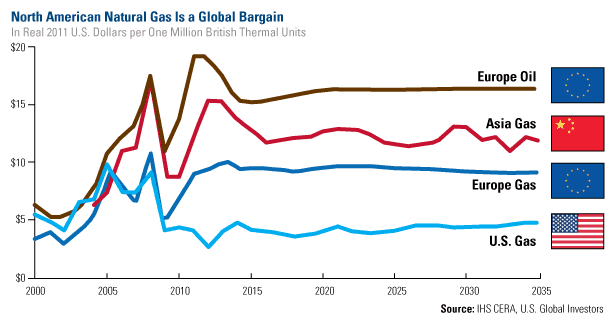
Along with the global economic recovery, natural gas is giving the U.S. a competitive advantage. We’re seeing chemical companies coming back to the states, creating jobs, expanding exports out of the U.S., and helping the nation’s current account deficit.
3. Shipping Companies at a Possible Inflection Point
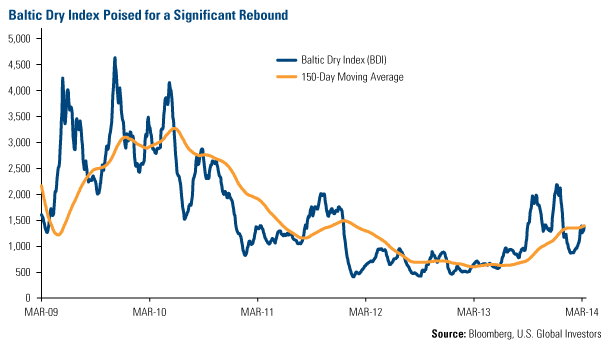
The prices to ship commodities around the world have been hovering around the lowest we’ve seen in five years. However, demand for shipping is starting to overtake the supply of new ships, which bodes well for shipping companies.
Take a look at the chart showing the Baltic Dry Index over the past five years. The index is made up of various sizes of carriers including the Baltic Capesize, Panamax, Handysize and Supramax indices and measures the price of moving raw materials by sea. Primarily, these vessels transport iron ore and grains, i.e., wheat, corn and soybeans, which are especially vital goods for China.
To keep its population of 1.3 billion fed, China needs to import millions of tonnes of wheat, corn, rice and soybeans. As this demand is recognized, shipping companies should benefit.
4. Alternative Energy Could Get You More Green
In China, residents have been dealing with increasing cancer-causing pollutants and vehicle congestion on roads, and public discontent is rising. This winter, as pollution grew to be 10 times higher than the acceptable rate, Beijing University students protested the conditions by putting masks on iconic statues.
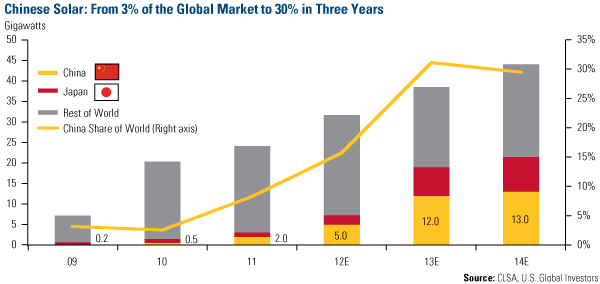
The effect that pollution is having on China’s economy benefits certain industries, including renewable energy or clean energy, whether it’s solar or wind power
You can see just how dramatic the investment has been over the last five years. Specifically, wind power and solar look especially attractive. Take a look at CLSA data: In 2009, the country had about 0.2 percent of the global market. By 2014, it’s estimated to grow to one-third of the global market.
China isn’t the only country with a growing renewable energy market. With the Fukushima nuclear reactors incident after the massive earthquake in Japan, the solar market is taking off there too.
The Diverse Approach of the Global Resources Fund (PSPFX)
We believe these areas of the market offer the most exciting opportunities today. They have the wind at their back, giving us the confidence to overweight the companies within these areas of the market that are also showing extremely robust fundamentals.
Because of the diversity and volatility of each commodity, we believe investors benefit by holding a diversified selection of commodity stocks actively managed by professionals who understand these specialized assets and the global trends affecting them.
I just flew back from Asia, where I spoke at Robert Friedland’s Asia Mining Club and Mines and Money Hong Kong, with a special stop in Carslbad, CA on my way home to speak at the Investment U Conference. It has been an exhilarating week meeting with global entrepreneurs, mining executives and curious investors. I look forward to sharing their advice and insights with you next week.
P.s. It’s not too late to join me for an investment adventure in Turkey in May.
Please consider carefully a fund’s investment objectives, risks, charges and expenses. For this and other important information, obtain a fund prospectus by visiting www.usfunds.com or by calling 1-800-US-FUNDS (1-800-873-8637). Read it carefully before investing. Distributed by U.S. Global Brokerage, Inc.
Fund portfolios are actively managed, and holdings may change daily. Holdings are reported as of the most recent quarter-end. Holdings in the Global Resources as a percentage of net assets as of 12/31/13: Energy Select Sector SPDR ETF 0.00%; EOG 0.00%; Pioneer Natural Resources (2.18%); Southwestern 0.00%
Because the Global Resources Fund concentrates its investments in a specific industry, the fund may be subject to greater risks and fluctuations than a portfolio representing a broader range of industries.


Each week CanadaStockChannel.com screens through their coverage universe of dividend paying Canadian stocks, and look at a variety of data — dividend yield, book value, quarterly earnings — and compare it to the stock’s trading data to come up with certain calculations about profitability and about the stock’s valuation (whether it looks ”cheap” or ”expensive”).
History has shown that the bulk of the stock market’s returns are delivered by dividends, and so the site pays special attention to dividend history. And of course, only consistently profitable companies can afford to keep paying dividends, so profitability is of critical importance. Dividend investors should be most interested in researching the strongest most profitable companies, that also happen to be trading at an attractive valuation — maybe there is a company-specific reason causing the stock to be ”cheap” or maybe the entire sector is taking a hit, but whatever the reason, CanadaStockChannel thinks there is great value in ranking their coverage universe weekly using their proprietary DividendRank formula, and sharing the top stocks with subscribers, neatly divided into 17 sectors/categories.
These are the three stocks in each category that their DividendRank system has identified as the top most ”interesting” … this is meant purely as a research tool to generate ideas that merit further research.

| DividendRank | Symbol | Dividend | Recent Yield* | |
|---|---|---|---|---|
| #1 | HNL.CA | Q | 0.32 | 3.84% |
| #2 | MSI.CA | M | 0.78 | 5.09% |
| #3 | DCI.CA | M | 1.38 | 9.68% |


-
I know Mike is a very solid investor and respect his opinions very much. So if he says pay attention to this or that - I will.
~ Dale G.
-
I've started managing my own investments so view Michael's site as a one-stop shop from which to get information and perspectives.
~ Dave E.
-
Michael offers easy reading, honest, common sense information that anyone can use in a practical manner.
~ der_al.
-
A sane voice in a scrambled investment world.
~ Ed R.
Inside Edge Pro Contributors

Greg Weldon

Josef Schachter

Tyler Bollhorn

Ryan Irvine

Paul Beattie

Martin Straith

Patrick Ceresna

Mark Leibovit

James Thorne

Victor Adair