
Personal Finance
Includes “10 Market Rules to Remember” by Bob Farrell, a Wall Street veteran who drew on some 50 years of experience in crafting his investing rules. After finishing a masters program at Columbia Business School, Bob Farrell started as a technical analyst at Merrill Lynch in 1957. Even though Farrell studied fundamental analysis under Gramm and Dodd, he turned to technical analysis after realizing there was more to stock prices than balance sheets and income statements. Farrell became a pioneer in sentiment studies and market psychology. His 10 rules on investing stem from personal experience with dull markets, bull markets, bear markets, crashes and bubbles. In short, Farrell has seen it all and lived to tell about it.- Editor Money Talks
“At the start of the bull market we have all the paper and they have all the money. At the end of the bull market we have all the money and they have all the paper”.
Regardless of the number major “booms” and devastating “busts” the majority of investors/speculators are normally wrong in the end. History has provided us with valuable lessons, yet the key emotions of fear and greed combined with a dose of stupidity create extreme volatility in both directions and opportunities for those not swept up in the herd activity.
In the “social media” age we are literally now bombarded with conflicting messages, calls and sales pitches from a variety of marketing geniuses, self-proclaimed gurus and those simply looking to milk your wallet even further. I admit to being part of this epidemic from being a content provider in a world now drowning in content. Let’s face it the majority of “Tweets” these days will have all the longetivity of a male orgasm (unless your Justine Sacco), yet I can see some major issues ahead in the next “speculative bubble” which will be the first where rumours and Figjam will spread to thousands of people instantaneously via the little blue bird. As FOMO increases as with any bubble, you will see traditional blue chip investors swept up in the mania holding a portfolio of rubbish on margin.
Apart from speculative bubbles, the other danger to investors/speculators is too much information or TMI as many parents of teenagers would hear often. The three books I strongly recommend to my subscribers (along with Don’t Sweat the Small Stuff by Richard Carlson) are at the bottom of this article, however Bob Farrell’s 10 Market Rules to Remember are well worth expanding on and adding a more “speculative” feel to them. (Please note readers are welcome to take an obligation free trial to my newsletter at the end of the article)
Bob Farrell commenced his career at Merrill Lynch in 1957 following a period of study under the great value investor Benjamin Graham at Columbia University. In 1967 he became Chief Market Strategist (1967-1992), and remarkably prior to that for 16 of the 17 prior years he was the top ranked Wall Street analyst in predicting the direction of the stock market. His 10 Market Rules to Remember were published in 1992.
1: Markets tend to return to the mean over time.
The best measure of this on a broader basis would be the historical PE ratios for the S&P 500. There will be periods (sometimes protracted) where stocks are either undervalued or overvalued, however the risk/reward profile of buying equities during periods of undervaluation is much more attractive than rampant enthusiasm at/or near the top. Jordan Eliseo, Chief Economist for ABC Bullion recently presented a compelling case that equity valuations are “stretched” and this apparent in the slides below. (Jordan sourced the figures from Schiller Data).
For the junior resource/precious metals investor in Australia, the Small Resources Index (XSR) is a fantastic barometer of value and sentiment, and based on a 72.5% decline from January 1 2011 to June 25 2013 it could be argued that the risk/reward of accumulating quality juniors remainsextremely attractive. The XSR has been >6000 in both 2008 and 2011 yet at the time of writing was a measly 2129. Whilst it doesn’t mean that the index will roar ahead and surpass these levels in the short-term, it should provide some comfort for those contrarians happy to go against the herd and buy when others are selling.


2: Excesses in one direction will lead to an opposite excess in the other direction.
Unless you believe that “Mining is finished, and resources are dead”, there is an extremely compelling case that interest in base and precious metals equities will eventually return and overshoot to the upside. The downbeat attitude has been exacerbated by three horrific years illustrated by the XSR below, however those who believe that “Mortgage rates or junior resource stocks will never rise again” I believe could be in for a nasty shock. Sure the catch phrase emanating from China is all about the looming “Dining Boom” as opposed to the stuttering “Mining Boom”, but last time I looked we still need copper, nickel and zinc to build stuff whilst gold has been around for a mere 5000 or so years and I don’t see it going away anytime soon.
XSR 10 Year Chart: Source Iress
3: There are no new eras – excesses are never permanent
If this were the case we would all be wearing stonewash jeans and Hypercolour tee-shirts, whilst attending to our tulips (or tip-toeing through them). One of the greatest catch phrases of recent times was “The new economy” and whilst there are always a handful of companies that “survive and thrive” every boom is littered with pretenders, transformers and speculators obliterated through their own greed and stupidity. I enjoy the convenience of my 1kg Ultrabook, yet my major concern when working remotely from a local café is the availability of a power point as the advances in battery technology have failed to keep up. It isn’t all bad news though, as having your phone well into the red zone out on a night out with your mates can be a good thing provided you have access to a taxi rank.
Despite all the lessons in history we are still going to fall for the next major “fad” and declarations of a “new era”. How often do you here school yard chatter about the investor whose ancestors sold out at the top of the tulip, railroad and electronics bubble, whilst his timing in tech, retractable syringes, childcare, uranium and Steve Madden shoes was impeccable?
4: Exponential rapidly rising or falling markets usually go further than you think, but they do not correct by going sideways.
Who would have thought that Fortescue Metals Group (FMG) would rise from 9c to a high of $136 (still trading around $53 eqv) or Paladin (PDN) roar from 0.008c (eight tenths of 1 cent) to an all-time high of $10.80 in April 2007? When you are in depressed market you tend to believe that every upward price movement is all you are going to get and this is why many junior resource stocks are now struggling after a 30-40% bounce. The great precious metals stock bubble of 1978-1980 is long forgotten and speculators are now satisfied in selling a chronically undervalued gold junior for 5.2c after acquiring the shares for 5c. Buying at the top of a bubble will lead to similar results but in reverse. Bad news takes time to be digested amongst larger investors, and whilst daytraders will move in and have their fun, the risk/reward of catching a falling knife is one or two price steps up for a 100% wipe-out should the company be suspended never to return.
“I can assure readers that stupidity to the upside will return to the junior resource sector and once paranoia is replaced with reality you will start to see a number of quality juniors trade around their rightful intrinsic value. Major mineral discoveries in Australia tend to be as rare as a three-star Adam Sandler movie and he is about due”
5: The public buys the most at the top and the least at the bottom.
Ever seen a Boxing Day sale where ladies fall over each other to buy shoes 700% more expensive than the previous week? This is the beauty of the stock market where contrarians are able to buy stocks cheaply (often on their own) that have thrown up a technical sell signal or whose market depth is as attractive has a taking a dip in a brown tinged ocean. It all gets back to fear, greed, the fear of missing out (FOMO) and ultimately stupidity. It is a lonely place buying at/or near the bottom, whilst you are likely to be ridiculed for taking profits in a stock that is heavily discussed on the financial forums and invites are already been sent out for the $5 party. Positive feedback is what drives markets higher and until that hairdresser, cobbler, baker or taxi driver starts making regular risk free profits the general public are still miles away.
6: Fear and greed are stronger than long-term resolve.
During the Dotcom bubble I remember clients buying a stock at 10c then becoming over anxious when it dipped to 9.5c or failed to move in an immediate time frame. With investors/speculators now drowning in TMI, we have concerns over Crimea, China, interest rates, employment numbers, European growth rates, and a potential short-term oversupply in copper which all create “fear” and “anxiety” and cloud our longer-term judgement. When stocks start to run and we start high-fiving fellow investors, the lessons learnt during bear markets are thrown out, with many rushing into leveraged and exotic products to “turbo charge” their gains. This pattern of greed and stupidity will then repeat itself with new themes, stock promoters and eager participants waiting to part with their money.
7: Markets are strongest when they are broad and weakest when they narrow to a handful of blue chip names.
Junior resource/precious metals investors will know all about this. The ASX 200 has enjoyed a stellar rally which has been the result of strong gains in the banking, telco and industrial sectors, yet apart from a number of high-growth opportunities it has been tough going in the smaller caps and in particular the miners. With the average PE ratio of the S&P 500 around 25x (as per previous slide) it could be argued that there has been some strength in the broader US market, whilst the Australian market is now dominated by the so-called “Yield chasers”
8: Bear markets have three stages – sharp down, reflexive rebound and a drawn-out fundamental downtrend.
The XSR chart from January 1 2011 (above) would highlight this perfectly. It has been an extremely challenging market for junior resource investors and apart from the odd major discovery or “fad” commodity, even the highest quality explorers and/or emerging producers have struggled for traction. This had led to issues in raising capital and has seen a number of miners enter administration and liquidation. There have been some positive signs emerging of late with stocks getting a “sugar hit” from newsletter recommendations and daytraders keen to pursue bio/tech and resource trading opportunities and stocks putting on some impressive gains albeit from a low base.
9: When all the experts and forecasts agree – something else is going to happen.
Just when gold was going through $2,000 in 2012 like a dodgy vindaloo the price corrected and now we are faced with a mixture of both bullish and bearish calls. Just as major banks and forecasters upgraded their iron ore price targets we copped a nasty near-term correction. The most worrying call for the “Mortgage belt” is that interest rates are going to remain at record low levels for the foreseeable future and house prices will continue to rise due to high demand and low supply. Leading up to the GFC we were being led to believe that the market will continually rise to the overwhelming support from super fund inflows. I am sure that 35 out of 27 economists will be picking the next “Recession Australia had to have”.
10: Bull markets are more fun than bear markets.
I am guilty of overusing the following saying “If it flies, floats or f….., rent it” Bull markets are great fun where we all go out for long lunches, fight over the bill then normally end up at the casino or disco thereafter. Despite all the pain of previous bubbles, many continue to purchase “illiquid” assets or tax deductions such as luxury cars, boats, a nightclub, restaurant or sporting team (for the super successful) from a major liquidity event. The other major mistake many make is to re-invest profits in stocks heading south and fail to put any away for the tax department. Whilst the intention to squirrel away profits in cash, industrial stocks or precious metals is a noble one, boredom quickly sets in and portfolios are then decimated to chase the “effluent” that normally flows and runs much faster. The real test will now come from the “Buy and hold” investors who have done extremely well from doing nothing, but may start to fall into the temptation of chasing a little more excitement. Whilst bull markets lead to us feeling wealthier, part of a crowd and more attractive to the opposite sex, for the uneducated, fearful, greedy and stupid they are the worst events that could possibly happen to the individual and their families. There is a horse race or Keno game being run somewhere, it doesn’t mean you spend all night at the casino or an on-line betting site.
The three most costly words for many of us are “I love you”, however “This time is different” is often regarded as containing the four most expensive words in financial history. Bob Farrell’s “10 Market Rules to Remember” are essential reading for investors across all asset classes, yet are often discarded at the first sign of a major bull market, era or paradigm as we all become self-proclaimed gurus and mistake a bull market for brains.
Tony J Locantro
Email: tony@locantro.com
Website: http://locantro.com
For a free trial without obligation to Locantro’s Life please visit www.locantro.com
TOP THREE BOOK SELECTIONS FOR INVESTORS
1: One Up On Wall Street, Peter Lynch
2: The Winning Habits of Warren Buffett & George Soros, Mark Tier
3: Devil Take The Hindmost A History Of Financial Speculation, Edward Chancellor

 A Global Boom in agriculture investments caused by rising food prices was forcast in 8 REASONS AGRICULTURE STOCKS ARE HEADED MUCH, MUCH HIGHER and FARMERS WILL BE DRIVING THE LAMBORGHINIS. This seems to be happening as you can see below – Editor Money Talks
Global food prices rose to their highest in almost a year in March, led by unfavourable weather for crops and political tensions over Ukraine, the United Nations food agency said on Thursday.
The Food and Agriculture Organisation’s (FAO) price index, which measures monthly price changes for a basket of cereals, oilseeds, dairy, meat and sugar, averaged 212.8 points in March, up 4.8 points or 2.3 percent from February. The reading was the highest since May 2013.
….read more HERE

So far, 2014 has been a paradoxical year for gold. Many investors aren’t even aware that it has rallied almost 8%. On the rare occasion that the financial media mentions the yellow metal, it is only in the context of comparing the recent rise to last year’s decline.
In spite of this overwhelming negative sentiment, gold is experiencing a stealth rally as one of the best performing assets of the year. Let’s look at some important metrics of the most under-valued sector in this market.
Speculations Reversed
So many investors want to believe that last year was the death knell for the yellow metal that they’ve stop paying attention to the technical metrics responsible for driving the price down. These metrics have already started to reverse.
Last year, technical speculators – and everyday investors trading behind them – influenced gold’s price more than anything else. Notably, 2013 was the first year since their creation in 2003 that gold exchange-traded funds (ETFs) experienced a net outflow of their gold holdings. This played a pivotal role in driving down both the gold price and investor expectations for the yellow metal.
Gold ETFs sold off their holdings by a whopping 881 metric tons last year. GLD, the largest fund, sold 550 of those tonnes on its own. This was influenced by, and then compounded, the effects of extremely bearish gold futures speculators, whose large net-short positions were responsible for some landmark drops in the gold price throughout the year. As is typical with markets, negative sentiment became a self-fulfilling prophecy.
For the previous decade up until last year, physical gold demand had driven the gold bull market. However, ETFs have over this time accumulated a greater and greater share of the market. Thus, last year’s sudden ETF sell-off was enough to drive total global gold demand down 15% year-over-year. Even 28% growth in bar and coin demand – resulting in record-breaking total demand – couldn’t counter the market’s bearish turn. But ETFs are getting back in the game. GLD started adding to its holdings again in February, the first increase since December 2012. And by mid-March, COMEX gold futures contracts had the most net-long positions since November 2012.
Gold Versus Equities
Why are ETF and futures traders reversing their previously bearish positions?
Prices are up in every area of the gold sector. GLD and COMEX futures are both up more than 6% this year. GDX, one of the broadest gold-mining ETFs, is up more than 12%. Even with a sell-off in the last week of March, physical gold was up almost 8% in the first quarter.
Meanwhile, the general stock market is barely performing at all. The S&P 500 and the NASDAQ are up barely 2% YTD, while the Dow is down.
Most importantly, when measured in terms of gold, the Dow has actually started to drop significantly. At the end of March, the Dow was about 12.5 times the gold price. This is already a 9% decline since December. For the majority of the last 100 years, the Dow has traded far below this level.

To get back to its historical average, either the Dow is going to have to drop significantly or gold will have to skyrocket. I believe it will be a combination of both.
Overpriced and Under-Earning
Anyone who really buys the story of economic recovery is likely riding a wave of irrational exuberance after a year in which the major indices hit record high after record high. They don’t express the slightest concern that the stock market is already in dangerous bubble territory.
However, one of the most important metrics of stock market valuation completely contradicts this.
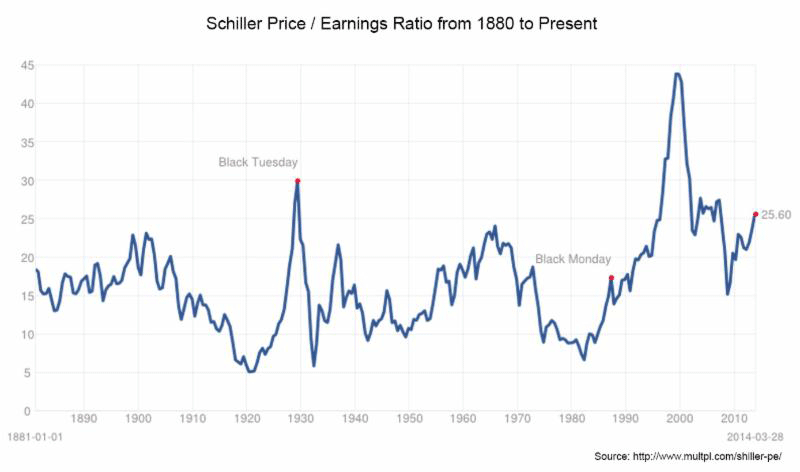
The Shiller Price/Earnings Ratio (Shiller P/E) is well-respected for helping analysts like me identify one of the most over-valued markets in history – the dot-com bubble. This metric gauges the return on investment for someone buying into the broader stock market. A higher ratio indicates investors are paying more for shares of companies that are earning less; therefore, they are receiving less value.
At the end of March, the Shiller P/E stood at 25.60 – almost 55% higher than the historical average of 16.5. As you can see in the chart below, the only previous times the ratio has breached 25 were during the 1929 stock craze, the dot-com bubble, and just before the ’08 financial crash.
I would not want to be anywhere near an investment with such poor yield.
Don’t Look Back
Investors often make the mistake of investing in the last trade, the same way that governments always fight the last war. After a year in which stocks brought in about a 30% return while gold was pummeled, nobody wants to be the first one to jump back into hard assets.
But fortunes are often made by ignoring the popular trend and buying underpriced assets when nobody else sees their value. Sometimes this is a risky maneuver, but in the case of today’s gold market, it’s as close as we can get to a sure thing.
It’s hard to predict what will trigger the next collapse of stocks, but gold is already on the road to new highs. Janet Yellen is gearing up to unleash a new torrent of freshly printed dollars onto global markets. I’d recommend building your ark well in advance.
###
Apr 2, 2014
Peter Schiff
C.E.O. of Euro Pacific Precious Metals
email: info@europacmetals.com
website: www.europacmetals.com
Peter Schiff is CEO of Euro Pacific Precious Metals, a gold and silver dealer selling reputable, well-known bullion coins and bars at competitive prices.
For the latest gold market news and analysis, sign up for Peter Schiff’s Gold Report, a monthly newsletter featuring contributions from Peter Schiff, Doug Casey, and other leading experts. Click here for your free subscription.

 Not Yet! Here’s when investors should start worrying about another major correction and & market in stocks. Ironically, says Financial Sense Newshour host Jim Puplava, when things start to get better, not worse – Editor Money Talks
In his recent Big Picture broadcast, “Yelling Yellen and the Change in the Fed’s Direction,” Puplava explains the four primary phases of monetary policy and how they’ve influenced the stock market and economy over the last half century.
In phase 1, the Federal Reserve is transitioning from a low interest rate environment to gradual tightening. This happens as the economy starts to improve and inflation begins to rise. Think 2004 as Greenspan started to raise interest rates in quarter point increments from extremely low levels. In this phase P/E multiples and the bond market begin to peak with the historical mean return on stocks around 10%.
In phase 2, monetary policy is now much more restrictive and well into tightening mode. The economy is doing quite well and inflation is running much higher. Commodity prices begin to climb steadily and profit margins are beginning to get squeezed with rising input costs. Think 2006 and 2007 as interest rates rose to 5%. This is a deadly combo for stocks and the economy, and typically the time when investors should start worrying. (Note: We’re not yet in this phase with low economic growth and inflation.) The historical mean return for stocks in this phase is around 2.5%.
In phase 3, policy is tight, interest rates have peaked and may now be rolling over. The stock market has corrected and the economy is either in or very near recession. Think 2008. In this phase, the historical mean return of stocks is -9%.
In phase 4, monetary policy is loose once again, the economy is in recovery mode, and inflation is running low. This is the best phase for stocks with a mean return around 23%.
So which phase are we in? Given the above, Puplava says the U.S. is near the latter stages of phase 4, with Yellen’s recent remarks of possibly raising rates in 6 months serving as a signal when we transition into phase 1 of the Fed rate raising cycle.
Is it time to be worried then? As you’ve probably heard over and over again, a bull market climbs a wall of worry. Yet, given the ebb and flow of the economy, stock market, and interest rates over the last half century, investors really need to start worrying, ironically, once things are doing much better: the economy is running on all cylinders, inflation is high, and the Fed has been raising interest rates for quite some time. That’s when the bubble bursts.
Right now, Puplava says, we’re just not there yet.
Click here to listen to his recent Big Picture broadcast, “Yelling Yellen and the Change in the Fed’s Direction.”
 7 Energy stocks with catalysts that could boost valuations are what Fadel Gheit recommends.
Gheit is managing director and senior analyst covering the oil and gas sector for NewYork-based Oppenheimer & Co.
He has been an energy analyst since 1986 and was named to The Wall Street Journal All-Star Annual Analyst Survey four times.
HAI’s Sumit Roy caught up with Gheit recently to discuss the latest developments in the oil and gas markets.
His recommendations are HERE


-
I know Mike is a very solid investor and respect his opinions very much. So if he says pay attention to this or that - I will.
~ Dale G.
-
I've started managing my own investments so view Michael's site as a one-stop shop from which to get information and perspectives.
~ Dave E.
-
Michael offers easy reading, honest, common sense information that anyone can use in a practical manner.
~ der_al.
-
A sane voice in a scrambled investment world.
~ Ed R.
Inside Edge Pro Contributors

Greg Weldon

Josef Schachter

Tyler Bollhorn

Ryan Irvine

Paul Beattie

Martin Straith

Patrick Ceresna

Mark Leibovit

James Thorne

Victor Adair