
Timing & trends
Next month marks the 3-year anniversary of the bear market in silver that started in May 2011. Later this summer we will hit the 3-year anniversaries of the bear markets in gold and gold stocks. We are now psychologically conditioned for pain and punishment in the gold markets and to beware of the next downward plunge.
In reality though gold has been in a basing phase. It’s not going down anymore, it’s going sideways where the downward plunges are muted and the upward rallies are still fake bear market rallies. What’s interesting about this base is that it started right at the height of bearishness in the gold market. That two day massacre in gold back in April 2013 when gold plunged below $1400 actually started the left hand side of the base. So right when everyone was panicking about gold, in reality it was starting to form a major bottom!
Just a couple months later after trying and failing to get back above $1400, gold made the low point in the base in June of 2013 around $1200. Gold then tried once again to get back above $1400, but then failed and retested the bottom of the base in December 2013. So a well established base formed in gold between $1200 and $1400 as you can see in the chart below.

Once gold held support again in December 2013 it rallied back to $1400 just last month, but then failed again and was turned back down to where it is today. So gold has been basing now for about a year between $1200 and $1400. Notice though in the previous chart the 30-week moving average has flattened out, and gold has now traded back above the 30-week moving average. Stan Weinstein, author of one of the best books ever on trend trading called “Secrets for Profiting in Bull and Bear Markets”, would call this a Stage 1 base.
Gold stocks have done essentially the same thing as gold. They started forming the left hand side of a base in April 2013, then traded mostly sideways for the rest of the year. Some of the gold stocks went on to make lower lows during the rest of 2013 but most of the damage had been done by the April-June time frame.
Taking a look a the GDXJ Junior Gold Miners ETF notice how the 30-week moving average has flattened out just like it has in gold. After going back and reading what Weinstein said about Stage 1 bases recently I noticed this quote which might relate to what we are seeing in the gold stocks today:
“But often volume will start to expand late in Stage 1, even though prices remain little changed. This is an indication that dumping of the stock by disgruntled owners is no longer driving down the price. The buyers who are moving in to take the stock off their hands are not demanding any significant price concession. This is a favorable indication.”
Notice the tremendous increase in volume in GDXJ since the start of 2014. As Stan says this is an indication that buyers and sellers have reached equilibrium. So after a year long base in gold and gold stocks, what were are looking for next is the breakout into a Stage 2 advance.
The ideal buy point, according to Weinstein, is when gold would breakout above the resistance of its base and above the 30-week moving average on above average volume. This would indicate buyers have taken back control of the gold market and a new bull market in gold is going to begin. Weinstein notes that there is often a retest of the breakout point during which a second chance opportunity arises to do low-risk buying.
Checkout what the solar stocks did from April 2012 to April 2013. They had a similar basing period to the current gold market. The solar ETF TAN based for about a year then broke out of the base on an increase in volume in May 2013. Then TAN retested the base towards the end of June 2013, and from there broke back into the Stage 2 advance that is still ongoing today. This is a great example of Stage Analysis in action.
So the bottom line is gold is in a basing phase, and this has been going on for about a year since April 2013. According to Stage Analysis the ideal buy point would be the breakout above $1400 on an increase in volume, or on a retest of $1400 after a breakout occurs.
Connect with me on Twitter: @nextbigtrade
The original article and much more can be found at: http://www.nextbigtrade.com
The views and opinions expressed are for informational purposes only, and should not be considered as investment advice. Please see the disclaimer.

Recently I visited the breathtaking city of Hong Kong to speak at the seventh-annual Mines and Money conference, Asia-Pacific’s premier event for mining investment deal-making and capital-raising. During my time in Asia I had the additional privilege of addressing the audience of the Asia Mining Club, alongside my good friend Robert Friedland, Executive Chairman and Founder of Ivanhoe Mines.
Asia Still Wants Physical Gold
The mission of the Asia Mining Club is to promote education among its members, and one way to achieve this is by hearing from experts in the financial markets, notably those focused on resources and commodities. During the club’s sell-out event, I too, confirmed a great deal about the commodity “buzz” on that side of the world, especially on gold.
The demand for the precious metal in Asia is truly phenomenal! In smaller countries like Indonesia, Thailand and Vietnam, consumption of gold totaled 300 tonnes in 2013, and according to Bloomberg, in 2014 mainland Chinese buyers purchased a total of 125 tonnes in February (including scrap). This number tops the 102.6 tonnes purchased in January and 97.1 tonnes purchased a year ago.
In February I wrote about how Switzerland plays a role in the movement of physical gold into Asia as well. Home to many of the big gold refiners, Switzerland released monthly gold trade data this year for the first time in over 30 years, with the report showing that 80 percent of shipments went straight into Asia. If we continue to see these large movements of the physical metal, especially from the West to the East, it’s only a matter of time until these supply-and-demand factors lift the gold price.
Is Janet Yellen Yelling?
I often say there are two sides to the gold equation: the Love Trade and the Fear Trade. While Asia’s cultural affinity for gold continues to feed the Love Trade, concern over government policies which increase inflation and devalue currencies, fuel the Fear Trade. The Fear Trade demanded attention again on the back of Janet Yellen’s talk of the Federal Reserve raising interest rates in the next six months.
While low interest rates make it less expensive to borrow money, measures to keep rates low also chip away the value of the dollar and cause concern of accelerating inflation. Once real rates start rising, gold isn’t as attractive to those who trade on fear.
As I’ve written about recently, a key driver in gold prices is the real interest rate environment—the real rate of return taking into account the level of inflation. When real interest rates are negative to low, gold prices historically turn positive because there is no opportunity cost to hold the metal. The lower the real rates, the better gold tends to do. So, Yellen’s initial hint of rising rates sent gold prices falling.
On Friday the March U.S. jobs number came in at 192,000. While the number is in line with expectations and clearly shows that hiring in the U.S. is rising, it fell a bit short of the 200,000 jobs projected. The number was just enough of a miss to disturb investor confidence and drive some to seek refuge in hard assets, spurring the price of gold again.
BCA Research believes that after Friday’s report, the current pace of employment will be sustained. Although the movement is gradual, hiring is going up.
BCA continued by commenting that, “The data will underscore the Fed’s view: that the need for quantitative easing or other non-conventional tools is waning, but that there is no rush to normalize interest rates.”
In my opinion, even with job numbers in line with expectations, the Fed is still going to focus on long-term job creation and keeping interest rates low, or at least not rushing to normalize them as BCA research stated. If inflation starts to rise while these rates are low, we could see a higher movement in the price of gold.
The Osisko Deal is Sweet and Sour
Another headline-maker for gold last week was Yamana Gold’s purchase of 50 percent of Osisko’s mining assets. I think our Portfolio Manager Ralph Aldis said it best in a recent BNN interview with Howard Green regarding the takeover; “This deal is both sweet and sour.”
The sour part is that by our models, which look at relative value of assets, it appears that both Osisko and Yamana are paying too much on this deal. On the flip side, the sweet part is that this bid caused companies like Mirasol, Pretium and SEMAFO to immediately rise. The structure of the entire deal is a complicated one, but witnessing these stocks finally waking up, is a change in the sentiment for the gold sector that, in my opinion, needed to be seen.
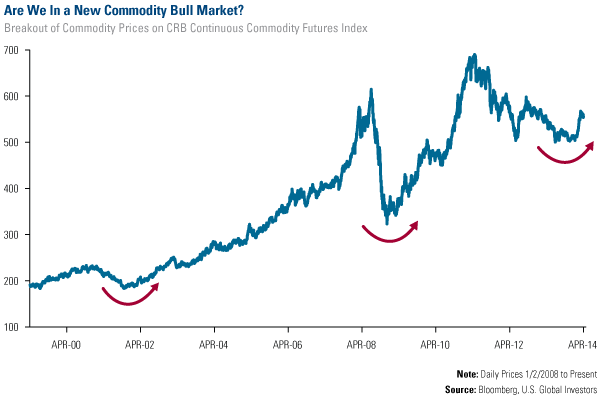
At U.S. Global Investors we are always watching for opportunity, while concurrently managing risk. Along with the “sweetness” of the Osisko deal, I find additional encouragement for the broader commodities space, as well as for gold, from Stifel Nicolaus’ Barry Banister. His strategy for the second quarter of the year is that we may see a one-year rally in commodity-related stocks.
Based on the breakout of the Continuous Commodities Futures (CRB) Index, along with the movement in the U.S. dollar, he forecasts that commodities could rise 15 percent year-over-year in 2014.
HFT: The new buzz word
High Frequency Trading became a household word overnight when bestselling author Michael Lewis gave an interview to 60 Minutes in advance of his new book, “Flash Boys.” Lewis’ allegations of high frequency trading practices that result in a rigged stock market have prompted a firestorm of support from Charles Schwab to Mark Cuban.
I agree with Schwab, chairman of Charles Schwab Corp., who said “high frequency trading has run amok and is corrupting our capital market system by creating an unleveled playing field for individual investors and driving the wrong incentives for our commodity and equity exchanges.” I’m glad to see this issue getting the attention it deserves.
From short selling to overreaching regulation, over the years I’ve shared my opinions on practices that harm individual investors and create unjust advantages in our free market system. I believe that investing is key to long-term wealth creation and that investor confidence in the system is key to capitalism.
The first quarter of the year has certainly provided surprises for the gold market, but remember that every coin has two sides. Every downward data point has an upside opportunity. Follow the smart money, stay diversified and remain a curious investor.
p.s. Don’t miss my new show on Kitco. Each week I’ll talk about the strengths, weaknesses, opportunities and threats in the gold market on Gold Game Film.
###
Apr 7, 2014
Frank Holmes
website: www.usfunds.com
I usually take forecasts with a big grain of salt.
Especially when it comes to commodity prices. With the experience being that accurately predicting movements in these markets for the short to medium term is nearly impossible.
But one forward-looking analysis this week deserves a mention. Both because of the experts who made the prediction–and the unusual angle these professionals took in examining one of the biggest metals markets globally.
The group is CRU. A leading specialist in tracking commodity prices and trends.
And the metal is zinc. Which this group sees as having a bright future ahead.
CRU analysts told the International Zinc conference in Dubai that this commodity may have some of the biggest upside going. With the group predicting that zinc prices could rise as high as $4,500 per tonne ($2.04 per pound) over the next five years.
That would be a big jump, considering zinc today is going for just over $2,000 per tonne.
More interesting than the scale of the predicted rise is the reason. Which has to do with growing demand in an unexpected part of the world: Asia, outside of China.
CRU professionals noted they expect ex-China zinc demand in Asia to grow significantly. To the point where the combined nations of this region will actually pass China as the largest consuming region in the world.
That prediction is a first, as far as I’m aware. And could have some important implications for this market.
Mainly in terms of sourcing supply. China is currently the only Asian nation that produces significant zinc output–almost all of which gets used domestically.
If Asian end users do start ramping up demand, they’re going to have to reach out to find supply. To places like Australia and perhaps even as far as Peru and the U.S.
This could be a big boost to mining projects in these regions (with Chinese consumers already becoming active in places like Peru). Perhaps more importantly, rising Asian demand could spur a wave of zinc exploration and development in the region itself. With focus shifting to nations like Myanmar and Mongolia.
We’ll see if the numbers pan out. The bull case for zinc seems to be growing stronger by the day.
Here’s to the other Asia,

 As part of our research to unveil the best tactics and strategies to protect against the upcoming tsunami in monetary and financial markets, we have reached out to Charles Savoie, author and researcher, with a tremendous knowledge of precious metals history. Our question was how individuals and small investors can best protect during the hard times that are coming, which will most likely be characterized as turmoil and collapses (of all sorts of assets, including currencies, around the world).
Charles Savoie wrote a very useful document for our readers. It is entitled “The Best Monetary Insurance”, counts 38 pages, and is a mix of practical tips embedded in an historical context. The key message of Mr. Savoie is to hold enough silver in physical form, ideally a mix of formats, but for sure silver dimes.
In this article, we highlight the most actionable tips and tactics. The full document is embedded at the bottom, it can also be downloaded.
Visit Mr. Savoie his two websites: www.nosilvernationalization.org and www.silverstealers.net. He offers all this information as a free service to the public.
Silver has historically played an important role. It has been money, but, more than anything else, a metal of the elites. Consider this:
U.S. Congress knew silver to be more valuable in regard to gold than the present bullion banking fiends. And Congress knew it nine generations ago! For details, see Senate document number 67 of the first session of the 73rd Congress, “Elementary Facts Bearing On The Silver Question” by Joel F. Vaile” (50 page document, 1896). Today the reality ratio of silver to gold may have fallen to 9, due to depletion of minable silver (The U.S. Geological Survey concurs) and even more so, the evanescence of above surface inventories. Ratios of silver to gold such as the approximate 64 to 1 of late March 2014 are illusory. But the real impact is that silver is a better buy than gold.
The best monetary insurance you can have is 90% silver dimes 1964 and earlier. Many gold bugs readily admit silver to be more depressed than gold. Ted Butler stated long ago that not even gold has a users association. The fact of the existence of this group is another of many proofs that synthetic money creators hate and fear silver even more than their loathing for gold. The Silver Users Association started out as the Silver Users Emergency Committee in World War II and in 1947 was renamed the Silver Users Association. Directors of SUA companies, especially the biggest silver users, are also since that time, directors of megabanks. 90% U.S. coins, historic money, facilitated many billions of transactions during their long history spanning many generations. Inasmuch as silver is so depressed relative to gold, personally, I advocate owning little or no gold; unless the investor cannot acquire silver. This is not disdain for gold, but more so, advocacy for acquiring the interest with higher potential. Silver can be swapped for gold at a later time if the ratio tilts to overvalue silver versus gold. Why buy 1 ounce of gold today versus 60+ silver ounces, when you may be able later on to swap those 60 + silver ounces for over 5 gold ounces?
A silver dime at the mints started out with a content of .0723 oz silver (4 digits is enough!) Due to average circulated wear, the business typically uses the figure of .0715 ounce contained silver. You will be able to tell the difference from a dime with no wear and a dime with light wear and more so, a heavily worn dime. I feel that very worn dimes are better melted, except for collectors seeking an inexpensive “cull” or “filler” coin for a key date and mint mark. When you buy dimes, you’re unlikely to get any with 89.24% silver, which were minted from 1796 to 1837. The clear advantage of Mercury dimes over Roosevelt is guaranteed identification of purity with no check of the date nor glance at the rim to look for telltale copper insides. Silver coins have a surprisingly large variation in surface tone, and you can’t always rely on telling the surface tone of a cupronickel (sandwich dime, 1965 and later) from a silver dime. Of course, proof silver dimes (1992-2009) can be found in dates beyond the fabled 1964 date. These are good buys generally only if you chance to come by some in a batch of mixed date dimes, in which case, they won’t be proof anymore, but will very likely stand way out due to newness and absence of wear.
I am not saying buy silver dimes, and no other silver. I have all types except the 1,000 ounce ingots, which you can anticipate having to have assayed if you have these and decide to sell. Unless you’re a larger investor and have intentions of using metal to buy land, stick with smaller units. Having smaller units wouldn’t preclude their use in buying land; smaller units are more “maneuverable” as to utility in purchases.
If dimes aren’t available, try for quarters. It mostly comes down to two considerations. One, the 90% coins haven’t been minted now for an entire half century—they get scarcer by the day, as some of these are always being smelted into bullion with silver scrap at refineries, and being melted in jewelers crucibles with some three-niner, in a proportion to yield .925 Sterling jewelry and Two, the silver dime is the most divisible, or the most fractionated, form of silver. You can go buy a 100 ounce silver bar. However, you can instead go for the same amount of silver, approximately, in 90% dimes. This equates to almost exactly 1,400 dimes (28 rolls of 50 coins) at the .0715 figure. In most cases, dealers have allowed me to cherry pick the dimes I wanted and the methodology I used was as follows.
Tip: Avoid damaged coins
Never buy coins with damage such as hole drilled, bent, clipped, etched (vandalized) or shaved rims. There’s the inevitable coin with red nail polish, best avoided. While date and mint mark checking is usually only practical in over the counter situations, and is unlikely to turn up anything of outstanding scarcity, it could help you in terms of being able to assemble some starter sets for sale to numismatic collectors. So while you aren’t paying numismatic prices, you will be getting some numismatic values, as long as people want to collect coin series as a hobby or business. It pays to print out a list of these mint issues and be familiar with them
Tip: Avoid high premiums
You can buy .999 silver as half, quarter, and tenth of an ounce rounds. There is nothing wrong with these items. However, know two things—the collectible value will remain less, and when you buy 90% coin, you aren’t paying for any manufacturing or minting premium. You will pay such premiums with the smaller three-niners. Seven dimes in nearly all cases can be considered a touch more than a half ounce of silver; and 14 dimes a full ounce. In terms of how much silver is out there as separate items each weighing less than one ounce, definitely at this time, there is more 90% coin than these newer bullion items.
If your silver consists entirely of three and four-niner bullion—stop! Buy some dimes, or trade bullion for some dimes. These 90% coins—in all denominations—are increasingly hard to source. More investors have caught on that whereas these coins are a half century and older, and the supply is constantly shrinking; bullion silver will be produced as long as mining and scrap can supply silver. The 90% silver, though not industrially pure as is, is nonetheless the scarcer form of silver. If buying on E-Bay, do avoid dealers with less than very high positive feedback. Be fairly quiet about your holdings—no boasting to anyone. Keep these precious items in several scattered, and unpredictable—locations. If a thief finds one cache, hopefully the others will be missed.
Tip: Where and how to store your bullion
If you don’t have a vault or safe, and plan to obtain one, you may consider paying cash, for clear reasons you can imagine yourself. If it needs to be delivered and installed, arrange to have someone photograph the delivery personnel and the vehicle, from several views. When my vaults were delivered to an off-site location I have, I remarked as they were finishing, “Now if I only had something worthwhile to store in them;” I then indicated I expected to inherit an antique gun collection in several years. It never hurts to be careful. Read “The Art Of War” by Sun-Tzu. Many major military blunders, costing so many lives. As always, check ratings first, and buy from the source with the best ratings.
There’s always the steel vault and loaded gun approach—which are quite reasonable. I advise going on EBay and buying some cheap synthetic rubies. Then, you make up a phony gemological appraisal showing a stone is worth lots of money. Next, you place these in a jewelry box (unlocked) on top of a dresser. A thief would think he’s got a real haul, and maybe decide to stop searching. I suggest printing out articles making fun of silver as investment, and leaving these where you think it might mislead someone. If you use a keypad operated vault, consider acquiring a battery recharger and the http://www.ebay.com/bhp/solar in case the power grid fails and the stores close. If you find your battery operated keypad fails due to battery exhaustion, this device will solve the problem of accessing your money metal. Be sure you’re using compatible batteries in the first place; they must be a size that matches the recharger, and must be rechargeable batteries. Keep backup batteries in a climate controlled environment where they’ll last longer. Cover any vault/safe with a tarp or other use of drapery, such as a decorative item—even a Mexican style multicolored serape http://www.ebay.com/bhp/mex or even plain canvas. Whenever possible, place any type of objects of low value on top, around and in front of the safe.
Tip: Check what you are buying
Never buy a bag, half bag, quarter bag or tenth of an ounce bag in a shop without first having it opened up and spread out, unless you have a long trust relationship with the dealer. Paper rolls, more than plastic tube rolls, should be checked. You aren’t accusing the dealer of dishonesty, you are verifying contents, because errors can happen on anyone’s part. Eventually, due to real variations in silver weight in bags, these will have to be sold by actual weight rather than by face value times a factor! Check ratings of Internet sellers before buying. Many unfortunates out there are stressed out due to the Tulving fiasco. I consider the 40% Kennedy halves (1965-1970) a poor choice as long as 90% is available. The war nickel series, 1942-1945, contains even less silver, at 35% but is a better buy, weight for weight, if similar rates for contained silver are offered. Those nickels are more historic.
In closing, Charles Savoie says: “The suppression of the silver price is the most nagging and pestilential problem in world monetary history.”
To read the entire 38 page report from Charles Savoie go HERE (scroll down)
Also from GoldSilverWorlds
10 Questions About Gold Investing In 2014
Stay Hedged with Precious Metals against Geopolitical Tensions and Monetary Policies
Is It Imaginable That Governments Would Confiscate Your Bank Account?

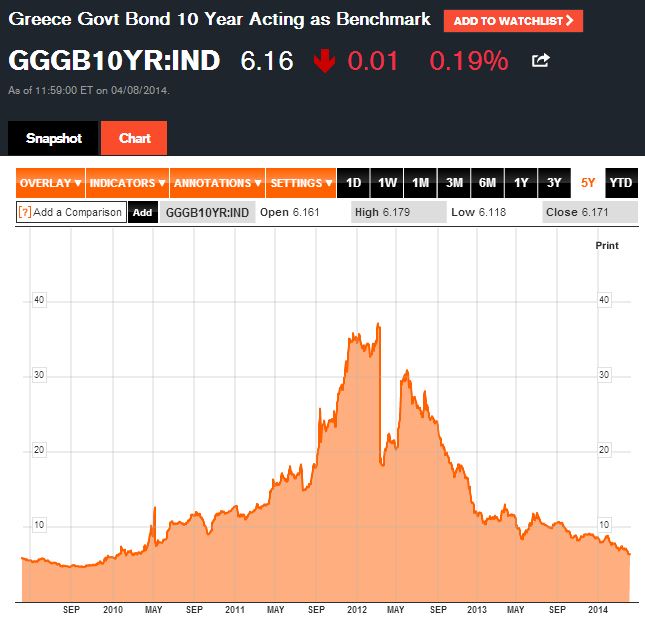 Greek 10 yr bond rates are returning to pre-crisis levels. What does it mean?
We pose the question in hopes that you’ll have an answer!
Join us on Facebook (Michael Campbell’s MoneyTalks) or Twitter (@moneytalkstweet) and share your thoughts.


-
I know Mike is a very solid investor and respect his opinions very much. So if he says pay attention to this or that - I will.
~ Dale G.
-
I've started managing my own investments so view Michael's site as a one-stop shop from which to get information and perspectives.
~ Dave E.
-
Michael offers easy reading, honest, common sense information that anyone can use in a practical manner.
~ der_al.
-
A sane voice in a scrambled investment world.
~ Ed R.
Inside Edge Pro Contributors

Greg Weldon

Josef Schachter

Tyler Bollhorn

Ryan Irvine

Paul Beattie

Martin Straith

Patrick Ceresna

Mark Leibovit

James Thorne

Victor Adair