
Gold & Precious Metals
 Two of the most shorted securities by IB customers this morning in the Basic Materials sector according to IB Stock Loan Borrow (SLB) data, are the parties involved in the merger that would have created the world’s largest gold miner: Barrick Gold Corp. (Ticker: ABX) and Newmont Mining Corp.
However, over the weekend talks between Barrick and Newmont Mining resulted in the abandonment of a merger agreement, which investors had been expecting to be announced as soon as Tuesday. Yet the fortunes for both stocks in Monday’s trading pinpoints weakness for Barrick (down 3.45%) but strength for Newmont (up 6.50%).
Discussions between the two were wound up prior to the weekend with no sign that the falling price of gold that created the catalyst for a defensive merger, was showing signs of changing course.
Gold fell to $1285 per ounce on Monday. The combination of the world’s two leading gold producers would have had a joint market capitalization of $60 billion. Both companies may need to further pare production in the face of reductions by the Fed in its monthly purchase of bonds. At the same time gold miners have announced impairment costs related to projects running into difficulties.

ABOUT THE AUTHOR
Andrew is a seasoned trader and commentator of global financial markets. He worked for several London-based banks trading cash and derivatives before moving to the U.S. to attend graduate school. Andrew re-joins Interactive Brokers following a two-year stretch at a major Wall Street broker-dealer as their Chief Economic Strategist. His coverage of stocks, options, futures, forex and bonds regularly surfaces in global media, and over the last several years Andrew has made many TV appearances on Bloomberg, BBC, CNBC and BNN and Yahoo Finance.

 When we think of investor fraud, many of us will automatically conger images of infamous stories such as Enron and WorldCom. More recently, we have seen several examples on our own TSX and TSX Venture exchanges of managers inflating or even outright falsifying performance and assets at the expense of unsuspecting investors. The latest example comes from the once highly-touted, Poseidon Concepts, who just Thursday reported that $95 million to $106 million of the $148.1 million in revenue for the nine months ended September 30th should not have been recorded as revenue. Poseidon which had hit an all-time high of $16.87 in the first quarter of 2012 was cease traded today at just $0.27. Whether this particular example was one of outright fraud or just gross incompetence is questionable but it is a classic example of how disastrous these scenarios can be for investors. While fraud can be very difficult to identify in foresight, if we adhere to a few fundamental rules, we can substantially reduce our susceptibility to the dangers of financial trickery and mismanagement of fiduciary duty.
Follow the Cash Flow
We have long been proponents of limiting investments to profitable companies. But when people hear the word profit, they automatically think of net earnings. The problem is that net earnings are an accounting figure and can be subject to manipulation. Cash flow on the other hand, is less subject to misstatement. Often we will see companies that report a history of net profit on the income statement but routinely fail to generate cash flow on the cash flow statement. A significant and prolonged differential between accounting profit and cash flow is an indication of poor earnings quality. While this does not necessarily indicate outright fraud it should be viewed with skepticism.
Invest In What You Understand
The greatest investor of all time, Mr. Warren Buffet, routinely discusses his adherence to the “simple and understandable business” tenant as fundamental and to his investment strategy. He will not invest in any company that he does not fully understand. At times (notably during the dotcom bubble) he has been criticized for missing opportunities, but in the long run his focused discipline has made fools of his critics. More than just the business, it is also important to understand the financial statements. Highly complex financials with nebulous accounting items make it easier for unscrupulous managers to hide facts or inflate figures.
Don’t Overexposure Yourself to Speculative Regions
In the recent past, we have seen fraudulent activities and scandals uncovered in companies whose base of operations are in emerging markets – notably China. There are two issues at work here. One is that in emerging markets, the regulatory framework and oversight has not had as long to develop as it has in the developed world. Secondly, when a company’s operations are located entirely in emerging market, it makes it more difficult for our regulators to monitor them effectively. We are not trying to say that fraudulent activities are exclusive to emerging markets – they absolutely are not. But we do believe that structurally there is a greater chance that fraud can be developed and concealed at a larger magnitude and longer amount of time in the emerging world. For this reason, we strongly suggest that investors confine the majority of their activities to developed regions.
Read the Footnotes
Many investors, and even analysts, confine their analysis strictly to the financial statements (income statement, balance sheet, and cash flow statement) and ignore the financial footnotes. However, the financial footnotes, which are typically provided after the financial statements, provide a wide range of information and clues about the assumptions and policies used by management (e.g. revenue recognition, depreciation and amortization policy, treatment of derivatives, off balance sheet items, financial covenants, etc). Understanding the information beneath the headline numbers makes those numbers more meaningful and allows the investor to develop a better comparison amongst companies in the same industry. It is also a little known fact that if a management team is trying to hide a piece of information then they will probably put it in the middle or at the end of a long document. Remember… if these notes are impossible to understand then maybe you should question whether or not this is a company you want to invest in.
Diversify your Stock Holdings
For most typical investors, diversification may be the best defense against fraud. The fact of the matter is that fraud does exist in the world of investing and it can be extremely difficult to uncover. By spreading your capital amongst a group of quality companies that adhere to these principles you substantially reduce your susceptibility to both fraud and poor financial performance. This is not to say that we think investors should over diversify into dozens of companies. Such a strategy could make your portfolio unmanageable. But we do strongly suggest that you hold enough companies so that your overall success does not hinge on one or two individual stocks – no matter how good they may look.
|
KeyStone’s Latest Reports Section |

 Energy and food will be hot commodities as emerging middle classes start buying cars and beef. That is why, in this interview with The Energy Report, Discovery Investing Founder Michael Berry explains the importance of quality of life investing. Oil and gas, uranium and fertilizer stocks are on sale now, but might not be in the years to come.
The Energy Report: When we last interviewed your son, Chris Berry, he advised to invest based on the reality of a growing, emerging market in China. That included both energy and agriculture sectors. Are you also bullish on quality of life-based (QOL) investing?
Michael Berry: I am bullish; I developed the QOL concept a few years ago. What I’m seeing is quite a few big institutions—life insurance companies, family offices and money management companies—opening quality of life funds, although often with different names. They are beginning to recognize that as people move from the country to the cities in the emerging markets, and a new middle class develops, they will want more animal-based protein—chicken, fish, pork, beef and eggs. By 2030, once the credit cycle is corrected, I’m very bullish that quality of life funds are going to push forward. I think both the energy and the agriculture sectors are going to be interesting investment areas.
Chris and I have been spending a fair amount of time lecturing and presenting our QOL thesis and talking to investors and companies that have big stakes in this area. When you have 2 billion (2B) new consumers who want to live longer, healthier and easier, and who want better food, education and transportation, energy and nutrition will be key sectors.
TER: Does that mean that you are not worried about reports of slowing economic growth in China?
MB: I’m not worried about the long term because growth in China must slow. As economies expand, growth, by definition, slows. I’m not saying we won’t have serious economic headwinds in the next few years. We have talked before about the impact of possible deflation in the metals sector. But ultimately, that will be overcome because members of the new and much larger middle class want to live better and they want to consume.
China and India are changing their models from export-driven economies to consumer-based economies. That might take a decade or more, but the Chinese government is transforming it now. China has its own credit problems that it must solve. Same goes for the United States. Regardless of the timeframe, energy and food are still keys to a higher quality of life. We are prepared to watch as this secular tsunami develops, and then take investment positions.
TER: A big part of that energy play is oil and gas. When we last interviewed Matt Badiali, he was very excited about shale plays because, “these are real companies producing real profits” compared to gold explorers. What’s your approach to the controversial shale oil sector?
MB: Shale oil is a great diversification play for all of your readers in either the metals sector or the energy sector. You want to spend some time and understand the Bakken and also the Eagle Ford Shale. I’m very bullish on the Eagle Ford. It is clear fracking technology works. The biggest oil producers are involved, including Freeport-McMoRan Copper & Gold Inc. (FCX:NYSE).
Specifically, I like the royalty play in the Eagle Ford Shale Trend. The U.S. is a great country because if you own the land, you own all of the mineral rights beneath the land. We are the only country in the world where private citizens can own the minerals. The first 25% of oil that comes out of the land comes to the property owner, with no working interest risks and no environmental risks. The royalty owner pays only his share of the taxes; other than the cost of purchasing the royalty, he has no capital costs associated with drilling and completing the wells, or monthly lease operating expenses.
It is a great dividend-like diversifier for people who are looking for yield and a hedge against inflation. Just in the Eagle Ford Shale alone, there have been approximately 9,000 wells drilled since its discovery in 2008, with a 97% success rate. The current average estimated ultimate recovery (EUR) per well is 351,000 barrels of oil equivalent (351 Mboe). This recovery rate appears to be increasing over time as the technology improves. There will likely be an additional 200,000 wells drilled in the Eagle Ford over the next 50 years.
TER: So you’re not worried about decline rates.
MB: Not at all, because the initial rate of production is about 1,000 barrels per day (1 Mbbl/d) or more. First-year declines are 76%, second-year declines are 35%, 20% for the third year and 6% or less thereafter. So 40% of the total estimated ultimate reserves are produced in the first five years, then it tapers off. But a company like EOG Resources Inc. (EOG:NYSE) is now drilling one well on 20 acres. There is lots of potential, even though the decline rates are steep and it’s $10 million ($10M) to drill a well. When you’re producing 11,500 bbl/d at $100/barrel ($100/bbl), the economics work. The risk is if oil were to fall to $40 or $50/bbl.
TER: What are some other companies that have been active in the shales?
MB: Penn Virginia Corp. (PVA:NYSE) and Carrizo Oil & Gas Inc. (CRZO:NASDAQ) are producers that know where the profitable properties are located.
TER: My understanding is that Penn Virginia is buying on the outskirts of the Eagle Ford, where the property is cheaper. Is that working?
MB: The Eagle Ford Shale in Texas is more than 450 miles long and 50 miles wide. Moving west to east across south Texas, it is about 300 feet thick, thinning to 50 feet thick around central south Texas, and thickening to 1,000 feet as you move east, to the Eaglebine. That is why the best properties may not be found in the heart of the Eagle Ford, but to the east, on the fringes. The whole oil window play is moving east across Texas now. In fact, the Eagle Ford probably goes all the way into Florida. Penn Virginia is doing a great job of buying properties before they are overpriced. Carrizo is another great operator in the Eagle Ford Shale. There is a lot of potential here, and I’m just talking about Texas. I’m not talking about North Dakota, the Bakken, Pennsylvania or any of the other ones that are there. The future energy scenario for the U.S. is very positive.
TER: You mentioned that you think we’re about a year from uranium prices returning to higher levels. What would be the catalyst behind that?
MB: The spot price of uranium has fallen to around $32.50/pound ($32.50/lb). That can’t last with the rest of the world building out its nuclear power capability. I don’t know what Japan and Germany will do, but China and India are building reactors as we speak. I think we’re a year away from a realization that the Russians aren’t going to be our friends anymore when it comes to sending us uranium to be down blended for commercial reactors. We are going to need more uranium soon and that means higher prices to make some of the great deposits in the Athabasca economic and hence mineable.
Chris and I attended the SME Conference on uranium in Corpus Christi in October and recognized the difference between the successful companies and those that might not survive to see higher prices. Presently, what’s really important about uranium is being able to produce it cheaply. So the in situ leach (ISL) producers are the place to be right now.
TER: What companies have that ISL advantage?
MB: One is Uranerz Energy Corp. (URZ:TSX; URZ:NYSE.MKT). The company recently announced that the NRC has allowed Uranerz to commence production at Nichols Ranch in Wyoming. Production means cash flows and liquidity. U3O8 Corp. (UWE:TSX; UWEFF:OTCQX) has Colombian and Argentinian assets of uranium and vanadium. It’s an earlier stage play that looks promising. I met with management at PDAC in March. I like Ur-Energy Inc. (URE:TSX; URG:NYSE.MKT) because it has been producing via ISL in Wyoming for several months. ISL is particularly economic in a low uranium spot and term market. Uranium Energy Corp. (UEC:NYSE.MKT) interests me because it’s a domestic producer.
We’ve had some wonderful discoveries in the Athabasca led by Fission Uranium Corp. (FCU:TSX.V). These will require a higher uranium price to enhance the economics of hard rock discoveries. We think we will require $50/lb or $60/lb uranium before we start to gain share price momentum in the sector.
TER: Despite the low uranium prices, some of the companies have had some traction in the market. Uranerz did an update on the Nichols Ranch ISL project and the stock is way up from the beginning of the year. What happened there?
MB: First of all, it is an ISL producer, which is where you probably want to be invested today. Second, I think there’s been a lot of hype in the sector itself, generating some behavioral excess in some of these stocks. Having said that, I think the ISL producers are probably going to hold their value as we go forward.
TER: You mentioned that energy and food are directly related. What fertilizer companies could benefit from an increased need for food?
MB: We’re going to see a massive need for new fertilizer development globally. The three things farmers need to grow more food on less land are nitrogen, phosphorus and potassium.
There’s an advanced phosphate developer in Quebec that I like called Arianne Phosphate Inc. (DAN:TSX.V; DRRSF:OTCBB; JE9N:FSE). It currently has an NI 43-101 feasibility study completed. Arianne has a very high-grade phosphate deposit at Lac à Paul in Quebec. The feasibility study shows a 25-year mine life with annual production of 3 million tones (3 Mt) of phosphate concentrate with a grade of 38.6% P2O5. There are many zones still to explore that will expand the resource. The feasibility study shows that after beneficiation, the resource will provide among the highest P2O5 grades in the world.
I think the company is an attractive takeover target given its location in Quebec, the vertical integration of the phosphate market and the very strong economics of the project. The phosphate market is comprised of a handful of big players, including OCP in Morocco (state owned), PhosAgro (PHOR:LSE) in Russia and The Mosaic Co. (MOS:NYSE) in the U.S.
TER: I understand Arianne has some permitting that it expects to get approved this year. Will that be an important catalyst?
MB: That should be a very important catalyst. The stock went up to CA$1.69, and it’s backed off to CA$1.15. I think it’s way too cheap right now. I think it’s a stock that you want to own now. It’s a big resource of 590 Mt of 7.13% Measured and Indicated ore. I don’t think it will have any major problems on the permitting side. The one area it’s going to have to deal with is the capitalization of the project. It may require a capex of $1.21B.
On the other hand, it certainly has a really strong following, with a very low estimated production cost of $93.70 per tonne. The average selling price will likely be around $200 per tonne. This is a wonderful margin. Furthermore, it’s a commodity that is relatively scarce in North America.
TER: You mentioned that potash has been much more volatile lately. What are some companies you like that could survive in a depressed potash market?
MB: The good news is the potash market is probably pretty close to a bottom right now because of big producers flooding the market. As the middle class consumer grows worldwide, I think we’re going to have much more demand for fertilizer, particularly overseas.
A Canadian company called Allana Potash Corp. (AAA:TSX; ALLRF:OTCQX) has a big, low-cost potash project in Ethiopia that is going fertilize Africa and some of Asia. It has an offtake agreement withIsrael Chemicals Ltd. (ICL:TASE) that could be transformational for the fertilizer space itself. This 80% offtake agreement places Allana in a different league from its competitors.
These are the Discovery Investments we love to understand.
The stock is in strong hands; Liberty Metals & Mining, an offshoot of an insurance company, is a big shareholder. If I were investing in potash companies, I would pick some producing companies overseas to supply demand overseas. Allana fits that bill, and the stock is trading for CA$0.38.
Some investors are nervous about Ethiopia, but the asset is there and the management is excellent. I know CEO Farhad Abasov very well. I’ve worked with him on other situations. I will be shortly travelling to Ethiopia to visit the Allana site.
The fertilizers are going to be very strong over the next few years as demand for protein skyrockets from the urbanization of the emerging world’s new middle class. Be patient and select good management with quality assets and sustainable business plans.
TER: Any final advice for energy investors trying to get through the rest of 2014?
MB: Look at the shale plays. Look for royalty trusts on the shale plays, particularly the Eagle Ford in Texas. There are all kinds of new rules. You can even put royalties in your IRA now. We haven’t gotten very much yield from the junior miners. It’s time to start rewarding yourself.
TER: Thank you for all the ideas.
MB: Thank you.
The Stockscores Approach Simplified
Over the past 15 years, I have been developing and writing about my approach to the market. When I look back through the archive of Stockscores weekly newsletters, the daily newsletter atTradescores.com, my course books, articles I have written for different media outlets and my most recent book, The Mindless Investor, it is clear that there are a lot of words out there. I can imagine that a person who is new to my approach could get overwhelmed with understanding it all or even knowing where to start.
Clearly, it is time to condense my approach down to a manageable group of articles and videos with the ultimate aim of understanding the different strategies that I use for trading stocks. That is a task that I am immersed in now with the ultimate goal of having a new education area on Stockscores.com. However, that is a job that is going to take some time.
For this week’s newsletter, I want to give a simplified overview of the Stockscores Approach to trading and how everything fits together.
To begin, an overly simplified explanation of what it is I do as a trader. I look for abnormal trading activity out of predictive chart patterns.
That one sentence pretty much describes all of my trading strategies. I realized a long time ago that most market beating trends start with abnormal trading activity but not all abnormal trading activity leads to market beating trends. The best opportunities come when the abnormal trading activity comes from one of the predictive chart patterns that I look for.
Abnormal trading activity is something that can be identified by a computer; it is something that can be described mathematically. Predictive chart patterns are more subjective, you have to learn to see them and it takes practice to get good at it.
You can apply the concept to different time frames. A longer term trader will look for abnormal activity from predictive patterns on a 3 year weekly chart. That is what I tend to do for the stocks I feature in this newsletter each week. The medium term trader will look for these strategy set ups on a daily chart, doing the research process each day either after the first hour of trading or in the evenings.
How to apply my method on the weekly and daily time frames is what I teach in the Stockscores Investor course.
For a person who has the time and desire to trade the market more actively, there is the Active Trader course which teaches my active trading strategies. Same concept, look for abnormal trading activity from a predictive chart pattern but do it on a chart that has a shorter time frame. I tend to use 30, 13 and 2 minute charts. Shorter time frame means it takes more of your time but you also have an opportunity to turn your capital over more often and improve return.
As I write this, I have found three stocks that fit the criteria of my Simple Swing strategy which uses 13 minute charts. In the first few hours of the trading day, those three stocks are up a reward for risk of 4, which means $500 risked on each trade currently have a profit of $2000. Yes, trading is simple enough that you can do it while writing a newsletter article.
Concepts like reward for risk are what make up the material that needs to be understood if you are going to apply my strategies. My book, The Mindless Investor, is a good starting point for learning these concepts. Each week, I write this newsletter to focus on basic concepts of trading and there is an archive of newsletters going back to 2003 that you can use to expand your knowledge of the basics.
The greatest value that I provide comes in my strategies. Not just the rules for when to buy, sell and manage risk but also the processes and tools used to find them. My strategies are taught in my courses which also include the support I give to my students while they learn my approach.
Learning my approach is a process. Read these weekly articles and read/www.stockscores.com/mindless.asp“>The Mindless Investor to get started. Then complete the Investor or Active Trader course to learn the strategy rules and processes. Use the Stockscores Market Scan (Investor) and the Stockscores indicators for Tradestation (Active Trader) to find trades. Practice trading without risking capital using the trading simulator at Tradescores.com. Once successful on the simulator, start to trade with real money.
Trading should be kept simple. For me, it is about abnormal activity and predictive chart patterns. Everything else is part of the effort to overcome emotion and stay focused on the strategy. Trading is simple, but not easy.
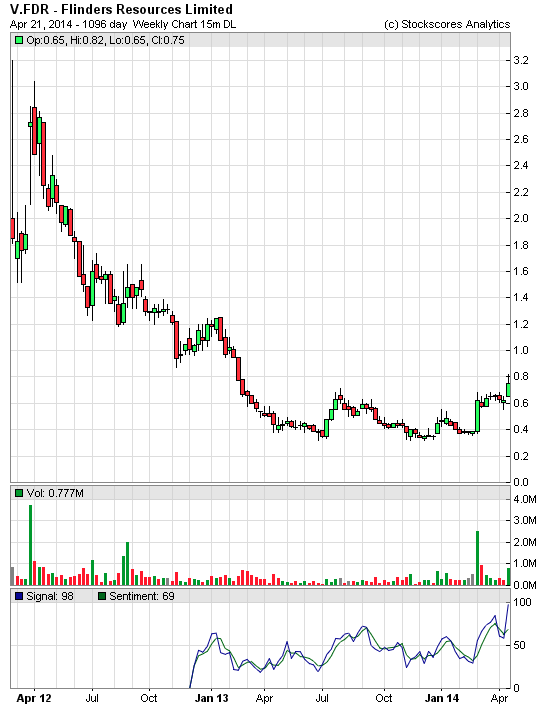
This week, I ran a scan for stocks making abnormal price gains with abnormal volume and then inspected the weekly charts for a good pattern. It seems traders are a bit slow to get back to trading after the long weekend as there are not too many stocks making strong moves. One does stand out, see below.
V.FDR has been trading sideways for about a year and making a nice price pattern. Today, it is breaking through resistance with strong volume and looks like it has decent potential to go to $1.20. The company is a Graphite miner, an area that is heating up because Graphite is used in batteries for green technologies. My main concern with this stock is that it is not yet very liquid. Also consider V.GPH. Support at $0.55.
- Get the Stockscore on any of over 20,000 North American stocks.
- Background on the theories used by Stockscores.
- Strategies that can help you find new opportunities.
- Scan the market using extensive filter criteria.
- Build a portfolio of stocks and view a slide show of their charts.
- See which sectors are leading the market, and their components.
Disclaimer
This is not an investment advisory, and should not be used to make investment decisions. Information in Stockscores Perspectives is often opinionated and should be considered for information purposes only. No stock exchange anywhere has approved or disapproved of the information contained herein. There is no express or implied solicitation to buy or sell securities. The writers and editors of Perspectives may have positions in the stocks discussed above and may trade in the stocks mentioned. Don’t consider buying or selling any stock without conducting your own due diligence.


-
I know Mike is a very solid investor and respect his opinions very much. So if he says pay attention to this or that - I will.
~ Dale G.
-
I've started managing my own investments so view Michael's site as a one-stop shop from which to get information and perspectives.
~ Dave E.
-
Michael offers easy reading, honest, common sense information that anyone can use in a practical manner.
~ der_al.
-
A sane voice in a scrambled investment world.
~ Ed R.
Inside Edge Pro Contributors

Greg Weldon

Josef Schachter

Tyler Bollhorn

Ryan Irvine

Paul Beattie

Martin Straith

Patrick Ceresna

Mark Leibovit

James Thorne

Victor Adair