
Timing & trends
Global synchronized growth, as measured by the Global Purchasing Managers’ Index (PMI), remained stable or positive for the past 12 months until Japan reversed the momentum in April with a precipitous drop in its PMI. China is contributing modest growth but, fortunately, the U.S. and Europe are rebounding. This lack of consistent global momentum has created a short-term, volatile, hot and cold, stop and go sentiment. Global real GDP growth peaked in 2010 at 5.2 percent, then slowed for the next three years, to 3 percent. Global growth in 2014 is likely to accelerate, for the first time in four years, to 3.5 percent, according to ISI. This is constructive news for commodities.
Brian Hicks and I co-manage the Global Resources Fund (PSPFX) using a model that focuses on companies demonstrating robust fundamentals in sectors showing strength. I’ve asked Brian to share his thoughts on the opportunities we see in today’s market.
Q: We’ve seen strength in the major oil companies, service and equipment companies, oil and gas exploration and production (E&P) companies, chemical companies and refiners. What’s behind the strength?
A: The major oil companies have benefited from higher Brent pricing and cheap relative valuation to energy and the broader market. E&P stocks are especially solid because the price of oil is strong. The shale revolution has been a transformative factor for a lot of companies in this space, creating very strong growth in production. Chemical companies and refiners are downstream beneficiaries of the shale play as relatively inexpensive oil and natural gas prices lower their main input cost in the manufacturing of chemicals and refined petroleum products. Because of this competitive advantage in the U.S., we’re seeing chemical companies moving back to the states and creating jobs. Global demand is also increasing for oil and chemicals.

Q: Other commodities such as copper, aluminum and iron ore have been struggling. The Brent oil price hasn’t moved as much as the WTI price. Explain what is happening in these areas.
A: Brent oil isn’t necessarily struggling, but it has been stuck in a sideways trading pattern. Copper prices have fallen hard and subsequently rebounded recently. The metal has experienced a lot of volatility as well. This is mainly due to soft economic growth in China and high inventory levels in global exchanges. Aluminum and iron ore are both oversupplied and the glut has weighed on prices. Until we see cutbacks in production and prices that support profit, they will likely remain weak. Australian iron ore producers have cranked up production to the point where 2014 will likely remain a year of oversupply.
Q: Talk about some of the recent “success story” stocks in the fund.
A: Raging River Exploration is a Canadian junior oil and gas producer. The company has a deep inventory of drilling prospects, strong netbacks (the gross profit per barrel of oil produced), and has seen rising profit growth. We bought this name on a price pull back.

Sherritt International Corp is another Canadian based resource company. It has interests in nickel, coal and cobalt mining. Nickel prices were under tremendous pressure last year due to oversupply but have surged this year since Indonesia banned exports of unprocessed ore in an effort to encourage domestic industrial development. Indonesia is the world’s leading supplier of high-grade nickel ore, which is used to make stainless steel. Sherritt has benefited from this drastic change in the nickel market.

Goodrich Petroleum Corp is an exploration and production company that looks for natural gas and crude oil. The company has had positive drill results recently in a developing new play, the Tuscaloosa Marine Shale in Louisiana and Mississippi. We first bought the stock around $14. Today it is trading around $24.

Q: Recently the overall market sentiment has shifted to prefer large cap companies over small cap stocks. Why do you still believe in small caps for the long term?
A: Small caps are where the growth is going to come from, and this is true of resource companies as well. These types of stocks may be out of favor for the time being, but in the stock market everything is cyclical. Eventually, the market will recognize (again) that smaller companies have higher growth potential and the sentiment will shift back.
Going back to 1926, small cap stocks have historically performed better from November through April. Check out the difference between a buy and hold strategy and one where small cap were held during the May to October period.

Vancouver is a lovely summer destination and the perfect place to learn more about resource investing. I’ll be speaking there at the Natural Resource Symposium July 22-25. I hope to see you there.
Please consider carefully a fund’s investment objectives, risks, charges and expenses. For this and other important information, obtain a fund prospectus by visiting www.usfunds.com or by calling 1-800-US-FUNDS (1-800-873-8637). Read it carefully before investing. Distributed by U.S. Global Brokerage, Inc.
Foreign and emerging market investing involves special risks such as currency fluctuation and less public disclosure, as well as economic and political risk. Because the Global Resources Fund concentrates its investments in specific industries, the fund may be subject to greater risks and fluctuations than a portfolio representing a broader range of industries.
Fund portfolios are actively managed, and holdings may change daily. Holdings are reported as of the most recent quarter-end. Holdings in the Global Resources Fund as a percentage of net assets as of 03/31/14: Goodrich Petroleum Corp 1.13%, Raging River Exploration Inc. 1.21%, Sherritt International Corp 1.24%.
All opinions expressed and data provided are subject to change without notice. Some of these opinions may not be appropriate to every investor. By clicking the links above, you may be directed to third-party websites. U.S. Global Investors does not endorse all information supplied by these websites and is not responsible for their content.
The J.P. Morgan Global Purchasing Manager’s Index is an indicator of the economic health of the global manufacturing sector. The PMI index is based on five major indicators: new orders, inventory levels, production, supplier deliveries and the employment environment.

 One of the biggest questions at the end of 2013 was how the Treasury market would react to the reduction of bond buying that would result from the Federal Reserve’s tapering campaign. If the Fed were to hold course to its stated intentions, its $45 billion monthly purchases of Treasury bonds would be completely wound down by the fourth quarter of 2014. Given that those purchases represented a very large portion of Treasury bond issuance at that time, it was widely assumed by many, me in particular, that the sidelining of such huge demand would push down the price of Treasury bonds. Without the Fed’s bid, interest rates would have to rise.
But almost five months later, yields on the 10-year Treasury bond are 50 basis points lower than they were at the end of 2013, despite the fact that the Fed has officially trimmed its monthly purchases in half. Apparently, plenty of other buyers were prepared to fill the void. Many have concluded that Uncle Sam doesn’t need the Fed after all. But a close look at international activity in the Treasury market reveals some odd patterns that should be explained.
Over the last six months Belgium has started to behave eccentrically, even by Belgian standards. No, the small country of 11 million has not decided to stop making chocolate or waffles. It has decided to increase its buying of U.S. Treasury bonds…in a very big way. According to latest U.S. Treasury Department data, since August of 2013 entities in Belgium have purchased and held a stunning $215 billion of U.S. Treasuries. This figure is equivalent to about half the country’s annual GDP, and equates to almost $20,000 for every living Belgian. Prior to that time, Belgium had held its cache fairly steady at around $170-$190 billion. But by March, that total had increased by almost 130% (to $381 billion) in just seven months. The purchases represented 61% of the total increase in foreign holdings of U.S. Treasuries over that time frame. Given the fact that Belgium, as of last September, had less than 3% of the Treasury bonds held by foreign sources, this is strange behavior indeed.
Of course exactly who is buying those bonds remains a mystery. It’s only known for sure that a Belgium-based clearing house called Euroclear is “likely responsible” for holding the $200 plus billion in Treasuries. It’s amazing in this day and age when every e-mail and phone call is scrubbed for security content that hundreds of billions of dollars could move across borders without anyone really knowing what is going on. Of course this is likely only possible if official sources themselves are the transacting parties.
What is clear is that this is not likely the government of Belgium, or private Belgian capital, that is doing the buying. The numbers are just too large. This is particularly true in the First Quarter of 2014 when the buying averaged a stunning $41.5 billion per month (January was the biggest month with $54 billion). In all likelihood, the only European buyer with a wallet that big would be the European Central Bank (ECB) itself. But why would the ECB buy when the Federal Reserve was supposed to be tapering?
It is widely recognized that as the flow of capital increases exponentially across borders, and financial systems become more globally integrated, international central bank cooperation has increased. This is especially true between the Federal Reserve and the European Central Bank (ECB) which have closely coordinated policy to deal with the Great Recession of 2008 and the European Sovereign Debt Crisis of 2011. Exactly how, where, and why these banks have worked together is a little harder to imagine.
Back in late 2011, when the sovereign debt crisis of Greece, Spain, Italy and Portugal threatened to fracture the European Union and take down the euro currency, the Wall Street Journal
reported the Federal Reserve was engaging at that time in a “covert bailout” of European banks. Using what was known as a “temporary U.S. dollar liquidity swap arrangement,” the Fed provided billions in funds that its European counterpart used to bail out its banks. The Journal
speculated that the roundabout arrangement was followed in order to get around legal restrictions that prevented the ECB from lending to banks directly. The Journal called the arrangement “Byzantine” and questioned whether its design was simply meant to confuse the press and investors as to who was funding whom. In any event, the program seems to have achieved its end of keeping European banks solvent until the debt crisis had abated.
The Belgian head-scratcher may therefore be a simple case of central bankquid pro quo. In fact, on my radio program today, former Congressman Ron Paul shared my suspicions that there was indeed some type of “quid pro quo” coordination. While there is no smoking gun, the timing and scope of the buying is certainly suggestive of a coordinated effort. Confidence that the financial markets would stay stable during the tapering campaign was a critical element of the program’s success. Any panic in the bond market would cause yields to spike, which would have a strong negative effect on stock prices and economic confidence. If the fear persisted for more than a few weeks, the Fed would have been forced to an embarrassingly early backtrack. The lost credibility would have greatly limited the Fed’s latitude for further maneuver.
But what if the ECB started buying just as the Fed stopped? Better yet, what if the ECB purchases were larger than the taper? It would then appear that the Fed buying was simply a footnote in the current environment of ultra-low interest rates, not the driving force. It may not be coincidental that the Belgian buying began in earnest just as the tapering got underway. Something may in fact be rotten, and it’s not in Denmark…but several hundred kilometers to the southwest.
Rather than looking to explain the unusual spike in Belgian coffers, most market watchers are fixated by recent comments by Mario Draghi that the ECB is poised to launch a quantitative easing-style bond buying campaign in order to weaken the euro and to push up inflation in Europe. If that is the case, how long could the ECB be expected to fight a two-front monetary war…carrying water for the Fed while buying European bonds simultaneously? We must expect that any clandestine campaign by the Europeans to support Treasuries will have a brief shelf life, which could get even briefer if the ECB initiates their own QE.
It is a testament to the bovine nature of our financial media that this story is not being pursued strongly by all the power the fifth estate can muster. But who cares when rates are low and stock prices high? Have another chocolate. The Belgian ones are the best.
Peter Schiff is the CEO and Chief Global Strategist of Euro Pacific Capital, best-selling author and host of syndicated Peter Schiff Show.
Catch Peter’s latest thoughts on the U.S. and International markets in the Euro Pacific Capital Spring 2014 Global Investor Newsletter!

 We take a look at key areas of the commodity markets.
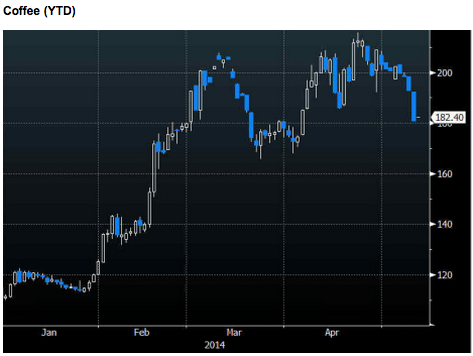
There’s been no shortage of volatility in commodity markets this year. From coffee’s spectacular surge to copper’s brutal plunge, there’s been ample opportunity to generate hefty returns or losses. Here we take a look at year-to-date performance in a number of the most important commodities and analyze where they could go in the coming months.

In terms of sector performance, agriculture has been far and away the best performer so far in 2014. Led by coffee—which at one point was up a whopping 95 percent year-to-date—the sector has delivered fantastic returns for investors.
At the heart of the increase in coffee prices has been the severe drought in Brazil. What has been called the worst drought in decades is expected to sharply reduce coffee supplies in the world’s largest grower and exporter. Analysts estimate that global coffee supplies may fall short of demand by more than 10 million bags this year—a significant amount in a world that consumes roughly 130 million bags annually.
But are these bullish fundamentals priced into coffee?
Bull case: If Brazil experiences heavy rains this summer during the harvest, the country’s coffee yields could suffer more. That would lead to a bigger gap between supply and demand and send prices spiking above $2/lb, perhaps even $3 (where they traded as recently as 2011).
Bear case: On the flip side, the world’s second-largest producer, Colombia, is expected to have a stellar harvest, which could help fill some of the gap left by Brazil. At the same time, global coffee surpluses during the past four years have left inventories at comfortable levels. Those could provide a buffer despite this year’s expected supply deficit.
Prediction: While it’s possible coffee prices may not rally much more from here, it’s hard to see them falling back to levels below $1.20/pound where they were at the beginning of the year—at least in the short term.
….read page 2 HERE

 Mortage brokers were abuzz this week when Investors Group announced a 1.99% variable 3 year floating rate mortgage. But is does come with a few surprises.
While there’s no denying the importance of getting a low interest rate when you get a mortgage, but there are big caveats that come with some of the record discounting going on for residential loans.

-
I know Mike is a very solid investor and respect his opinions very much. So if he says pay attention to this or that - I will.
~ Dale G.
-
I've started managing my own investments so view Michael's site as a one-stop shop from which to get information and perspectives.
~ Dave E.
-
Michael offers easy reading, honest, common sense information that anyone can use in a practical manner.
~ der_al.
-
A sane voice in a scrambled investment world.
~ Ed R.
Inside Edge Pro Contributors

Greg Weldon

Josef Schachter

Tyler Bollhorn

Ryan Irvine

Paul Beattie

Martin Straith

Patrick Ceresna

Mark Leibovit

James Thorne

Victor Adair