
Currency
Austria, 1920-21: The government printed money to cover its debts from World War I.
Food and fuel costs exploded. Banks urged their customers to convert Austrian kronen into a more stable currency… even though it was against the law.
A law-abiding widow is wiped out on the day of a bank run. Her diary entry is reproduced in Adam Fergusson’s book When Money Dies…
“Why don’t you think the krone will recover again?” [I asked my banker.]
“Recover!” [he] said with a laugh… “just test the promise made on this 20 kronen note and try to get, say, 20 silver kronen in exchange.”
“Yes, but mine are government securities: Surely, there can’t be anything safer than that?”
“My dear lady, where is the state that guaranteed these securities to you? It is dead.”
We’ve recounted the tale before. We tell it again now for two reasons. First as a reminder that most of the imbalances that caused the Panic of 2008 remain woefully out of balance. But you already knew that.
There’s extra urgency to our telling now: The one “X factor” the pundit class touts as the U.S. dollar’s savior? It might prove the dollar’s final undoing. Bank runs, capital controls, an effective default on the national debt — and all because of the “prosperity” we’re enjoying now.
Our suspicions were first raised in January… when two “opposing” politicos held hands and sang in sweet harmony about America’s energy boom.
“Cheap natural gas is going to allow us to basically reshore manufacturing,” says Chicago Mayor and former Obama chief of staff Rahm Emanuel. As a result, manufacturing will be “coming back in ways we can barely anticipate,” says former Republican presidential contender Steve Forbes. Together they were on CNBC to pitch an event called the “Reinventing America Summit.”
Not that we disagree: It all sounds very familiar if you were following the “Re-Made in America” thesis of our own Byron King more than two years ago. Then it was radical. Now it’s conventional wisdom.
Leave it to us to throw a cat among the pigeons: For as much prosperity as the U.S. energy boom is creating now… it will ultimately set off the next major economic crisis. Indeed, it will tank the U.S. dollar’s status as the world’s “reserve currency” once and for all.
We say this knowing we court the wrath of conventional wisdom…
- “The U.S. shale oil revolution which has been quietly unfolding behind the scenes has now begun to exert a direct influence on foreign exchange markets — to the benefit of the U.S. dollar,” says a report from UBS
- “Global reserve currency status allied with less dependence on foreign investors will boost the currency on a five-year view,” says a strategist at Société Générale
- Because of “the technological advances that enable oil and gas to be extracted from shale,” says fund manager David Donora at Threadneedle Investments, “the dollar will likely enjoy a period of sustained strength.”
Right. Until it doesn’t.
The very thing helping to prop up the U.S. dollar now will ultimately kick out all those props and topple the greenback from its status as the world’s reserve currency. Not tomorrow or even next year. But the destination is set… and our arrival is certain. It won’t look exactly like Vienna in 1921… but it will feel just as awful.
So strap in: Some of the ground we’re about to cover might sound like old hat to you… but we promise you’ve never seen the dots connected in this way before.
U.S. oil production averaged 7.5 million barrels per day during 2013. The increase over 2012 marked the biggest in U.S. history. Indeed, it’s the fourth-biggest annual increase by any country ever… and Saudi Arabia holds the top three spots.
And it only gets better from here. The peak year for U.S. crude production was 1970 — a little shy of 10 million barrels per day. As you see from the “Back to the Future” chart, the U.S. Energy Department projects the nation will once again equal that number by 2019.

In 2005 — only nine years ago — the United States imported 60% of its oil needs. By 2012, that number collapsed to 40%. Check out the chart nearby and you’ll see the percentage is set to shrink even more over the next quarter-century. And make a mental note — we’ll be coming back to this chart later.

As we go to press, a barrel of oil fetches $100, give or take. So every 1 million barrels per day of new supply means $100 million less imported oil every year. Lower import costs, a lower trade deficit, fewer dollars flowing overseas — great news for the dollar, huh? It’s all good, right?
Well, yes… except that now the entire structure that’s supported the global financial system for 40 years is starting to come unglued.
Since 1974, the world has run on “petrodollars.”
The petrodollar arose from the ashes of the Bretton Woods system after President Nixon cut the dollar’s last tie to gold in 1971.
In the immediate post-World War II years, Bretton Woods made the dollar the world’s reserve currency — the go-to currency for cross-border transactions. If you were a foreign government or central bank, the dollar was as good as gold — for every $35 you turned in to the U.S. Treasury, you received one ounce of gold.
Chances are you know the rest of the story: Foreigners recognized Washington was printing too many dollars, the French wanted more gold than Washington was willing to give up and Nixon “closed the gold window.” But without gold, what would continue to cement the dollar’s position as the world’s reserve currency?
After the “oil shock” of 1973–74, in which oil prices shot up from $3 a barrel to $12, Nixon’s Secretary of State Henry Kissinger got an idea and convinced the Saudi royal family to buy in.
The deal went like this: Saudi Arabia would price oil in U.S. dollars and use its clout to get other OPEC nations to do the same. In return, the U.S. government agreed to protect Saudi Arabia and its allies against foreign invaders and domestic rebellions.
The appeal for the House of Saud was obvious — the weight of the U.S. military would keep the family’s 7,000 princes living in the style to which they’d become accustomed.
The appeal for Washington was more subtle — but no less important. Anyone who wanted to buy oil now needed dollars to do so. That meant perpetual demand for dollars and a cycle that goes like this…
- Dollars used to buy oil are deposited in the banking system to support international lending by the major banks
- That lending supports the purchase of American goods — everything from Boeing airplanes to Archer Daniels Midland corn. Oh, and U.S. Treasury debt. Can’t forget that.
“This gave the dollar a special place among world currencies, and in essence ‘backed’ the dollar with oil,” explained Rep. Ron Paul in a prescient speech on the floor of the U.S. House in 2006. “The arrangement gave the dollar artificial strength, with tremendous financial benefits for the United States. It allowed us to export our monetary inflation by buying oil and other goods at a great discount as dollar influence flourished.”
Then came his forecast: “The economic law that honest exchange demands only things of real value as currency cannot be repealed. The chaos that one day will ensue from our 35-year experiment with worldwide fiat money will require a return to money of real value. We will know that day is approaching when oil-producing countries demand gold, or its equivalent, for their oil, rather than dollars or euros.”
Strange as it might be to imagine… the great American energy boom is hastening that day’s arrival. More to come tomorrow…
Regards,
Addison Wiggin
for The Daily Reckoning
P.S. Regardless of how or when the U.S. dollar eventually collapses, there will be solutions for you to protect your wealth and even profit in the process. In today’s Daily Reckoning email edition I gave readers a chance to discover two specific solutions to the coming dollar collapse, absolutely free. And that’s just one small benefit of being a reader of the FREE Daily Reckoning email edition… Every issue comes jam-packed full of great opportunities just like this. If you’re not getting it, you’re not getting the full story. Sign up for FREE, right here, and never miss out on your chance to get this kind of expert investment advice.
You can read Part II of this essay, right here: Prepare for the Death of the Petrodollar.
About Addison Wiggin
Addison Wiggin is the executive publisher of Agora Financial, LLC, a fiercely independent economic forecasting and financial research firm. He’s the creator and editorial director of Agora Financial’s daily 5 Min. Forecast and editorial director ofThe Daily Reckoning. Wiggin is the founder of Agora Entertainment, executive producer and co-writer of I.O.U.S.A., which was nominated for the Grand Jury Prize at the 2008 Sundance Film Festival, the 2009 Critics Choice Award for Best Documentary Feature, and was also shortlisted for a 2009 Academy Award. He is the author of the companion book of the film I.O.U.S.A.and his second edition of The Demise of the Dollar, and Why it’s Even Better for Your Investments was just fully revised and updated. Wiggin is a three-time New York Times best-selling author whose work has been recognized by The New York Times Magazine, The Economist, Worth, The New York Times, The Washington Post as well as major network news programs. He also co-authored international bestsellers Financial Reckoning Day and Empire of Debt with Bill Bonner.

Gold is traditionally an investment of choice when inflation is rising or global tensions are growing. But this year, despite the conflict between Russia and the Ukraine, gold prices haven’t moved much, and inflation in much of the developed world is muted.
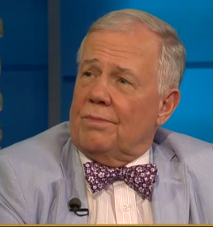 “I’m not buying gold at the moment,” international investor Jim Rogers tells The Daily Ticker. “But if the opportunity comes along — and it will in the next year or two — I will buy more.”
Related: Gold industry “needs to get its act together”: Randgold CEO
When The Daily Ticker’s anchor Lauren Lyster asked Rogers in the video above what such an opportunity might look like, Rogers said that a 50% decline in gold prices, to under $1,000 an ounce would justify buying the precious metal. (That’s a 50% decline from its record high just under $2,000 an ounce in August 2011.) But Rogers also says, “if America goes to war with Iran,” he’d be “begging to buy at $1,600 an ounce.”
As of mid-day Wednesday gold futures were trading at $1,300 an ounce, or about 8% higher than the 2013 year-end close of $1,202. Gold prices fell a whopping 28% in 2013, but Rogers says a 50% correction every three or four or five years is more normal for an asset class, and therefore, a reason prices could fall from here.
Related: The lessons of gold’s collapse
As for why gold prices haven’t taken off this year, Rogers says demand from China, the number one consumer of gold, is declining because the market there is “saturated.” He says investors, meanwhile, would rather put their money into stocks. The Dow (^DJI) and S&P 500 (^GSPC) closed at record highs Tuesday but have since retreated, while the 10-year Treasury note price has advanced, as its yield slipped to 2.55%.

 Bill Bonner‘s note: You’ve probably heard well-to-do friends and neighbors talk about wealth inequality… and what “should be done about it.”
Bill’s long-time business partner and editor of The Palm Beach Letter, Mark Ford, calls this “buying cheap seats in the I Want to Feel Good About Myself theater of the absurd.”
Mark believes you can favor equality… or you can favor freedom… but you can’t favor both.
Fair warning: This week’s Weekend Edition is not politically correct. But we think you’ll enjoy it nevertheless.
Why You Can’t Have Freedom AND Equality
By Mark Morgan Ford, Editor, The Palm Beach Letter
At a dinner party last month, our hostess interrupted the small talk to make a little speech. She told us that she really hated oppression and inequality. She then invited us to talk about how we were combating oppression and inequality by doing good.
A young woman – a yoga teacher – said that she had recently volunteered to teach a class to women in a detention center. She admitted that yoga “might not” change their lives. But she was “very proud” that they could “at least breathe in freedom” for an hour every week.
The dinner guests oohed and ahhed.
A man – a successful executive – said that he collects his family’s old shoes, stores them in the back of his Mercedes-Benz, and then distributes them to homeless people on the side of the road.
The dinner guests oohed and ahhed.
Something – was it the canapés? – was churning in my stomach. I excused myself to have a quick cigar break.
As I stood outside the posh apartment building trying to sort out my feelings, a relatively well-dressed man approached me and asked for a light. As I lit his cigarette, he informed me that his car had run out of gas. And since he happened to have just lost his wallet, he wondered if I could lend him some money to fill up his tank.
I told him that I had heard that line before. He insisted that, in his case, it was true. I told him that my personal policy was to direct all my giving to my family’s charitable foundation. “But if you want to work,” I said, “I will pay you a dollar a minute.”
The look on his face was a mixture of surprise, indignation, and disgust. He uttered a few unkind words and stormed away.
Had he agreed to work, I would have asked him about his personal situation. I meant to keep an open mind. I don’t know nearly enough about homelessness and financial inequality. I wanted to know more.
I returned to the party to find the recitations going full bore. But the subject had veered slightly from poverty to victims of prejudice. In particular, to the plight of African Americans, gays, and some group identified by an acronym I can’t quite remember.
Not everyone was participating. But those who were speaking were positively brimming with good cheer. There is, apparently, nothing that makes some people happier than to tell other people how kind they are.
This sort of social consciousness is nearly ubiquitous among Hollywood celebrities. It is also quite common among those who write letters to The New York Times.
These are, for the most part, affluent people with college degrees. I sometimes wonder if they ever stop to think carefully about what they are doing? Do they ever wonder if they are simply buying cheap seats in the I Want to Feel Good About Myself theater of the absurd?
The economic foundation of such ideas are popularly represented by writers like Paul Krugman, a columnist for The Times.
Like so many of the guests at that dinner party, Krugman is proudly “in favor of” freedom and equality and worries that capitalism is making them scarce. He divides politicians and economists into two groups: The good guys that love freedom and equality and the bad guys that love capitalism and free markets.
For most human enterprises, in fact, freedom and equality are nearly polar opposites. Free markets inevitably result in some degree of economic inequality, just as free societies result in some degree of educational, cultural, and social differences.
There are many reasons for that. But the most fundamental reason is that human beings are not created equal. We are each a mixture of talents and handicaps, intelligence and stupidity, ambition and ennui, diligence and laziness. And even when we use the power of politics to enforce some degree of equality, people find a way to assert their differentness.
What I’m saying is this: Either you favor freedom or you favor equality. You cannot favor them both. It is intellectually shallow and/or insincere to pretend that you do.
Bill Bonner’s Note: Mark is editor of a monthly newsletter called The Palm Beach Letter. He has a simple goal – to help readers “get richer every day.” And he specializes in finding low-risk ways to generate wealth. Right now, Mark is offering Diary of a Rogue Economist readers the opportunity to try The Palm Beach Letter for a year (365 days) at his expense. If you’re interested in taking Mark up on his offer, you can find full details here


#10. Aberdeen Asia Pacific Income Investment Co. Ltd. (TSE:FAP.CA) — 9.9% YIELD
At #10, Aberdeen Asia Pacific Income Investment Company is a closed-end investment company. Co.’s investment manager is Aberdeen Asset Management Asia Limited, which provides investment services.


Ah, the Italians. They’re good for at least one entry in the “Why We’re Ungovernable” series each year, and their latest is the best yet:
“Drug trafficking, prostitution revenue set to boost Italy’s GDP result
Italy has announced it will start including estimated revenues from prostitution and illegal drug sales in official gross domestic product (GDP) figures.
The country’s National Institute of Statistics says starting next year, the GDP result will also include estimates on the value of the black market in cigarettes and alcohol.
The move has been driven by new European Union rules requiring nations to include all activities that produce income in their national accounts, regardless of their legality.
The institute says the procedure would be it will be “very difficult for the obvious reason that these illegal activities are not reported”.
The Bank of Italy in 2012 estimated the value of the criminal economy at 10.9 per cent of GDP.
Theoretically, that could mean Italy’s GDP result with the new calculation will come in far higher than the government’s 1.3 per cent growth estimate.
Eurostat earlier estimated the average GDP increase for EU nations due to the new calculation to be at 2.4 per cent.
The highest rises were estimated for Finland and Sweden at 4 to 5 per cent, followed by Austria, Britain and the Netherlands at 3 to 4 per cent.
The increase for Italy would be around 1 to 2 per cent.
The “grey economy” of businesses that do not pay taxes is already calculated in Italy’s GDP and was estimated to be worth between 16.3 per cent and 17.5 per cent of the economy in 2008 – the last year for which the calculation was made.”
As the above article notes, the concept of GDP relies on economic players reporting their activity. Criminal activities, in contrast, are by definition not reported. So how do state statisticians come up with a number? The same way the US gets its inflation/GDP/unemployment stats, by running assumptions through a bunch of other assumptions and then making some favorable adjustments to what comes out. In other words, since official numbers are largely guesswork (or conscious manipulation), the idea of adding made-up numbers for drugs and prostitution to GDP is really not that big a stretch.
It might, however, make for some amusing reports down the road: “Italy’s prostitution sector exceeded Wall Street expectations in the Third Quarter while cocaine sales and car thefts were off slightly, noted Goldman Sachs analyst Vito Soprano…” You’d think the investment banks would have a pretty good feel for black-market trends, since they’re such active consumers of hookers and drugs.
And this isn’t just the Italians being Italian. As the above article notes, the new rules apply to all of Europe. One odd stat: “The highest [GDP] rises were estimated for Finland and Sweden at 4 to 5 per cent, followed by Austria, Britain and the Netherlands at 3 to 4 per cent. The increase for Italy would be around 1 to 2 per cent.” Apparently, crime is a much bigger part of the Scandinavian economies. At the risk of being racist (or reverse-racist or whatever), that’s a bit counter-intuitive.
In any event, the implications are consistent with the theme of this series: When a country borrows too much, life gets more complicated, voters get angry and leaders find it harder to get reelected. And ideas that once seemed crazy begin to look like the least problematic of the remaining options. Adding crime to GDP is about as close to perfect an example as we’re likely to find.
The other “Why We’re Ungovernable” posts are here

-
I know Mike is a very solid investor and respect his opinions very much. So if he says pay attention to this or that - I will.
~ Dale G.
-
I've started managing my own investments so view Michael's site as a one-stop shop from which to get information and perspectives.
~ Dave E.
-
Michael offers easy reading, honest, common sense information that anyone can use in a practical manner.
~ der_al.
-
A sane voice in a scrambled investment world.
~ Ed R.
Inside Edge Pro Contributors

Greg Weldon

Josef Schachter

Tyler Bollhorn

Ryan Irvine

Paul Beattie

Martin Straith

Patrick Ceresna

Mark Leibovit

James Thorne

Victor Adair