
Bonds & Interest Rates
 Today Canadian legend John Ing warned King World News that the moves by the ECB and other central planners will end in disaster. Ing, who has been in the business for 43 years, said it is just a matter of time before disaster strikes, and he also spoke about key events in a number of other markets:
Ing: “Thursday was what I consider a turnaround day as Draghi dropped European rates to negative territory”
Continue reading the John Ing interview HERE

For 5 years the correlation between the expansion of the Federal Reserve’s balance sheet and the growth of the S&P 500 has risen dramatically. Since QE3 was unveiled, the correlation is converging on 1 which of course is just happy coincidence and nothing to do with the free and easy flow of liquidity that month after month of Fed largesse has created. The problem is we now know that the hurdles to a Fed un-Taper are very high and so we can extrapolate the end-point for the Fed’s balance sheet and where stocks would trade at that point.The S&P 500’s recent exuberance has priced in the total expansion of the Fed’s balance sheet to the end of the taper, so how much more upside is there?
Coincidence…?

Perhaps not…continue reading HERE

With gold prices down over $130 from its most recent high in March 2014 and only a little over $60 above the lows of June and December 2013 one has to wonder if there is another major bear drop to come. Gold remains down over $600 from its all-time (nominal) high of $1,911 seen in September 2011. This has played out against the backdrop of the US stock markets making ongoing moves to new all-time (nominal) highs. Gold as a result has become a “bad word” with some predicting that gold has much further to fall even as those committed to the “yellow metal” continue to believe holding gold is the right strategy.
So who is right? Despite the fall in gold’s price since September 2011, the fundamentals have not changed.
(Click on images to enlarge)
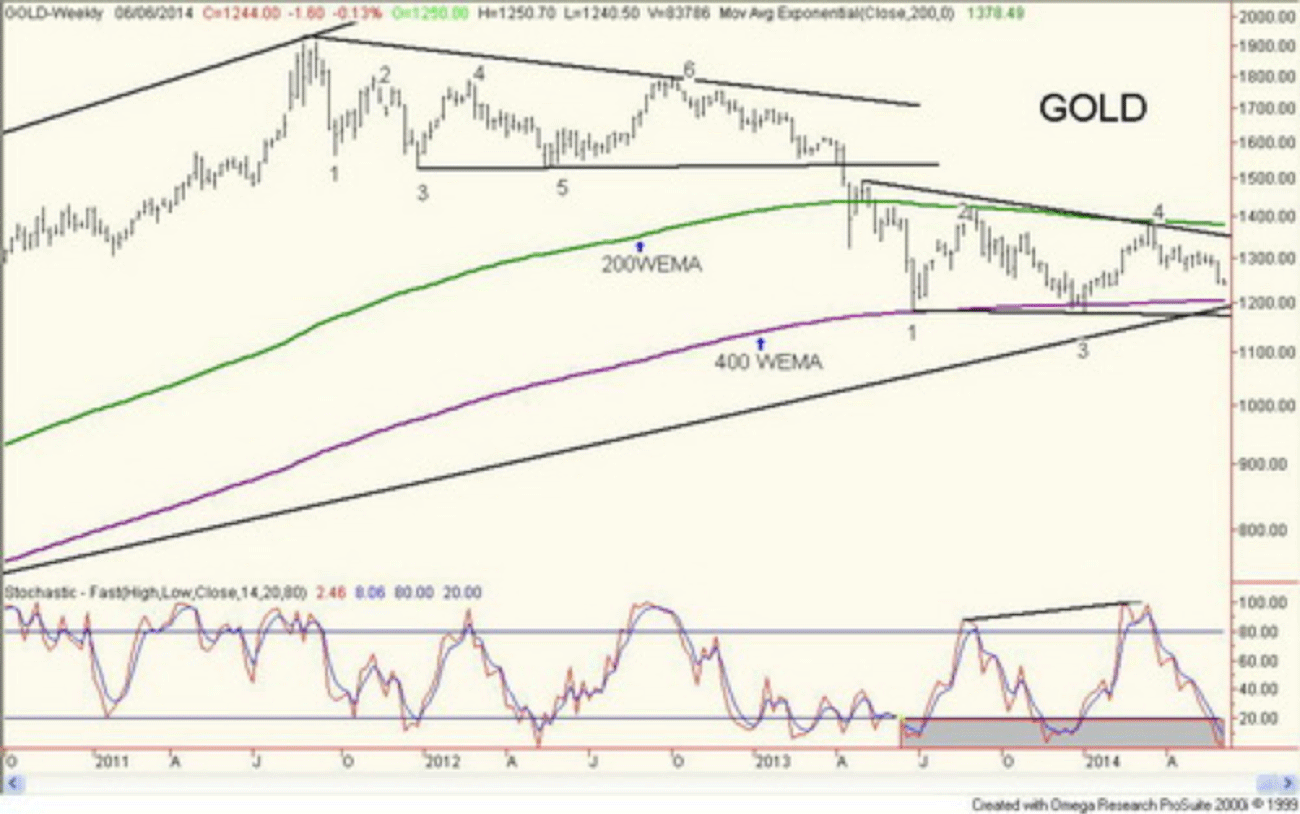
Despite the fall in gold’s price since September 2011, the fundamentals have not changed. Despite what many say, gold is not a hedge against inflation or deflation. It could perform well under either scenario. If gold is a hedge it is a hedge against bad government and currency depreciation.
Gold is an alternate currency and is currently the only alternate currency to fiat currencies. It is traded either beside or on the currency desks of major financial institutions. Gold has acted as a safe haven during times of financial stress. In countries that have experienced currency collapses, those who held gold were able to maintain their wealth and purchasing power. They could also have maintained their wealth through the holding of US$ as well. The US$ as the world’s reserve currency is still viewed as safe haven despite being a fiat currency.
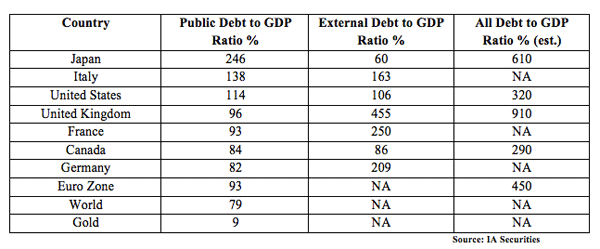
Fiat currencies have no value other than what a government says they are worth. At one time, the world’s monetary system was backed by gold. That was scraped in August 1971 under former US President Richard Nixon. Since then money and debt have exploded. Today the world’s leading industrial countries are burdened with debt. Since the financial crisis of 2008, the debt burden has increased sharply for all countries particularly for the G7. The table below outlines various forms of debt to GDP ratio of the G7 countries that represent 63% of the world’s GDP.
-
Public Debt is the total amount of debt owed by government to creditors whether domestic or external.
-
External debt is the total of public debt plus private debt owed to non-residents repayable in internationally acceptable currencies, goods or services. External debt can be lower than total public debt. External debt is considered more important than public debt.
-
All debt is the total of government public debt plus household debt, financial institutions debt and non-financial institutions debt.
-
NA – Not available or not applicable
-
Gold to GDP Ratio is the value of all of the available gold in the world at US$1,260 as percentage of total world GDP. Gold is estimated to make up less that 3% of all financial assets (stocks, bonds).
A public debt to GDP ratio of 100% or higher is a cause for concern. It is estimated that a public debt to GDP ratio above 100% could shave upwards of 1% off GDP. Since the financial crisis of 2008, debt is growing faster than GDP ensuring that the debt to GDP ratio should continue to move higher.
More debt usually means higher interest rates. However, the G7 countries have been using interest rate suppression in order to keep interest rates down. Interest rates in the G7 countries are for the most part below the rate of inflation. Negative interest rates are considered to be positive for gold. The ECB announced that they would be imposing negative interest rates on deposits in order to cajole banks into lending. The Euro fell in response to the move by the ECB. Negative interest rates could lead banks to also impose negative interest rates on their deposits.
World trade has been shrinking or at least slowing. According to the WTO world trade grew at a rate of 5.5% in 2011 but slipped to only 2.5% growth in 2012. World trade has been slowing further since then. This has been causing trade tensions between countries. Trade tensions can lead to competitive currency devaluations as each country seeks to gain an advantage for their exports. Trade wars in the 1930’s exacerbated the Great Depression. There was no WTO back in the 1930’s so it is hoped that with the WTO today it can lead to trade solutions before they become a problem. Global trade tensions are positive for gold because of the risk of currency devaluations.
Because of the cost of the global financial crisis of 2008 to taxpayers, governments are moving from bailouts to bail-ins as a means of bailing out banks in future financial crisis. What this means is that instead of taxpayer funds being at risk instead it will be depositors funds that are at risk. It is not expected to impact depositors who are covered by government deposit insurance. This is another factor that should be positive for gold. However, in order to avoid potential confiscation by governments as was seen in the US in 1933 gold should be held “off the grid” outside the banking system.
There has also been talk of seizing pension funds. No, they do not actually seize the funds. Instead, what happens is that pension funds particularly social security funds are obligated to invest only in government debt. This is currently occurring in Greece where pension funds will accept only Greek government bonds as an investment.
Global geopolitical tensions are rising. There is growing geopolitical tension between the West and Russia over Ukraine and growing geopolitical tension between the West and China over China’s actions in the South China and East China Sea. Numerous countries are facing social unrest and in Europe and even in North America there has been a significant rise in more extremist right wing parties and some left wing parties. It is the most significant rise of extremist parties since the 1930’s. Anti-European Union parties gained a number of seats in recent Euro zone elections. Growing global geopolitical tensions should be positive for gold as a safe haven.
Despite the positive fundamentals for gold, fundamentals that have grown stronger since the financial crisis of 2008, gold has not responded in a positive manner. Gold is down 35% from its 2011 top while the US stock markets are up 66% as measured by the S&P 500 in the same period. During this same period the US government debt has expanded by about 16%, the US monetary base is up 47% while GDP has grown only about 8%. US credit market debt for all participants has expanded roughly 8% while consumer liability debt has expanded 12%.
The stock markets have been driven higher on monetary expansion and low interest rates, which led to outflow of funds from bonds into the stock market. As well numerous companies rather than invest their excess cash reserves in plants and equipment that could result in job growth they have instead embarked on stock buyback programs contributing further to the rise in the stock market. But the rise in the stock market is not reflecting the reality of the economy. Economic growth in the G7 countries has at best been sluggish and at worst in an ongoing recession. The US reported that Q1 GDP contracted 1%. While many quickly blamed it on the weather, the reality is that after five years of quantitative easing (QE) the US economy is contracting not growing. The stock market appears to have started to churn a sign that institutional money is fleeing the stock market and moving back into bonds. While the S&P 500 has moved higher, broader stock market indices such as the Russell 2000 are down on the year.
In April 2013, a number of banks including Goldman Sachs, JP Morgan Chase and Morgan Stanley forecasted that gold was going to fall to $1,000. Over April 12 and 15, 2013 someone offered upwards of 500 tonnes of gold in the futures markets at the open resulting in a panic in the gold market as it fell $200. Gold has not recovered since. The perpetrators of the sell-off have never been identified. While there have been many theories about who it might have been there has been no definitive identification. Because of the size (estimated to be $23 billion at the time), there are few market participants that could carry out an operation of that size.
There have been numerous arguments presented as to who may have been behind the sell-off. Many have claimed that the sell-off was manipulation. The most identified players who may have been behind the sell-off are the Federal Reserve, China, or the large financial institutions that have been active in the gold market and may have been spooked by requests from central banks for the return of their leased gold.
For the longest time it was denied that manipulation occurred in the gold market. This denial persisted despite a number of large financial institutions being investigated and ultimately paying billions of dollars in fines for manipulation of LIBOR, currency fixing, energy price fixing and some commodity price fixing. Ultimately, price fixing was under investigation in the gold market particularly surrounding the daily London fix of gold and silver. The result of the investigation determined that there was price fixing occurring on the London gold and silver fix and fines have been imposed.
Not only have fines been imposed against at least one large financial institution, the 100 year old London silver fix is coming to an end in August and one bank, Deutsche Bank of Germany dropped out of the London fix process and closed its commodity trading desk and was in the process of selling its seat on the LME. In some of the financial institutions, traders were let go. This has ended speculation as to whether there is price fixing and manipulation in the gold market. As with the LIBOR market, the currency market and the energy market the large financial institutions have paid fines. The fines were paid with no admission as to guilt. Manipulation in markets is temporary phenomenon that while it works for a period the markets eventually revert to the mean.
During the 1990’s central banks leased their gold out to financial institutions. The financial institutions subsequently most likely sold the gold in the market thus creating what became known as the gold carry trade. It is estimated that this may have created a short position in gold of at least 14 thousand tonnes and possibly higher. This position would need to be covered if the central banks were to ask for their leased gold back. In August 2011, Venezuela asked for their gold back and in January 2013, Germany asked for its gold that was stored with the NY Fed back. Germany was told it could take upwards of five years to get its gold back.
More recently, the same financial institutions that were predicting a collapse in gold prices prior to April 12 and 15, 2013 have been once again predicting gold could fall to $900. Is that possible? The simple answer is yes. The weekly chart of gold shown at the outset shows both the consolidation following the September 2011 high and the current consolidation. Note the six-point reversal pattern. On the seventh wave, gold broke support at $1,525 resulting in the crash of April 12 and 15, 2013. The pattern has appeared as a possible descending triangle. A descending triangle usually has a generally flat bottom with a series of declining highs. The pattern was more prevalent on silver that did not break out to what appeared at the time new highs in September 2012. The breakout to new highs in September 2012 for gold turned out to be a false breakout but at the time, it was viewed as quite bullish.
Since the breakdown in April 2013, gold has formed what appears to be another descending triangle. The relatively flat bottom is seen with the lows of June and December 2013 near $1,180. So far using the same wave count as the earlier pattern gold appears to have completed four waves and the current decline may be the fifth wave. If the pattern holds, gold should not breakdown on this move. If it falls to the bottom of the range, a low near $1,190 may be seen. This zone is also where some other trendlines come in as well as the 400-week exponential moving average (currently at $1,205).
Assuming $1,190 holds on any pullback the key is how high will the sixth wave go? Resistance is currently near $1,350. A breakout over $1,380 and the 200-week exponential moving average would be positive and possibly break the pattern. If the market were to fail under $1,350 and return to the lows, the risk rises for a breakdown and close under $1,180/$1,190. If that were the case, the potential objective for the possible descending triangle is down to about $875.
On an encouraging note, the rally that took place following the December 2013 low was a strong one. The stochastic indicator during that rally went higher than it did during the July/August 2013 rally even though the price of gold did not go as high. That is a potentially positive divergence.
Two other charts are shown below that also offer some encouragement. The first chart is the Dow Gold Ratio. The Dow Gold Ratio has been rallying since bottoming in September 2011. Currently the Dow Gold Ratio is under its recent high of 13.7 but just. The pullback in the ratio seen in January/February saw the stochastic indicator go lower than it did in August 2013 even though the Dow Gold Ratio did not make new lows. This is a potential positive divergence in favour of gold. The Dow Gold Ratio may also be forming an ascending wedge triangle, which is normally bullish once it breaks under 12.25 (and back under the 400 week exponential moving average currently at 12.39).
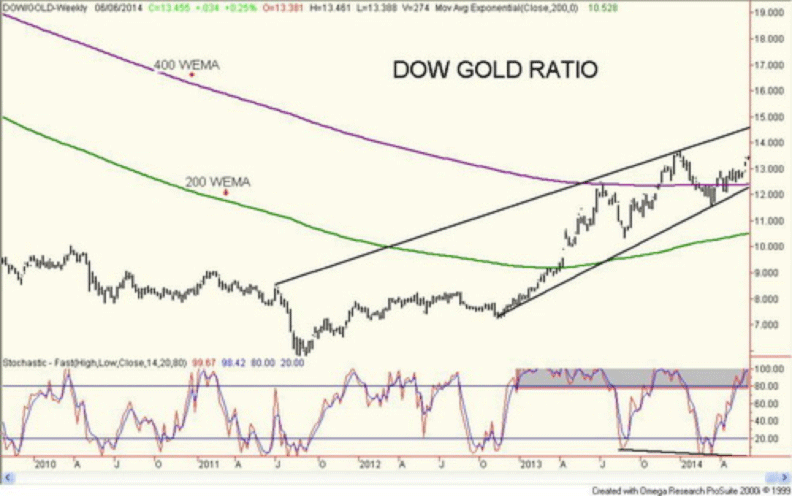
Charts created using Omega TradeStation 2000i. Chart data supplied by Dial Data
The second chart is the Market Vectors Gold Miners (GDX-NYSE). Here too the GDX made higher highs on the stochastic indicator during the January/February rally than it did during the July/August 2013 rally even though the GDX did not make new price highs. Again, this is a potentially positive divergence. The significance of these divergences on gold, the Dow Gold Ratio and the GDX suggests the next low for gold could prove to be important.
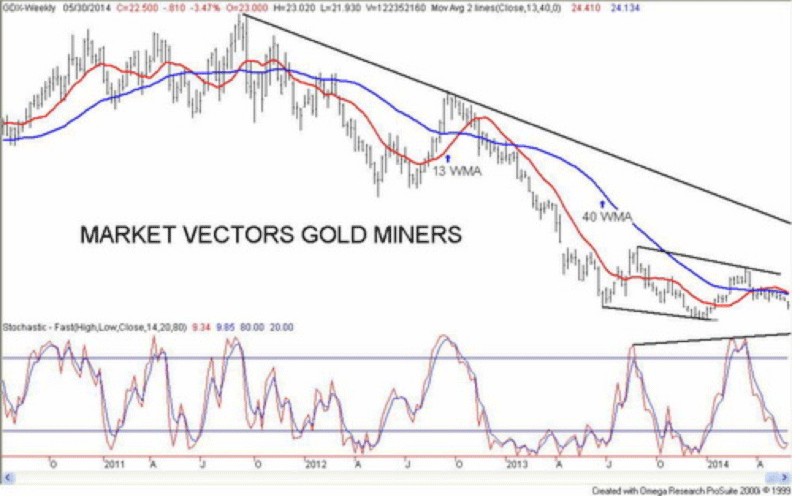
harts created using Omega TradeStation 2000i. Chart data supplied by Dial Data
The fundamentals for gold remain positive. The positive fundamentals are being offset, however, by potentially bearish technicals. This is a condition that appears to have existed prior to the April 2013 meltdown. There are some positive signs but gold needs to take out key areas to the upside. The important points to take out are at $1,350, $1,380 and especially above $1,430 the high of August 2013. The danger is that Goldman, JP Morgan and Morgan Stanley’s bearish forecasts prove correct and gold does breakdown and close below $1,190 on a weekly or monthly basis. If that were to happen it would most likely set up gold’s final low. The next few months could prove to be important for gold’s future direction.
###
David Chapman
email: david@davidchapman.com
website: www.davidchapman.com
David Chapman: Disclosure
Copyright 2014 All rights reserved David Chapman
As the stock market continues to trade around all-time record highs, today’s chart provides some perspective by illustrating the inflation-adjusted Dow since 1900 — there are several points of interest. For one, while most major US stock market indices trade well within record territory (e.g. the Dow is currently trading 45% above its 1999 peak), when adjusted for inflation, the story changes. For example, the inflation-adjusted Dow trades only 3.2% above its 1999 all-time, inflation-adjusted record high. On a positive note, the inflation-adjusted Dow has just punched through the 16,000 level — a level at which the Dow put in major peaks on its previous two attempts back in 1999 and 2007.

Notes:
Where’s the Dow headed? The answer may surprise you. Find out right now with the exclusive & Barron’s recommended charts of Chart of the Day Plus.
Quote of the Day
“Fish see the bait, but not the hook; men see the profit, but not the peril.” – Chinese Proverb
Events of the Day
June 07, 2014 – Belmont Stakes
June 09, 2014 – US Open golf tournament begins (ends June 15th)
June 14, 2014 – Flag Day
June 15, 2014 – Father’s Day
Stocks of the Day
— Find out which stocks investors are focused on with the most active stocks today.
— Which stocks are making big money? Find out with the biggest stock gainers today.
— What are the largest companies? Find out with the largest companies by market cap.
— Which stocks are the biggest dividend payers? Find out with the highest dividend paying stocks.
— You can also quickly review the performance, dividend yield and market capitalization for each of the Dow Jones Industrial Average Companies as well as for each of the S&P 500 Companies.
SUBSCRIBE FOR FREE HERE
The newest publication from Global Gold Switzerland “The Clean Slate” focuses on the theory and practice of economic cycles. In just 12 pages (download pdf), the “Austrian Business Cycle Theory” (ABCT) is explained in a simple and accessible way. Subscribe here to receive similar updates in the future via e-mail.
The key of the ABCT is that economies operate in cycles, they go through ‘booms’ and ‘busts’, ‘expansions’ and ‘recessions.’ A ‘crisis’ should not come as a surprise. Austrian School economists argue that central banks don’t help in smoothing the amplitude of the cycles, but are actually the root cause of the business cycle. While some may view that the expansionary monetary policy can mitigate the adverse effects of a crisis, the Austrian School begs to differ.
The paper does an outstanding job in explaining the ABCT and applying it on the major business cycles of the modern US economy. It also answers the question whether we have seen the end of the current crisis (“bust”). Although Barack Obama believes that “we have cleared away the rubble from the financial crisis and begun to lay a new foundation for stronger, more durable economic growth”, this report will tell you otherwise.
The Austrian Business Cycle Theory
Mises and Hayek believed that business cycles are a direct cause of excessive credit flow into the market, which is facilitated by an intentionally low interest rate set by the government. The supply of credit gives the false impression that money originally saved for investment has increased. By doing so, banks mislead borrowers into believing that the pool of investible funds is bigger, and therefore they tend to do what entrepreneurs do: invest in larger production facilities or projects they originally could not afford to finance. These investments bear what economists describe as a “longer process of production”, or capital good industries that stimulate a shift of investment away from consumer goods. This shift is unsustainable, and eventually a correction ensues. The reason is that you have a market that is out of balance and falsely directed to a level of investments that is far from reality. In other words, the state has instigated unsustainable growth.

What happens when the central bank comes in and artificially lowers the interest rate? To explain we take a look at the chart below prepared by Roger Garrison. In this chart, which relies on the Hayekian triangle depicting the different stages of production, Garrison illustrates how a change in the economy’s money supply affects its structure of production. The curve of the Production Possibility Frontier (PPF) shows different combinations of consumption and investment for any given economy (chart on the top right). Any point on the PPF curve is a sustainable mix between consumption and investment (savings).
There are three main scenarios:
- In a pro-savings economy: Investments go up, encouraged by a drop in interest rates. This point on the PPF corresponding to this lower interest rate shows that the economy directs its investments to earlier stages of production. As a result, the triangle expands horizontally.
- In a pro-consumption economy: Savings and investments (discouraged by the rise in interest rates) decrease. As a result, the triangle becomes shorter from the horizontal axis as investments go to lower order consumer goods.
- In the case of a policy-induced credit expansion: This scenario is depicted in the graph as Saug.Here we have two opposing factors at play as a result of the drop in interest rate. As it appears in the graph, the new interest rate encourages both an increase in investment as well as discouraging savings. The low interest rate intersects with both S (the real supply of money by savers given that low interest rate) and Saug (the supply induced by the central bank). These are basically the “mixed signals” we were talking about earlier. Both points are located on the PPF, but meet outside the curve, implying this level is neither efficient nor sustainable.

Who is behind the boom and hence responsible for the bust?
According to the ABCT and the Austrians, it all starts with the primary engineer of the cycle: the government. Any form of state intervention is an attempt to influence markets to prolong the process of needed adjustment and reallocation of resources to more productive uses. Therefore, by manipulating interest rates, governments negatively impact the economy as creators of the growth bubble– which in essence is artificial, distorted and imbalanced.
The illusion behind the boom
The illusion lies in the misallocation of investments or ‘malinvestment’, using Mises’ terminology. This mismanagement involves two concepts: “time preference” and “forced savings”. We recommend readers to go through the explanation of these concepts in the paper (embedded at the bottom). But for now, we highlight the following: It is a play on consumer behavior: Present consumption carries more value to individuals than future consumption. When interest rates are intentionally lowered, consumers are misled to thinking more money is available, and ready to be spent – when in fact their purchasing power, as per forced saving, has weakened. In this inflationary environment, everything is an illusion. Everything has become more expensive, whether wages, commodities, services, even assets and real estate.

From boom to bust
Because the thrust of ABCT is that credit inflation is a distortion and illusion of what is actually available to support current production and consumption levels – a correction is inevitable. Mises warned, however, the longer the state of malinvestment continues, the longer and more aggressive the correction becomes. This is when everything goes down; it is a reversal of the inflationary pick up during the boom. These funds that will be accumulated will then go to future investments rather than consumption and in turn will increase the supply of goods in the future available for consumption.
So, what is the way out?
According to Mises, there is no way out of this and no way to fix this except by going through the correction process, as the economy will be undoing what caused this situation altogether.
Empirical evidence and where we are in the current cycle
Critics suggest that the lack of empirical evidence reflects the lack of explanatory power of the Austrian theory. However, many believe that the ABCT best serves to illustrate the real cause behind the boom and bust cycles of the past. One of these economists was Murray Rothbard, who traced the historical evidence of the Great Depression . In addition to the Great Depression, this paper explores the recession of 1990, the dot-com bust, and the subprime mortgage crisis. Each of these examples, we find, provide interesting perspectives and underline the validity of the ABCT.
Readers are recommended to read the analysis of the aforementioned cases in the paper, which is embedded at the bottom. In this article, we pick out the current cycle.
Since the 2007/08 global financial crisis we have seen government intervention at its peak trying to save the day. The current policy is considered the largest monetary policy actions seen in world history. We cannot really pin point our position in the cycle, but as we stated earlier in this paper, if it weren’t for state intervention in 2007/08, the correction would have been hard but short. Whether with bailouts, expansionary monetary policies, stimulus programs… the names differ but they all offer the same “temporary fix”: inject more cash into the system. The Austrian School further suggests that current governments will not reverse the situation, but rather resort to further inflationary and expansionary credit policies as damage control measures. After the collapse of Lehman Brothers and other financial institutions, we were on the verge of a bust, had it not been for the stimulus packages of US and European central banks – to postpone hitting rock bottom.
To give you a rough indication where we think we are in this cycle we would like to refer to the image below by Ray Dalio. Three lines are visible in this chart. The straight line indicates GDP growth over time if there where no credit induced growth. The other two lines show the business cycles (or debt cycles as Dalio calls them): one depicts short-term cycles and the other the long term trend. We believe that the recessions mentioned above all fall into the category of short-term variations (cycles).

Since 1971, when Nixon closed the Gold Window, we believe that we are in a booming phase in the long-term economic cycle. We believe we are reaching the top (boom phase) of this long-term cycle, meaning we are slowly but surely approaching a devastating bust. Pin pointing the tipping point is impossible in our view! This cycle has started over 40 years ago and can easily continue for years to come. Looking at where we stand on a short-term cycle basis, we think that we are approaching a top as well (possibly not the last one, before the devastating bust). We expect a sharp correction in the US economy and stock markets in the next 2-3 years. We consider the 1990 recession, the dot-com bubble and the financial crisis, which we discussed in this paper as busts of short-term cycles.
Concluding remarks
The ABCT teaches us that the government, or the central bank, is largely responsible for the boom-and-bust cycles we encounter on a regular basis. Contrary to the belief that the expansionary monetary policy through QE mitigates some of the adverse effects of the crisis, the ABCT says there is no way out. If you want to rectify the situation, you have to endure the correction process and allow the market to readjust itself.
Global Gold offers some preserving wealth tactics for down-to-earth investors:
Diversify your portfolio NOW
The risk of a bust that is unprecedented in both scope and scale is worth consideration. Even the ABCT says it is impossible to predict when the bust will happen. Timing is of the essence! We, therefore, believe that those unprepared will be the most affected. We find that a prudent portfolio structure and diversification is critical, along with appropriate risk mechanisms.
Beware of asset pricing distortions
There are numerous investment options to choose from, and one should take advantage of good opportunities when they arise. However, the manipulation of interest rates has led to substantial “illusions” and dangerous misallocations. Projects that would be considered unattractive at higher interest rates appear very attractive when interest rates are close to zero. When evaluating investments, we believe it is wise to always take this into consideration. In general, the lower the interest rates, the higher the asset prices!
Hold a part of your wealth in gold as your insurance – it’s essential
When the kind of “bust” described above eventually arrives, we consider gold a precious counter-balance to other asset classes. Holding a scarce asset with absolutely no counterparty risk affords investors a “hedge” against a crisis!
It is possible that our current monetary experiment, called QE, will end in a currency reform or hyperinflation instead of a bust. But even under such a scenario, gold and silver offer the protection needed. Gold, in particular, will remain the purest form of monetary insurance and the purest real asset which offers protection in a crisis scenario, but only if it is held physically, outside the banking system, in a jurisdiction which respects property rights.
Read the full paper: download the paper (pdf format) on the Global Gold website.
Subscribe here to receive similar updates in the future via e-mail.


-
I know Mike is a very solid investor and respect his opinions very much. So if he says pay attention to this or that - I will.
~ Dale G.
-
I've started managing my own investments so view Michael's site as a one-stop shop from which to get information and perspectives.
~ Dave E.
-
Michael offers easy reading, honest, common sense information that anyone can use in a practical manner.
~ der_al.
-
A sane voice in a scrambled investment world.
~ Ed R.
Inside Edge Pro Contributors

Greg Weldon

Josef Schachter

Tyler Bollhorn

Ryan Irvine

Paul Beattie

Martin Straith

Patrick Ceresna

Mark Leibovit

James Thorne

Victor Adair