
Energy & Commodities
Right after the financial crisis hit and the Federal Reserve started printing money with no end in sight, many of the media talking heads and even some very influential economists claimed that central banks were out of ammunition.
There was nothing left they could do to stem the tides of deflation, they said. Central banks had no more weapons left.
I tried to set them straight, but to no avail. I told everyone I could, in no uncertain terms, that the central banks of the world — including the European Central Bank – had many more weapons left at their disposal.
Chief among them, I said, were the following:
A. They could reduce the bank reserve ratio, the amount of funds that must be held in the bank’s vault (or at the central bank on behalf of the bank) on deposit by banks. Currently, for U.S. banks with more than $79.5 million of customer deposits, that requirement is 10 percent.
B. They could demand that banks buy assets, like equities, real estate and more. And …
C. They could punish banks by charging them a negative interest rate for depositing funds they’re’ not lending out to the economy with the central bank.
If you’re a bank, for instance, with $100 million in customer deposits that you’re not making use of (lending out) and instead you parked that money with the central bank for so-called safe-keeping …Then the central bank would charge you for holding that money. You’d get no interest on that money, but instead, take a haircut for depositing that idle cash with the central bank.
The U.S. Fed has not yet employed any of the above three additional weapons it has at its disposal. Simply because the U.S. economy, as weak as it is, is surviving such that it’s actually off life support, and the Fed is now tapering its money printing operations.
However, as I have pointed out all along, the real disaster facing the world is not the U.S. but Europe.
Its economy is dying. It is collapsing in the nightmarish consequences of horrendous policy decisions … the most ill-advised of which was the implementation of the euro … not to mention the euro region’s mountain of debts that are going bad.
Europe is in a depression. A deflationary depression that will only get worse. Where 123 million people — one out of every six – now live in poverty … where total unemployment is above 20 percent in many countries … and where youth unemployment is greater than 60 percent.
Which is precisely why the European Central Bank (ECB), headed by Mario Draghi, last week rolled out Weapon C above …
And is now charging any European bank that wishes to deposit funds with the ECB a negative interest rate, or penalty, of MINUS 0.10 percent.
Mark my words: Draghi’s negative deposit rate won’t matter one iota when it comes to Europe’s depression. Europe’s depression will only end when the euro breaks apart at the seams and each country is allowed to take back its native currency, devalue it and stoke the flames of inflation.
Until then, Europe will continue to sink deeper and deeper into depression. And the longer Europe’s policymakers try to stick to the hair-brained single currency, the worse the social chaos in Europe will become, as the war cycles I have been telling you about ramp up ever higher.
Mark my words now a second time: Before this great financial crisis ever comes to a close, you will see our very own Federal Reserve also implement negative deposit rates to try and get commercial banks to lend money into the economy.
That’s a year or two off based on my research, but negative rates will come to the U.S. Federal Reserve. I have absolutely no doubt about it.
So what do negative central bank rates mean for the markets?
That’s the heart of the matter for us investors. I see three chief consequences:
First, since negative rates have hit Europe first, we should now see the euro’s demise accelerate. Why? There are many reasons, but chief among them is that there is nothing to prevent European banks from taking their excess funds and depositing them into banks in other countries where they can indeed get a better return, instead of being penalized.
That’s going to depress the euro, and cause other stronger currencies to rally: Asian currencies, and especially the U.S. dollar — which is now clearly in bull mode — a forecast I have made that is now unfolding very quickly.
Second, but on a longer-term basis, we will see the U.S. equity markets fulfill my forecast of much higher prices to come, with the Dow Industrials eventually heading toward the 32,000 level.
As I’ve spelled out in previous columns and in detail in issues of my Real Wealth Report, there are several forces that are going to drive the U.S. equity markets much higher over the longer-term. Negative rates in Europe is now one of them.
 Third, we are going to see a renewed bull market in commodities, especially gold, silver and select mining shares.
There are two simple reasons:
1. Europe’s negative central bank interest rate — the first time ever that a central bank has had to take such a drastic measure — also sends a loud and clear signal that Europe’s economy is in worse shape than most people realize … and that the euro is on its death bed.
That means savvy European money is now going to take a fresh look at tangible assets — commodities — again, especially gold and silver.
In addition …
2. It’s a huge boon to mining shares, just like it was in the 1930s, when Europe last went bankrupt, and mining shares such as Homestake Mining soared from $65 a share in 1929 to nearly $373 in 1933 — a 474 percent gain in just four years …
And where Dome Mining soared from $6 to $39.50, a 558 percent gain.
Thing is, this time around, the gains in mining shares will likely be far greater, even greater than they were in the first phase of gold’s bull market from 2000 to 2011.
The two chief reasons:
1. Due to gold’s three-year bear market, many mining shares were completely destroyed. As a result, there are now only a handful of mining shares that savvy investors would want to buy.
That means a rush to buy the best of the best, which will rocket their share prices higher, multiplying investors’ money many times over.
2. As the war cycles continue to ramp higher and the world enters an almost unprecedented period of social chaos, the flood of money into commodities and mining shares will become ever greater.
Best wishes,
Larry
P.S. To help you position yourself to ride this tsunami of rising stock prices, I have a special gift for you: My FREE Dow 31,000 Preparedness Kit. Click here to get your copy now!

WHAT CAUGHT OUR ATTENTION THIS WEEK… & WHAT TO DO ABOUT IT
Stocks: It’s a Bull Market! The S+P 500 is up 13 of the last 15 days…up more than 5% in the last month…up 22% in the last year… up nearly 200% from its March 2009 lows.

Current action: No positions. The Vix is at 7 year lows…right at the bottom of its last 25 year range…margin usage is at extreme all-time highs…bullish sentiment is very strong…the market seems perfectly poised for a smack down…but it’s a Bull Market and skeptics and cranky bears would save themselves a lot of money and aggravation by waiting…we can’t bring ourselves to buy this runaway bull market…we’ve just been wrong in anticipating a top…the market looks like it wants to go higher still! Someday we will have an opportunity to make money on the short side…impatience may be costly!
Bonds: Got hammered in 2013 but had a great run in 2014…until last week. We’re anticipating stronger H2 economic growth in the USA than the market currently expects…which would hasten the Fed taper and bring forward the first interest rate increases. We’re anticipating another leg up in bonds on a stock market correction may give us a chance to short bonds.

Current action: no positions…patiently waiting for an opportunity to get short.
Currencies: We anticipate economic growth in the USA to increasingly outpace the Eurozone and that the ECB will have to “do a lot more.” We expect they “wouldn’t mind” seeing the Euro lower…we look for EURUSD and maybe EURYEN to weaken in the months ahead. We’ve held this view for over a year with little reward…however we maintain our view and make a little money chipping away with short dated short option trades. Currency vol (like vol across all asset classes) is at very low historical levels.

Current action: We’ve held short AUDCAD positions for 5 weeks and this past week saw a decent paper profit melt away. We will exit the trade on a clear break above 102.25. We see this trade as a simplified long USA / short China trade. Over the past few months we’ve had various short option trades on to benefit from a weaker Euro and a weaker CAD. The last of those options expired June 6. We will probably do more of the same in the weeks ahead. We recently bought more US Dollar Indices. We remain long term USD bulls and expect more currency wars…some subtle…some not-so-subtle…
Metals: We believe the gold market remains in a liquidation phase with rising volume and declining open interest on price breaks. Gentlemen obviously prefer stocks…the gold/S+P ratio is at a 6 year low…down over 60% from its 2011 highs. Copper has been in a choppy decline from it’s All Time highs made 3 years ago. In the last 3 months it has bounced about 25 cents from 4 year lows…we wrote last week that we expect it to resume its longer term downtrend…breaking this year’s lows of 295 and perhaps falling to 250 or less.

Current action: We’ve had net short positions in gold on-and-off for the past 2 years (and sometimes we’ve been net long!) We’ve been net short for the last 3 months and continue to hold those positions. We initiated net short copper positions in late May and continue to hold. We would exit on a rally through 322.
Energy: We anticipate that the net supply/demand picture over the next several months will push WTI prices lower. We’ve seen the 105 level act as a “roof” three times since WTI rallied from January into March. We see a historically large long spec position in crude being vulnerable to and perhaps exacerbating a price break. Any lessening of geo-political risks will also contribute to lower prices…the flip side of that is any significant increases in geo-political risks could take prices through 105 in a heartbeat.

Current action: We initiated net short WTI positions in late May and continue to hold. We would exit on a breakout above 105.

ECB, Markets & A “Confirmed” Buy Signal
This week’s newsletter is a heterogeneous amalgamation of reflections on recent events, the most important of which was the European Central Bank’s (ECB) push into a negative interest rate policy.
The European Central Bank took extraordinary steps this past week to stave off the threat of deflationary pressures in Europe. This included cutting key interest rates below zero for the first time in a bid to get banks to lend more to credit-starved customers and would make, for a start, up to €400 billion ($545 billion) in cheap loans available to banks later this year. The ECB hopes that the banks will lend more to the private sector in the future.
 The Buy Signal Is In
In January of this year, the markets gave both a “warning” and then a “sell” signal in our portfolio allocation model. This would have normally been a signal to reduce equity exposure to portfolio allocation models. However, we opted not to do so as the markets had “technically” not done anything wrong.
The only reason that we went against our portfolio model signals was due to the Federal Reserve’s ongoing monetary intervention programs. The excess liquidity has continued to act as a support for asset prices in recent months so we opted to remain allocated with a cautious eye towards to financial markets. This has worked out to our advantage so far.
ALSO INSIDE THIS ISSUE
- Caught In A Liquidity Trap
- Pictures Of An Exuberant Market
- The Buy Signal Is In
- Portfolio Action Recommendations:
- The Cost Of Doing Business In Your 401k Plan
…..read more & view some great charts HERE

That title is not meant to imply Gold shan’t trade nary a pip lower from here; instead there is evidence of price remaining in broad consolidation, that the worst of the selling has truly passed, and that we ought be facing up the road rather than down.
To wit, we commence straight-away with this one-question quiz:
What number did both Gold and the S&P 500 have in common back on 15 January 1991?
“The same number of secret admirers, mmb?”
Hardly that, Squire. Gold better than 23 years later to this day remains the most under-admired, under-owned, under-understood, tried-and-true asset of irrefutable wealth on the planet. The answer to the quiz is 369, the closing price of both Gold and the S&P on that day. Which with their percentage growth tracks, along with that of StateSide M2 money supply from 1991, make for quite the fascinating chart as follows:

…continue reading HERE

3 Stocks that meet the featured strategy of the week below – Editor Money Talks
In This Week’s Issue:
– Stockscores’ Market Minutes Video – Understand Resistance
– The Trader’s Edge – Gold at a Crossroads, Energy Continues to be Strong
– Stockscores Trader Training – How to Fix 7 Common Trading Problems
– Stock Features of the Week – T.ECI, T.CWB, FST
Active Trading With Tyler
Tyler will be running a private active trading room service from June 16th to June 27th. See every short term day and swing trade he makes in real time. Only 35 subscriptions will be sold, emailtylerb@stockscores.com for more information on how this service will work, costs and how to register.
Stockscores Market Minutes Video
People sell stocks for different reasons and understanding resistance is key to knowing when they will sell. This week, Tyler looks at resistance before providing his regular weekly market analysis. Watch the video by clicking here.
THE TRADER’S EDGE
After profit taking in May, the Energy sector is strong again in June. Pay particular attention to Energy stocks that are doing good things as they have the optimism of investors to help them move higher. The majority of strong stocks in Canada last week were from the Energy group.
Last week, I called for a bounce back in the Gold Miner sector which was oversold. That happened this week and the sector has moved up to its downward trend line, a price zone where it will again encounter selling pressure. Gold is at a critical junction where the long term optimistic trend is meeting with the shorter term pessimistic trend. In the next month, I expect we will see Gold make a stronger directional break in one way or another. Since the longer term trend tends to take precedent over the shorter, the probability of an up move in the months ahead is slightly higher than a decline. However, I recommend waiting for a break from the current low price volatility to tell you what direction this sector will go in rather than try to anticipate. In other words, sit on your hands until we have better insight in to where the Gold Miners are likely headed.
I sold Canaccord Financial (T.CF) last week, it is nearing RBC’s $12 price target and running up and away from its upward trend line. That sets up for a likely pull back soon, consider it on weakness.
Stockscores Trader Training – How to Fix 7 Common Trading Problems
I have often said that making money trading stocks is simple, but not easy. Once you learn basic technical analysis techniques, have good tools to identify opportunities and gain some experience at identifying good trading opportunities, the actual job of picking stocks is relatively straightforward. Where most traders fail is in the application of a methodology. The simple and undeniable fact is that we are all human, and therefore, we are all blessed with emotion. When money is on the line, our emotional attachment to it can take over our decision making process.
With that said, I thought it would be helpful to examine the common problem areas that are a result of mental breakdowns. By examining the emotional conduits to decision making, hopefully I can provide some solutions to correct common trading mistakes.
Trading Problem #1 – No Patience on Entry
Anticipating a signal that never comes is common for traders monitoring the market closely and eager to get some money working. For example, a good buying opportunity arises when a stock breaks from an ascending triangle. Jumping in ahead of the breakout is not an ideal situation because the probability of success buying an ascending triangle is not as good as buying a breakout from one.
What causes this mistake? I think a fear of missing out on the maximum amount of profit or the fear of too much risk in buying a stock are the two most common mistakes. Essentially, the two guiding forces of the stock market are at work here; fear and greed.
By buying early, we can realize a greater profit when the stock does breakout since we will have a lower average cost. Or, by buying early we can reduce risk since a breakout followed by a pull back through our stop will result in a smaller loss as we have a lower average cost.
What tends to happen, however, is that the stock does not break out when expected and instead pulls back. This either leads to an unnecessary loss or an opportunity cost of the capital being tied up while other opportunities arise.
The Solution
The simple and obvious solution is to wait for the entry signal, but there are also some things you can do to help yourself stay disciplined. Rather than watch potentially good stocks tick by tick, use an alarm feature to alert you to when they actually make the break. Watching stocks constantly is somewhat hypnotic, and I think the charts can talk you in to making a trade. However, letting the computer watch the stock may help you avoid the stock’s evil trance.
Another good solution is to focus on different thoughts when considering a stock. Don’t think about potential profits, don’t think about minimizing losses. Instead, focus in on the desire to execute high probability trades. It takes time to reprogram yourself, so persevere.
Trading Problem #2 – Selling Too Soon
We have all felt the disappointment of not selling a stock at the high. When a stock is marching higher, we set a point where we intend to sell so that we can lock in the gain before it goes down. The problem is that after we sell the stock, it continues to go higher leaving us with an opportunity missed.
Selling too soon is a problem that I continue to wrestle with after 23 years of trading stocks. I want to lock in that good feeling of taking a profit off the table. I want to avoid the negative feeling of watching a good profit get cut in half by a rapid sell off. And so, I break my selling rules and sell the stock in anticipation of weakness, rather than when the market tells me I should.
The result is that profitability over the long term is not maximized. Once in a while, I may get out of a trade at a better price than I would if I followed my rules, but over 10 or more trades, my net profitability is not as good as if I had maintained my selling rules. Keeping in mind that trading stocks is a probability game, it is important to maximize gains on the winners so that the inevitable losers can be overcome.
The Solution
There are few things that can help you avoid falling in to this trap. First, go through a number of past trades and apply your selling rules to see what your net profitability would have been if you have been disciplined, and compare those with what you actually achieved. I did this and it gave me powerful proof that maintaining discipline pays off, and is worth striving for. In fact, when I did this over one particular one week period, the difference amounted to a pretty nice new car! That gave me the leverage on my emotions I need to overcome them.
Second, turn off the profit and loss indicator that most brokerages and trading platforms give you. How much you are up or down is irrelevant to the decision making process. Since we have an emotional attachment to the money, knowing that we are up a certain amount and then seeing that shrink on a normal pull back in a stock leads us to make an emotional decision.
Finally, remember to sell at floors, not ceilings. Do not limit the upside movement of a stock by setting a price target, but instead, limit the downside movement by setting a price floor. Sell a stock when it pulls back to a floor, rather than selling it in anticipation of it reaching a ceiling price.
Trading Problem #3 – Letting Small Losses Turn in to Big Losses
As I just mentioned, trading stocks is a probability game. You will not be right all the time, which means that one of the most important aspects of trading stocks is to never let small losses grow in to big, portfolio debilitating losses. You have to limit losses at a risk level if you are going to be successful over the long run.
Solution
The simplest and I think most effective solution for most people is to set a stop loss point before purchasing a stock, and apply it immediately after purchasing a stock. Use basic chart analysis to determine where the market will have proven your decision to enter a trade wrong, and set your stop just below that. Automated stop losses are best because they do not require you to have the discipline to pull the exit button. Do not change your stop once you are in the trade. Making the stop loss judgment before you enter the trade is best since you will not have an emotional attachment to the stock at that point since you have not put your money on the line yet.
Trading Problem #4 – Trading Low Probability Opportunities
My dad is one of those do it yourself guys who would rather work hard than have someone else do the job for him. As a kid growing up, that meant that I helped build fences, garages, basement developments, pour concrete driveways, do yardwork and generally learn that same ethic to work hard. I am thankful that I have that spirit, but in the early stages of being a trader, it was something that hurt me.
The stock market cannot be made to go your way by hard work. There are times when the market giveth, and there are times when the market taketh away. The legendary Vancouver stock promoter Murray Pezim once said that all abnormal profits in the stock market are just short term loans. His point is that people do not know when to leave the market alone, and when it is time to work hard.
Traders will tend to take low probability trading opportunities at the worst time, because it is during weak market conditions that the market only shows marginal opportunities. By working really hard, traders can find opportunities that are pretty good, but not great. By taking these lower probability trades, the trader sets him or herself up for failure, since their rate of success will not be as good.
The Solution
I have said it many times, when the going gets tough, tough traders get lazy. You must always be picky about the kind of trades you make, particularly when the market is weak. Working hard to find opportunities will not make you more money, working hard at being disciplined will.
Teach yourself to look forward to the slow times. Make a list of things that you are going to do when the market slows down. Plant a tree, play golf, kill the ants that are crawling around your house. Just make the list.
Perhaps most importantly, if you depend on the market for a paycheck, make sure that you bank money when the market is good so that you don’t have to trade when the market slows down. Making a trade because you need to pay some bills is not a good way to trade.
Trading Problem #5 – Overtrading
There are stock traders who make 150 or more trades in a single day. I am not sure they make a lot of money. I firmly believe that you can make more money by making fewer trades because it will make you focus on only the best of opportunities, and play them with a larger amount of capital so the pay off is better. By being patient and disciplined with the really high probability trades, you can maximize profitability.
The Solution
If you are currently making 50 trades a week, tell yourself that next week you will only be allowed to make 10. If you are making 20 a week, promise yourself that you can only make 5. Don’t just tell yourself that you are going to stick to your new rule, write it down!
By setting this limit, you will hopefully change your outlook and try harder to only consider very high probability trades. We want to focus on great trading opportunities, not just those that are good.
Trading Problem #6 – Hesitation
You are watching a stock that has all the signals you look for in an opportunity. The proper point to enter comes, but you wait. You second guess the opportunity and don’t buy the stock. Or, you bid for the stock at a price that is not likely to get filled if the opportunity does pan out the way you anticipate it will. As a result, you get left behind while the market pushes the stock higher.
A short while after the initial entry signal, when the stock has made a decent gain, you decide to finally enter the trade. After all, the market has proven your analysis correct, so you must be smart, and right! Not long after you enter, the stock turns south and you end up with a losing trade. If only you had bought when you first thought about it.
The Solution
This is really just a confidence issue. You are either not confident in your ability to analyze stocks, or you are not confident in the methodology that you are using to pick trades. Therefore, you have to research your method so that you have the confidence that it works. Then, you have to start small, making trades that have a potential loss that you are comfortable with. As you gain confidence in your method and your ability, increase the trade size. With your new found confidence, stand in a crowded room and scream, “I am great!” Well, maybe don’t carry it that far.
Trading Problem #7 – Letting Winners Turn in to Losers
The final trading problem that I want to focus on is allowing winning trades to turn in to losers. Many of us have probably had a time when a trade was making big loot, and we started to count the profits like they were ours before we exited the trade. When the stock started to lose the ground it had gained, we avoided selling because we had built up an emotional attachment to the paper profits we had seen. Instead of selling the stock to lock in some gain, we opted to hold out for the stock to go back to where it used to be, promising to sell when it came back to the point where we felt good about the trade. The stock drifts lower, and eventually the gain turns in to a loss. We ultimately sell it at the bottom, swearing never to do it again. But without some reprogramming, we probably will.
The Solution
Like Kenny Rogers used to sing, “Don’t count your money, when you are sitting at the table, there will be time enough for counting, when the dealing’s done.” Do not calculate your profits before you lock them in. Avoiding the profit watch will help you avoid an emotional attachment to the paper profits, giving you greater clarity to take the exit door when the market tells you it is time to do so.
I hope this outline of mental problems and some solutions helps you become a better trader. The difference between those who succeed in trading and those who fail is not the system they play, but how well they play it. Your mind is a powerful thing, don’t let it beat you in the market.
For more information on Stockscores Trader Training, go to www.stockscores.com/learn
STRATEGY OF THE WEEK
While the major market indexes surged to new highs, trading action in the lower priced speculative stocks continued to be quiet. There are some signs that this could change in the next week so traders should not turn their back on these stocks. Here are some more conservative stocks to consider while we wait for the junior market turn.
STOCKS THAT MEET THAT FEATURED STRATEGY
1. T.ECI
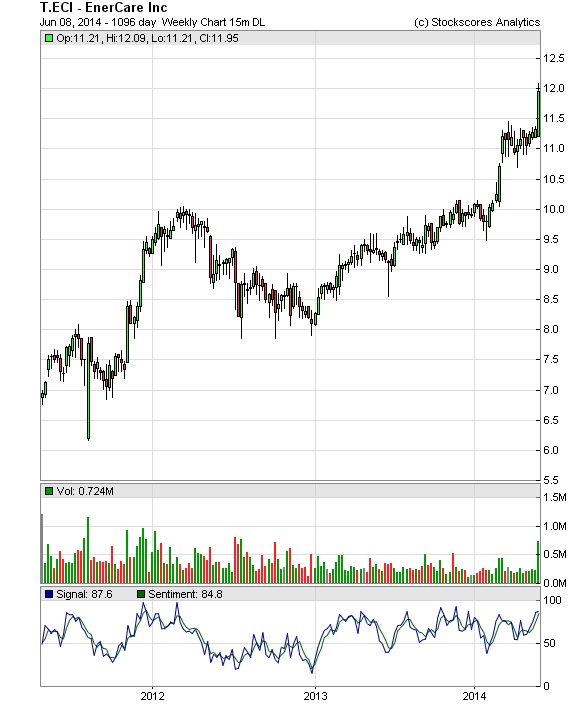
Investors seeking yield should consider Enercare (T.ECI) which has a historical yield of 6.21%. I highlighted this stock in early March and it has been heading higher since, moving to new highs this week and looks like it can enjoy more upside. Support now at $11.20.
2. T.CWB
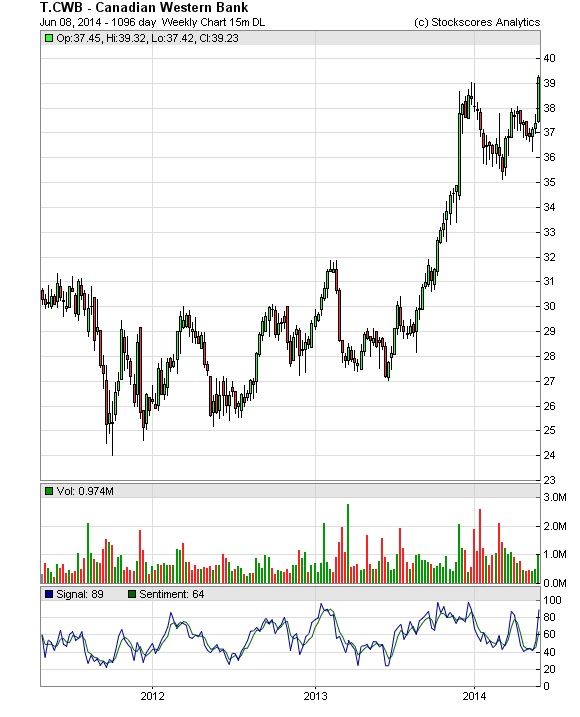
Canadian Western Bank (T.CWB) is breaking out to new highs after sideways base building through 2014 thus far. This break should result in a continued price rise with some yield (historically at about 2%)
3. FST
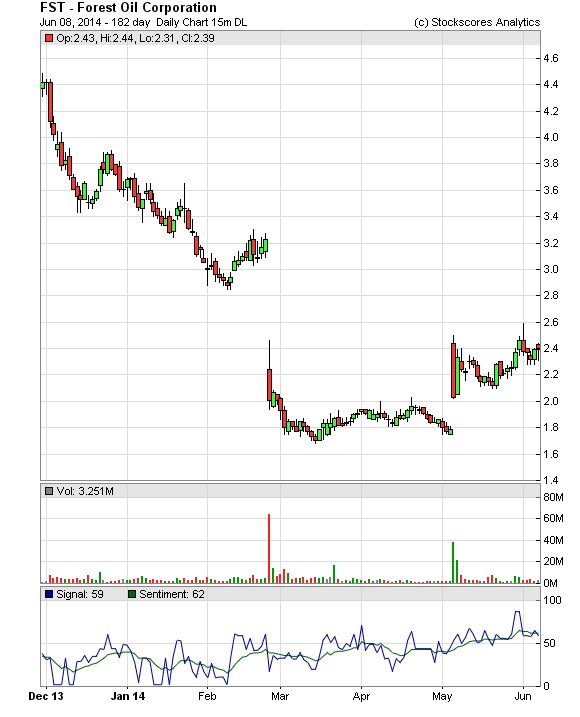
Keep an eye on Forest Oil (FST, NYSE) which is building optimism after a lengthy period of underperformance. A break out through $2.50 with strong volume will be a strong signal from the buyers that the outlook for the stock is improving.
References
- Get the Stockscore on any of over 20,000 North American stocks.
- Background on the theories used by Stockscores.
- Strategies that can help you find new opportunities.
- Scan the market using extensive filter criteria.
- Build a portfolio of stocks and view a slide show of their charts.
- See which sectors are leading the market, and their components.
Disclaimer
This is not an investment advisory, and should not be used to make investment decisions. Information in Stockscores Perspectives is often opinionated and should be considered for information purposes only. No stock exchange anywhere has approved or disapproved of the information contained herein. There is no express or implied solicitation to buy or sell securities. The writers and editors of Perspectives may have positions in the stocks discussed above and may trade in the stocks mentioned. Don’t consider buying or selling any stock without conducting your own due diligence.

-
I know Mike is a very solid investor and respect his opinions very much. So if he says pay attention to this or that - I will.
~ Dale G.
-
I've started managing my own investments so view Michael's site as a one-stop shop from which to get information and perspectives.
~ Dave E.
-
Michael offers easy reading, honest, common sense information that anyone can use in a practical manner.
~ der_al.
-
A sane voice in a scrambled investment world.
~ Ed R.
Inside Edge Pro Contributors

Greg Weldon

Josef Schachter

Tyler Bollhorn

Ryan Irvine

Paul Beattie

Martin Straith

Patrick Ceresna

Mark Leibovit

James Thorne

Victor Adair