Gold & Precious Metals

Gold & Silver Trading Alert: Miners Break Out Despite Dollar’s Rally

After successfully shorting the Gold & Silver markets in the most recent decline from $1400, this analyst outlines the opportunities he sees below. Definitely worth reading – Money Talks Editor

Briefly: In our opinion no speculative positions in gold, silver and mining stocks are justified from the risk/reward perspective.

The precious metals market moved higher yesterday, which was in tune with what we’ve been expecting. The key question is if gold, silver and mining stocks have completed their rally or are they still likely to move higher before turning south again.

Before jumping into charts, we would like to point out that the reasons for which we think the medium-term move is down were covered in the previous Monday’s alert, and if you haven’t had the chance to read it, we encourage you to do so today. Having said that, let’s move to charts 

Larger Image Click on Chart 

gsta-2014-06-11-01-1

Gold moved higher, but hasn’t reached the levels that we thought were likely to stop the rally.

Quoting our previous alert:

How high will gold rally before turning south again? There are no sure bets, but our best guess is that it will correct to the previously broken 61.8% or 50% Fibonacci retracement levels – which means a move to (or very close to) $122 or $124.50 or so in case of the GLD ETF and $1,260 or $1,290 in case of spot gold. We will be looking for bearish confirmations (signals from indicators, ratios, other markets, etc.) around these levels and we’ll probably re-enter short positions once we see them.

We saw the GLD ETF close at $121.39, so it’s still below the lowest of the above-mentioned resistance levels and thus it seems that the rally will continue for at least a while.

What’s even more interesting, is the fact that gold managed to rally despite a rally in the USD Index.

 gsta-2014-06-11-02

How high will gold rally before turning south again? There are no sure bets, but our best guess is that it will correct to the previously broken 61.8% or 50% Fibonacci retracement levels – which means a move to (or very close to) $122 or $124.50 or so in case of the GLD ETF and $1,260 or $1,290 in case of spot gold. We will be looking for bearish confirmations (signals from indicators, ratios, other markets, etc.) around these levels and we’ll probably re-enter short positions once we see them.

We saw the GLD ETF close at $121.39, so it’s still below the lowest of the above-mentioned resistance levels and thus it seems that the rally will continue for at least a while.

What’s even more interesting, is the fact that gold managed to rally despite a rally in the USD Index.

gsta-2014-06-11-03

At this point it’s worth quoting what we wrote in the previous alert:

When a given market refuses to react in a certain way in spite of a visible factor for such a move, it usually means that a move in the opposite direction is likely. At this time, precious metals refused to decline given the move higher in the USD Index, which means that they “don’t want to” move lower and that they are not done rallying.

During yesterday’s session gold has not only not-declined – it actually managed to rally despite USD gains and the short-term implications for the precious metals market are bullish in the short term. There are none in the medium term as metals’ reaction to dollar’s strength can – and likely is – delayed once again.

The situation on the silver market remains rather unclear so we will once again seek confirmations in the mining stock sector.

gsta-2014-06-11-04

The situation in mining stocks is even more bullish for the short term than it is the case with gold. Before commenting on yesterday’s price/volume action we would like to quote our previous comments as they remain up-to-date:

Mining stocks declined on Monday, but moved lower on low volume, which suggests that this might not have been the true direction of the move. The move lower was relatively small – compared to the size of the upswing in the USD Index, so the overall implications are overall bullish. (…)

In case of the GDX ETF, the price targets are relatively close as well. The first one is slightly below the $23 level, at the declining resistance line, and the second one is at the 61.8% Fibonacci retracement. The third one is at the 50% Fibonacci retracement slightly above the $24 level. Either way, the upside is rather limited and we don’t think that the GDX will move and stay above $24 for long – if it gets there, that is.

If gold is to double its recent move higher, then we could expect mining stocks to move at least to their 61.8% Fibonacci retracement, slightly above $23.

Miners moved above their initial target level – we saw a breakout above the declining resistance line. The move above it was rather insignificant, so it’s not necessarily really meaningful. The volume accompanying the breakout was not small, but it was not really huge either – we don’t think it was big enough to confirm the breakout on its own. Given the situation on the gold market (the resistance level was not reached), it seems that the mining stocks could see higher prices in the coming few days as well, but we don’t think that this is the start of another huge rally just yet.


The ‘Least Loved’ Bull Market Becomes Euphoric

After nearly six years of unprecedented intervention by the world’s top central banks, the world’s financial markets are hopelessly broken. What used to be accepted as market gospel and guided investors’ decisions in the marketplace, before the 2008 financial crisis, – no longer seems to apply in today’s marketplace. Wall Street is no longer the bastion of free and open markets, where the prices of bonds and stocks are determined by the collective judgment of millions of investors. Instead, market prices are determined by a handful of political appointees, called central bankers, who pull the levers and intervene from behind the scenes, in an effort to influence the direction of the markets.

Playing by the older and more traditional set of rules of investing (prior to 2008) has caused many astute investors to miss out on some of the biggest gains in Wall Street’s history. The “Least Loved” Bull market is now 63-months old, and it’s the fourth longest money minting rally in history. It’s still running on steroids, with the S&P-500 index having nearly tripled from its Great Recession nadir, and is now zeroing in on the once unthinkable 2,000-level. The Dow Jones Industrials are clawing their way higher, and are within spitting distance of the psychological 17,000-level. The faithful Buy-and-Hold – and dollar cost averaging investor, is enjoying the ride, having cast aside the frightful memories of six years ago.

Strangely though, even as the US-stock market indexes soar to new stratospheric heights, the trading volume in the most actively traded exchange traded fund – based on the S&P-500 index, (ticker symbol; SPY) has plunged by roughly -60% compared with a year ago. Investors are more content to let their Bullish bets ride rather than to add to their exposure to the market. Who is the biggest buyer in the marketplace today, with an unrelenting bid, that buys on all dips? The answer is: Corporate America. Amid such thin market conditions, the S&P-500 companies can buoy the market, with a few big blocks of buybacks. And further dispelling investors’ fear of heights, there’s the safety net of the secretive “Plunge Protection Team” (PPT) that rescues the index funds when risky bets go sour.

The aging Bull market on Wall Street is dubbed the “Least Loved” Bull, because it’s been accompanied by the weakest economic recovery from a recession since the 1930’s. Since the recovery officially began in June 2009, the US-economy has been crawling ahead at an anemic +2% growth rate, or less than half the vigor of the typical rebound from a recession since 1946. The rapidly expanding wealth on Wall Street, mostly flowing to the Richest-10% of US-households, hasn’t trickled down to the average household – take home pay of $839 a week in April ’14, was only +$20 higher than in January 2008, when adjusted for inflation.

What skeptics of the “Least Loved” Bull market have failed to realize over the past 5-years is that the Federal Reserve has turned the stock market upside down, making bad economic news a reason to buy stocks, and good economic news a reason to sell them. The distortion keeps the real value of assets obscure and stuck in the “Twilight Zone.” The answer to this bizarre market behavior is simple: the stock market is being ruled by the Fed, not by fundamentals. In simple terms, what matters to the stock market is the easy money from the Fed, not the performance of the companies whose stocks they are buying and selling.

Indeed, the Bank of International Settlements (BIS) warned a year ago, on June 6th, 2013, “the equity markets are under the spell of monetary easing policies that have enabled market participants to “tune out signs of a global growth slowdown.” Investors are able to shrug off weak economic data and instead, continue to bid stock prices higher, “amid the prospect of further central bank stimulus. Abundant liquidity and low volatility fostered an environment favoring risk-taking and carry trade activity,” the BIS observed.

As recently as May 20th, 2014, Philly Fed chief Charles Plosser lamented, “It’s the Fed’s fault that the markets are ignoring the fundamentals.” “Since the onset of the financial crisis, central banks have become highly interventionist in their effor ts to manipulate asset prices and financial markets in general, as they attempt to fine-tune economic outcomes. This approach has continued well past the end of the financial crisis. While the motivations may be noble, we have created an environment in which “it is all about the Fed.” Market participants focus on how the central bank may tweak its policy, and central bankers have become too desirous of managing prices in the financial world,” he said.

“I do not see this as a healthy symbiotic relationship for the long term. If financial market participants believe that their success depends primarily on the next decisions of monetary policymakers rather than on economic fundamentals, our capital markets will not deliver the economic benefits they are capable of providing (ie; accurate price discovery). And if central banks do not limit their interventionist strategies and focus on returning to more normal policymaking aimed at promoting price stability and long-term growth, then they will simply encourage the financial markets to ignore fundamentals and to focus instead on the next actions of the central bank,” Mr Plosser said.

34135 a

It’s all about the Fed – During the tenure of the Bernanke Fed – the US-central bank shifted its focus from central banking to central planning, from smoothing the business cycle to micro-managing the markets and financial engineering. The trading desk that controls the formerly free capital markets is situated on the ninth floor of 33 Liberty Street, also known as the home New York Fed. From a glass-enclosed conference room situated next to a small cluster of trading desks the uber-secretive “Plunge Protection Team” (PPT) controls the money flows that determine the daily fate of credit, equity and virtually all other markets, that have now been hijacked by the central planners at the White House and the US Treasury. As the number of shares traded each day in stock market dwindles to a six year low, the PPT has become an even more influential price setter in the stock market. The PPT concentrates its firepower in the Dow Jones Industrials futures market, which in turn, can move the S&P-500 index several points, with trading volumes as pathetically low as they are today.

The biggest winners in the financial markets last year were traders that respected the old axiom, “Don’t Fight the Fed.” They rode the QE gravy train, and kept their bets focused on the increasing size of the Fed’s portfolio of bonds. Under the cloak of “Infinity QE” – the Fed injected $1.5-trillion into the coffers of its agents on Wall Street, which in turn, was funneled into the stock market, and inflated the market value of NYSE and Nasdaq listed stocks by $6.5-trillion to a record $25-trillion today. Since the Fed fist launched QE in Sept ’08, the central bank has increased its portfolio of bonds by $3.45-trillion, while the value of US-listed shares has increased $15-trillion. In other words, for every $1 of QE, the Fed increased the wealth of shareholders by $4.35. The Fed’s propaganda artists say the QE injections didn’t fuel market bubbles, because the monies were bottled up at the Fed itself, in special reserves accounts, which have captured most of the QE monies.

However, the chart above tells a different tale. It shows a +87% degree of correlation between the growing size of the Fed’s bond portfolio and the increasing value of the S&P-500 index. There has a been few periodic pullbacks in the S&P-500 index along the way to the 2,000-level, but they were all very brief, and only served as better buying opportunities for Bullish traders that kept their focus squarely on the size of the Fed’s portfolio. Last year, every bit of news that did not fit the Bullish narrative was downplayed and soon forgotten.

Even after racking up a stellar +28% gain for all of 2013, the biggest annual gain in 16-years, the “Least Loved” Bull market was easily able to shrug-off news of a -1% contraction in the US-economy in Q’1 of 2014. Proving for the umpteenth time that a weak economy does NOT translate into a weaker stock market, when all the smoke had cleared, the S&P-500 index ended the first quarter with a +1.2% gain, despite the lousy economy. The old adage, “Sell in May and Go Away,” was tossed into the trash heap and the “Least Loved” Bull continued to show its agility as it climbed to new stratospheric highs.

34135 b

“Least Loved” Bull market running on 2 Cylinders, – Corporate America, – flush with $2-trillion of cash stashed away in their US-banking accounts, has decided there’s nothing more attractive than itself. So, the S&P-500 companies are spending big bucks to buy back their own shares. Last year, they plowed about 80% of their profits into the hands of shareholders, through buybacks and dividend payments. Over the past 3 ½ years, the number of shares of stock available to be bought or sold on the US-stock exchanges has dwindled by -10%. Shareholders like buybacks because they automatically increase earnings per share (EPS). And most often, though not always, a higher EPS leads to rising stock prices. It’s also made it more treacherous for short sellers to maintain bearish bets.

Some notable examples are; Northrup Grumman (ticker NOC), the military contractor expects to reduce its shares outstanding by -25% by the end of 2015, with buybacks. Last year, Home Depot (ticker HD), announced a $17-billion buyback program, that will remove -18% of the shares outstanding at current prices . On June 9th, Home Depot issued $2-billion in five and 30-year bonds, with the intention to use the monies to buyback shares. The demand for HD’s debt exceeded the supply by a ratio of more than 3-to-1. Shares of FedEx (FDX) the operator of the world’s largest cargo airline, – soared to above $140 /share, after it authorized a buyback plan equivalent to -10% of its shares outstanding.

The powerful impact of Corporate QE can be seen with the outsized performance of the Power-Shares Buyback Achievers fund (ticker; PKW) compared with the benchmark S&P-500 index. PKW buys shares of companies that have already purchased at least 5% of their shares outstanding over the past 12 months. The goal is to avoid companies whose buybacks go solely toward offsetting stock option grants and don’t shrink the share count. Since January 1st, 2009, PKW has increased in market value by +176%, compared to a gain of +113% for the S&P-500 index fund, ticker: SPY. Analysts estimate that 40% of the increase in the earnings per share of S&P-500 companies in the past 12-months was due to the “financial engineering” of corporate treasurers. In other words, corporate buybacks has scared the daylights out of short sellers – and is conceivably responsible for about one third of the stellar gains of the “Least Loved” Bull market.

Financial Engineering at Apple – Everyone knows Apple Inc (AAPL) employs many of the best high-tech engineers in the world. But who knew some were also on the financial-engineering side? In a deal that was greeted so eagerly by salivating investors hungry for a piece of Apple’s debt pie, the Cupertino, California – based iPhone maker issued $12 billion of bonds on April 29th, designed to reward shareholders with a leveraged buyback of shares. The world’s most valuable technology company has $151-billion in cash, but only $18-billion of that stash is readily available in the US – meaning Apple needed to issue additional debt to help fund its $130-billion shareholder capital return plan.

The resurgence of Apple’s stock has as much to do with financial engineering as the company’s technological wizardry. For years, AAPL has shifted billions in profits out of the US and into affiliates based in Ireland, where it negotiated a tax rate of less than 2%. Its offshore entities have paid little or no tax in recent years, on $40-billion of earnings generated outside the US. Luca Maestri, – Apple’s chief financial officer, explained on the latest earnings call, “To repatriate our foreign cash under current US-tax law, we would incur significant tax consequences and we don’t believe this would be in the best interest of our shareholders.”

The sharp rebound in AAPL’s share price to near its all-time high has a lot to do with the wizardry of Carl Icahn who has repeatedly argued that AAPL’s shares were undervalued, and Icahn did provide a blow-by-blow update on Twitter of every new investment he’s made in the company since June ’13, when he first disclosed his buying spree in AAPL.

On October 1st, 2013, Icahn said in a tweet that he had pushed Apple CEO Tim Cook for a $150 billion share buyback, ” Had a cordial dinner with Tim last night. Pushed hard for a $150-billion buyback. We decided to continue dialogue in about three weeks,” Icahn tweeted. In a CNBC interview, Icahn emphasized how strongly he felt about an increased buyback. “It’s a no-brainer and it makes no sense for this company with their multiple being so low not to do a major buyback. And there’s another reason that I mention, that I think might go forgotten, the fact that you can borrow money so cheaply today. I don’t think we are going to see this again,” Icahn said on CNBC’s “Halftime Report.”

34135 a-1

“They have a golden opportunity to go borrow money. With Apple trading at about $482 per share, a repurchase of this kind would mean buying more than 300-million shares. Apple currently only has about 900 million shares outstanding, so a buyback of this size would be a reduction of more than one-third,” Mr Icahn explained. On April 23rd, 2014, Apple put Icahn’s advice into motion, it issued $12-billion of debt, boosted its dividend +8%, and said it would spend an additional $30-billion to buy back shares, taking to $130-billion the total amount it plans to spend on repurchases and dividends by the end of 2015.

Even before the ramped up buybacks, Apple had already reduced the amount of its floating shares by -8.5% to 860-million shares, and by shrinking the float, helped to catapult AAPL’s share price to $665 today, (pre-split basis) up from as low as $390 in April ’13.

AAPL’s most brilliant maneuver was voting to authorize a 7-for-1 stock split. Since the split was announced in late April, Apple’s stock has climbed +25%, creating more than $100-billion in shareholder wealth while the benchmark S&P-500 index edged up +4%. The lower price also clears the way for AAPL to be included among the 30 stocks in the Dow Jones Industrial average. Meanwhile, the mastermind of AAPL’s resurgence, – Carl Icahn, the “King of Wall Street” can celebrate since his hedge fund (IEP) is holding 7.5-million shares of AAPL.

Even as stock prices continue to spiral higher, the S&P-500 companies are trying to keep pace by raising their dividend payouts . 421 of the S&P blue-chips are expected to pay a combined $348-billion of dividends this year . That equals a dividend yield of 2.3%, or about 30-basis points less than the yield on the US Treasury’s 10-year note.

34135 d

Dow Blue-Chips Unfazed by Shakeout in Small Caps, Nasdaq high flyers, – There hasn’t been a correction of -10% in the benchmark S&P-500 index for 34-months. Historically, a correction rocks the market about 18-months apart, on average. Yet there was a stealth correction within the US-stock market from the beginning of March through the middle of May that went undetected by the unsuspecting US-public. For instance, the small-cap Russell-2,000 index recently tumbled -10% from its all-time highs, skidding to the 1,100-level. Other segments of the high flying Nasdaq index, such as the social media, bio-tech, and internet retailers stocks were hit even harder, plunging -20% or more. Even Nasdaq kingpins such as Amazon, (AMZN) lost more than a quarter of its market value from its peak levels, and the heavyweight champion Google (GOOGL) stumbled -15% from its highs. As of May 17th, roughly one-third of all US-listed stocks were trading -20% or more below their 52-week highs, (a bear market), with the average Russell-2,000 member down -24%!

At its peak levels in early March, the Russell-2,000 index was priced at a whopping 103-times its 12-month Trailing earnings. Historically, its P/E has averaged 35-time earnings. If there is a bubble to be found anywhere in the marketplace, the most obvious place to look is the Russell-2,000 index, which is home to two thirds of all listed US-companies. It’s a homegrown collection of companies that earn about 85% of their revenue within the US’s borders, and is often seen as a proxy for the US-economy. The sudden -10% correction through the middle of May shaved the Russell-2,000 index’s trailing P/E ratio to 73-times.

Typically, when small-caps get in trouble, a sell-off in the big names is next. However, on May 7th, the new Fed chief Janet Yellen sought to prevent the large cap S&P-500 Oligarchs from suffering the same fate, by assuring Wall Street traders in testimony before Congress that “valuations for the broad stock market remain within historical norms. O verall, broad metrics don’t suggest we are in obviously bubble territory,” she said. And with those magical words, Yellen put a floor under the Dow Jones Industrials at the 16,350-level. As the Dow Industrials and Transports quickly regained their footing and climbed to new heights, the small-caps breathed a sigh of relief. The Russell-2,000 index built a base of support at the 1,100-level, and recovered most of its recent losses to close at the 1,165-level today. When the PPT does intervene in the stock index futures market, it concentrates its firepower in the Dow Industrials contract, where it can get the biggest bang for its buck.

34135 e

Fear Gauge at 7-year Low, Euphoria sets in, – Nowadays, the higher the S&P-500 index climbs, the less investors seem to worry. Thanks to the hallucinogenic effects of the Fed’s QE-injections, corporate QE (buybacks), and Mergers & Acquisitions, risk is no longer priced into anything. Everyone has been brainwashed to interpret and spin all economic news as Bullish for the stock market. There is no need to hedge and no need to lighten up on positions carrying huge paper profits. It’s enough to just sit back and enjoy the fireworks. As such, the trading volume on the US-stock exchanges has shriveled up. For example, in the week ended June 6th, only 353-million shares traded in S&P-500 index fund (ticker; SPY) that’s -62% less than a year ago . In the previous week, only 279-shares traded.

When the S&P-500 index hit an all-time high on May 23rd, only 24 of its 500-members reached new 52-week highs. That’s the lowest participation in a year. Since 1990, there have been four other times when the SPX set a 52-week high with fewer than 10% of its members peaking and the overall volume trailing the average. In 3-of-4 occasions, the SPX fell at least -5% in the next two or three months. When volume and breadth are weak, and stock indexes surge, it’s often served as a warning sign that has preceded losses in the past.

However, what used to be true in the past is no longer relevant in the hallucinogenic world of QE, and the Zero Interest Rate Policy (ZIRP). The Fed has made sure that markets are a one-way bet, risks are eliminated, and by stimulating investors’ animal spirits – the omnipotent Fed can create a virtuous cycle that will support economic expansion.

The sharp drop in the number of shares changing hands is not necessarily a sign of danger, because a certain amount of money will buy fewer shares the higher the stock price goes. Most companies have chosen no to split their shares, despite the higher prices. As such, corporate buybacks would lose some of their potency, since treasurers can buy fewer shares as prices become more expensive, through their own rigging activities. But for now, most traders are reluctant to jump off the Fed’s QE-gravy train, and the safety net of buybacks.

34135 f

Serene Sense of Tranquility among Buy-and-Hold Investors, On March 4th, Warren Buffett told CNBC that investors should not to pay much attention to short-term moves. “M ost investors are blinded by the markets’ gyrations and spend far too much time trying to form macro opinions or listen to market predictions, rather than investing simply and prudently for the long-term. Games are won by players who focus on the playing field, not by those whose eyes are glued to the scoreboard,” Buffet said. And there is no need for investing expertise. Buffett recommends a low-cost S&P-500 index fund for nonprofessionals. “Forming macro opinions or listening to the macro or market predictions of others is a waste of time,” he adds. His bottom line fundamental advice: “Ignore the chatter, keep your costs minimal, and invest in stocks as you would in a farm.” (In other words, just Buy-and-Hold, and relax).

After 5-years of monetary sedation, traders don’t see the need to buy ultra-cheap insurance against the possibility of a nasty market correction. The CBOE Volatility Index (VIX), also known as fear gauge, can be bought as a hedge against falling markets . Yet the VIX plunged to its lowest level in 7-years last week, reflecting the lack of fear of even the slightest pullback. Instead, investors on Wall Street are mesmerized by the Fed and are comfortable living in a calm and predictable universe, where there is no fear of turbulence. In the past, contrarians used to view such complacency as a major warning sign of a bubble top.

Outlook; The “Least Loved” Bull market is still running on steroids, even at 63-months old. The median lifetime of the Top-12 Bull markets is 55-months. So it’s lasted 8-months beyond its mid-life. A -10% correction hasn’t happened for the past 34-months, far beyond the average of 18-months between corrections. Yet it looks as though the S&P-500 index has entered the Euphoria stage, – the fourth and final phase of the Bull market. It wouldn’t be surprising to see the Madness of Crowds, – where frustrated investors jump off the sidelines to buy equities, alongside the indiscriminate buyers, (ie; corporate treasurers), in what’s called a “Melt-Up.” The Euphoria stage could see the S&P-500 index surge another +5% to +10% higher from today’s close of 1,950. Even as the Fed winds down its QE injection scheme by October, its comrades at the Bank of Japan and the European Central Bank will be running the printing presses in its absence, and keeping the liquor flowing for the late night partiers.


This article is just the Tip of the Iceberg of what’s available in the Global Money Trends newsletter. Subscribe to the Global Money Trends newsletter, for insightful analysis and future predictions about the (1) top stock markets around the world, (2) Commodities such as crude oil, Gold, copper and base metals, (3) Foreign currencies, such as the Australian and Canadian dollars, Brazil real, the Euro and Japanese yen, (4) Central bank interest rates and global bond markets, (5) Central bank Intervention techniques (6) and key Credit Default Swap markets.

GMT filters important news and information into (1) bullet-point, easy to understand reports, (2) featuring “Inter-Market Technical Analysis,” with lots of charts displaying the dynamic inter-relationships between foreign currencies, commodities, interest rates, and the stock markets from a dozen key countries around the world, (3) charts of key economic statistics of foreign countries that move markets.

Subscribers can also listen to bi-weekly Audio Broadcasts, posted Monday and Wednesday evenings, with the latest news and analysis on global markets. To order a subscription to Global Money Trends, click on the hyperlink below,

http://www.sirchartsalot.com/newsletters.php

or call toll free to order, Sunday thru Thursday, 8-am to 9-pm EST, and on Friday 8-am to 5-pm, at 888-808-7978. Outside the US call 561-391-8008.


Pointless Science From Your Superiors

The US State Departments report on the Keystone Pipeline has concluded that the new pipeline will not have any material impact on the development of the Canadian Oil Sands, demand for Oil or Global Warming. But here is the part you should note……

{mp3}/mikesdailycomment/mcbuscomjun11x{/mp3}

8c5f9e2dad1a28ba8fae5a0e69fba064b8e670cb

The Summer Sell-off Scenario

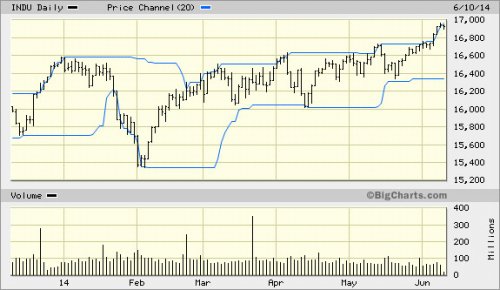
One of the most salient features of the market environment of recent months is the evolution of investor psychology. From March through May, stocks experienced a classic internal correction in which the most overbought and overvalued stocks declined while fairly valued large caps remained buoyant.

The rationale behind this strategy was the determination of money managers not to give back the big gains from the 2013 rally. Instead of selling everything they simply moved money out of last year’s top-performing (but overvalued) small caps and moved money into stocks sporting lower P/E ratios and higher dividend yields. Consequently, the benchmark S&P 500 large cap index held up well throughout the March-May correction, as did the Dow Jones Industrial Average.

[Read AlsoThe Two Most Powerful Forces Pushing the Stock Market Higher]

The trading pattern which emerged in the S&P during this internal correction was a lateral trading range. Many investors have difficulty evaluating trading ranges, although it’s a fairly straight-forward procedure. The most important thing to consider isn’t the progression of prices within the range, but the tenor of investor psychology while the range is taking shape. This is one of the ways which makes it easier to predict which direction prices will break out from once the lateral trend has run its course.

indu-10-jun

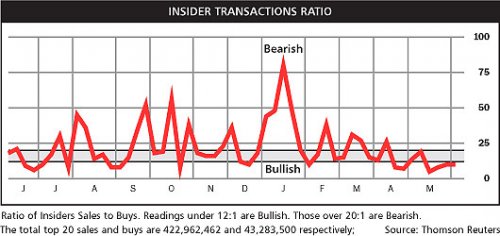
During the last few weeks investor sentiment has shown a remarkable neutrality or lack of commitment. Small investors have been reluctant to take a stand, whether bullish or bearish. Yet while the lateral trend was unfolding in the Dow and S&P, corporate insiders displayed a remarkable bullish bias. Insider purchases of shares in May hit their highest levels since October, the time of a previous interim low. So while small investors were too gun shy to buy, insiders were buying shares of their own companies with both hands.

insider-transaction-ratio

Our Composite Gauge also suggested that “smart money” traders were positioned for an upside breakout from the trading range. This indicator, which combines OEX put-call data with insider buying and other sentiment measures, was closer to the bullish end of the spectrum in the weeks preceding the breakout. True to form, the market eventually broke out above the top end of its multi-week trading range just as the smart money apparently predicted.

As discussed previously, we need to see the 10-day moving average of the Composite Gauge hit a reading of 45 or higher in order to signal the arrival of a frothy market. This would also tell us that a top could be imminent, at least short-term. The indicator is currently at about 40 and is inching closer to the critical 45 level. It’s not there yet, however, so the market could still make some additional gains before this indicator signals that smart money have started pulling in their horns.

[You May Also LikeMarket Strength Continues to Build as Laggards Become Leaders]

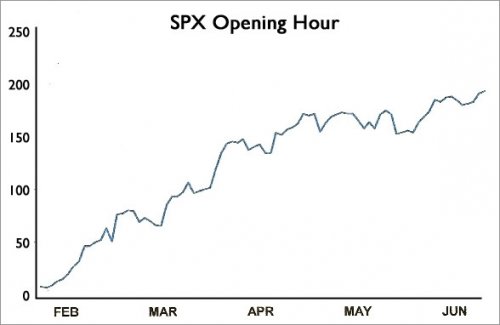
Another expression of Wall Street money managers’ stubborn refusal to give up the ghost is reflected in the S&P open-close indicator. This indicator is simply a cumulative graph showing the opening hour of trading each day for the SPX along with the closing hour. The theory behind it is that, in a well-established bull market, the opening hour should show a tendency to move higher on most days. This is a simple measure of the market’s forward momentum. What’s amazing about the following graph is that during the entirety of the March-May internal correction, the SPX continued to show a measure of forward momentum in terms of its opening hour performance. This explains how the S&P was able to remain so buoyant during the internal correction period.

spx-opening-hour

Meanwhile the closing hour component of this indicator was in negative territory throughout much of the last couple of months. In May, however, it started gaining upside traction and eventually broke back into positive territory. The assumption behind this is that “smart money” traders were gradually accumulating large cap stocks and thus the market was still on a bullish footing.

As strong as the stock market has been lately, many are wondering if the trend will remain up through year end or if there’s still a chance for a sell-off. Many investors consider the market to be overvalued and have launched what amounts to a buyer’s strike in the wake of the latest rally. These investors are nonetheless salivating at the prospect of being able to buy in at lower level if given the opportunity. Their hope is that this occurs sometimes between now and this fall when the major Kress cycles are scheduled to bottom.

Keeping in mind that the market is apt to disappoint the majority’s wishes, there’s still the chance that this summer could witness an important correction. The odds of this occurring will increase if the major indices continue rallying from here and become severely over-extended from their 200-day moving averages. This would put the market in a technically vulnerable position.

Under this scenario, a potential repeat of the August-September 1998 mini-bear market would be possible. For now, though, consider that the market’s main trend is up as the bulls still hold sway.

******

Kress Cycles

Cycle analysis is essential to successful long-term financial planning. While stock selection begins with fundamental analysis and technical analysis is crucial for short-term market timing, cycles provide the context for the market’s intermediate- and longer-term trends.

While cycles are important, having the right set of cycles is absolutely critical to an investor’s success. They can make all the difference between a winning year and a losing one. One of the best cycle methods for capturing stock market turning points is the set of weekly and yearly rhythms known as the Kress cycles. This series of weekly cycles has been used with excellent long-term results for over 20 years after having been perfected by the late Samuel J. Kress.

In my latest book “Kress Cycles” I explain the weekly cycles which are paramount to understanding the timing of stock market turning points. Never before have the weekly cycles been revealed which Mr. Kress himself used to great effect in trading the SPX and OEX. If you have ever wanted to learn the Kress cycles in their entirety, now is your chance. The book is now available at:

http://www.clifdroke.com/books/kresscycles.html

Order today to receive your autographed copy along with a free booklet on the best strategies for momentum trading. Also receive a FREE 1-month trial subscription to the Momentum Strategies Report newsletter.

Clif Droke is a recognized authority on Kress cycles and internal momentum, two valuable tools which have enabled him to call most major stock market turning points from 1997 through the present. He is the editor of the Momentum Strategies Report newsletter, published three times a week since 1997. He has also authored numerous top-selling books, including his most recent one, “Kress Cycles.” For more information visit clifdroke.com

We Need More Tungsten & 12 Stocks Poised To Take Advantage

Catch-22: We Need More Tungsten, But Projects Can’t Find Funding

Even as demand rises steadily, the world’s largest non-Chinese tungsten mine will be exhausted by next year. So investors should be lining up to fund new mines, right? Not a bit of it, says analyst Mark Seddon of Tungsten Market Research. In this interview with The Mining Report, Seddon argues that a supply shortage could mean much higher prices, leading to handsome profits for those companies that get to market soonest.

imagesCOMPANIES MENTIONED: ALMONTY INDUSTRIES INC. : BLACKHEATH RESOURCES INC. : CARBINE TUNGSTEN LTD. : HAZELWOOD RESOURCES LTD. :LARGO RESOURCES LTD. : NORTH AMERICAN TUNGSTEN CORP. LTD. : NORTHCLIFF RESOURCES LTD. : ORMONDE MINING PLC : VITAL METALS LTD. : WOLF MINERALS LTD. : WOULFE MINING CORP.

The Mining Report: Tungsten is often called “rare.” Just how rare is it?

Mark Seddon: It’s not that rare compared to a minor metal such as rhenium, which is used in superalloys. The total rhenium market is maybe 70 or 80 tons per year, whereas the tungsten market is currently around 80,000 tons (80 Kt) per year of tungsten metal content. So tungsten’s nothing like a rare earth element (REE), but it is considered a strategic metal.

TMR: How is tungsten strategic or critical?

MS: It’s strategic in that it has industrial uses. It’s used in hard metals, cutting tools, etc. It has military applications, as well. The U.S. Defense Logistics Agency built up a stockpile of tungsten over a number of years, which it has pretty much sold off now.

And tungsten is a critical metal due to China’s dominance of the market. China accounts for 80% or more of supply in various forms.

TMR: Tungsten is often compared to rare earths, but the latter’s price is highly dependent on high tech. This is not true of tungsten, correct?

MS: Yes. Tungsten’s main uses are industrial; the largest end user is in cemented carbides, what are known as hard metals. Those can be used in things like cutting tools, mining tools, drill bits and wear parts. So tungsten’s demand curve tends to follow gross domestic product growth quite closely, whereas REE demand growth is more volatile.

TMR: But tungsten prices are rising.

MS: Yes, tungsten has risen in price because of a change in Chinese policy. Some 10–15 years ago, you could buy as much tungsten as you wanted from China, and the price of ammonium paratungstate (APT) fell to about $100/metric ton unit ($100/mtu). APT rose to a peak of $470/mtu in 2011 and was above $400/mtu in 2013.

Recently, the market has been a bit quiet. Today, APT sells for about $370/mtu.

TMR: So would it be reasonable to say that, as with REEs and other metals, the Chinese have decided they want to keep production for internal use?

MS: China is now less interested in exporting natural resources and much more interested in adding value to them. Internal demand in China for tungsten, REEs and so on has been increasing as its GDP has grown, recently about 7–10%/year.

China has made very little investment in new tungsten mines, so it is really struggling to maintain production at current levels, which also would put pressure on exports because, obviously, it just doesn’t have the material available for export.

TMR: Given the tightening of supply, where can we expect tungsten prices to go by 2020? 

MS: In the short term, I expect that prices will end 2014 quite a bit higher than now and continue rising in 2015. The only significant new supplier that has entered the market recently is the Nui Phao project in Vietnam. This is owned by the Masan Group, which is privately held. It came onstream in 2013, and is, as far as I know, still ramping up to production capacity.

In the longer term, major new tungsten supply will likely not enter the market until the second half of 2015. So the pressure on prices is really going to be upward, especially considering that Europe expects reasonable economic growth this year and slightly better than that in 2015. My feeling is that production shortages will result in rising prices at least until 2016–2017. Then, depending on how much new supply enters the market, a leveling off may occur.

TMR: Given that there’s no futures market for tungsten, prices are determined by individual end-user contracts, correct?

MS: Yes. Tungsten prices are discovered, if you will, from data on ores, concentrates and APT provided by such publishers as MetalBulletinMetal-Pages and Platts. The main price that’s followed is ATP. There are two prices in China: the internal Chinese price and the export price, which is a shipped-on-board Chinese port price. There’s also a European APT price. However, because China dominates the market so thoroughly, Western prices tend to follow the Chinese example.

TMR: Given the paucity of non-Chinese supply and the exhaustion of North American Tungsten Corp. Ltd.’s (NTC:TSX) CanTung mine in Canada by 2015, how great is the need for new Western tungsten mines?

MS: The need is fairly great. CanTung is the largest single mine outside China, with production of about 2.8 Kt/year tungsten metal content, about 3.5% of global supply. As you say, it’s nearing exhaustion, and its production will have to be replaced. It’s unlikely to be replaced by the Chinese. Steady growth in tungsten demand of 4–5% per year, which is lower than it has been for the last decade, would add, say, 3–5 Kt per year tungsten metal to demand. Current producers outside China do not have the capacity to increase production significantly.

TMR: So how many new mines will be required to meet this rising demand?

MS: Pretty much one major new project coming onstream every year.

TMR: What is the average initial capital expense (capex) of tungsten projects compared to other metals?

MS: I would say no more than $100 million ($100M), probably a bit less. Quite a few current projects reside in the $50–75M range.

TMR: That’s quite modest.

MS: Absolutely.

TMR: That raises the question of why tungsten projects have such difficulty in being funded, especially given expected rising demand and prices. 

MS: One of the biggest problems is that tungsten is not a terminally traded product, like gold, silver, copper, etc. So banks have difficulty in hedging their price risk. I’ve done quite a lot of work for various projects producing marketing reports and price forecasts, and my experience has been that 50% of potential banks and other institutional investors reject tungsten projects out of hand due to the lack of futures markets and the hedging they provide. The other 50% simply doesn’t know much about tungsten, and so it is quite low on their list of priorities.

This funding deficit is obviously not just a problem for tungsten mines. It applies to rare earths, antimony, graphite and other minor minerals.

TMR: Tungsten is not as glamorous as metals such as gold and silver and, as discussed above, is not high-tech, like rare earths. Is this part of the problem?

MS: That’s certainly a possibility. Tungsten’s uses are almost exclusively industrial, so it’s a steady metal, not a sexy one. It is perceived that the rewards to be gained in REEs might be that much greater, but then obviously the risks associated would also be greater.

Tungsten is not a metal that is much discussed, unlike rare earths, which have been featured in the global media since 2011, when the Chinese export restriction become widely known. However, studies done by the European Union, etc., place tungsten in the top three of most-critical metals.

TMR: There was a long article about tungsten in the Financial Times in March.

MS: True, but that’s probably the first major article on tungsten in the Financial Times for years, even though China’s export restrictions are a decade old.

TMR: Significant past European tungsten production originated from the Iberian Peninsula. Are we seeing significant developments there today?

MS: Almonty Industries Inc.’s (AII:TSX.V) Los Santos mine in Spain is actually producing. It’s not a huge operation. It just published its production figures for Q1/14: 17 mtu tungsten trioxide (WO3) or 135 tons tungsten metal content for the quarter. If that trend continues, it would mean 540 tons/year tungsten metal produced annually.

TMR: What’s the most advanced Iberian project?

MS: The Barruecopardo project, also in Spain, which is owned by Ormonde Mining Plc (ORM:LSE), an Irish company. Almonty tried to buy that project, but its bid was rejected by Ormonde.

TMR: Would Barruecopardo be a bigger project than Los Santos? 

MS: About three times larger: 1,800 tons/year tungsten metal. As much as CanTung produces, about 2.5% of current global production.

TMR: Ormonde published a definitive feasibility study (DFS) in February 2012. When is production scheduled to begin?

MS: Barruecopardo is still not fully funded, so it’s difficult to say.

TMR: According to the DFS, the project has a pre-tax net present value (NPV) of $164.5M, a 52% internal rate of return (IRR) and a two-year payback period. The capex is $66.5M, and the Noble Group has agreed to buy the first five years of tungsten concentrate produced. So why isn’t this project fully funded?

MS: There are quite a few tungsten projects working toward full funding. Many of them reach something similar to what Hollywood calls “development hell,” where the studio has the script but can’t get started without funding, and it goes around and around.

TMR: Is there a major European project that has got full funding?

MS: The Wolf Minerals Ltd. (WLF:ASX) project at Hemerdon in Devon, England, has fully met its initial capex of $197M, but that took quite a while. Construction has begun, and production should begin in H2/15: about 2.8 Kt tungsten metal annually over an initial 10-year mine life.

TMR: In this environment, how much of a premium is attached to getting a mine in production first?

MS: Hemerdon’s projected operating cost is about $105/mtu APT. Compare that to the current APT price of $370/mtu, and you can forecast a high margin, if prices remain at similar levels. So the earlier a company can get into this market, the more it will benefit. And should new projects remain unfunded, prices will remain high.

TMR: Speaking of media coverage of tungsten, Forbes in May noted that Warren Buffett and Berkshire Hathaway have agreed to invest $80M in a South Korea project. What do you think of this, considering Buffett’s oracle status?

MS: The project is called Sangdong. It is owned by Woulfe Mining Corp. (WOF:TSX.V), which is headquartered in Vancouver and not to be confused with Wolf Minerals, which is an Australian company.

Sangdong published a DFS in 2012 but seems to have run into difficulties. There has been considerable turnover in senior management, three CEOs in 13 months, for instance. Although Buffett is looking at investing, it’s difficult to see what’s going on there. There have been no announcements about construction or anything like that. One would have thought Sangdong would be well along the development path by now.

TMR: Woulfe’s market cap is under $40M. Wouldn’t it just be easier for Berkshire Hathaway to buy the whole company?

MS: Somebody with Warren Buffett’s deep pockets could do that quite easily.

TMR: What is happening in Australia?

MS: Carbine Tungsten Ltd.’s (CNQ:ASX) Mt. Carbine project in Australia has an offtake agreement with Mitsubishi Corp. (MSBSHY:OTCPK). It is actually in production already, processing tailings.

TMR: How big is the project ultimately planned to be?

MS: Around 2.6 Kt tungsten metal per year—slightly bigger than Barruecopardo and slightly smaller than Hemerdon. If that succeeds, this would be a major project.

TMR: Are there any notable tungsten projects in North America? 

MS: North American Tungsten has a Yukon project even further north than CanTung. It’s called MacTung and the company published a feasibility study in 2009. It projects almost 6 Kt annual tungsten metal production, which is bigger than any of the other projects we’ve discussed, but initial capex is $402M.

Largo Resources Ltd. (LGO:TSX.V) has quite a big project in Yukon, just over the border with British Columbia, called Northern Dancer.

Northcliff Resources Ltd. (NCF:TSX.V) has the Sisson project in New Brunswick. It hopes to be in production by 2016 at around 4 Kt tungsten metal capacity per year. According to its January 2013 feasibility, Sisson has a $418M post-tax NPV, a 16.3% IRR and a 4.5-year payback period. Initial capex is $579M.

TMR: Northcliff has investment from Todd Corp. in New Zealand.

MS: Yes, and it is part of the HDI/Hunter Dickinson group of companies. It has a record of bringing mines into production. In the past, the junior mining company would do the initial resource work and prefeasibility study, possibly even up to the DFS, then the project would be sold to a bigger mining concern that would bring it into production. But that’s not happening in the current climate.

TMR: Isn’t it true that in recent years many junior mining companies have foundered after they overextended themselves attempting to bring projects to production?

MS: You’re right. But needs must, as they say. The juniors can’t sell their projects to larger mining companies because they are not interested. The larger companies are consolidating in precious metals, copper and so on, while leaving minor metals to the juniors.

TMR: Largo’s Northern Dancer has molybdenum, as well as tungsten. To what extent does a tungsten project with other metals make it more prospective?

MS: It depends on which other metals. Tungsten tends to occur on its own. Hemerdon has some tin but not very much. Sisson has molybdenum. This is a credit against the tungsten costs, so it can only help. But tungsten projects must be treated as such. If a company is relying on byproduct to get it over the line, that would be dangerous because if the byproduct price takes a dive, then it is left with a very marginally viable project, if that.

TMR: Which of the projects we’ve discussed seem most likely to succeed?

MS: Hemerdon is pretty likely to go ahead because it’s fully funded and in construction. Sisson looks to be a pretty good bet because it has HDI behind it, and Todd Corp. is invested in it. It is making good steady permitting progress but still needs financing and will not produce until 2016–2017, at the earliest.

TMR: What about other projects?

MS: Vital Metals Ltd. (VML:ASX) has the Watershed project, and Hazelwood Resources Ltd. (HAZ:ASX)the Cookes Creek project. Both are in Australia. Blackheath Resources Inc. (BHR:TSX.V) has the Covas project in Portugal.

Most tungsten projects have similar size, deposit grade and production costs. If only one besides Hemerdon were to go ahead, it would be difficult to say which one. It always comes down to funding, and that is obviously down to the bankers. Picking winners in this business is hard, which makes investing in mining projects that much more risky.

TMR: Let’s say that only one or two of these major tungsten projects begins producing in the next couple of years. So we have a tungsten shortage leading to a significant price increase. Then the financial institutions worry they’ve missed the boat, finance a bunch of projects, and we end up with a bubble. A possibility? 

MS: This is the problem. No market is run with perfect efficiency, and you do get cycles. It is quite possible we will see more volatility in tungsten prices in the next several years. To repeat, there doesn’t seem to be enough projects ready to begin production in the next five years to cope with the expected increase in demand and the exhaustion of CanTung.

The logical conclusion would be that tungsten prices will rise. Depending on how tight the market gets, that rise could be quite rapid. When tungsten prices got over $450/mtu for APT in mid-2011, this sparked interest in tungsten from those who were normally not interested in it.

TMR: We saw much the same with rare earths that year.

MS: When prices go crazy, everybody thinks, “We should be in REEs. Or tungsten.” Or whatever. If that leads to a whole slew of projects suddenly hitting the market at the same time, the pressure on prices would be inevitably downward. History shows that this is the way things tend to happen.

TMR: So we could see a collapse in tungsten prices?

MS: It is actually quite difficult to see a bust situation in tungsten because it’s quite difficult to see enough projects coming on to make prices crash. Prices could come down, but they should still be significantly higher than 10-15 years ago.

TMR: Mark, thank you for your time and your insights.

Mark Seddon has over 25 years of experience in the commodities industry. He is director of Tungsten Market Research Ltd. in London and was formerly managing director of Roskill Information Services and a sugar trader with Louis Dreyfus. He holds a Bachelor of Arts in European business administration from Middlesex University, as well as a Diplôme d’Études Supérieures Européennes de Management.

Want to read more Mining Report interviews like this? Sign up for our free e-newsletter, and you’ll learn when new articles have been published. To see recent interviews with industry analysts and commentators, visit The Mining Report homepage.

Related Articles


DISCLOSURE: 
1) Kevin Michael Grace conducted this interview for Streetwise Reports LLC, publisher of The Gold Report, The Energy Report, The Life Sciences Report and The Mining Report, and provides services to Streetwise Reports as an independent contractor. He owns, or his family owns, shares of the following companies mentioned in this interview: None. 
2) The following companies mentioned in the interview are sponsors of Streetwise Reports: Carbine Tungsten Ltd. and Largo Resources Ltd. Streetwise Reports does not accept stock in exchange for its services.
3) Mark Seddon: I own, or my family owns, shares of the following companies mentioned in this interview: None. I personally am, or my family is, paid by the following companies mentioned in this interview: None. My company has a financial relationship with the following companies mentioned in this interview: None. I was not paid by Streetwise Reports for participating in this interview. Comments and opinions expressed are my own comments and opinions. I had the opportunity to review the interview for accuracy as of the date of the interview and am responsible for the content of the interview. 
4) Interviews are edited for clarity. Streetwise Reports does not make editorial comments or change experts’ statements without their consent. 
5) The interview does not constitute investment advice. Each reader is encouraged to consult with his or her individual financial professional and any action a reader takes as a result of information presented here is his or her own responsibility. By opening this page, each reader accepts and agrees to Streetwise Reports’ terms of use and full legal disclaimer.
6) From time to time, Streetwise Reports LLC and its directors, officers, employees or members of their families, as well as persons interviewed for articles and interviews on the site, may have a long or short position in securities mentioned. Directors, officers, employees or members of their families are prohibited from making purchases and/or sales of those securities in the open market or otherwise during the up-to-four-week interval from the time of the interview until after it publishes.


test-php-789