
Stocks & Equities
 Gabelli’s 19.7% 5 year return boosts his average to 12.6% since inception of Gabelli Asset Management Company in 1987.
He is the founder, chairman, and CEO of his $30 billion dollar global investment firm headquartered in Rye, New York. Click on the image or HERE to see this comprehensive and easy to read the sector analysis and what Gabelli is Buying/Selling/Holding – Editor Money Talks

Iraq & Ukraine concerns see global shifting
Concerns over fighting in Iraq and Ukraine saw a global shift into traditional safe haven currencies, precious metals and bonds today as oil rose again and hovered near a nine-month high. European stocks fell.
Today’s AM fix was USD 1,281.75
Friday’s AM fix was USD 1,273.00
Gold climbed $3.10 or 0.24% Friday to $1,276.90/oz. Silver rose $0.14 or 0.72% to $19.70/oz. Gold and silver were both up on the week at 1.92% and 3.52% respectively.
Worries about Iraq were intensifying after Sunni insurgents seized the mainly ethnic Turkmen city in the northwest of the country over the weekend. It continued to drive fears about widespread turmoil in the country and the region.
Russia said it would cut off gas supplies to Ukraine this morning, setting the stage for a new phase of the months-long conflict between the two nations. The move came after the two sides failed to agree on a price for natural gas, a vital ingredient in Ukraine’s energy-intensive manufacturing economy. Ukraine is also a vital link between the rest of Europe and Russia’s gas supplies, transporting 15% of Europe’s gas supplies through its pipelines.
Hopes of Ukraine coming off the boil were dashed after pro-Russian separatists shot down a Ukrainian army transport plane, killing all 49 military personnel on board.
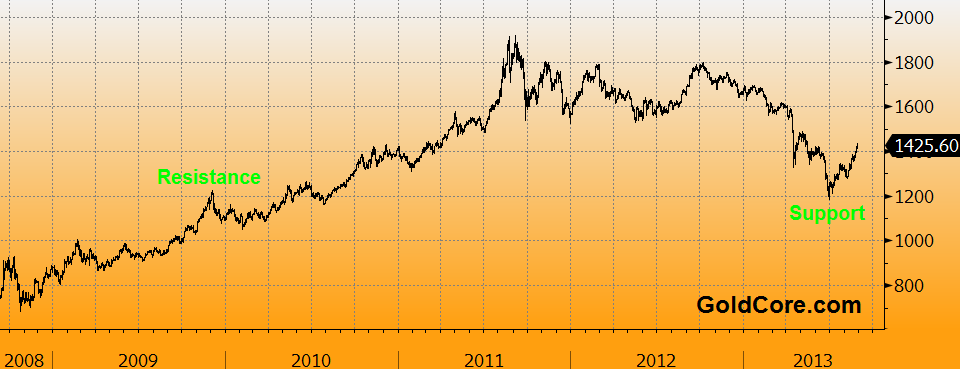
Gold climbed another 0.6% to the highest level in almost three weeks, extending a second weekly increase, as escalating violence in Iraq led to rising oil prices and safe haven demand. Gold rose 1.9% last week and a fifth day of gains today would be the longest such run since February.
Silver reached a one-month high, while platinum and palladium rose. Silver for immediate delivery climbed over 1% to $19.889 an ounce, the highest level since May 14. Palladium gained 0.9% to $822.09 an ounce, while platinum rose 0.7% to $1,443.25 an ounce.
NYMEX Light Sweet Crude Oil (WTI) – 2014 YTD (Thomson Reuters)
Gold bullion has advanced 6.7% this year in part because of unrest in Ukraine, where tension escalated last week after pro-Russian militants shot down a transport plane in the east of the country. In Iraq, the army killed more than 279 rebels as fighting intensified in OPEC’s second-biggest producer.
If Iraq’s oil supply goes offline, crude prices could reach $150 to $200 a barrel, T. Boone Pickens, founder of BP Capital Management, told CNBC on Friday. “That’s where you have to kill demand with price. That’s the only way you can do it, because oil won’t be there,” Pickens said in an interview with “Street Signs.”

Gold in U.S. Dollars – 1 Week (Thomson Reuters)
Geopolitical risk remains high and does not look to be abating any time soon.

All truth passes through three stages. First, it is ridiculed. Second, it is violently opposed. Third, it is accepted as being self-evident” —Arthur Schopenhauer
In the early 20th century, Russian scientist Alexander Maximow proposed a groundbreaking scientific theory.
For decades, this theory would be laughed at by the medical community. For years, it would be aggressively opposed by politicians and religious activists, sometimes even in violent protests.
Today, the same theory is building fortunes…
In 1908, Maximow became the first to coin the term “stem cell,” theorizing that all blood cells came from a common parent cell found in bone marrow. In 1924, he discovered those very cells…
But his success was short-lived.
Maximow died just four years later — before any other scientists were willing to accept his findings as truth. Like Pythagoras’s claim that the Earth is round or Galileo’s finding that the Sun is the center of the solar system, it would take years before others were willing to fully embrace this knowledge.
A Short-Lived Dogma
It wasn’t until 1963 that a man by the name of James Edgar Till was able to validate Maximow’s work by identifying self-regenerating bone marrow cells in animal models. Following this research, a slew of stem cell studies hit the academic scene, sparking the beginning of the end of stem cell ridicule.
But just like Maximow’s 1924 discovery, Till’s victory was short-lived. A wave of aggressive opposition, the height of which hit in the early 2000s, would obscure the benefits of stem cell research for decades to come.
A gross misunderstanding of stem cells allowed politicians and religious activists to misdirect the public for their own personal gain. This 2005 cartoon from the Pittsburgh Post-Gazette sums up the history quite nicely:
As you’re likely already aware, the opposition to stem cell research has since drastically faded. Bush-era restrictions were lifted in 2009, and just last month, the European Commission rejected pleas to block stem cell research funding.
Today, we’re at Schopenhauer’s third stage of truth: where the benefits of stem cell treatments are becoming self-evident. Research claims are no longer ridiculed by academics, and political quarrels have been reduced to a whimper.
This is what happens when study after study continues to show the benefits of any new science.
The Regenerative Generation
Late last month, dentist and researcher Praveen Arany of the National Institutes of Health (NIH) released yet another study showing the futuristic applications of stem cell therapy.
Arany and his team drilled holes into the teeth of rats, only to regrow parts of the tooth through stem cell activation. Unlike most stem cell therapies that require doctors to harvest cells beforehand, these researchers were able to activate cells already present in rats’ teeth using energy from a laser.
The study took place at Harvard’s Wyss Institute and raises the possibility that conventional dental procedures may completely be avoided in the future. Specifically, root canals and standard fillings may become a thing of the past thanks to this advance in regenerative medicine.
Of course, teeth are just the tip of the iceberg when it comes to stem cell applications.
In February, for example, Mitsutoshi Yamada of the New York Stem Cell Foundation successfully turned cells from a woman with type 1 diabetes into insulin-producing cells normally lost to the disease.
The findings are a major breakthrough because current methods of cell transplantation usually result in rejection from the immune system. But when stem cells from a patient’s own body are used, the immune system is far less likely to attack the intruding cells.
Further, just last week, researchers from Johns Hopkins University announced they have successfully grown a human retina — perhaps the single most complicated biological structure — using a type of stem cell taken from nothing more than a piece of skin.
Advancements like these are near-miracles for those suffering from age-related disease. As we get older, our regenerative capabilities slow, but stem cells have the potential to completely reverse many aging processes we previously thought were inevitable.
Hearing loss and macular degeneration (age-related blindness), for instance, are two areas that receive a heavy amount of focus from the stem cell community. Scientists have recently restored hearing to deaf rodents using stem cells, and several human clinical studies are currently underway for the treatment of vision loss.
For every release of positive data and every step into the next clinical stage, the companies running these kinds of studies experience a new rally in share price.
Just take Osiris Therapeutics’ (NASDAQ: OSIR) Prochymal, for example — a treatment for an obscure condition known as graft-versus-host disease.
Sparked by marketing approval in Canadian and New Zealand markets, this stem cell treatment rallied nearly 400% within less than two years.

With movement like that on international approvals, you can only imagine how the market would react to a positive PDUFA decision from the FDA. Likewise, we can expect an even bigger rally from stem cell therapies targeting less obscure markets.
It’s for this reason that we’ve recently added this stem cell company to our portfolio. Its stem cell pipeline is targeting progressive heart disease in the U.S. — one of the largest medical markets in the world.
Turning progress to profits,
Jason Stutman
Energy and Capital’s tech expert, Jason Stutman has worked as an educator in mathematics, technology, and science… Before joining the Energy and Capitalteam, Jason served on multiple technology development committees, writing and earning grants in educational and behavioral technologies. Jason offers readers keen insights on prominent tech trends while exposing otherwise unnoticed opportunities.

 We Are So Not Prepared For Another Oil Shock
In one sense, energy doesn’t matter all that much to what’s coming. Once debt reaches a certain level, oil can be $10 a barrel or $200, and either way we’re in trouble.
But the cost of energy can still play a role in the timing and shape of the next financial crisis. The housing/derivatives bubble of 2006 -2008, for instance, might have gone on a while longer if oil hadn’t spiked to $140/bbl in 2007. And the subsequent recovery was probably expedited by oil plunging to $40 in 2008.
With the Middle East now lurching towards yet another major war, it’s easy to envision a supply disruption that sends oil back to its previous high or beyond. So the question becomes, what would that do to today’s hyper-leveraged global economy? Bad things, obviously. But before looking at them, let’s all get onto the same page with a quick explanation of why everyone seems so mad at everyone else over there:
The story begins in 570 A.D. in what is now Saudi Arabia, with the birth of a boy named Muhammad into a family of successful merchants. After having some adventures and marrying a rich widow, around the age of 40 he begins having visions and hearing voices which lead him to write a holy book called the Qur’an. More adventures follow, eventually producing a religious/political system called Islam that comes to dominate a large part of the local world.
In 632 Muhammad dies without naming a successor, creating a permanent fissure between the Shi’ites, who believe that only descendants of the Prophet Muhammad should run Islam, and the Sunnis, who want future leaders to be chosen by consensus.
Now fast forward to the end of World War I: British leader Winston Churchill sits down with some other old white guys to draw a series of rather arbitrary lines through the Middle Eastern territories recently captured from the Turkish Ottoman Empire. They name their creations Jordan, Syria, and Iraq and appoint kings to rule them. Unfortunately, the new borders enclose both Sunnis and Shi’ites, along with Kurds and Christians who don’t get along with either kind of Arab Muslim. Shortly thereafter, Israel is tossed into the mix and massive but unequally-distributed oil fields are discovered, pretty much guaranteeing instability for as far as the eye can see.
Since then, the Western powers have been trying to keep the oil flowing by periodically deposing/replacing leaders and making/breaking alliances. All without the slightest idea of what they’re doing. So the situation has gone from really bad in the 1960s and 1970s to potentially catastrophic today as various Middle Eastern dictatorships and terrorist groups plot to create a pan-Islamic “New Caliphate” while secretly developing weapons of mass destruction.
Which brings us to the present crisis: The US, having deposed Iraqi dictator Saddam Hussein and spent a trillion or so dollars trying to create a functioning democracy, has pulled out, only to see the new Shi’ite government oppress the Sunni minority into rebellion. With the help (or leadership, it’s not clear) of Syrian Islamists trained in that country’s ongoing civil war, the Sunnis are on the verge of taking over Iraq, and both the US and (Shi’ite) Iran are being pulled back in — apparently on the same side.
It’s a mess, in other words, and the flow of oil, of which Iraq and Iran produce a lot, is now threatened.
So what would $150/bbl oil mean today? Several things:
Another recession. The US economy contracted at an annual rate of about 2% in the first quarter and isn’t nearly as strong as analysts had predicted going forward. Let gas go to $5 a gallon, and the consumer spending on which the US economic model depends would dry up. Put another way, we might spend the same amount but it will be mostly for gas and not much else. So much for the recovery.
Equity bear market. Stock prices depend on corporate profits, which in turn depend on sales. If Americans buy less, corporations earn less. With blue chip equities currently priced for perfection, major companies faced with a sales slowdown will, if they want to keep their stock prices from tanking, have to borrow even more money and buy back even more shares, which will only work until interest costs start consuming what’s left of their profits. Then US stocks fall hard.
Currency crisis. If Saudi Arabia manages to stay out of this latest conflict, it will see its revenues surge as it sells the same amount of oil at higher prices. But it’s not happy with the US (something about us recently tilting towards Iran) and apparently no longer feels obligated to accept only dollars for its oil. Let it start accepting euros, yen and yuan, and the result will be lessened demand for dollars, a falling dollar exchange rate and all manner of turmoil in global bond markets.
Derivatives implosion. Derivatives — basically private bets on the behavior of interest rates, currency exchange rates and corporate bond defaults — on the books of major banks have actually increased in the five years since those instruments nearly destroyed the global financial system. There are between half a quadrillion and one quadrillion dollars face value of derivatives out there, and a spike in financial market volatility would cause a lot of them to blow up.
There are other possible consequences of a major Middle East war, but the preceding is enough to make the point that the more leveraged a system is, the more vulnerable it is to external shocks. And no one has ever been as leveraged as we are right now.
Also from John:
They’re Lying To Us, Part 1: Unemployment
“One of the most mis-priced assets on the Planet.” – Richard Bookbinder of Terre Verde Capital Management
Richard says there are more than a 1000 companies an investor can look at. Areas to look at are in pumps, compressors, dams & infrastructure engineering, water delivery & utilities. – Editor Money Talks
“The coming battles for water” – Peter Grandich
Peter chose this 3 minute video HERE to bring investors up to date on this investment opportunity.

-
I know Mike is a very solid investor and respect his opinions very much. So if he says pay attention to this or that - I will.
~ Dale G.
-
I've started managing my own investments so view Michael's site as a one-stop shop from which to get information and perspectives.
~ Dave E.
-
Michael offers easy reading, honest, common sense information that anyone can use in a practical manner.
~ der_al.
-
A sane voice in a scrambled investment world.
~ Ed R.
Inside Edge Pro Contributors

Greg Weldon

Josef Schachter

Tyler Bollhorn

Ryan Irvine

Paul Beattie

Martin Straith

Patrick Ceresna

Mark Leibovit

James Thorne

Victor Adair