Personal Finance

90 Yr Old Russell: Gold Distrusted – Even Hated By General Public – Expects a Melt-Up

Gold was being accumulated prior to recent upward thrust, thus recent move was genuine Richard Russell argues below. Also Richard’s biggest worry is the US Dollar, and he looks at its technical condition. This piece was done on June 20th, just after the big thrust up to a close over $1320 – Editor Money Talks

“Below I show gold along with its On-Balance-Volume at the top of the chart. Note that OBV tuned up before the big up-thrust last week. This tells me that the huge move in gold was not just a violent one-day short-covering panic, but gold was being accumulated prior to the up-thrust.

rr1

Following the big upward surge in the precious metals, I wanted to see whether it was a one-day short covering panic or whether we were seeing a continuation of the gold bull market. The daily chart below shows the action prior to the big surge which took gold above both of its moving averages.

rr2

Below we see HUI, the NYSE “gold bugs index.” Note that the pattern we see here is that of a huge head-and-shoulders bottom. The P&F target is 316. This formation has been building for many months, and thus when the latest surge arrived, the surge can hardly be seen as a sudden one-day short covering panic. If HUI can hit the 264 box, I expect an upward explosion.

rr3

The precious metals are still distrusted and even hated by the general public. Before this bull market is over, I expect to see a mad rush and melt-up as the pros and the public scramble headlong into gold and silver.

….also from Richard

The price of protein (meats, fish, beans, bacon and nine other proteins) is heading higher. Protein prices jumped 28% in the last five years. Protein prices jumped five percent in 2014. This according to Bloomberg.

Throughout the year 2014, I have advised my subscribers to do as I have done, and that is to load up with physical silver and gold. Gold is way up this year; better than many hedge funds have done. And sitting with physical silver and gold has been a lot easier on the nerves than sitting with a portfolio of assorted stocks. What will I do from here? I’ll sit with my silver and gold — along with my lone preferred stock — Tri Continental Preferred.

My biggest worry for the United States is our dollar. The dollar is part of almost every nation’s reserves. And as you can imagine, nations that hold dollars are on edge. They see the Fed pumping out trillions of new dollars, and they know that the more dollars — the weaker the dollar.

I’m not going to talk about the sanity of the Fed’s dollar creation, I’m just going to look at the technical condition of the dollar. The P&F chart below depicts the dollar. The dollar just hit the 79 box which set off a bear signal with a target of 73. Thus, the action of the dollar will be critical in the weeks ahead. As the dollar declines, it will put upside pressure on all commodities, and this, in turn, will put pressure on the middle class, which, from what I understand, needs food in order to survive.

rr4

Late Notes — The precious metals continue inching higher with gold closing up 3 to 1321 and silver up 13 cents to 21.04. Just to make things difficult, the gold miners backed off with GDXJ closing down 1.99 to 40.00. After looking over the charts, I continue to think that gold has made its lows and from here on it will take patience as the universe of precious metals slowly and subtly creeps higher. 

Gold has had a habit of declining every Friday, so this coming Friday’s action should provide a hint as to which way gold is going. In the meantime, China continues to be the world’s leading accumulator of gold in its long term strategy of preempting the dollar. From what I gather, China has now passed India as the worlds biggest accumulator of gold. China is famous for its patience and its long term strategies. I hope my subscribers enlist a bit of Chinese patience as they continue to accumulate silver and gold.”

The Juniors That Can Survive

Brent Cook’s Tips for Finding Juniors that Can Survive the Dust Bowl

As romantic as the idea of the gold explorer who strikes it rich in lightning fashion is, the far more common tale is one of hard work and persistence. For investors, that means doing due diligence to search out the likely success stories. In this interview with The Mining Report, Brent Cook of Exploration Insights shares the telltale signs of success he looks for in the junior gold, phosphate and uranium sectors and discusses the synergies that stand to benefit some recent mergers.

COMPANIES MENTIONED: B2GOLD CORP. : DALRADIAN RESOURCES INC. : FIRST QUANTUM MINERALS LTD. : FISSION URANIUM CORP. : FOCUS VENTURES LTD. : OSISKO MINING CORP. : PAPILLON RESOURCES INC. : PILOT GOLD INC. : RIO ALTO MINING LTD. : SULLIDEN GOLD : YAMANA GOLD INC.

The Mining Report: Brent, you’ve predicted that the summer of 2014 will be a great dust bowl for junior mining investors. Why so bleak?

Brent Cook: The junior mining sector has lots of issues to work through. The major mining companies have even bigger issues to work through, starting with the inability to show a profit over an extended period of time. Investors are disappointed by the performance of the majors and have left the sector in search of more reliable, more profitable sectors.

Pilot Gold Inc.’s drilling on Kinsley Mountain is turning up some very positive numbers that point to the potential of another major gold deposit.

Until we see the major mining companies start making money, it will be tough for the juniors to raise money. That’s the reason for my prediction.

TMR: You’ve said that investors might start to return to the mining sector as soon as 2015–2016. Is that because you think the majors will be making money by then? 

BC: No, I think the opposite. The majors, on average, have all-in production costs that are higher than the gold price right now; they are struggling. They’re cutting costs by 1) curtailing development and exploration, 2) laying off staff, including geologists, engineers and, hopefully, some human resources people, and 3) high-grading their deposits. High-grading is more profitable in the short term, but in the long run it degrades the future revenue from that deposit.

Although the majors will improve their earnings this year, in 2015 and 2016 their mines won’t be making much money. At that point, they will have to replace what they’re producing with new, profitable ore deposits, but the problem is there aren’t that many out there. In the next couple of years, and we’re starting to see it already, the majors will be acquiring the very few profitable deposits out there that are now held by juniors.

Fission Uranium Corp. has the best uranium discovery in a long, long time.

TMR: Do you foresee a lot more deals coming up?

BC: Not a lot more, and that’s the problem. There aren’t that many good deposits out there.

In H1/14, I went through more than 100 gold deposits with NI-43-101-compliant resources and found very few that I felt actually made good money. There are lots of resources being touted by too many companies, just not many that can make money, assuming the gold price and cost structure stays more or less where they are.

If we see a rapid rise in the gold price, maybe some of these assets will look more profitable. The last time the gold price rose, the majors dropped the grade they were mining, thereby lowering their per ton profitability. At the same time the input costs that go into mining—labor, materials, consumables—rose. We never saw the profit that was advertised and that we expected.

TMR: Let’s talk about some of the deals that have been made. What were the synergies and the challenges?

BC: A couple of weeks ago, Rio Alto Mining Ltd. (RIO:TSX.V; RIO:BVL) bought Sulliden Gold Corp. (SUE:TSX; SDDDF:OTCQX; SUE:BVL). That’s a great deal for Rio Alto, which is currently mining an oxide-gold deposit in Peru. By acquiring Sulliden, Rio Alto gets another Peruvian deposit that is very similar geologically and metallurgically, so it shouldn’t be too big an issue to bring it into production. The timing works well because the Sulliden deposit should pick up just when Rio Alto’s La Arena deposit starts to decline. Rio Alto knows how to work in Peru, and it seems to have the social issues under control. The synergies work really well when a company that knows what it is doing buys a deposit that fits right in with what it’s up to.

Another one is B2Gold Corp.’s (BTG:NYSE; BTO:TSX; B2G:NSX) planned purchase of an Australian company called Papillon Resources Inc. (PIR:ASX; PAPQF:GREYS). Papillon’s deposit in Mali is more than 5 million ounces (5 Moz), in my opinion probably the best gold deposit not owned by a major. We bought it in my letter about a year ago because of its high quality asset. B2Gold is just finishing off building its deposit in Namibia, so the whole team now moves to the deposit in Mali and begins building that. Again, very synergistic for B2Gold.

TMR: Interestingly, looking at the stock prices it appears that Papillon shareholders saw it as a positive, but the B2Gold shareholders did not.

BC: It’s an all-share deal, so it’s a lot of dilution. The Papillon shareholders end up with about 25% of B2Gold. B2Gold dropped quite a bit, but it has come back. But I guarantee you this will be a fantastic profitable deposit for B2Gold; it made a good move while the majors who should be buying it have their collective heads in the sand.

TMR: The bidding war over Osisko Mining Corp. (OSK:TSX) was one of the deals that kicked off a lot of this activity. Now that some time has passed, is that deal positive for the shareholders? 

BC: It appears to be. I don’t follow Osisko in much detail. The deal offers Yamana Gold Inc. (YRI:TSX; AUY:NYSE; YAU:LSE) a big tax advantage because it gives Yamana a Canadian operation. In addition, it gives Yamana some political security in that most of its other options are in less stable jurisdictions. This deal is a big plus for Yamana.

TMR: Do these deals add liquidity to junior mining investors who, after having had a positive experience, might now be willing to put some money into other junior mining stocks?

BC: Certainly. I think a lot of the funds and individuals are taking some money off the table and plowing it back into the sector. That’s positive.

TMR: Your newsletter recently quoted a Newmont Mining Corp. (NEM:NYSE) study that 1 in 1,000 prospects turns into an economic deposit, and 1 in 10,000 becomes a 4 Moz or more resource. Why is it getting more difficult to find economic deposits, given all the cool new technology?

BC: That study is a few years old, and I need to emphasize that it’s a statistical number. The real odds are better than that if you do a bit of due diligence.

It’s getting harder because we’ve scoured the earth fairly well. There are not many outcropping ore deposits left to find. We have to look under cover or through barren rocks. Explorers have to spend more to drill and use geophysics and such. The less expensive but still critical surface work now only gets you to a drill test that is often little more than an initial look at the rocks of interest.

Once you do find something, it has to be good because it’s probably buried under 100–200 meters (100–200m) of rock. That depth adds to the cost of exploration, resource definition, stripping, engineering and often recovery. Therefore your grade and tons hurdle are higher for an economic deposit. A 2 Moz deposit grading a gram at surface may make money, but at 150m depth it probably doesn’t.

There really haven’t been that many advances in technology. Unlike the simpler geology of oil and gas, this is complex geology. Take a porphyry copper deposit, for example, or an epithermal gold deposit. They form on continental margins, subduction zones, fault zones. The deposits get chewed up, broken up, bent up and moved. I just posted an article on my website that goes into the complications of exploration and the discovery process.

TMR: Do investors understand the difficulty of finding and developing a successful project?

BC: Overall, no. That’s a real problem with this industry. There is a lack of communication and understanding between the finance side and the technical side.

Most speculators in this sector have very short-term time horizons. They expect to drill a few holes, make a discovery and turn a $0.10/share stock into a $1 stock. It doesn’t happen that often. It occasionally does, and that’s what keeps hope alive.

Exploration is a scientific endeavor, in which you conceptualize a target or a theory, and you test it using a drill and the data. You re-analyze the data and adjust your model to fit, often more than once. That takes time and money.

A lot of companies are raising money on prospects that have been tested and retested in the past. The rationale is that speculators will give them a bit of money if they know some flash drill assays are coming from a re-drill of a previous hole, thereby providing the speculators a chance to get off the stock with a small profit. In reality, however, the project was a dog, always has been a dog, and the problem was all the other holes that didn’t carry any grade, not the one good hole that keeps getting re-drilled. Schemes like this are a waste of precious capital and one of the reasons that odds of success are so low.

TMR: Nonetheless, you’re still buying companies. What do you look for and how do you take that deep breath and make your estimates?

BC: I’ve done this my whole life. I think you can get the odds down with a lot of due diligence and understanding what a company is looking for.

I look for the very few projects that offer a shot at a deposit, whose production costs and capital expense (capex) will be in the lower third of the projects out there. Those projects will make money, assuming some government doesn’t steal it.

First off, you need to consider the economics behind mining something as early as possible. Most companies, and most investors, don’t seem to do that, which is too bad, because it’s really important. On my first visit to any early-stage project I mentally build a mine that includes metallurgy, mining costs and capex and then judge results based on that rough model.

Second, you need to invest in a company with competent people who understand what they’re looking for: the target type, the geology and what it will take to advance the project. Too many companies find something and, although their market cap may increase, the share price never increases because management needs to keep financing to continue exploring. Even if the company succeeds, we shareholders don’t get much bang for the buck because we’ve been diluted out as management kept on drilling. A company has to know how to financially engineer the exploration and development of the project.

TMR: What are some examples of companies that have competent management that knows how to both find and develop a deposit without diluting shareholders and raise enough money to get somewhere?

BC: It’s a real short list. The exploration team at Pilot Gold Inc. (PLG:TSX) came out of Fronteer Gold Inc., which, in conjunction with AuEx Ventures Inc. (XAU:TSX), found and proved up the Long Canyon deposit in Nevada. That deposit was bought by Newmont for $2.33 billion.

Pilot acquired new targets in eastern Nevada, where it’s having some real success drilling for a similar-style gold deposit on Kinsley Mountain. It doesn’t have a defined resource yet, but the drilling is turning up some very positive numbers that point to the potential of another major gold deposit.

The company is doing something similar in Turkey on some gold and porphyry projects. Pilot has about $30 million ($30M) in the bank. That’s an exploration company worth watching. We own it in the letter, which also means I own it personally.

TMR: Pilot just released some drill results from Kinsley Mountain. Did they meet your expectations?

BC: Yes, they did. Pilot drilled a new target, where it intersected 41m of 3 grams per tonne (3 g/t) from surface. That’s a very good number. It put one hole under each of two other conceptual targets, and failed on both. That doesn’t kill the project, but it makes it more complicated.

We want to see a company conceptualize ideas that, if they succeed, will be meaningful to a major. Results have been pretty positive so far at Kinsley Mountain.

TMR: Pilot’s stock price is up quite a bit from the beginning of the year. Is there still upside there?

BC: Yes, if success continues. Pilot’s copper-gold resource in Turkey is kind of small, but it’s valuable to somebody, perhaps a smaller Turkish mining company. Its other resource in Turkey is metallurgically complex, and it may be worth something to somebody. I like that Pilot continues to test new ideas and is successful. We don’t find many companies doing that these days.

TMR: What’s another company?

BC: Dalradian Resources Inc. (DNA:TSX) is proving up an interesting deposit in Northern Ireland. It’s a series of narrow, high-grade vein structures that run under what is basically sheep pasture. In its preliminary economic assessment (PEA), Dalradian has proven up a Measured and Indicated 1 Moz grading 10.4 g/t, plus an Inferred 2.5 Moz grading about 9.6 g/t. It’s located in an area of Northern Ireland that has high unemployment. From what I’ve seen and heard, the local authorities are positively inclined toward development. I don’t see any serious environmental hurdles.

It’s a simple deposit, low capex, low operating costs in a very stable place. I think a midtier company should go in and buy it. Right now, the PEA, which is going to be updated, shows a value close to $500M on an after-tax basis, and the company is selling for $100M. It has enough cash to move ahead to the feasibility stage. This summer and fall, Dalradian will be taking a bulk underground sample; I am headed there to get a closer look at the resource shortly.

TMR: How soon could that be a mine?

BC: Let’s give it two years. Engineering, permitting and production all take time. If the old PEA is accurate—and I think it’s probably close—this would produce gold for less than $600/ounce. There aren’t many projects that can do that. The internal rate of return on Dalradian is about 42%.

TMR: Who else do you like?

BC: One of the most geologically boring deposits in the world is a phosphate deposit being proven up byFocus Ventures Ltd. (FCV:TSX.V) in Peru. It’s dead simple geology: shallow seabeds that are continuous for tens of kilometers. The phosphate beds within them are being mined or developed on two adjacent deposits, one owned by Vale S.A. (VALE:NYSE) and the other owned by Hochschild Mining Plc (HOC:LSE), as well as some agricultural companies. They are making lots of money off the phosphate.

The deposit that Focus is drilling is essentially the same. It is proving up a resource right now. If it’s successful, it should be worth multiples of what the company is trading at right now, which is about $0.26/share. I can see Focus going substantially higher, assuming it brings in a company that can take the project forward and mine it. I think there’s a good chance of that happening.

TMR: Is phosphate a play on the thesis that developing countries need more food? 

BC: Yes, in a sense this is a play on a growing world population that needs more and higher-quality food. Phosphate is a major fertilizer. China and India have trashed their environments, so they need to use more and more fertilizer.

TMR: If junior gold mining investment opportunities resemble a dust bowl, how do you describe uranium juniors? 

BC: They’re even worse. Not too long ago, Rick Rule called uranium the most hated sector. When I first joined up with Rick in 1997, uranium was about as hated as it is now.

You have to step in and buy these things when they’re really unloved, and that is where uranium is now. We’ve made good money on Fission Uranium Corp. (FCU:TSX.V) and continue to hold it in the newsletter because it is the best uranium discovery in a long, long time. That is partly because of the grade but, more important, the costs of mining this deposit will be substantially less than most other deposits in the Athabasca basin or the world. Its advantage is being near surface, open-pittable and permittable. A lot of the issues faced by companies in the Athabasca are caused by having to go underground. Whoever develops this deposit won’t have to face that challenge. The stock has come off quite a bit. It’s probably worth accumulating right now.

TMR: Fission Uranium has been something of a darling since it spun out from Fission Energy Corp. (FIS:TSX.V; FSSIF:OTCQX). Is there still upside there?

BC: Yes, I think so. It has yet to release a resource, but it had a big drilling program this year. The deposit is wide open in a number of directions along trend.

I don’t mind paying up for the best because, ultimately, it’s these high-quality deposits that will make money. Somebody will buy this deposit.

TMR: We’ve covered a lot of ground. How about some advice for investors looking to get through the great dust bowl intact?

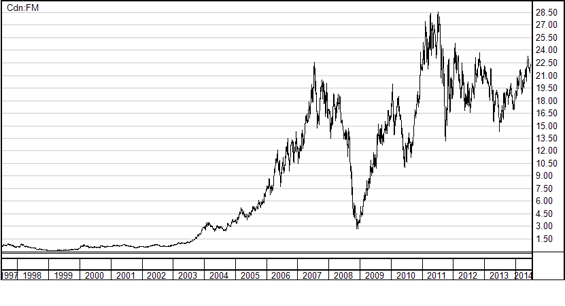
BC: The rain will come. At my most recent presentation in Vancouver, I showed a slide of a couple of stocks that collapsed in 1997. One of them was First Quantum Minerals Ltd. (FM:TSX; FQM:LSE). It got down to about $0.50/share; within five years, it was up to $17 and, ultimately, got up to be a $28 stock.
FMchart1

You have to ask yourself these questions: Will we keep consuming metals? Are we consuming metals at a higher rate than we used to? Will we be finding enough deposits to replace what’s being produced? I think the answer to the first three questions is yes and the last is no. If that’s the case, all we have to do is selectively and intelligently buy the companies that have the prospects or the people capable of finding the deposits that will be the leaders when the bull market comes back to the sector, as it will.

TMR: That’s great advice. Brent, thank you for your time and your insights.

Brent Cook brings more than 30 years of experience as a geologist, consultant and investment adviser. His knowledge spans all areas of the mining business, from the conceptual stage through detailed technical and financial modeling related to mine development and production. Cook’s weekly Exploration Insightsnewsletter focuses on early discovery, high-reward opportunities, primarily among junior mining and exploration companies.

Related Articles


Want to read more Mining Report interviews like this? Sign up for our free e-newsletter, and you’ll learn when new articles have been published. To see recent interviews with industry analysts and commentators, visit The Mining Report home page.


DISCLOSURE: 
1) JT Long conducted this interview for Streetwise Reports LLC, publisher of The Gold Report, The Energy Report, The Life Sciences Report and The Mining Report, and provides services to Streetwise Reports as an employee. She owns, or her family owns, shares of the following companies mentioned in this interview: None.
2) The following companies mentioned in the interview are sponsors of Streetwise Reports: Pilot Gold Inc. and Fission Uranium Corp. Streetwise Reports does not accept stock in exchange for its services.
3) Brent Cook: I own, or my family owns, shares of the following companies mentioned in this interview: Pilot Gold Inc., Fission Uranium Corp., Focus Ventures Ltd. and Dalradian Resources Inc . I personally am, or my family is, paid by the following companies mentioned in this interview: None. My company has a financial relationship with the following companies mentioned in this interview: None. I was not paid by Streetwise Reports for participating in this interview. Comments and opinions expressed are my own comments and opinions. I had the opportunity to review the interview for accuracy as of the date of the interview and am responsible for the content of the interview. 
4) Interviews are edited for clarity. Streetwise Reports does not make editorial comments or change experts’ statements without their consent. 
5) The interview does not constitute investment advice. Each reader is encouraged to consult with his or her individual financial professional and any action a reader takes as a result of information presented here is his or her own responsibility. By opening this page, each reader accepts and agrees to Streetwise Reports’ terms of use and full legal disclaimer.
6) From time to time, Streetwise Reports LLC and its directors, officers, employees or members of their families, as well as persons interviewed for articles and interviews on the site, may have a long or short position in securities mentioned. Directors, officers, employees or members of their families are prohibited from making purchases and/or sales of those securities in the open market or otherwise during the up-to-four-week interval from the time of the interview until after it publishes.



It’s Time To Buy These Two Stocks

The 2 Stocks with potential are below as is Tyler’s training:- Editor Money Talks

Seven Ways to Take the Emotion Out of Trading

The Trader’s Edge
There is life in the TSX Venture Exchange. After sliding since mid March, the exchange dominated by junior commodity stocks found buyers this week, breaking the three month downward trend. There is a good chance that this will begin a resumption of the recovery that started in January.

tylertoday

The Junior Gold Mining sector had another strong week but I expect short term profit taking before a possible resumption of the upward trend. This week’s rally takes the sector up to a long term downward trend line where sellers inevitably congregate to take profits. Expect a stall in the trend but be watchful for an eventual break of that downward trend line as a signal of strength.

GDXJ Weekly June 20

STRATEGY OF THE WEEK

Each day, I use the Stockscores Market Scan tool to look for stocks trading abnormally. The Market Scan has filters that seek out statistically significant abnormal price and volume action, two important signals that investors are anticipating improving fundamentals, or at least an improving perception of fundamentals.

Here are two stocks that showed abnormal action recently and also chart patterns that make them stocks worth considering:

STOCKS THAT MEET THAT FEATURED STRATEGY

1. T.ORE
T.ORE has been trending sideways for about a year but came alive this week, breaking out through $0.75 resistance. The stock may finally be starting its recovery process after a lengthy basing period. Support at $0.65.

tyxx

2. DRRX
DRRX recently had its Sentiment Stockscore cross above the important 60 mark, taking the stock in to optimistic territory. Abnormal price and volume action on Friday indicate investors are excited about something, giving the stock a good chance of filling in the price gap up to $2. Support at $1.44.

tylertoday2


Stockscores Trader Training – Seven Ways to Take the Emotion Out of Trading
I think that many traders have a hard time believing that they can make money by buying a stock and waiting. Most of us are not taught to make our money work for us but instead that we must work for our money. Go to a job, put in the time and you get a pay check. Work hard, your pay checks will grow. But the thought that you can make money by putting your feet up is a difficult thing for most to grasp.

With that mental programming, most of us have difficulty holding on to our strong stocks and letting the profits grow. If we buy a stock at $1 and it goes up to $1.20 in a couple of days we are likely to sell. In some ways we think of this fast return as good luck, not much different than buying a winning lottery ticket. We have a fear that someone is going to figure out that we have benefited from a mistake and so we better get out now before we get discovered.

This thinking is strengthened when we own a marginal stock and it goes down as quickly as it went up. If we take a marginal trade we should expect marginal results but somehow we only remember the negative feeling of watching a paper profit turn in to a loss. We tell ourselves that next time we will sell at the first sign of weakness and crystallize the gain. Avoiding pain is human nature.

Our next trade is of higher quality but we sell it on a short term weakness and lock in a quick but relatively small profit. While lost in self congratulations we realize that someone named Murphy is writing the laws of trading and we watch the stock march ever higher with us eating the stock’s dust. We have jumped off of a high speed bus that is headed for Profit City.

So what is behind this destructive behavior? It is that deep routed emotional response to danger that keeps us out of trouble but also makes us avoid a greater feeling of fulfillment.

Fear is what makes us sell our winners too early and hold our losers too long.

The best traders are not afraid of holding on to strong stocks, they are afraid of holding on to losing stocks. What do you do?

If you are a normal human being, you do the opposite. Think about the last loser that you owned. As the stock fell lower and lower, what was it that you told yourself over and over?

“It will bounce back eventually, I will just be patient.”

What your subconscious mind was really saying was, “It is much too painful to sell this loser and see that loss of my hard earned capital. I will hold on with the hope that it goes back to what I paid for it and then I will sell.” And of course, it continued lower because there was something wrong with the company and it deserved to go lower.

So what can be done to fight our destructive minds? How can we program ourselves to hold on to our winners and dump the losers? How can we trade without fear?

Here are my Seven Ways to Take Emotion Out of Trading

Trade Quality
Our fears are confirmed when we enter marginal trades. If you only trade the best opportunities you will trade less but you will have greater success. This will put you on the road to fearless trading and help you to simplify the trading approach. Write down your rules and do nothing if every rule is not satisfied. When you consider a stock, look for a reason to avoid the trade. If you can’t find one then you have a trade worth taking.

Buy With Confidence
The rules that you trade with have to have a foundation of success. You have to believe in your rules or you won’t believe in holding the stock through the shakeout periods in the longer term up trend. Analyze and test the strategy until you have proven to yourself that it works. Then trade it slowly without a lot of risk so you can gain a greater level of confidence that it works.

Don’t Watch the Scoreboard
Sports fans don’t spend a lot of time watching the scoreboard during a game, it only matters when the game is over. In trading, the scoreboard is the profit and loss figure for your account. If you focus on the scoreboard it is likely that you will lose sight of what is happening in the game. As a technical trader, all that matters to me is what the chart is telling me.

Plan Your Losses
Before you enter a trade, figure out what needs to happen for you to consider the trade a loser. For me, that is a move through chart support; I plan to exit the trade when the stock goes through a psychological floor price on the chart. Understanding where that point requires some experience and knowledge but once you know how to identify support on the chart, plan your losses.

Plan the Trade
I find it helpful to predict pull backs. My rational side knows that stocks cannot go straight up and that they must suffer pullbacks to recharge buyer interest and shake out weak holders. My emotional side feels fear when those pull backs happen. If I plan my trade and build in expectations for the counter trend pull backs I can deal with them better and have a greater chance of not succumbing to the fear when they do.

Don’t Fall in Love
I don’t want to know too much about what a company is doing because I have found that the more I like a stock the more likely I am to not listen to the message of the market. There is a lot of bias in the information that we receive about companies and what they are doing. The ultimate arbiter of truth is the market itself; we should have a greater faith in the opinions of thousands of market participants than a few biased sources of information.

Tolerate Risk
Without risk, there is no potential for return. To avoid trading with fear we have to be comfortable with the risk. If not, we will let fear guide our decisions and those decisions will probably be wrong. Therefore, do not take more risk on a trade than you are comfortable losing. Plan your losses based on how much you are willing to lose and let that determine the size of your positions.

The Profit is in the Patience
When a trade is working, let it work for you. A business owner does not fire her best employee. A hockey coach does not send his best player to the minor leagues. A company does not stop making their best products. Hang on to your best stocks with the same attitude. Hold the stock until there is a rational reason to exit the trade rather than selling because it feels good. If you are taking quality trades and trading without fear, you will feel better over the long run.

The time to get started on your reprogramming is now. Don’t expect to break habits built up over a life time in a couple of days. The battle against your fears is one that takes time win but with determination you can do it.

References


Stockscores Market Minutes Video
A look at Gold with a focus on how the chart time frame will change the outlook for a trade. Plus, Tyler’s regular weekly market analysis, watch the video at

http://youtu.be/NoktguCylLU

Live Webinar Tuesday June 24 6:30PT, 9:30ET
An Introduction to Active Trading – This free webinar will highlight the tools and processes used to actively trade the stock market using the Stockscores strategies. If you have ever thought about making trading a full or part time occupation, this webinar should not be missed. Stockscores founder Tyler Bollhorn will show what he does each trading day to find and execute his trades. Register at:

https://attendee.gotowebinar.com/register/6772855646720316162

or use the link on the Stockscores.com home page.


Disclaimer
This is not an investment advisory, and should not be used to make investment decisions. Information in Stockscores Perspectives is often opinionated and should be considered for information purposes only. No stock exchange anywhere has approved or disapproved of the information contained herein. There is no express or implied solicitation to buy or sell securities. The writers and editors of Perspectives may have positions in the stocks discussed above and may trade in the stocks mentioned. Don’t consider buying or selling any stock without conducting your own due diligence.


  1. Global fundamentals for gold are bullish. Let’s do a quick review of the facts.
  2. Narendra Modi has been elected to build gold-obsessed India into the world’s largest economy. 
  3. In China, the government’s plan to transition the economy from export-based to consumption-based is proceeding well, with only a tiny drop in GDP occurring.
  4. In Europe, Mario Draghi is considering implementing QE, and he’s committed to doing “whatever it takes” (money printing) to increase growth there. 
  5. In America, Janet Yellen is a dovish Keynesian. Her important 2007 research paper links higher inflation with higher real employment. To review it, please click here now 
  6. In Iraq, Exxon is evacuating personnel. The Kurds, ISIS, and the national government are all fighting each other, while America’s government says they are “monitoring the situation”. The Ukraine situation seems to be worsening on a daily basis. Clearly, the geopolitical price drivers for gold are bullish.
  7. With almost all fundamental and geopolitical lights for a higher gold price flashing green, I’ll argue today that the technical lights are just as green.
  8. Professional investors don’t make a lot of predictions. They lay out possible and likely scenarios, and allocate risk capital only on serious price weakness. On that note, please click here now . This monthly chart, and the HSR zones on it, should be the foundation of all technical analysis about gold. 
  9. What is HSR? Well, HSR is horizontal support and resistance.
  10. Gold declined into key buy-side HSR in the $1228 area twice in 2013, where I immediately “ordered” my subscribers to buy, regardless of the pain threshold. I often refer to my subscribers as financial marines.
  11. I use the 5,15 MA (moving average) series to project possible price trends of size, but not to place capital. Substantial capital has been placed by myself and my subscribers in the $1228 area, with an emphasis on gold stock rather than bullion, and now the key 5,15 MA series is on the verge of flashing a massive uptrend signal. 
  12. In my professional opinion, the most likely big picture scenario for gold can be viewed by clicking here now . Double-click to enlarge.
  13. In 2009, I suggested that a huge inverse H&S bull continuation pattern was forming on the gold chart. It had “outrageously bullish” implications. I believe a much bigger inverse H&S bull continuation pattern is forming now on the monthly gold chart.
  14. If I’m correct, the “bare minimum” arithmetic target is: $2663. I think my target price is absolutely justified by the global fundamental and geopolitical price drivers.
  15. What about the shorter term picture? To view it, please click here now . A bullish flag pattern is in play for gold on this daily chart. That follows a powerful upside breakout from the sizable (and bullish) green wedge pattern.
  16. If the flag pattern fails, I think that failure would create a bullish inverse H&S bottom pattern. To view this scenario, please click here now 
  17. Rather than bullion, my buy-side emphasis in the $1228 area has beengold stock. On that note, please click here now . Double-click to enlarge. This weekly ZJG-TSX chart shows the price action of junior gold stocks. The chart is “over the top” bullish. Note the sizable bullish non-confirmations taking place on almost all the technical indicators and oscillators. 
  18. Volume is immense, and it’s increasing with the rally from the right shoulder low, something that Edwards and Magee outline as highly significant, in their “Technical Analysis of Stock Trends” handbook.
  19. Please click here now . Double-click to enlarge. This weekly GDXJ chart has a record-size bullish volume bar. All of the technical indicators and oscillators suggest that the key highs in the $46 and $54.56 areas will be exceeded.
  20. Please click here now . Double-click to enlarge. This Global X Gold Explorers ETF, GLDX, suggests that gold exploration companies are poised for a spectacular upside breakout, targeting the $37.64 area highs of 2012.
  21. Companies that have minimal hedging programs, or none at all, seem to be leading all gold stocks, from the standpoint of relative strength.Please click here now . Double-click to enlarge. This Pure Gold Miners ETF weekly chart (GGGG-NYSE) is important. The rally from the head of the base pattern to the $14 area exceeded the rally to $13.84, from the left shoulder. 
  22. Gold stocks attract momentum-oriented hedge funds, when they trend with higher highs and higher lows, and so the Pure Gold Miners fund is already technically in an uptrend.
  23. Note the bullish blue wedge pattern that formed the right shoulder. If unhedged gold stocks are poised to do best in the coming months, does that mean gold itself is likely to move much higher in price? I think so.
  24. The Western gold community loves junior gold stocks, and the charts of key junior gold stock ETFs suggest that substantial financial rewards for loyal shareholders, are now on the way.

Jun 24, 2014
Stewart Thomson
Graceland Updates
website: www.gracelandupdates.com
email for questions: stewart@gracelandupdates.com 
email to request the free reports: freereports@gracelandupdates.comGraceland Updates Subscription Service: Note we are privacy oriented. We accept cheques. And credit cards thru PayPal only on our website. For your protection we don’t see your credit card information. Only PayPal does.

Subscribe via major credit cards at Graceland Updates – or make checks payable to: “Stewart Thomson” Mail to: Stewart Thomson / 1276 Lakeview Drive / Oakville, Ontario L6H 2M8 / Canada

Stewart Thomson is a retired Merrill Lynch broker. Stewart writes the Graceland Updates daily between 4am-7am. They are sent out around 8am. The newsletter is attractively priced and the format is a unique numbered point form; giving clarity to each point and saving valuable reading time.

Risks, Disclaimers, Legal
Stewart Thomson is no longer an investment advisor. The information provided by Stewart and Graceland Updates is for general information purposes only. Before taking any action on any investment, it is imperative that you consult with multiple properly licensed, experienced and qualifed investment advisors and get numerous opinions before taking any action. Your minimum risk on any investment in the world is 100% loss of all your money. You may be taking or preparing to take leveraged positions in investments and not know it, exposing yourself to unlimited risks. This is highly concerning if you are an invetor in any derivatives products. There is an approx $700 trillion OTC Derivatives Iceberg with a tiny portion written off officially. The bottom line:

Are You Prepared?

Get in Sync with the Central Banks

The Federal Reserve meeting: The market may have been expecting the Fed to “hint” at some very modest “tightening” of policy…but that didn’t happen…the Fed remained as “dovish” as ever…it seems that the Fed is “more than willing” to tolerate inflation running well above their 2% target for several months before they will start “tightening.” Therefore:

Stocks: after a very brief 2% decline on “geo-political concerns” the DJIA and the S+P have resumed their uptrend…registering new All Time Highs…long live the Fed!  

EP-June23

US Dollar: fell modestly against most currencies.

DXE-June23

Bonds: May start to “worry” more about inflation.

USA-June23

Canadian Dollar: jumped to 5 month highs on anticipation that stronger CPI and retail sales may stop Poloz from “talking the dollar down.

CA-June23

Gold: jumped over $40…breaching resistance levels…it appears poised to move higher.

GCE-June23

Option Volatility: for most asset classes remained near historical lows…with stock market option vol moving to new multi-year lows.

VIX-June23

Crude oil: Consolidated last week’s sharp gains and moved modestly higher.

CLE-June23

What are we trading? The Driving Force behind current Market Psychology remains the anticipation of Central Bank policy/action…last week the market had “hints” from the UK and New Zealand CBs that interest rates would be rising…and their currencies rallied…this week the “dovish” tone from the Fed gave the stock market a green light to rally to new highs…while the USD fell…while “hints” from the Norwegian Central Bank that interest rate hikes would be delayed caused the Krone to tumble.

It’s a Central Bank Market: The absolutely massive “money printing” from the world’s CBs has clearly caused asset inflation in stock and bond markets…and now we have reports that CBs around the world have been directly buying equities as well as bonds!..that huge Chinese buying of European equities probably caused the Euro to be much higher than it would otherwise have been!

DEFLATION/INFLATION: Last week we wrote the following paragraph…and we want to repeat it again this week: For years we have steadfastly embraced the Gary Shilling “Age of Deflation” view…and that seems to have been correct…but…we are beginning to change our mind on that score. This past week saw Central Banks in New Zealand and Britain caution that interest rates will be rising. Current Market Psychology seems to expect that interest rates will be kept low for a long time and that any increases will be very timid. If Market Psychology changes, and begins to anticipate a shift to a more inflationary environment with higher interest rates,  we could see big moves in the market.        

Trading this past week: We started the week short gold but…the rally in gold the previous week had put gold price action on our “radar screen” and we covered our short positions mid-week as gold began to rally through resistance levels. We continue to hold our long US Dollar Index positions and…we are hanging onto our cheap out-of-the-money S+P puts…the trade was a “punt” and we are losing money…the puts have lost ~50% of their value and if the stock market doesn’t roll over next week we will liquidate. We have NOT moved to sell short the COMDOLS as we thought we might…we had thought that Market Psychology was underestimating how quickly the Fed might move to “tightening”…but it seems we were wrong about that…our trading is out-of-sync with the market…we need to “clear our minds” and get back in sync!

Trade Banner


test-php-789