
Mike's Content
The CD Howe Institute recommends that the Government borrow & spend money in order to create jobs & stimulate the economy. Michael decimates that idea with facts below…..
{mp3}/mikesdailycomment/mc072414{/mp3}


Summary
- S&P 500 is Becoming Increasingly Overvalued.
- TSX Venture Bottomed in mid-2013.
- Bifurcation between Partnership and Market.
Market Outlook
I will start with the Partnership’s designated “alternative investment of choice” – the S&P 500. For the past five years, investors in the S&P 500 have enjoyed fantastic returns and minimal volatility. It is also likely that this “easy money” will be available for some time. The path of least resistance certainly seems to be up. However, it is essential to remember that, even as the S&P’s steady rise grows more and more intoxicating to the average investor, the past is not indicative of the future. This is not to say that a prudent speculator can’t make money by buying at these levels and then selling at an opportune time in the next 1-3 years. But for those trying to build a nest egg or save up for a college education, this is not the place to be. In light of the below chart, you can’t possibly believe that you’re early to the party!

The US macro backstop does not seem to support the rally. I understand that increasingly more of the S&P’s revenues are being generated outside of the US (currently 45% of S&P revenues are from overseas), but one would think that the recently reported 2.9% decline in US GDP for Q1 2014 would have at least some effect on the exuberance. A glance at the above chart suggests otherwise. Additionally, as stated in the previous letter, the most significant data point that belies this rally is the dearth of U.S. Net Investment over the past decade. With Tesla’s Gigafactory being a notable exception, the slump in capital expenditures (even in a period of record profits) does not bode well for the sustainability of this move.
A sharp decline in the velocity of money also behooves the current market environment. As demonstrated by the below chart, the velocity of the M2 Money Stock has plunged over the past five years. This is happening despite historically low interest rates and the Fed’s multi-year money printing experiment that will continue through at least 2014. In his typically direct (and sometimes draconian) manner, John Kaiser concludes: “The people of America are paralyzed with fear about the future; the shriveling middle class has no spending power and the elite has no desire to spend its accumulating net worth. Banks are not lending because there is no vision of America’s economic future, businesses are not investing capital because they do not see a growing consumption demand, and the wealthy are preparing to ride out the deflation that will accompany the return of interest rates to normal levels.” There are notable exceptions to this statement (think Silicon Valley or the shale gas boom), but I agree largely with this sentiment.

Trends keep working in the same direction until they don’t. When a trend stops working, there is a reversal in the opposite direction. And the longer the original trend, the more painful the reversal (think 2000 or 2008). Whether the next S&P reversal occurs before or after the Fed ceases their omnipresent hand waving remains to be seen. But, one way or another, there will be a significant reversal in the near to medium term. This is the nature of our debt-fueled, boom and bust economy.
Switching gears to the resource market, it appears that the TSX Venture Index bottomed in mid-2013. (Remember that 80% of the Partnership’s capital is deployed in mining equities, with many of these companies in the exploration/development stages. The TSX Venture Index is the best proxy for this market.) While determining a market bottom is an inexact science at best, the stages of capitulation we witnessed in 2012/2013 and the current market disinterest signals that, in the absence of a black swan event, the TSX has reached its lows in this current cycle. The below chart outlines the index’s performance in this historic bear market.

However, this “bottoming” needs to be taken with a grain of salt. The index as a whole is unlikely to zoom upwards anytime soon and many marginal companies will continue to decline for the indefinite future. There are still lots of dead beats out there. According to John Kaiser, 60% of juniors in the TSX Venture Exchange have $500k or less in capital. Companies with this amount of capital will have a hard enough time covering overhead, let alone making tangible development progress on their properties. Within a year there will be dramatically fewer choices in the resource space – these companies can only function as walking dead zombies for so long.
As this attrition continues over the coming quarters, in composite, the surviving juniors will be much stronger than the current batch. Bad bear markets are the perfect breeding ground for leaner and meaner indexes. There will be a time in the upcoming two years where a fresh wave of money enters the junior resource market, right as the remaining zombies are closing up shop. This decrease in variety of potential investments will be good for two reasons. The first is that institutions will begin to team up in financing the very best prospects, leading to strong shareholder bases all around. The second is that these surviving companies are poised for exciting outperformance. As these new investors reap killings in the junior space, more money will find its way into resources as the cycle shifts into a bull market. The Partnership looks forward to waiting patiently as this process unfolds.
One of the most frustrating aspects of the past few years has been the high correlation between all mining related equities. Regardless of the company’s fundamentals, the only direction for the past couple of years has been down. This is a terrible situation for investors attempting to cherry pick the very best from a larger universe of companies. (I am a strong believer in Pareto’s Principle, or the “80-20 Rule”. This rule of thumb dictates that 80% of any industry’s profits are generated by the best 20% of the companies. Extending that further, 64% of an industry’s profits are generated by the best 4% of the companies.) That being said, this concept was temporarily defied in the previous few years as all mining equities traded lower in tandem.
The exciting news is that bifurcation is now very real between the Partnership’s current holdings and “the rest”. This is the “stealth rally” that Rick Rule often references – and it has really come to life since November 2013. I’ve provided some charts below to demonstrate this marked change of performance since late 2013. For points of comparison, I also provide the aggregate performance of past holdings of the Partnership (that have been liquidated due to poor operational performance) and the TSX Venture Index as a whole. Keep in mind that these charts assume equal weightings between all Partnership holdings. As evidenced by the upcoming Overview of Partnership Holdings section, this is a simplification.
Current Holdings

Past Holdings

TSX Venture Index

Read more on Alternative Investing »

It’s been a summer of open windows and dormant air conditioners in the Eastern U.S. as the mercury has failed to break 85 degrees on most days and night-time lows fall down to the mid-50s in much of New England.
And that partially explains why natural gas prices are plunging to seven-month lows. Gas-fueled power plants are operating at a low hum as electricity demand has been unusually tepid. When you consider that late July typically represents a turning point for summer temperatures, this may turn out to be a year without any major heat waves. Good news indeed for residents in the Eastern U.S. after enduring an unusually dispiriting frigid winter.
As demand for gas remains subpar, gas storage facilities are re-filling at a rapid rate, turning gas back into a buyer’s market. That’s a quick change from six months ago when gas was being consumed at a faster-than-normal rate. And the resulting price collapse has left many to wonder: Will gas prices keep plunging, or have they hit bottom?
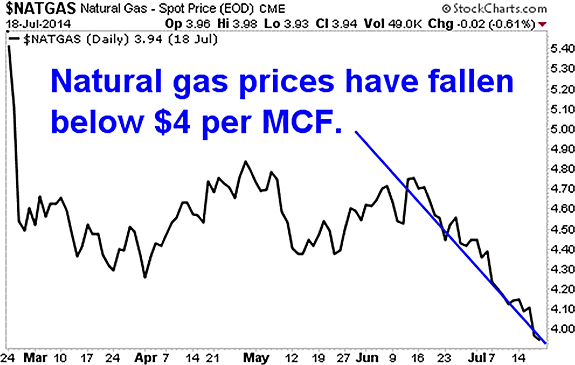
The answer to that question: Gas prices are likely to keep falling.
Tepid demand is likely to lead to more increases in the amount of gas in storage, and with each weekly update from the Energy Information Administration (EIA), gas prices will likely move down another leg. A commodity needs a catalyst to reverse direction, and natural gas prices have no positive l catalysts on the near-term horizon. Also, recall that gas prices were historically closer to $3 per thousand cubic feet (MCF) before last winter’s polar vortex, so there’s no reason to think that the current $4 per MCF price range represents any sort of bottom.
But the continued erosion in gas prices means that you should now be monitoring this commodity. Because when a bottom is in, there could be a solid snapback in prices. That’s because the supply side of the equation continues to be a question mark for some investors. Though exploration for oil and gas in the nation’s shale regions remains robust, geologists will tell you that such deposits are at their production peak in the first few years of drilling before a steady rate of depletion takes place. And many productive gas wells have already been gushing output for several years now. Looked at another way, the most promising shale segments have already been staked and newer areas of gas development hold lesser output potential than the first wave.
As it stands, falling gas prices are likely to deter gas producers from tapping more wells. According to Baker Hughes, the number of rigs dedicated solely to gas production in North America has fallen from 369 a year ago to a recent 311. That’s down from 1,500 in 2008 and represents the lowest figure since 1993. To be sure, today’s wells are more productive, but the laws of depletion argue against maintaining their pace of prodigious output. Thus far in the shale gas revolution, we have yet to see a sharp drop in depletion rates. But as news of depletion rates starts to trickle in, sentiment toward this issue could shift quickly.
Pivoting back to the other end of the equation, when will demand rebound for natural gas? We’ll find out as we approach the coming winter season. One of my favorite indicators is the Siberian ice pack. Last autumn, this indicator again showed an uncanny ability to predict temperature patterns in North America over the ensuing winter. If you are looking at natural gas as a commodity investment, or natural-gas related stocks, then I encourage you to repeatedly monitor this website beginning in early October.
Taken together, both the supply and demand side of the equation portend a further drop in gas prices. So avoid the temptation to start bottom fishing. As an example, several analysts gave recently sung the praises of Rice Energy (NYSE:RICE), a fast-growing gas producer. “Rice’s Marcellus well designs achieve the best reservoir drainage of the group currently,” note analysts at Cannacord Genuity, who see shares doubling to $51. But as this company’s stock price chart shows, investors are paying more attention to gas prices right now than company-specific outlooks.
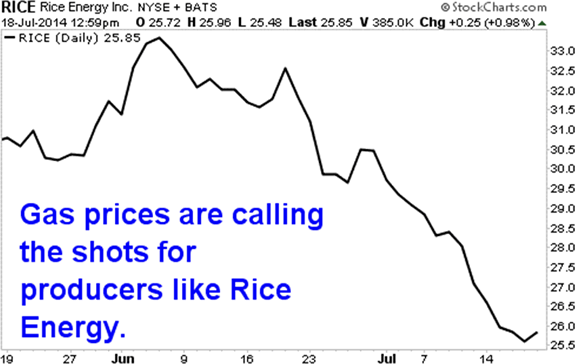
Risks to Consider: If you directly invest in natural gas producers, you need to keep an eye on their balance sheets. Some of these firms are counting on firm natural gas prices to support their capital spending programs and debt burdens and falling gas prices may imperil their cash flow.
Action to Take — The outlook for a further drop in gas prices suggest you should start gathering a watch list of favorite gas names. Some of them like Rice Energy are steadily sinking. But when a floor is in, such stocks will represent solid upside potential again. And as I noted in my follow-up look at the polar vortex theme key commodity-specific exchange-traded funds (ETFs) represent better leverage to prices than the underlying gas producers.
In the past year, Street Authority recommendations on individual stocks have gained +72%, +26% and +60% all in less than six months… and recently, their trades could have made you +26% in 42 days and +42% in less than one month. Click here to get the free trading advisory — Trade of the Week.

Major indexes like the S&P 500 and the Dow Industrials appear to be on autopilot — cruising along with an up-and-to-the-right pattern — thanks in large part to free money from the Federal Reserve. They are up 7.5% and 3.1%, respectively, on the year.
Meanwhile, the smaller-cap-biased Russell 2000 continues to struggle against the S&P 500, as was down -0.5% for the year at yesterday’s close.
Two weeks ago, the Russell 2000, via the iShares Russell 2000 ETF (IWM), tested the 38.20% retracement ($115.80) from the May low to the July high, and last week tested the 50% retracement level ($114.21).
Until the Russell 2000 rights itself (i.e., get above the 38.20% retracement), I remain with a degree of caution for the overall stock market.
A similar pattern has emerged with several of the stocks and sectors we are watching together …

I remain with a positive outlook on Amazon (AMZN) and gold via the SPDR Gold Trust (GLD).
However, our positive view on semiconductors, via the SPDR S&P Semiconductor ETF (XSD), is complete now that there are too many mixed earnings results this July.
Witness the puke on Wednesday of Xilinx Inc. (XLNX), which gave back 10.3% on the day.

Last week, I also noted that the broadest ETF measure of the biotech stocks, the iShares Nasdaq Biotechnology ETF (IBB), was not in bubble territory. Last Thursday, it opened at $246.15 and yesterday it closed at $259.08, for a nice pop of $12.93. A positive bias remains on IBB.
Back in January, I weighed in on Byron Wein’s predictions for the year. Then in April, I reviewed my forecasts from January. Now I am grading our thinking from April.
Let me state at the outset of this update that there is a broad agreement with Wien on 70% of his ideas for 2014. However, several points were problematic, and I weighed in on how I thought they would play out.
1. The worst of the year does NOT come first due to geopolitical trouble. Wien still gets a grade of “B-” here and we get a “B-.”
January was down strong, February up strong and March down a bit on the Russell 2000. This weakness continued into mid-May. The geopolitical trouble in the Ukraine and now Israel caused volatility but not a broad sell-off.
My prediction was that the second quarter would be the challenging one for the markets, which turned out to be the case for the Russell 2000, but not the S&P 500 as noted above.
It appears this is happening particularly with the “momentum” Nasdaq names and that rocket ship known as biotech. Time will tell but so far, my timing seems to be on target.
Given that the second quarter is evolving, I give myself an “Incomplete.” The final grade will come at the end of the quarter.
2. Emerging markets will NOT prove treacherous in 2014. So far, Wien gets a grade of “C” as the iShares Emerging Markets ETF (EEM) is up for the year, and we get an “A.”
EEM was up 7.1% through Wednesday’s close. I expect EEM to continue higher IF it can get through $45 here. (It’s currently at $44.76.) Otherwise, a swoon into September could be forthcoming.
3. West Texas Intermediate crude will NOT exceed $110 unless a geopolitical crisis develops in the Middle East — which seems unlikely at this point. So far, Wien continues to get a grade of “C” as WTI crude was at $103.01 yesterday afternoon.
Here, I will give myself a “B+.” What I did not see in January was the geopolitical event driven by Russia invading Ukraine and the current trouble in Israel.
Even the Central Intelligence Agency missed that one. However, my buddy and partner James DiGeorgia nailed that one late last year.
Note, when James pontificates on geopolitical issues, pay attention. (You can catch up on his most-recent writings here.)
That being said, WTI crude had a very brief move above $110 on geopolitical tensions discussed above.
The only area where I agreed with Wien completely was that yields on the 10-year Treasury note would see 4% in 2014. So far, that has not happened and therefore we both get a grade of “C-.”
I noted in April that “There is still plenty of time for that to occur, but clearly the bond market knows something I cannot see with my data concerning the potential weakness for the U.S. economy this year.” This arrived with the Q1 GDP drop of -2.9% we saw in June.
The goal of this exercise is to continue to show you that it is important to re-evaluate your thesis on the market. As George Soros said, “Making an investment decision is like formulating a scientific hypothesis and submitting it to a practical test.”
With two quarters behind us, the practical test is well under way.
Cheers & Hit ‘Em Straight,
Geoff Garbacz
P.S. Right now, James DiGeorgia is excited about a brand-new form of energy, one that mixes sunlight and water with an idea that’s ahead of its time. The U.S. government is excited about it, too. //www.gliq.com/cgi-bin/click?weiss_uwd+GRH-0123c-video+07232014UWD1697UWD+vgbb@shaw.ca+g446+5857231“>Click here to find out why >>
P.P.S. We started looking at the SPDR S&P 500 Semiconductor ETF (XSD) earlier this summer as a potential buy idea. Eight weeks ago Thursday, it opened at $70 and is currently at $73.03, up $3.03 or 4.3%. It has moved up nicely since it was mentioned in this column. As mentioned above, we are now done with our recommendation on XSD. We hope you put some jingle in your pocket on this idea.

This week’s TedBits is as important a commentary as any I have ever written in my 10+ years writing Austrian analysis of the unfolding world macroeconomics and geopolitical situation. It covers the origins, causes and destinations we are headed for, the participants, historical context and the future based upon past episodes: Past, present and future so to speak. I hope you enjoy it. Best wishes Ty.
Adam Smith in his seminal book, Wealth of Nations, outlined how all great empires rest upon an educated, productive and prosperous citizenry. The United States is no exception as its schools over the centuries from grade school to colleges provided the teachings of history, reading and writing, logic, self-reliance, independence and the principles of the constitutional republic brought to us by our founding fathers and God. The United States was founded by people seeking shelter from Despots, authoritarian governments and dictators. Independent souls who were not afraid of providing for themselves, who wanted freedom of religion, and who were willing to strike out into the wilderness to flourish or die. And flourish they did, as did their children and grandchildren. They created the greatest empire in history, the most freedom, the least government, the greatest wealth and middle classes as never seen in history.
Now, this is coming to an end. The assault on the wealth (citizens) and freedoms of the United States began with Teddy Roosevelt and Woodrow Wilson (created the Federal Reserve) a century ago. With a BIG BOOST from progressive liberal Franklin Delano Roosevelt and the creation of the Second Bill of Rights. The progressive movement goal of transforming the United States from a Capitalist constitutional republic to a progressive socialist democracy has been underway for over 100 years and its realization spells the demise of the greatest country ever known. We are near the final denouement of economic collapse and destruction of our monetary and financial system caused by their policies. Ultimately, these PROGRESSIVE men and their supporters transform their societies from the production of great wealth, also known as CAPITALISM, to the consumption of it, known as SOCIALISM (the Orwellian name they use is DEMOCRACY). This final conversion of capitalist economies in the developed world to SOCIALIST economies was set in motion in the developed world at Bretton Woods II.
As empires enter the sunset of their existence, a malignancy of a “Something for Nothing” society emerges which has put the nails in the coffins of every empire that has preceded it. They are a man-made personality/societies created by the powers that be to be sheepish and serfs to the most corrupt at the top of the societies who they have placed their trust in. These elites have forgotten how to create and maintain the policies of wealth creation. Socialism is the consumption and redistribution of wealth not the production of it. The something for nothings/useful idiots cannot produce more than they consume. They are CRIPPLED by the system they inhabit and it is man made by those who control society. They are not taught the lessons of history, how wealth is created and where it comes from, or how to think for themselves. They are not given any of the skills and habits of successful living and prudent lifestyles, creating legions of people DEPENDENT on Government or thinking they are helpless to help themselves. They are ROBBED of their futures by the powers that be.
They are created by public school monopolies as espoused by Karl Marx and Vladimir Lenin who called them USEFUL IDIOTS. They are the mob. One of the primary missions of the constitution was to protect the minorities among us from the majorities. Most people think just because they are born that intelligence follows. No, if that was the case the world would be a highly productive and prosperous place. Humans are like pieces of clay; they are molded just as a sculpture is. The people in charge of our schools have broken the old mold that created the most successful and wealthy society in the history of mankind and created more wealth and prosperity for more people in history. And substituted it with one that is RIGGED against the public, creates the foundations of failed socialist states, and turned their futures from BRIGHT to BLEAK. I have put a video of George Carlin at the end of this missive and he has it completely correct that the elites who control society have no interest in creating citizens who can challenge them. They are created to serve the elites in a type of quiet desperation.
The elites that George Carlin speaks of were left out of a having a place in the United States by the founding fathers, INTENTIONALLY. Their core comes from the multi-century banking houses such as the Rothschild’s, Warburg’s, Rockefellers (female side of the Rothschild’s) and JP Morgan’s of history. These families have been preying on men for over 400 years; playing the booms and busts their banking models create to acquire one way or another over 60% of all wealth in the world over that period. They understand and exploit the difference between real tangible wealth and paper wealth with no tangible value (leverage and credit created out of thin air through their central banking monopolies) which create the oscillations necessary to sell at the top and buy at the bottom. They are masters of the game and own virtually every politician, and government. The constitution had many clauses which sought to prevent them gaining a foothold here. Divided government, prohibiting a PRIVATELY OWNED central bank, PRIVATE classical education (reading, writing and arithmetic) and a constitutional requirement for sound money were the primary barriers to them. Those barriers have now been dismantled in one manner or another and the tenets of Marxism/socialism have been substituted.
“Let me issue and control a nation’s money supply, and I care not who makes its laws.”
– Mayer Amschel Rothschild
It has been accomplished slowly but surely over the last 100 plus years. As Socialism displaces wealth creation, the world’s economies are constantly shrinking in real terms. As the economic pie shrinks, they resort to measures which create more for them and less for the public at large. Using unsound money, crony capitalism, and an ever expanding welfare state (redistribution of wealth from the makers to the takers) to create a NET under their supporters and victims, which are one and the same.
There are FIVE ELEMENTS to CREATING a SOMETHING-for-NOTHING society:
- The first and most important element is the creation of UNSOUND money (control of the central bank), the destruction of private property rights and confiscation/destruction of freedom through RUNAWAY economic regulations. The Something for Nothing society destroys all incentives to produce wealth, as it will be confiscated in one manner or another (inflation or taxes).
- A CENTRALLY controlled public school system to destroy the wealth of the nation by crippling the ability of citizens to solve problems, be economically productive and self-reliant, think for themselves, and understand history to learn its lessons.
- A mainstream media that reports misinformation as fact to manipulate the masses (useful idiots created by the public school monopoly) for the benefit of socialists and elites who control things.
- Make a middle class into SERFS and slaves to government and banks in one form or another. Create desperation for growth and personal progress in their lives.
- Embrace the very leaders who have preyed upon them and support them in ROBBING the very parts of their economies which are the only hope of a prosperous future (freedom, capitalism, sound money and hard work) – aka KILLING the GOLDEN Goose.
THE CREATION OF UNSOUND MONETARY SYSTEM
Money is now a government sponsored monopoly designed to change the private sector into a land of serfs to governments (socialists) and Private banksters. (Can anyone reading this article give me one example of a monopolist who served its customers more than it served themselves?) Woodrow Wilson in 1913 sold Americans down the river in exchange for UNLIMITED funding for EXPANDING progressive government and his campaign. He also implemented the INCOME tax a concept that the founding fathers also tried to prohibit. The road to the serfdom and ultimate demise of Capitalism and the United States began at this time.

“I believe that banking institutions are more dangerous to our liberties than standing armies. If the American people ever allow private banks to control the issue of their currency, first by inflation, then by deflation, the banks and corporations that will grow up around the banks will deprive the people of all property – until their children wake-up homeless on the continent their fathers conquered.”
– Thomas Jefferson
Thomas Jefferson is one of the greatest Founding fathers of the United States speaking of the privately owned Federal Reserve, a bank who was given a monopoly on the creation of money and credit in the UNITED STATES. From that point forward the economy is and has been run for the BENEFIT of the BANKING systems. Of course, we are at the conclusion of this process today. The next wave of deflation, insolvency and credit failures will usher in the next wave of confiscation by the banking and financial systems.
The Dollar was remade into a semi-sound monetary system, but fractional reserve banking began its insidious rise in 1913. Booms and Busts became the GAME plan, not the prevention of them as was presented to the public. The independent private banks around the country became the game to be hunted by the central bank known as the Federal Reserve and its owners scattered geographically around the country and the BIG New York commercial banks were its owners. The great depression was just an episode of a business plan that BANKSTERS have had in place for over 400 years. They took what was yours and made it theirs. You owned it at the top and, when the leverage FAILED, they bought it at the bottom… with what else? “Money printed out of THIN AIR”. The busts of 1973, 1982, 2000 and 2008 were also episodes of asset transfers from you to them using their business plan. The big commercial banks also known as too big to fail are part of the cabal participating.
After World War II, the global financial systems and most developed world economies lay in shambles. To the victor went the spoils and the United States had gathered most of the gold in Europe and Asia during the battles and transferred it to the United States. It did not want to return the spoils of war (Gold) so a new monetary system was created with the dollar as the world’s currency. At Bretton Woods, in New Hampshire in 1944, it was reformed with the dollar redeemable in Gold by central banks but the currencies systems of the central banks who were party to the agreement were required to run FIAT currency and credit systems. This is when the term the “Dollar is as good as gold” began. It also led to the world’s central banks creditably saying their currencies were back by gold by simply holding dollars as reserves.
The US started printing away and was when Lyndon Johnson implemented the great society programs of welfare, and simultaneously was involved in the Vietnam War. Central banks, seeing the debasement of their RESERVES, began repatriating their gold. This proverbial run on the bank lasted until the US gold reserve had been cut by about 80% since Bretton Woods I. In order to preserve some of the United States GOLD holdings, Richard Nixon closed the central bank gold window in August 1971.
In 1971, Richard Nixon, a big Government progressive in conservative clothing, betrayed the world when he tore the final foundations of sound money from the reserve currency of the world and exchanged worthless IOU’s redeemable in NOTHING in exchange for them. The concept of private property was destroyed on that day, only very few knew it. It was the greatest THEFT in HISTORY and succeeded because no one really knew what money was anymore. What sound money had been dropped from school curriculums decades earlier. Humans worldwide no longer had a sound place to store their labor and wealth.

This is a picture of the destruction of the money people are paid and store their wealth in. It is a picture of the middle class being destroyed by unsound money. As a store of value and purchasing power, it is obviously on its way to WORTHLESSNESS!
- Gold is the currency of KINGS
- Silver is the currency of MERCHANTS
- Credit is the currency of SLAVES
- Credit is NOT MONEY
In August 1971, Americans went from the top two categories to the bottom two categories in one fell swoop! Money is now a government sponsored monopoly designed to change the private sector into a land of serfs to governments and banksters. In exchange for UNLIMITED funding for government, the economy is run for the BENEFIT of the BANKING systems.
THIS IS WHY THE MIDDLE class is GONE, killed by the governments and banking systems they have placed their trust in. UNSOUND MONEY has:
- allowed Public servants to COVER up POOR economic policies with artificial demand and FAKE GDP created by issuing credit and growing government, bringing forward demand and borrowing from the future.
- allowed government and credit to grow in an unlimited fashion and far in excess of inflation and economic growth.
- implemented redistribution of wealth from the private sector to the public sector and banking systems.
- allowed Governments (though deficit spending and currency debasement) and bankers to absorb the income and wealth of the private sector through runaway currency and credit growth.
…and set in motion the final demise of the capitalist systems which had created the prosperity of the developed on a scale previously unknown by man:
“The best way to destroy the capitalist system is to debauch the currency. By a continuing process of inflation, governments can confiscate secretly and unobserved, an important part of the wealth of their citizens… There is no subtler, no surer means of overturning the existing basis of society than to debauch the currency. The process engages all the hidden forces of economic law on the side of destruction, and does it in a manner which not one man in a million is able to diagnose.”
– John Maynard Keynes
At Bretton Woods II, The Capitalist Economic model was PERMANENTLY changed to Progressive Socialist model!
From: producing more than you consume, creating capital, wealth and savings for future investment in productive ventures.
To: Consuming more than you produce and borrowing from the future creating growth and economic activity predicated on always expanding credit and consumption of wealth rather than living within ones means, producing more than you consume and creating wealth! The CAPITALIST economic model was TURNED UPSIDE DOWN, and INSIDE OUT.
The Something for Nothing society was BORN! Instead of taxes from a growing private sector, the government could just borrow it (putting its citizens in debt) or print it out of thin air!
“In the end all paper money returns to its intrinsic value: worthless”
– Voltaire
“Nations are not ruined by one act of violence, but gradually and in an almost imperceptible manner by the depreciation of their circulating currency, through excessive quantity”
– Nicholas Copernicus
“Gold is money, everything else is just credit.”
– JP Morgan
“Paper is poverty. It is only the ghost of money, and not money itself.”
– Thomas Jefferson
In conclusion, the path to the future is firmly inculcated into society today. It is like a stone rolling downhill, or being below the event horizon of a black hole: UNSTOPPABLE! I am writing this tome to let you see this progression and unfolding debacle so that you can prepare yourselves. Austrian economics is extremely PREDICTIVE, as it is history repeating and common sense as outlined by Ludwig Von Mises, Frederic Hayak and many more too numerous to mention. May God Bless them all for giving us their wisdom and roadmaps to today’s issues.
Part two of three of this commentary “Useful Idiots and the Something for Nothing Society” will cover more of the five elements bringing us to where we find ourselves today. It will be sent out next week to your favorite website, posted to our blog at www.TedBits.com, or you can have it delivered into you inbox by subscribing. Subscriptions are free CLICK HERE.
Wishful thinking or living with rose colored glasses will not serve you well. We all need to see reality, work to restore what elements we can, and plan for the worse and hope for the best in our personal lives. There are many things you can do personally to insulate yourselves from much of the chaos and capitalize on it as well. I have always said that this is the greatest opportunity in history and I continue to believe this. Applied Austrian economics and a great grasp of history can help you turn lemons to lemonade. I am working to turn a light on and let you connect the dots, which so many fail to do. May God bless you and see you next week!
Author’s Note: In my opinion the greatest manmade disaster and OPPORTUNITY in history is unfolding in every corner of the world. Are you diversified or operating with EYES WIDE SHUT? Are you prepared to turn it into opportunity by properly diversifying your portfolio? Adding absolute return investments which are designed with the potential to thrive (up and down markets) regardless of what unfolds economically or politically? This is what I do for investors; help them diversify into investments which are created to potentially thrive in the storm. For a personal consultation with meCLICK HERE!

-
I know Mike is a very solid investor and respect his opinions very much. So if he says pay attention to this or that - I will.
~ Dale G.
-
I've started managing my own investments so view Michael's site as a one-stop shop from which to get information and perspectives.
~ Dave E.
-
Michael offers easy reading, honest, common sense information that anyone can use in a practical manner.
~ der_al.
-
A sane voice in a scrambled investment world.
~ Ed R.
Inside Edge Pro Contributors

Greg Weldon

Josef Schachter

Tyler Bollhorn

Ryan Irvine

Paul Beattie

Martin Straith

Patrick Ceresna

Mark Leibovit

James Thorne

Victor Adair