For more insights from Sprott Global Resource Investments, sign up for the free Sprott’s Thoughts newsletter.
Securities Disclosure: I, Vivien Diniz, hold no investment interest in any of the companies mentioned.
Related reading:

Gold’s strong season is just getting underway, with this metal’s summer-doldrums seasonal low in place. The past couple months’ stiff headwinds are starting to shift to fierce tailwinds, thanks to Asian demand ramping up heading into autumn. Gold’s pronounced seasonality is very important for all investors and speculators to understand, as today’s inflection point is a very bullish omen for this still-unloved asset.
Gold seasonality is somewhat counterintuitive, with its mined supply essentially constant year-round. Once a company spends over a decade and many hundreds of millions of dollars to develop a gold deposit into an operating mine, its future production profile is essentially fixed. The gold supply is not like that of the soft commodities, where harvest floods the markets with a massive onslaught of new supplies.
But supply is only half the price equation, demand is equally important. And rather fascinatingly, global gold demand varies dramatically as each calendar year marches forward. There are specific times of the year where demand explodes and other times where it withers. Gold’s ironclad demand-driven seasonality is the product of well-understood income-cycle and cultural phenomena from all around the world.
And today we happen to be right at the great ebb of this perpetual seasonal cycle, the end of July. The summer is gold’s weakest season of the year, because there are no major recurring demand surges. But starting now, that changes dramatically. In the coming weeks Asians will once again start flooding into gold in droves, forcing its price higher. So buying today ahead of that near gold’s seasonal lows is very prudent.
Soon gold will start powering higher in its initial strong-season rally straddling late summer and early autumn. As gold rises, so will the entire precious-metals complex. The gold tracking ETFs, led by the mighty American GLD gold ETF, will mirror gold’s advance. And silver and the stocks of the precious-metals miners will leverage and amplify it. The dawn of gold’s strong season is always an exciting time.
So this week I decided to celebrate 2014’s major seasonal low by furthering my long-running studies on gold’s seasonality. This critical knowledge will greatly help if you invest in or speculate in anything precious-metals related. The methodology is simple and easy to understand. Every calendar year of gold’s secular bull since 2001 is individually indexed, and then each year’s indexes are averaged.
The results charted reveal gold’s seasonal tendencies over any calendar year. Limiting this study to gold’s secular bull is important because prices behave very differently in secular bulls and bears. And it is essential to index each year individually before averaging them to ensure percentage comparability. With gold averaging $311 in 2002 and $1409 in 2013, its raw unindexed prices just aren’t equivalent.
Every calendar year’s gold prices are indexed off the final trading day’s closeof the previous year, which is set to 100. If gold is up 10% at any time during a year, its index will read 110. These indexed percentage moves are always perfectly comparable regardless of gold’s absolute price level. Every year’s since 2001 individual index is then averaged together, yielding this unique and indispensable gold-bull seasonality chart.

Gold has enjoyed a very strong seasonal uptrend since its secular bull was born in 2001. On average over that span, gold ended each year an amazing 13.4% higher! It’s just flabbergasting that gold is still so unloved by investors with such an awesome track record. That trounces the universally-adored S&P 500 stock index, which has gained a pitiful 1.9% annually at bestover essentially the same secular timeframe.
The problem is traders’ short-term memories dangerously cloud their long-term perspectives. All anyone remembers is 2013, the most anomalous market year seen in our lifetimes after 2008’s stock panic. The Fed’s reckless jawboning and massive bond monetizations catapulted the S&P 500 29.6% higher. And that sucked vast amounts of capital out of alternative investments including gold, which plummeted by 27.9%.
But investing is about riding long-term trends, not betting crazy anomalies will magically last forever. And gold’s secular-bull seasonals reinforce how incredibly profitable it has been. Thanks to recurring gold demand surges that flare up around the world at various times of the calendar year, gold has enjoyed four major annual seasonal rallies on average. And since we’re in late summer today, that’s a great place to start.
Gold’s weak season runs from late May to late July, the time of the year devoid of regular surges in gold demand. I’ve long called these the summer doldrums. Gold tends to drift sideways to lower on balance in June and July, spawning a dark sentiment wasteland where everyone either forgets about gold entirely or starts to loathe it. Sound familiar? While gold bottoms seasonally in early July, it still languishes until late July.
And then like Rip Van Winkle, gold awakens from its nightmarish slumber. The initial catalyst is actually agricultural harvest season! All of Asia is in the northern hemisphere, sharing the same growing season we do. After an entire year of hard work and heavy capital investment, Asian farmers start to harvest the fruits of their long labors. They sell their crops and finally learn how much surplus income they earned.
Some of this is deployed into physical gold, driving up demand consistently in August and September. This is particularly true in rural India, where there isn’t much of a banking system and a deep centuries-old cultural affinity for gold abides. This post-harvest gold buying may sound quaint, but actually we do something very similar in America. Our income-cycle investing happens in late December and January.
Like Asian farmers, we don’t know how much surplus income our entire year of work generated until the end of the year. Finally after bonuses are awarded and tax burdens are figured, we can invest any surplus we earned. Thus the American stock markets tend to see major capital inflows in early January. Investing can only come from surplus income beyond living expenses, no matter where in the world one lives.
This Asian post-harvest buying pushes gold higher in August and early September. And as it starts petering out, Indian’s famous wedding seasonramps up. If you know any Indians, ask them about this fascinating cultural phenomenon. Indian weddings are huge and elaborate productions that collectively demand a staggering amount of gold to pull off. This buying accelerates gold’s strongest seasonal rally of the year.
Marriage is so important in India that most are arranged by families. The timing of these weddings is critical, as Indians fervently believe that getting married during the autumn festival season increases couples’ odds for success, longevity, happiness, and good luck together. Who wouldn’t want such great blessings in their marriage? The autumn festivals including Diwali are the most auspicious times to tie the knot.
Indian families pay fortunes to outfit their brides with extensive gold dowries, most in the form of intricate and beautiful 22-karat jewelry. Not only can the bride wear this gold on the most important day of her life, its value secures her financial independence within her husband’s family. Like American parents, Indian parents spare no expense when marrying off their precious children. They buy vast amounts of gold.
Something like 40% of India’s entire massive annual gold demand occurs during this autumn wedding season! This helps drive gold’s biggest seasonal rally of the year, which averages 6.9% gains between early July and early October. With such an important and one-off event as a child’s wedding, Indian parents buy gold aggressively regardless of price or artificial barriers like the current crazy-high import duties.
Gold takes a seasonal breather in early October, but then its price shoots higher again in November. Why? We start our own festival season here in the West, the holidays of Thanksgiving and Christmas. That period is dominated by a crazy spending frenzy. Many Americans do the great majority of their entire year’s discretionary spending leading into Christmas, and that includes heavy gold jewelry buying.
Jewelry demand explodes as holiday dollars deluge into golden gifts for wives, girlfriends, daughters, and mothers. Apparently many American jewelers do well over half their entire year’s sales between just before Thanksgiving and Christmas! This Western festival season makes us happy too, just like Indians during their own festival season. And happy people are far more likely to freely spend money on discretionary wants.
This Western holiday buying leads to another 5.0% gold surge on average between late October and early December. That drives gold’s decisive seasonal breakout above its seasonal uptrend. Much like July, that October seasonal ebb is a great time to buy gold, silver, and the stocks of their miners. Gold tends to slump a bit in December, but soon awakens for another major 5.2% surge into late February.
The strong early-year gold buying starts in the West, and is income-cycle driven just like the Asian farmers’ buying. That’s when we figure out how much surplus income we’ve earned and invest some of it in the financial markets. Even with gold still out of favor, there were still enough smart contrarian investors over the course of its secular bull to propel this metal sharply higher on average in January.
And just as these big Western demand surges subside, the major Chinese festival season arrives. The Chinese calendar is based on the moon as well, and its new year usually arrives in the first couple weeks of February. The Chinese people celebrate this Lunar New Year by buying gold for gifts. While these gifts are small, there are a lot of Chinese which means a lot of aggregate gold demand. Income cycles play a part too.
Like American investors in late December and January, Chinese investors figure out how much surplus income their entire year of work generated in late January and February. So the popular festival buying is augmented with serious investment buying. Once this surge in Chinese gold demand peaks later in February, gold usually starts slumping into late March. But note the chart above shows a mid-April low.
Why? April 2013’s extremely anomalous gold panic was such a wildly-outlying event that it dragged down the entire secular bull’s averages a bit compared to my last seasonal read in late 2011. And the subsequent extreme selling in 2013 significantly reduced gold’s average spring rally to merely a 3.0% gain. I certainly suspect this will mean revert higher as normal gold-buying patterns resume in the coming years.
Unlike the rest of the strong season between late July and late May, gold’s spring rally has no clear income-cycle or cultural driver. I suspect it is the result of the same psychology that leads to general-stock buying in the spring. After a dark, cold winter, the longer daylight hours and warmer temperatures of spring leave people happier. And traders who feel better are much more likely to deploy capital.
Gold’s strong season is powerful and well worth riding for any investor or speculator. All-in between early July and late May, gold has averaged a stellar annual seasonal gain of 15.4% in its entire secular bull between 2001 and today! That is one monster of a seasonal rally. If gold merely enjoys an average one between its recent mid-July low of $1294 and May, we are looking at $1493 gold by next spring!
And since last year was such an extremely anomalous down year that largely short-circuited gold’s usual seasonal tendencies, probabilities greatly favorthe opposite this year. We are likely to see far more upside than usual as gold continues to mean revert out of 2013’s extreme lows. And once again the ETFs like GLD will mirror gold’s gains, but silver and the precious-metals miners’ stocks will amplify them.
This next chart uses the same indexing and averaging methodology but carves up gold’s secular-bull price action into calendar months instead of years. Each calendar month is individually indexed off the final close of the preceding month set at 100, and then they are averaged. This perspective gives a clearer view on how gold tends to perform in any given calendar month. And the best of the year are approaching.

August, which is almost upon us, is actually gold’s second strongest month of the year on average with a 2.7% gain. Then September is the third strongest, with a slightly lower (before rounding) 2.7% gain too. And then after October’s seasonal slump, November is actually gold’s strongest month of the calendar year at +3.3% on average. Now is a great time to buy precious metals with gold’s best months of the year nearing!
July is the best time of the year bar none to add new precious-metals long positions, with the whole string of major seasonal rallies still ahead. Late October, late December, and mid-April are secondary buying points to add positions, but with much less seasonal rallying left after these points they aren’t as optimal as late summer. Right now is the year’s most favorable time to deploy serious capital in precious metals.
As always, it’s very important to remember that seasonals are tendenciesbased on long-term averages. They are secondary drivers, affecting prices like headwinds and tailwinds affect airplanes. Gold can certainly still move counter to seasonal tendencies for a spell if that’s the way its primary drivers happen to be pushing. Sentiment, technicals, and fundamentals can all easily offset and outweigh seasonals.
So don’t get discouraged or scoff at seasonals if gold moves the wrong way for a week or two during a seasonally-strong time. That happens, as even strong tailwinds can be bucked with sufficient power. But over time, these seasonal tendencies are very strong and will normalize. Recurring major gold buying worldwide is the underlying source of seasonals, which is the mostfundamental force possible.
In addition to the usual income-cycle and cultural gold buying, the coming months are likely to see additional very bullish big fundamental buying come into play. 2013’s extreme gold anomaly was driven by just two groups of traders dumping gold at epic record rates, American stock traders and American futures speculators. And so far this year even before gold’s strong season they’ve actually been buying gold instead.
GLD’s gold-bullion holdings are actually rock-solid this year after plummeting last year. As of this week, they were up 0.9% year-to-date. That may not sound like much, but it is a vast improvement from the extreme 31.2% year-to-date plunge as of the same day in 2013! As the overvalued andoverextended US stock markets inevitably roll over, stock traders are going to remember the wisdom of portfolio diversification.
They will flood back into GLD shares faster than gold is rallying, forcing this ETF’s custodian to shunt that deluge of excess capital directly into gold-bullion buying. This will combine with the Asian buying to force gold up faster. And that will accelerate the massive buying in gold futures that has been underway this year. American futures speculators still have lots of buying left to do to mean revert to normal years’ levels.
So when the fundamentally-driven tailwinds of the strong autumn seasonals combine with heavy buying of the GLD gold ETF by American stock traders and gold futures by American futures speculators, we are likely looking at one exceptional autumn gold rally! It won’t be smooth, it won’t climb in a nice straight line, and there will be sharp setbacks. But on balance gold is perfectly poised for a major new upleg.
We’re ready at Zeal. We started adding new precious-metals-stock trades this week for the first time since April, on top of our existing ones that have unrealized gains as high as +119% this week. We expect to continue this new deployment over the coming weeks as we position for this year’s gold strong season. The best of the smaller gold and silver miners’ stocks could easily double or triple from here by next spring.
The stocks we’re buying come off our popular comprehensive reports detailing the ones our research has shown have the best fundamental prospects. Buy your reports today and get deployed while this sector remains out of favor! We have also long published acclaimed weekly and monthly contrarian newsletters. In them I draw on our decades of hard-won experience, knowledge, wisdom, and ongoing research to explain what’s going on in the markets, why, and how to trade them. Since 2001, all 686 newsletter stock trades have averaged stellar annualized realized gains of +22.6%! Subscribe today!
The bottom line is gold’s strong season is just getting underway. While gold’s mined supply is constant, its global demand fluctuates dramatically throughout the calendar year. Major income-cycle and cultural drivers from around the world lead to outsized gold demand surges. And gold’s best months of the year are nearing as Asian harvest buying ramps up followed by the fabled Indian wedding season’s arrival.
The usual autumn gold seasonal strength this year coincides with extremely toppy global stock markets due to roll over any day. And when they do, investors will flock back into neglected gold for prudent portfolio diversification. This Western mean-reversion buying after last year’s extreme gold anomaly stacked on top of Asian seasonal buying ought to spawn one monster gold upleg. Get deployed ahead of it.
Adam Hamilton, CPA
July 25, 2014
So how can you profit from this information? We publish an acclaimed monthly newsletter, Zeal Intelligence, that details exactly what we are doing in terms of actual stock and options trading based on all the lessons we have learned in our market research. Please consider joining us each month for tactical trading details and more in our premium Zeal Intelligence service at …www.zealllc.com/subscribe.htm
Questions for Adam? I would be more than happy to address them through my private consulting business. Please visit www.zealllc.com/adam.htm for more information.
Thoughts, comments, or flames? Fire away at zelotes@zealllc.com. Due to my staggering and perpetually increasing e-mail load, I regret that I am not able to respond to comments personally. I will read all messages though and really appreciate your feedback!
Copyright 2000 – 2014 Zeal LLC (www.ZealLLC.com)

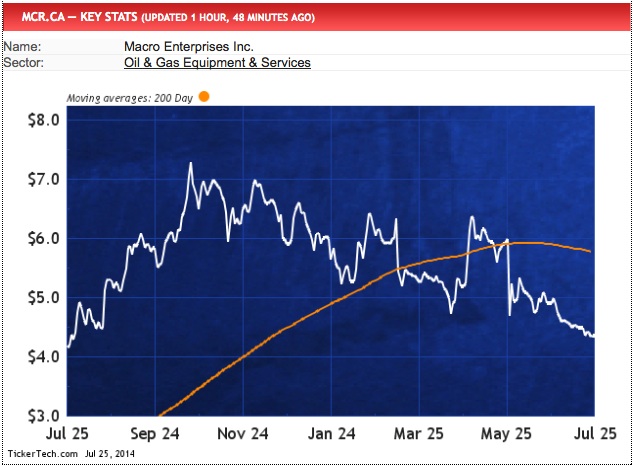
Read full article in a new window: RSI Alert: Macro Enterprises (CVE:MCR.CA) Now Oversold


This infographic, the finale of our five part 2014 Gold Series, covers gold trends that investors should be watching through the rest of the year and beyond.
With input from some of the most important names in gold such as Brent Cook, Doug Casey, Frank Holmes, Bob Moriarty, and James Fraser, we aim to cover the broadest and most important signals for investors to watch. Those include Chinese wealth, Indian demographics, money printing, debt, and a lack of significant gold discoveries.
The 2014 Gold Series is now over – thank you for reading! Don’t forget to connect with Visual Capitalist to receive daily infographics through e-mail or social media. – A great visual that answers a lot of questions – Editor Money Talks


Once upon a time, there were safe havens in this world, places where investors could hide when the going got rough. If you believe this fairy tale world will persist, pinch yourself. In our assessment, not only are there no safe havens left, but instability may be the new normal. Is your portfolio ready?

In a ‘typical’ crisis, if there is such a thing:
• First, the equity markets tend to have a broad sell-off as risky assets become less popular. Historically, this is where the U.S. dollar or cash in general has been king. In the Eurozone debt crisis, in this phase, the Euro was sold as a proxy for all things bad in the Eurozone.
• As a crisis evolves, markets tend to become more differentiating. When Cyprus “blew up,” Spain had a Treasury auction paying the lowest yields since the early 1990s.
• Moving on even further, the markets get used to the crisis. When a Portuguese company didn’t pay its loans on time, the markets barely blinked. Part of it was that the risk seemed manageable; but part of it was also that even though crisis management in the Eurozone continues to be far from perfect, participants kind of know the game plan to expect. With that, risk can be priced more appropriately.
Based on this pattern, pundits are quick to encourage investors not to sell and to buy the dips as the recovery is all but assured. Except, of course, if you had your money in Cyprus. The ‘buying the dip’ mentality has reached extremes; arguably, for good reason: by promising to keep rates lower for longer, the Federal Reserve and other central banks around the world have compressed risk premia. That is, the premium demanded for “risky” assets has come down. This may be most apparent in the low yields in junk bonds, an area Fed Chair Janet Yellen has called bubbly, even if her very policies are a key driver. In Europe, European Central Bank (ECB) Chief Mario Draghi has promised to do ‘whatever it takes.’ So why shouldn’t investors chase yields in the weaker Eurozone countries?
What could possibly go wrong?
Anything that looks too good to be true usually is. When risk premia is artificially depressed, it is understandable that volatility is also depressed. But if risk premia expands once again, for whatever reason, asset prices may be at risk. That’s because investors may be less inclined to buy stocks or junk bonds if it suddenly deems riskier. It can be as little as perception (“the glass is suddenly half empty”); it can be the Fed trying to engineer an ‘exit;’ or, for example, it can be geopolitical uncertainty.
There will be lots of confusing signals. For example, for a bit over a year now, the euro appeared to be the preferred “safe haven” – as investors fled emerging bond markets, it didn’t make it to the U.S. dollar, but to places such as Spanish and Portuguese bonds. Of late, though, the dollar appears to show baby steps of yet again being preferred over the euro. But don’t be fooled: the euro is weaker because of the risk that Russia might turn off the gas supply to Europe if the Ukrainian crisis were to escalate. Yet again, while the dollar has strengthened a tiny bit, the yield chasers mostly went right back into emerging markets, with some currencies there rising versus the greenback. This appears more a shuffle by high stakes yield chasers rather than a flight to safety.
While anyone may be excused for being confused by the headlines, consider the medium term outlook: pundits have suggested the Fed will only engineer an exit if the economy looks better. The corollary is that asset prices should then be able to stomach the headwinds caused by rising risk premia. Except that I have my doubts that good news in a market that’s near historic highs will compensate sufficiently for the headwinds of common sense. Let me be clearer: I’m concerned that even if, say, earnings improve, equity prices are at risk as price-to-earnings (P/E) ratios compress. Similarly, even if default rates don’t jump, bonds could fall.
And why do I say ‘headwinds of common sense’? That’s because the markets are historically a risky place to be in. It’s just of late that equity prices have risen on the backdrop of ever greater complacency (lower volatility). In such an environment, investors are chasing performance unaware of the risks they are taking on. Such investors are referred to as “weak hands” – they will be quick to jump ship when the going gets rough. And don’t think most will get out at the top, as investors have been conditioned to buy the dips. To me, it is no question that volatility – read fear – will come back. The question only is can current asset prices withstand fear?
Similarly, I hear folks arguing we shouldn’t be afraid of higher rates, as rates will only go up as the economy improves. In my assessment, Yellen has all but promised us to be late in raising rates. I can see her move nominal interest rates a little higher; but on a real basis, i.e. after inflation, I very much doubt we will see higher rates. Think about how interests are aligned when both government and consumers have too much debt? They both benefit from higher inflation, i.e. debasing the value of the debt. Who is losing out? Foreigners holding US debt may well be on the losing end of this battle. As foreigners don’t vote, their opinion may matter little.
If you are a consumer with savings rather than debt, be aware that your government’s interests are not aligned with your interests. Don’t count on the government to protect the purchasing power of your savings. Just keep in mind that during the past 100 years when government debt was generally much lower, the greenback lost over 96% of its purchasing power (as measured by the CPI). Differently said, if you are not concerned, you are not paying attention.
Instability the New Normal?
But if a crisis can be priced in, so should be a risky environment, right? It all depends on where one is coming from and where one is heading. We are coming from a highly complacent environment, but are heading towards one that may be ever less stable. I’ve already discussed rising risk premia that should be part of the normalization process. But my negative sentiment extends further.
When I raise my concerns, skeptics point out that the financial system as a whole is a lot more robust now. That’s correct in some ways, but has come at a high price: the destruction of the social fabric and political disintegration. By reflating asset prices, those holding assets disproportionally benefit, increasing the wealth gap. Indeed, I would argue policies of the Fed have a far greater impact on wealth distribution than the policies of Republicans or Democrats. Those that know how to deal with easy money, such as hedge funds, can do great in this environment; however, those that don’t know how to deal with debt easily fall through the cracks, unable to recover.
This isn’t just a U.S. problem. Citizens in large parts of the world are dissatisfied with their political leadership. The reason, in my assessment, is that they have seen their purchasing power decline. In my analysis, when citizens see their purchasing power erode over longer periods, they veer towards more populist politicians and explain:
• The rise of the Tea Party and Occupy Wall Street movements in the U.S.;
• Uprisings in the Middle East; • A populist Prime Minister in Japan; and, amongst others,
• The rise of populist parties in Europe.
Folks in the Middle East start revolutions because they can’t feed themselves anymore as food and energy prices have risen. These trends have come on the backdrop of excessive government debt. Ukraine’s problem is that they can’t balance their books; for now, they have the European Union take over from Russia subsidizing Ukraine. Politicians the world over have in common that they rarely ever blame themselves for the plight of their own people. They tend to blame the wealthy, a minority or foreigners.
To put it bluntly, there’s a reason the Great Depression ended in World War II. We don’t predict World War III is about to break out, but the aftermath of a credit bust is a fertile environment for the sort of dynamics that can lead to armed conflict. Russia has an interest in an unstable Ukraine; Japan might ramp up military spending to boost domestic growth, to name but two sources of instability. The U.S., a superpower no longer able to finance all of its commitments is not exactly a source of stability, either: the biggest threat to U.S. national security may not be China or Russia, it’s the national debt.
As the social fabric in the U.S. erodes, I believe we will elect more populist politicians, making it unlikely that we will come up with major entitlement reform to make deficits sustainable. I was dismayed by Janet Yellen’s testimony last week in which she was either evasive or ignorant about the cost of financing U.S. deficits as rates rise. If she was evasive, she missed a major opportunity to try to foster a national debate. While she provided lip service to the fact that costs will rise as rates move up, she failed to say that if we were to move back to historic rates, we could spend $1 trillion more a year a decade from now servicing the national debt (that’s based on CBO projections and historic levels of interest rates). If she is ignorant of the numbers, I’m no less concerned. Either way, though, odds are the Fed may try to keep borrowing costs low, making the discussion irrelevant. It’s in this context that I believe real interest rates will stay low for a long time, as I don’t think we can afford positive real interest rates for any extended period. This is the key reason why I like gold as an investment, as low to negative real interest rates may make the shiny metal that pays no interest (but cannot be easily ‘printed’) a formidable asset.
To summarize:
• Asset prices are at or near record levels;
• Fear appears almost absent from the markets, complacency near record levels;
• Political instability is on the rise as governments drown in debt.
The first two attributes alone should encourage investors to consider rebalancing their portfolios, taking chips off the table.
But where to hide? Historically, bonds or cash are preferred hiding places; even as bonds have performed just fine of late, I can’t help but be concerned bonds might be one of the worst investments over the next decade. I don’t advocate shorting bonds (it can be very expensive to short bonds as interest is to be paid rather than received), but rather consider shorting the dollar should real interest rates continue to be negative. Broadly speaking, buying anything with one’s dollars is akin to shorting dollars. But one can be specific by buying precious metals; one can diversify to baskets of currencies, possibly be tactical in an effort to stay a step ahead as currency wars may be raging; or one goes up the risk ladder to, say, buy equities. Indeed, equities have performed well relative to cash; but as I think I make very clear in this analysis here, I’m afraid investors buying equities now may be late to the party.
The bad news is that there’s no silver bullet, as there may be no such thing anymore as a ‘safe’ asset. The good news is that many investors could benefit from stress testing their portfolio. If you haven’t done so, make sure you sign up for this free newsletter as we explain how you can get your portfolio stress tested in an upcoming analysis. Also, for more detail on how this may play out, make sure to attend our free Webinar, today, Thursday, July 24, at 4:15pm ET. Please share this newsletter with your friends.
Axel Merk
Axel Merk is President and Chief Investment Officer, Merk Investments,
Manager of the Merk Funds.

 “Mining is an inherently difficult business,” Adrian Day, CEO of Adrian Day Asset Management, told investors at this week’s Sprott Vancouver Natural Resource Symposium. Of course, mining companies, be they senior or junior, run into problems – which if we are being honest are mostly due to money.
During his presentation, Day weighed out some of the ups and downs of senior and junior gold companies highlighting some differences, but also some similarities. By looking at both sides of the coin, investors can have a better understanding of the companies that they are investing in.
Apart from cash costs or operating costs, Day highlighted one very significant aspect of the mining industry that affects all producing companies: replacing ounces mined.
“If you look at the production of gold over the course of the bull market, where gold has gone from $200 per ounce to $1,300 per ounce (with a stop at $1,900 along the way), one would think that people would have found and produced more ounces,” Day said.
Unfortunately, that is not the case. For a company like Barrick Gold (TSX:ABX,NYSE:ABX), which mines some 7 million ounces of gold per year, finding a deposit to replace those ounces is no easy task. In fact, Day explained that despite gold’s price increase, the truth is that it’s difficult to find and produce more gold.
So for companies like Barrick, the only solution for replacing depleted reserves is acquisition. The problem with this strategy — although it’s a very good one — is that major mining companies, as Day put it, “do not buy things when things are cheap.”
Essentially, major companies tend to replace their assets when costs and premiums are higher, leading them to acquire debt. The reason they do that, said Day, is that they tend to follow the herd and do as their shareholders request. The flip side is that when the market isn’t doing so well, and investors want to know the reason for such companies’ poor performance, the companies will cut costs, putting assets up for sale and even cutting dividends.
On the exploration side, there are also problems. The biggest of those, as Day explained, are the long odds.
“Only 1 in 5,000 anomalies actually becomes a deposit. Only 1 in 10,000 prospects becomes a major deposit of over 4 million ounces,” Day said. “Those are amazingly long odds, and you obviously can’t succeed by just randomly buying prospects.”
Another problem that Day sees impacting the junior market is money — or rather, a lack thereof. Because exploration companies have no revenue, they need to raise money. That means that it makes no difference whether the market is good or bad: exploration companies need to raise capital.
So why invest?
Looking at gold companies — both major and junior — under the harsh light of day does not make them seem like a good investment. But fret not — Day insisted that “gold stocks can produce outsized returns.”
“If you look at the mining companies today relative to the price of gold, you can see that they are selling at multi-decade lows relative to bullion,” Day said, which is a great opportunity.
Now, if you believe that, then only one question remains: what do you buy?
As Day explained, senior, mid-tier and junior miners do well at different times, with the majors generally performing well early on.
“When the price of gold starts to move and people start getting attracted to gold mining companies, what do they buy? They buy the names they know. And they tend to be for big mining companies,” Day noted.
But when weighing out whether to invest in a major or junior, Day was pretty clear. He commented, “I wouldn’t want anyone to make a mistake that senior mining companies are good investments or that they are less risky than junior mining companies.” So how does one navigate these murky waters?
Well, for Day, that answer comes in two words: business models.
“I think that it is important is to look very selectively at this business,” Day said, adding, “I prefer looking at the business model that mitigates risk.”
In terms of seniors, Day looks for the royalty business model, which can be found at large companies like Franco-Nevada (NYSE:FNV) or at smaller companies like Callinan Royalties (TSXV:CAA) and Altius Minerals (TSX:ALS).
“I think it’s fair to say that by and large most of these companies are not the tremendous bargain basement bargains that the mining companies are, but they are by and large stronger companies with much less risk and much better business models,” he noted.
On the exploration side, just like Rick Rule, Day looks at companies that have adopted the prospect generator model. ”Prospect generators typically use other people’s money to do the risky exploration and are in a much better position to preserve their balance sheets,” he explained.
But in the end, it really is about managing risk and realizing that volatility is the nature of the market.
For more insights from Sprott Global Resource Investments, sign up for the free Sprott’s Thoughts newsletter.
Securities Disclosure: I, Vivien Diniz, hold no investment interest in any of the companies mentioned.
Related reading:

I know Mike is a very solid investor and respect his opinions very much. So if he says pay attention to this or that - I will.
~ Dale G.
I've started managing my own investments so view Michael's site as a one-stop shop from which to get information and perspectives.
~ Dave E.
Michael offers easy reading, honest, common sense information that anyone can use in a practical manner.
~ der_al.
A sane voice in a scrambled investment world.
~ Ed R.

Greg Weldon

Josef Schachter

Tyler Bollhorn

Ryan Irvine

Paul Beattie

Martin Straith

Patrick Ceresna

Mark Leibovit

James Thorne

Victor Adair