Personal Finance

One of the All-Time Greatest Investment Myths Exposed

Bill-BonnerLet’s begin with a quote in Latin. That will put us in the right mood – reaching for the eternal verities: 

Fere libenter homines id quod volunt credunt. 

That was penned by Julius Caesar in De Bello Gallico, his account of the Roman conquest of Gaul. 

We didn’t know what it meant either, until last night. In case your Latin is a little rusty, we will give you a little WD-40. It means “Men willingly believe what they wish to be true.” 

At least, they believe it as long as they can… 

As long as stocks rise, for example, they believe the economy is recovering nicely… and that they will get richer and richer just by owning little pieces of someone else’s business.

The Problem with “Investing”

They call it “investing.” But that is mere flattery. Someone else already did the investing when they built the factories and developed the business. 

“Investing” means you are doing something that will result in more or better products and services in the future… something that improves productivity and makes us better off. 

When someone buys shares in a company in an IPO, he is investing his capital to help that company create future production. But when you buy someone else’s shares in the secondary market (on an exchange) all you’re doing is buying out someone else’s position and allocating your savings to some financial instrument. 

Will the price of your shares go up? Or down? Who knows? 

One business grows. Another shrinks. You cannot consistently know, in advance, which will be which. 

And taken together, the shares in a nation’s businesses are unlikely to consistently grow at a faster pace than the economy. 

In the US, for example, over the last six years, real GDP growth has averaged 0.9% a year. But stocks have gone up more than 130% in the US. 

How is that possible? 

Well, first, earnings rose. Businesses ditched expensive labor… halted new projects… trimmed down… and boosted profit margins. They also benefitted from low-cost financing, which reduced their interest expenses. 

Then the liquidity produced by QE and ZIRP needed a place to go. It could not get to the consumer, because households were still cutting back on debt and wages were actually going down. So, it stayed in the financial sector, pushing up asset prices. 

Result: stock prices far in excess of GDP growth. 

Perverting the System

But you were probably concerned about our garden party here in France, weren’t you? 

Well, despite the drippy forecasts, the rain held off. What a lucky break! The guests could spread out on the lawn. Otherwise, they would have had to squeeze into the house. 

Among the guests was an attractive French woman in her 70s, an economist… 

“I am so annoyed by Monsieur Piketty. He has become famous. The rest of the world must think we French economists are a bunch of idiots. Imagine… Keynesianism… the class struggle… the envy of the rich… it’s as though these were new ideas that hadn’t been thoroughly discredited. 

“I don’t know why they take Piketty seriously in the US. I thought American economists were smarter than that…” 

We rose to defend our countrymen: 

“Oh… no. American economists are as dumb as the rest of them. They all seem to believe capitalism needs to be carefully controlled. By them, of course. 

“Then they control and pervert the system… it blows up… and they blame it on capitalism. I think there is a catastrophic episode of that coming down the pike.” 

“They distort asset prices with QE and ZIRP. Then people invest their money foolishly – because they are reacting to the distorted asset prices. 

“Just look at the US stock market. It is near an all-time high… even though the economy is barely growing. The prices are based on two things that can’t possibly continue: cost cutting and zero-interest-rate policies. Stock prices could easily be cut in half. 

“But this time, it’s not just a few foolish investors who will lose money. It will be millions of ordinary investors and business people… and households… and governments that depend on tax revenues. 

“We could be looking at a major problem. And it will be blamed on capitalism…” 

Fere libenter homines id quod volunt credunt,” our guest concluded. 

“Yes, madam, the canapés are very nice,” we replied. 

Regards,

Bill

Further Reading: Bill’s new book, Hormegeddon, explains in detail why US stock prices are headed for a major downturn. The first print run is selling fast. But there’s still time to claim your copy of Hormegeddon before we run out. You’ll also receive some of Bill’s best essays and access to a new project he is working on that is not yet available to the general public. Click here for the details.

This Aging Bull Market Can Still Rage Dow Theory Experts Say

3e1dede22ada5c6b1d4179322bc99c287abbf1887073502481583ffe3e3ec760 largeInsight: Timing system shows U.S. stocks with firm support

The Dow Theory-the oldest stock-market timing system in widespread use – remains bullish. The Dow Theory, for you history buffs, was introduced gradually over the first three decades of the 20th century in editorials in the Wall Street Journal by its then editor, William Peter Hamilton. The three preconditions for a sell signal that he set out are: *Step #1: Both the Dow Jones Industrial Average and the Dow Jones Transportation Average must undergo a “significant” correction from joint new highs.

*Step #2:….continue reading HERE

Gold Is Unstoppable With Stocks Leading the Way

Downward manipulation of gold and silver is real, declares Jason Hamlin, but the longer it continues, the higher prices will go when the free market reasserts itself. In this interview with The Gold Report, the publisher of the Gold Stock Bull newsletter argues that rising geopolitical anxiety coupled with endless monetary expansion could lead to explosive growth in precious metals and equities. He also lists his favorite royalty/streaming companies and gold and silver miners.

COMPANIES MENTIONEDFRANCO-NEVADA CORP. :GOLDCORP INC. : LAKE SHORE GOLD : PINECREST RESOURCES LTD. : ROYAL GOLD INC. : SANDSTORM GOLD LTD. : SILVERCREST MINES


The Gold Report: You told The Gold Report in December 2012, “I think the official inflation adjusted [gold] high of $2,400 per ounce ($2,400/oz) will be taken out within the next 12 months.” Why didn’t this happen?

Jason Hamlin: One reason is that inflation hasn’t risen significantly until lately. That is due to the recent record low velocity of money. Trillions of dollars in new money were created to stimulate the economy and get us out of the financial crisis of 2008–2009, but the banks have held this money in excess reserves, earning interest from the Federal Reserve. As a result, it hasn’t been loaned out and hasn’t flowed through the economy. I think we are beginning to see this change, and coupled with de-dollarization driven by Russia and China, I expect the inflation rate to increase at a quicker pace than most people expect.

The other reason why the price of gold didn’t increase was outright manipulation. Before people roll their eyes at seeing this “conspiracy theory” once again, we should point out that Britain’s Financial Conduct Authority actually fined Barclays Bank £26 million (£26M) in May for manipulating the daily gold fix between 2004 and 2013. In my estimation, this is just the tip of the iceberg. A number of class-action lawsuits have recently been filed against the big banks for gold manipulation and one needs only look objectively at the recurring not-for-profit selling to understand that manipulation is taking place. When you consider the immense power that printing the world reserve currency gives a nation, the motive to continue this system and suppress alternative currencies becomes clear. We could never have the endless wars and continual deficit spending without Nixon delinking the dollar from gold.

TGR: What do you make of the report by the <href=”#axzz38yvtopxn” target=”_blank”>Financial Times that central banks have invested $29.1 trillion in markets, mostly equity markets?

JH: This is another example of “conspiracy theory” becoming “conspiracy fact.” It helps explain why there’s been such a divergence between equity prices and the true health of the economy. This also supports theories of a plunge-protection team working to prop up the market and keep confidence high. The greater the interventions and the farther we drift from free market price discovery, the more extreme the boom and bust cycles will be and the more devastating the impact on everyday investors. This grand experiment ends very badly, in my estimation.

TGR: The financial media pays great attention to the Dow Jones Industrial Average and the S&P 500, but are these really such good indices of the broad health of the U.S. economy?

JH: Not at all. You can look at the weak manufacturing numbers. You can look at stagnant wages or at median household net worth, which plunged 36% from 2003 to 2013. You can look at the labor force participation rate, which hasn’t recovered at all from 2008. There are so many divergences from the official story of a full recovery and we are now finally starting to see some cracks in the facade.

TGR: We had stock market crashes in 2000 and 2008. Are we due for another?

JH: The warning signs have been flashing for quite some time, but stocks have continued marching higher. Valuations on a price/earnings basis have risen to lofty and unwarranted levels. By any number of measures, we are due for a major correction in the stock market. It’s just a matter of when, not if. In the meantime, I haven’t been shorting the market. I think it’s wise to continue to ride the trend higher. We’ve been doing that with some technology and agricultural plays because, if the markets are manipulated, this bubble can last much longer than most people would think. But it is important to mind your stops.

TGR: Given how high the Dow Jones and S&P 500 numbers have become, what would be the psychological and political effects of another crash?

JH: Devastating. That’s why we have so much manipulation behind the scenes. On the political front, it would gravely damage the current administration. On the psychological front, investors would suffer a grave loss of confidence in the market. And, very rapidly, these effects could spin out of control. Some of the financial conditions that led to the last crisis in 2008–2009, such as leveraged indebtedness and derivatives exposure by banks, are far worse today than in 2008.

TGR: Some people willing to admit manipulation of gold and silver prices ultimately conclude, “So what?” What do you make of that response?

JH: It makes sense in one respect. Essentially, holding down gold prices through manipulation allows investors to accumulate gold at lower prices. Manipulation is similar to holding down a spring. The countervailing force continues to grow stronger as the artificial forces weaken, and when the spring is finally released, it moves with explosive force.

Precious metals manipulation frustrates short-term investors and speculators because the price action doesn’t match the fundamentals or technicals. If you have a long-term investment horizon, however, as we do, you can live with it because it gives you more time to accumulate at lower prices.

TGR: Why haven’t events such as the war between Hamas and Israel, the downing of a civilian airliner over Ukraine and the ISIS takeover of much of Syria and Iraq led to a flight to safety in gold?

JH: There is always an initial kneejerk reaction toward liquidity, i.e., the U.S. dollar. However, the world is starting to move away from the dollar as its reserve currency. We see bilateral trade agreements inked by a growing number of nations and a $400 billion natural gas deal just signed by Russia and China that bypasses the dollar. As this “de-dollarization” continues, I believe investors will increasingly reject all fiat currencies, and precious metals will reassert themselves as the safe-haven asset in times of financial crisis.

TGR: You have decried the demonization of Vladimir Putin by Western leaders. What’s your opinion of U.S. sanctions against Russia?

JH: They are really foolish. We are needlessly antagonizing nuclear powers—not only Russia but China as well. As scary as it sounds, the long-term goal is probably to drag Russia into some type of protracted conflict that will weaken its economy and give the U.S. an excuse to initiate force against Russia. Putin is seemingly aware of this plan and has avoided the trap. He has provided some support for the rebels in Eastern Ukraine, but Russia’s involvement in that region has been quite restrained since the new Ukrainian government came to power.

I believe that these maneuvers by America to isolate Russia economically will eventually backfire.

TGR: Will the European Union (EU) back President Obama’s campaign against Russia?

JH: It is my understanding that many EU nations, Germany in particular, do not share America’s antagonism against Russia. Yes, sanctions can harm Russia, but the EU is already on a shaky economic footing, and so its members are worried about a boomerang effect. To harm ties with Russia, a huge trading partner, simply to please the U.S. for political reasons doesn’t seem to make a lot of sense.

TGR: Why do you believe the price of gold could rise to $10,000/oz or higher?

JH: An increase in the supply of fiat money. The faster the money supply increases, the higher the gold price targets can be. As outlandish as it may seem, we must consider as models what happened in Zimbabwe, Argentina and other countries that have suffered currency crises. And what happened was a rapid devaluation of each currency and tremendous price rises in stable assets, such as precious metals.

More important than the gold price in fiat dollars, however, is how gold performs in preserving wealth and increasing purchasing power. On that front, gold has an unblemished success rate throughout history in times of crisis. Gold price targets of $10,000/oz and above reflect the belief that the U.S. dollar losing world-reserve status could lead to a panicked move out of dollars and dollar-denominated assets.

TGR: A gold price of $10,000/oz or even $5,000/oz would be great news for gold holders, obviously, but wouldn’t it be terrible news for everyone else? Wouldn’t socioeconomic conditions be dreadful?

JH: I tend to agree. Unfortunately, that’s the trajectory we’re on. So we hope for the best but prepare for the worst. I may not like the economic conditions that would accompany $3,000/oz, $5,000/oz or $10,000/oz gold, but I would at least know that my hard work and the wealth it generated would not be stolen by the Fed-induced forces of inflation. Gold is basically an insurance policy, but it also has the added benefit of significant capital appreciation over the past decade. People like to criticize gold for not paying a dividend or generating income, but the price has more than tripled in the past decade, even counting the recent correction. By comparison, the Dow Jones is up around 65% in the past 10 years. Which investment would you choose?

I would hope there is still some way to avoid the economic crash that I see coming. On the other hand, however, this crash is in some ways essential. It’s needed to clear out the excess and mal-investment from the markets and begin again with a system that’s more sustainable. I just hope we learn lessons from the past and find ways to avoid the same type of mistakes and crony capitalism that has taken over the current system.

TGR: What’s the best way for investors to hold gold and silver?

JH: I recommend holding physical metals in your possession first and foremost, but I believe it’s good to diversify geographically, so as to not have all your assets in one place. Physical bullion should be supplemented with investments in mining stocks. This is one of the only remaining sectors where I see value, and quality mining stocks will offer significant leverage to the coming advance in gold and silver prices. So far this year, we are seeing mining stocks generating returns of three to four times that of gold and silver bullion, which is a bullish indicator.

TGR: The gold–silver price ratio continues to hover around the recent historical number of 1:65. Do you anticipate this ratio changing and, if so, in which direction?

JH: Supply and demand fundamentals are now more attractive for silver than gold. It’s my expectation that the gold–silver ratio will fall toward its longer historical number of 1:30. Only under extreme short-term crisis conditions might we see gold outperform silver, because gold is viewed more as a monetary and investment metal than silver, where 50% of demand comes from industrial uses.

TGR: Franklin Delano Roosevelt banned private gold ownership in the United States. Could future Western governments move to contain an economic crisis with similar measures?

JH: Anything is possible, but I don’t expect it. Gold investors are wise to the possibility of confiscation, and the decentralization of information that has occurred over the Internet over the past 20 years makes it less likely. I doubt that gold investors would simply hand it over en masse now, as they did in 1933.

In addition, I know plenty of investors who buy their precious metals without a paper trail, cash and carry There’s no way for the government to know who owns these metals, let alone confiscate them.

TGR: You wrote recently that “gold mining stocks remain severely oversold.” Do you expect this to continue?

JH: It continued longer than I had expected, but we’re already seeing signs of a bottom process. As I mentioned, mining stocks have outperformed the metals by three to four times in 2014, which is an encouraging trend.

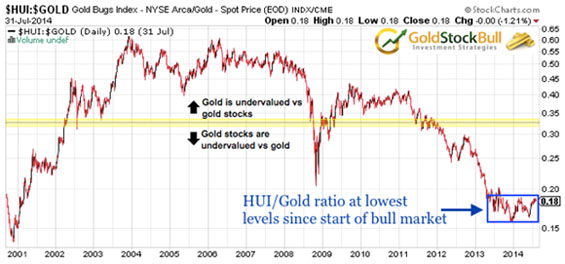
I use the NYSE Arca Gold BUGS Index (HUI)-to-gold ratio to track this. It fell all the way to 0.16 and has since had a bit of a bounce back, but the upside potential remains absolutely huge. I think that as gold moves back toward previous highs, we’re going to see a major revaluation higher for mining stocks. Already, we’re seeing hedge funds and big-money traditional investors moving into precious metals equities for the first time ever because most other asset classes are so overvalued.
Hamlinchart1

TGR: Which type of mining stock do you like best?

JH: I have a particular affinity for the royalty and streaming sector. Its business model is superior to strictly mining. These companies offer the same upside potential as their mining-company partners—new discoveries, increased production, etc.—but royalty companies have mitigated downside risk because they have fixed costs as per their streaming contracts and aren’t exposed to the cost overruns that are commonplace in the mining industry.

TGR: Which streaming company is your favorite?

JH: Sandstorm Gold Ltd. (SSL:TSX; SAND:NYSE.MKT). Its market cap is about $800M, and so it has tremendous growth prospects over the next four or five years. I am a big fan of its CEO, Nolan Watson, who was previously CFO of Silver Wheaton Corp. (SLW:TSX; SLW:NYSE). Although Sandstorm has recently experienced some hiccups, I rate Watson’s business acumen very highly and believe the company will bounce back strongly during the next advance in gold.

TGR: What do think of Sandstorm’s strategic alliance with Pinecrest Resources Ltd. (PCR:TSX.V)?

JH: Sandstorm bought 18% of outstanding Pinecrest shares. As a result, it gets a share of Pinecrest’s Enchi gold project. This contains an Inferred resource base of 1 million ounces (1 Moz) gold, is open for expansion in all directions and is located in a mining-friendly jurisdiction, Ghana. In addition to buying equity, Sandstorm also gets the right of first refusal on any future streaming deals, which I expect it to pursue aggressively.

In addition, Watson hinted that Sandstorm could for the first time buy entire companies. With the junior sector beaten down and undervalued, having someone like Watson turning companies around could reap huge rewards for Sandstorm and for investors as gold climbs back to $1,800–1,900/oz. Sandstorm has over $100M, zero debt and $100M in an undrawn line of credit. I expect several exciting announcements between now and the end of the year.

TGR: Could you comment on some of the other royalty companies?

JH: Franco-Nevada Corp. (FNV:TSX; FNV:NYSE) is a more conservative play that I also like. It is better diversified than Sandstorm and has more exposure to platinum and palladium. It’s a good stock to have in your portfolio, but investors willing to take on additional risk for greater reward might prefer Royal Gold Inc. (RGLD:NASDAQ; RGL:TSX).

TGR: What do you like about Royal?

JH: Sandstorm is up 65% year-to-date. Royal Gold is up 70%, making it one of the few stocks in the precious metals sector outperforming Sandstorm. Royal benefits from the commercial production begun at the Mt. Milligan mine in British Columbia owned by Thompson Creek Metals Co. Inc. (TCM:TSX; TC:NYSE), one of its streaming partners. During Q1/14 Royal generated income of $20M on revenues of $58M. That’s more than triple the income from the same quarter last year despite gold falling around 20%. As production continues to ramp up at Mt. Milligan, we should see even greater Royal share appreciation in 2014.

I also like Royal’s project pipeline. The company’s most recent news is a 6.3% stream on Rubicon Minerals Corp.’s (RBY:NYSE.MKT; RMX:TSX) Phoenix gold project in Red Lake, Ontario. Royal got this for a $75M investment to finance construction. This is a late-stage project, with production expected in mid-2015 and returns for years to come. Royal Gold is a top performer this year, and I expect more of the same to come.

TGR: The Gold Report interviewed Pierre Lassonde, co-founder of Franco-Nevada, in May, and he arguedthat because “the silver space is smaller than the gold space,” Silver Wheaton will eventually “run out of runway” and will be forced to compete in the gold space. Do you agree?

JH: I do. And perhaps in additional commodities as well. There is only so much growth Silver Wheaton can achieve strictly in silver, so it makes sense that it branches out into other commodities in search of deals that will be accretive to shareholders.

TGR: What’s your favorite non-streaming gold company?

JH: Lake Shore Gold Corp. (LSG:TSX). I like companies that are high grade and low cost with a strong growth profile. Lake Shore has two mines in commercial production in Ontario: Timmins West and Bell Creek. Expansion of its mill to a capacity of 3,000 tons (3 Kt) per day was completed late last year. Gold production is expected to increase 27% in 2014, and Q2/14 production was a record 53,300 oz, up 70% year-to-year. Lake Shore is one of the best production growth stories, is located in a mining-friendly jurisdiction and has a strong management team. As such, I think it is a potential takeover target for a company like Goldcorp Inc. (G:TSX; GG:NYSE), so investors could see upside there.

TGR: What’s your favorite non-streaming silver company?

JH: SilverCrest Mines Inc. (SVL:TSX; SVLC:NYSE.MKT) in Mexico. This is a high-grade epithermal silver producer with low costs. In today’s environment, the value of these attributes cannot be stressed enough. The company is in the middle of the expansion plan that is expected to increase production by roughly 50% this year. It has a base-case internal rate of return of 88% on its Santa Elena expansion in Sonora. I also like its La Joya property in Durango as a pipeline; it has nearly 200 Moz silver equivalent (Ag eq).

Second quarter production of 412,000 oz Ag eq was down versus a year ago and versus Q1/14, leading to a dip in the share price. This is because Santa Elena began an early transition in Q2/14 from an open-pit, heap-leach operation to a 3 Kt per day underground and mill operation. I think this provides an excellent opportunity for investors to buy on the dip because Santa Elena has huge potential, and I believe SilverCrest will be one of the top-performing silver miners for the next couple of years.

TGR: You mentioned several stocks with huge increases in 2014. Where are we in the cycle? Is the much anticipated bull market finally here?

JH: We’re seeing signs that this current advance is different than the breakout attempts that have failed in the past year. Again, I look for mining stocks to outperform the metals. That’s usually a sign of strength behind the advance. We’ve seen about 3.5 times leverage on the Market Vectors Gold Miners ETF (GDX) versus gold itself. I also like to see silver outperforming gold, and we have seen this, by roughly 50% in 2014.

When prices have been beaten down this year, investors have stepped in to buy the dips, so they have rebounded pretty rapidly. I think there are stronger hands holding gold this time around. The current prolonged correction and consolidation over the last two to three years has shaken out a lot of speculators. Those that are left tend to be committed investors that believe in the fundamentals and have long-term horizons. Short-term price drops don’t discourage them and don’t lead to panic selling, which would occur with a higher percentage of bandwagon speculators.

All of this is very encouraging, and when you also consider rising geopolitical tensions, the U.S. dollar losing ground as world reserve currency and the other fundamental factors we’ve mentioned, this tells me that the advance has legs and will likely continue throughout the rest of 2014 and into 2015.

TGR: Presumably, many investors sold in May and went away. What happens in September when they return?

JH: Precious metals are entering their strongest seasonal period of the year, and this is another factor that should lend support in the coming months. As investors return, I expect them to seek value within sectors that haven’t reached historically high valuations. I expect a rush into precious metals and precious metals equities, particularly from new investors. And given the relatively small size of the precious metal sector, this could have a huge impact on prices in a relatively short time.

Hamlinchart2

TGR: Jason, thank you for your time and your insights.

Jason Hamlin is the founder of Gold Stock Bull, the highly rated investment newsletter focused on strategies for profiting on bull markets in gold, silver, energy, rare earth metals and agriculture. Well versed in fundamental and technical analysis, he has consulted to Fortune 500 companies globally and speaks regularly at North American investment conferences.

Want to read more Gold Report interviews like this? Sign up for our free e-newsletter, and you’ll learn when new articles have been published. To see recent interviews with industry analysts and commentators, visit our Streetwise Interviews page.

Related Articles


DISCLOSURE: 
1) Kevin Michael Grace conducted this interview for Streetwise Reports LLC, publisher of The Gold Report, The Energy Report, The Life Sciences Report and The Mining Report, and provides services to Streetwise Reports as an independent contractor. He owns, or his family owns, shares of the following companies mentioned in this interview: None. 
2) The following companies mentioned in the interview are sponsors of Streetwise Reports: SilverCrest Mines Inc. Franco-Nevada Corp. and Goldcorp Inc. are not affiliated with Streetwise Reports. Streetwise Reports does not accept stock in exchange for its services.
3) Jason Hamlin: I own, or my family owns, shares of the following companies mentioned in this interview: Franco-Nevada Corp., Lake Shore Gold Corp., Royal Gold Inc., Sandstorm Gold Ltd. and SilverCrest Mines Inc. I personally am, or my family is, paid by the following companies mentioned in this interview: None. My company has a financial relationship with the following companies mentioned in this interview: None. I was not paid by Streetwise Reports for participating in this interview. Comments and opinions expressed are my own comments and opinions. I had the opportunity to review the interview for accuracy as of the date of the interview and am responsible for the content of the interview. 
4) Interviews are edited for clarity. Streetwise Reports does not make editorial comments or change experts’ statements without their consent. 
5) The interview does not constitute investment advice. Each reader is encouraged to consult with his or her individual financial professional and any action a reader takes as a result of information presented here is his or her own responsibility. By opening this page, each reader accepts and agrees to Streetwise Reports’ terms of use and full legal disclaimer.
6) From time to time, Streetwise Reports LLC and its directors, officers, employees or members of their families, as well as persons interviewed for articles and interviews on the site, may have a long or short position in securities mentioned. Directors, officers, employees or members of their families are prohibited from making purchases and/or sales of those securities in the open market or otherwise during the up-to-four-week interval from the time of the interview until after it publishes.


 

US Stock Market; Weekly Charts

With the help of some of NFTRH‘s standard weekly charts, we take a snapshot of the US stock market.

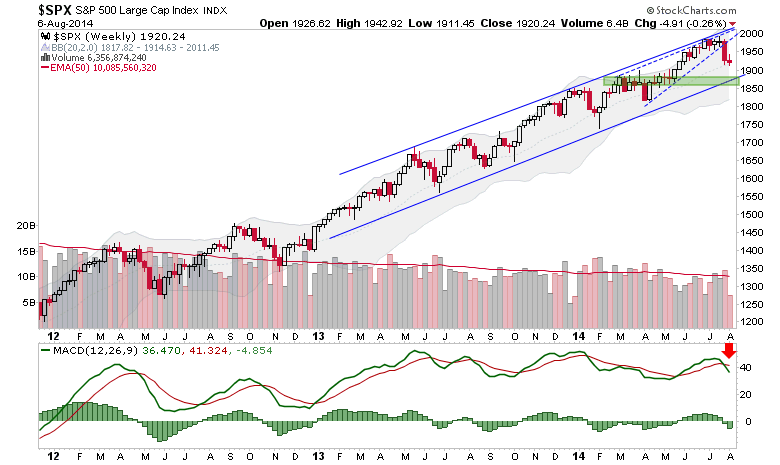
The Bank index is unbroken from a weekly perspective.  People will talk about an H&S but it is not activated until the trend channel and the neckline (a well defined support area) are broken.  BKX, along with the Semiconductors has been a notable leader to the entire surprise* phase of the bull market out of Q4, 2012.

bkx1

A breakdown of support would break this cycle of the bull market (if this is a secular bull market as manyexperts think, then the bull would live again after the cycle completes).  It would probably be healthiest to the secular bull case for a breakdown to occur into a relatively small cyclical bear market.

An alternative is that this summer correction proves to be the mini variety, serving to refuel for a final and manic launch to new highs (S&P 500 measurement is after all, 2192) that would ironically put a lie to Team Secular Bull after it ultimately flames out.

* Surprised?  Well, I came to be surprised (since moderated) by the longevity and intensity of this bull phase but our analysis was among the distinct minority leaning bullish in Q4 2012 due to the unsustainable hype of the Fiscal Cliff drama and the waning hype of the acute phase of the Euro Crisis.  Then in Q1 of 2013 came macro fundamental news (provided for NFTRH subscribers in real time) out of the Semiconductor equipment sector, an up-turned Palladium-Gold ratio and down the road improving ISM, ‘jobs’, etc.  Surprised?  Nah.

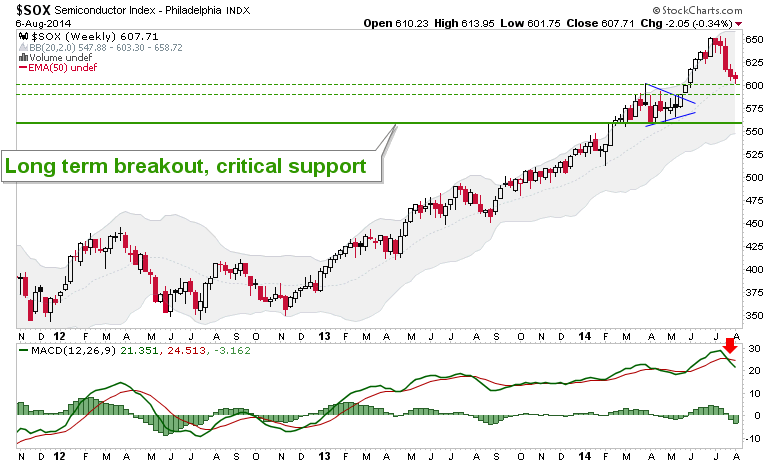
The Semiconductor index has dropped to a logical support area but the important – as in for all the marbles for Team Secular Bull – is the big picture breakout point at 560.  It cannot be stressed strongly enough how critical that support would be to determining what this bull market is (or was).

sox

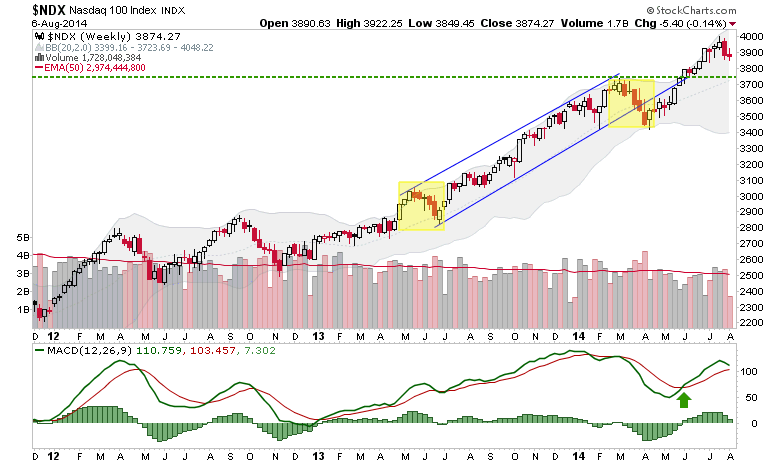
NDX is on a routine drop to test the first support area after yellow shaded correction #2 proved just as bullish as #1.

ndx

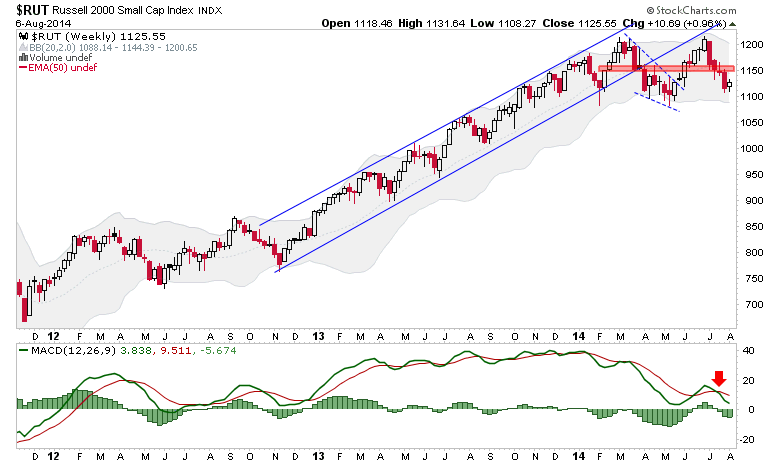
A momentum leader, the Russell 2000 continues to look poor, with an ugly double top forming.  As noted previously, a logical point to take bear positioning is at or around 1150.

rut

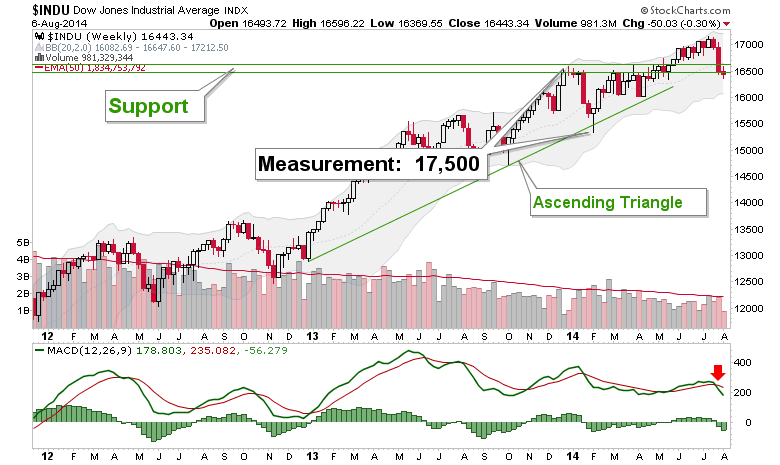
The Dow is getting interesting because it is at support critical to its Ascending Triangle and our long-standing operating target of 17,500.  If it breaks down from here it does not mean 17,500 will not be achieved one day, but it does mean that it would not have done it off of this Triangle, which would be neutered before its measurement was achieved.

dow

S&P 500′s weekly chart matches up well with the daily we reviewed the other day.  While SPX has not (yet) bounced to the degree I had hoped in order to re-short, the important support zones of the daily and the weekly match up nicely.  A drop below the noted support would break the bull cycle.  But a drop to that zone could prove a buying opportunity.  Don’t you love the markets?  Parameters parameters everywhere, and not a definitive answer among them.

spx2

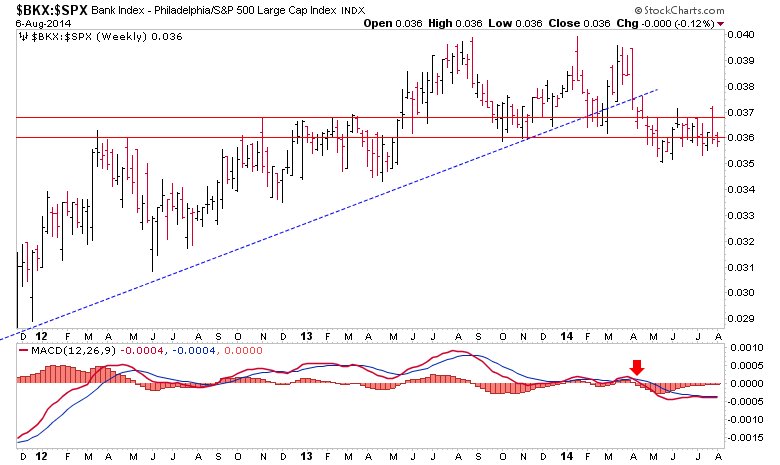
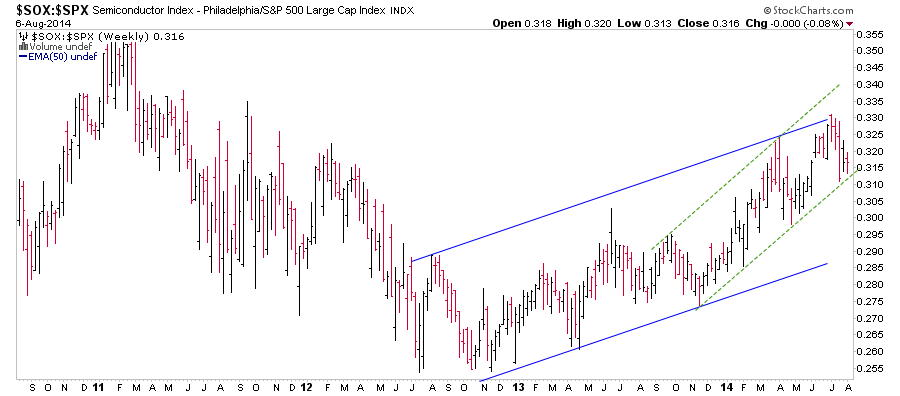
We’ll wrap it up with a look at the post-Q4 2012 leaders, the BKX-SPX and SOX-SPX ratios.

bkx.spx

Banks vs. the S&P 500 is still wobbly and below resistance.  This ratio led the recent decline in the stock market.

sox.spx

SOX-SPX ratio is well within its post-Q4 2012 channel as well as its more pronounced channel out of 2013.  In other words, the Semi’s leadership is a-okay.

Bottom Line

We fully anticipated a summer correction and thus far that is all it has been; and it’s been a mild one (so far) at that.  But what the markets do from here on out will refine probabilities as to these options…

Option 1:  A shallow correction here, could be a prelude to strongly renewed speculative vigor, culminating in a terminal bull market blow off.  Ironically, Team Secular Bull would look heroic for a while and yet, this is not the scenario true secular bull adherents would want to see.  A healthy market would need a real bearish clean out and even a moderate cyclical bear.

Option 2:  The current correction bites deeper, testing the cyclical bull market’s limits but ultimately holds (using SPX 1860′s as a general reference point).

Option 3:  Of course, such a test of limits implies a decision point, and if the decision is that support would fail, then the cyclical bull may have already ended as I write this.

That does not invalidate the prospect that we are in a new secular bull market, but personally I find the ‘secular vs. cyclical’ discussion useless because I for one do not ride cyclical bear markets down in anything resembling a ‘stocks for the long run’ brain wash.

You’ll notice I did not make even a passing mention of policy makers and their influence upon markets.  That is because TA is TA and macro fundamental bitching and moaning is what it is.  The above is the weekly TA picture on US markets, on the straight and narrow.

Biiwii.com | Notes From the Rabbit Hole | Free eLetter | Twitter

Subscribe to NFTRH Premium for your 25-35 page weekly report, interim updates (including Key ETF charts) and NFTRH+ chart/trade ideas!

Money: How the Destruction of the Dollar Threatens the Global Economy

Forbes Editor-in-Chief and longtime friend Steve Forbes leads off this week’s Outside the Box with a sweeping 500-us-dollar-billhistorical summary – and damning indictment – of the “cheap money” policies of the US executive branch and Federal Reserve. Four decades of fiat money (since Richard Nixon and his Treasury Secretary, John Connally, axed the gold standard in 1971) and six years of Fed funny business have led us, in Steve’s words, to an era of “declining mobility, great inequality, and the destruction of personal wealth.”


And of course the damage has not been limited to the US; it is global. Steve reminds us that “The bursting of the subprime bubble put in motion a collapse of dominoes that started with the U.S. financial sector and European banks and led to the sovereign debt crisis in Europe, the Greek bankruptcy crisis, and the banking disasters in Iceland and Cyprus.” To make matters worse, the fundamentally weak dollar (and fiat currencies worldwide) have contributed a great deal to record-high food and energy prices that are spurring serious social instability.

As I showed in Code Red and as Steve notes here, we now face the looming specter of a global currency war. Steve reminds us that the real bottom line is that

Money is simply a tool that measures value, like a ruler measures length and a clock measures time. Just as changing the number of inches in a foot will not increase the building of houses or anything else, lowering the value of money will not create more wealth. The only way we will ever get a real recovery is through a return to trustworthy, sound money.  And the best way to achieve that is with a gold standard:  a dollar linked to gold.

Today’s Outside the Box is from Steve’s latest book, which is simply called Money.

I think it’s Steve’s best book in years. Get it for your summer reading. While there is more than one solution to reining in the current abuses by the major global central banks, Steve highlights the problems as well as anyone. This situation really has the potential to end badly. Just this morning the Wall Street Journal noted that “Reserve Bank of India Governor Raghuram Rajan warned Wednesday that the global economy bears an increasing resemblance to its condition in the 1930s, with advanced economies trying to pull out of the Great Recession at each other’s expense.” Rajan is one of the more highly respected economists in the world.

I am back in Dallas for an extended period of time (at least extended by my standards), where my new apartment is paying off in a less hectic lifestyle – people seem to be coming to me for the next few weeks. Tomorrow my good friend Bill Dunkelberg, the Chief Economist of the National Federation of Independent Business, will drop by for a day. We’re going to talk about the future of work, what kind of jobs will be there for our kids (and increasingly our fellow Boomers), what policies should be developed to encourage more jobs, and a host of other issues.

I’m still trying to absorb what I learned in Maine. We enjoyed the most beautiful weather we’ve had in the last eight years, and the conversations seemed to take it up a notch. I fished more than usual, too, which gave me more time to think. On Sunday, however, my thought process was not disturbed by so much as a nibble on my hook. That was after the previous two days, when the fish were practically jumping into the boat.

We had a discussion on complexity theory and why complexity actually had a hand in bringing down more than 20 civilizations. I understand the argument but think there is more to it than that. Something can be complex but continue to work smoothly if information is allowed to run “noise-free.” I began to ponder whether our government has become so complex that it has begun to stifle the flow of information. Dodd–Frank. The Affordable Care Act. Energy policy. The list goes on and on and on. Are we taking all of the profit out of the system in order to comply with complex rules and regulations? Not for large companies, necessarily, but for small ones? When we are losing companies faster than new ones are being created, that should be a huge warning flag that something is wrong in the system. The data in this chart ends in 2011, but the pictures is not getting better.


It will be good to see my old friend Dunk, and perhaps he can shed some light on my continually confused state. Enjoy your August.


John Mauldin, Editor
Outside the Box
JohnMauldin@2000wave.com


The following book excerpt is adapted from Chapter One of Money: How The Destruction of the Dollar Threatens The Global Economy – and What We Can Do About It, by Steve Forbes and Elizabeth Ames

The failure to understand money is shared by all nations and transcends politics and parties. The destructive monetary expansion undertaken during the Democratic administration of Barack Obama by then Federal Reserve chairman Ben Bernanke began in a Republican administration under Bernanke’s predecessor, Alan Greenspan. Republican Richard Nixon’s historic ending of the gold standard was a response to forces set in motion by the weak dollar policy of Democrat Lyndon Johnson.

For more than 40 years, one policy mistake has followed the next.  Each one has made things worse. The most glaring recent example is the early 2000s, when the Fed’s loose money policies led to the momentous worldwide panic and global recession that began in 2008. The remedy for that disaster? Quantitative easing—the large monetary expansion in history.

One of the reasons that QE has been such a failure was a distortionary bond-buying strategy that was part of QE known as “Operation Twist.” The Fed traditionally expands the monetary base by buying short-term Treasuries from financial institutions.  Banks then turn around and make short-term loans to those businesses that are the economy’s main job creators. But QE’s Operation Twist focused on buying long-term Treasuries and mortgage-backed securities. This meant that instead of going to the entrepreneurial job creators, loans went primarily to large corporations and to the government itself.

Supporters insisted that Operation Twist’s lowering of long-term rates would stimulate the economy by encouraging people to buy homes and make business investments. In reality this credit allocating is cronyism, an all-too-frequent consequence of fiat money.  Fed-created inflation results in underserved windfalls to some while others struggle.

Unstable Money:  Odorless and Colorless

Unstable money is a little bit like carbon monoxide:  it’s odorless and colorless.  Most people don’t realize the damage it’s doing until it’s very nearly too late.  A fundamental principle is that when money is weakened, people seek to preserve their wealth by investing in commodities and hard assets. Prices of things like housing, food, and fuel start to rise, and we are often slow to realize what’s happening. For example, few connected the housing bubble of the mid-2000s with the Fed’s weak dollar.  All they knew was that loans were cheap. Many rushed to buy homes in a housing market in which it seemed prices could only go up. When the Fed finally raised rates, the market collapsed.

The weak dollar was not the only factor, but there would have been no bubble without the Fed’s flooding of the subprime mortgage market with cheap dollars.  Yet to this day the housing meltdown and the events that followed are misconstrued as the products of regulatory failure and of greed. Or they are blamed on affordable housing laws and the role of government-created mortgage enterprises Fannie Mae and Freddie Mac. The latter two factors definitely played a role.  Yet the push for affordable housing existed in the 1990s, and we didn’t get such a housing mania. Why did it happen in the 2000s and not in the previous decade?

The answer is that the 1990s was not a period of loose money. The housing bubble inflated after Alan Greenspan lowered interest rates to stimulate the economy after the 2001 – 2002 recession. Greenspan kept rates too low for too long. The bursting of the subprime bubble put in motion a collapse of dominoes that started with the U.S. financial sector and European banks and led to the sovereign debt crisis in Europe, the Greek bankruptcy crisis, and the banking disasters in Iceland and Cyprus.

Other Problems Caused by the Weak Dollar

Many may not realize it, but the weakening of the dollar is at the heart of many other problems today:

High Food and Fuel Prices

As with the subprime bubble, the oil price rises of the mid-2000s (as well as the 1970s) were widely blamed on greed.  Yet here, too, no one bothers to ask why oil companies suddenly became greedier starting in the 2000s.  Oil prices averaged a little over $21 a barrel from the mid-1980s until the early part of the last decade when there was a stronger dollar, compared with around $95 a barrel these days.  Rising commodity prices spurred by the declining dollar have also driven up the cost of food. Many shoppers have noticed that the prices of beef and chicken have reached record highs. This is especially devastating to developing countries where food takes up a greater portion of people’s incomes.  Since the Fed and other central banks began their monetary expansion in the mid-2000s, high food prices wrongly blamed on climate shocks and rising demand have caused riots in countries from Haiti to Bangladesh to Egypt.

Declining Mobility, Great Inequality, and the Destruction of Personal Wealth

The destruction of the dollar is a key reason that two incomes are now necessary for a middle-class family that lived on one income in the 1950s and 1960s. To see why, one need only look at the numbers from the U.S. Bureau of Labor Statistics. What a dollar could buy in 1971 costs $5.78 in 2014.  In other words, you need almost six times more money today than you did 40 years ago to buy the equivalent goods and services. Say you had a 2014 dollar and traveled back in time to 1971. That dollar would be worth, according to the CPI calculator, a mere 17 cents. What has this meant for salaries?  According to statistics from the U.S. Census Bureau, a man in his thirties or forties who earned $54,163 in 1972 today earns around $45,224 in inflation adjusted dollars –a 17% cut in pay. Women have entered the workforce in much larger numbers since then, and women’s incomes have made up the difference for families. As Mark Gimein of Bloomberg.com points ou t, “The bottom line is that as two-income families have replaced single-earner ones, the median family has barely moved forward. And the single-earner family has fallen behind.”

Increased Volatility and Currency Crises

The 2014 currency turmoil in emerging countries is just the latest in a succession of needless crises that have occurred over the past several decades as a consequence of unstable money. Today’s huge and often-violent global markets, in which a nation’s currency can come under attack, did not exist before the dollar was taken off the gold standard. They are a direct response to the risks created by floating exchange rates. The crises for most of the Bretton Woods era were mild and infrequent. It was the refusal of the United States to abide by the restrictions of the system that brought it down.

The weak dollar has also been the cause of banking crises that have been blamed on the U.S. system of fractional reserve banking. Traditionally, banks have made their money by lending out deposits while keeping reserves to cover normal withdrawals and loan losses.  The rule of thumb is that banks have $1 of reserves for every $10 of deposits.  In the past, fractional reserve banking has been criticized for making these institutions unnecessarily fragile and jeopardizing the entire economy. Indeed, history is replete with examples of banks that made bad loans and went bust.  Historically, the real problems have been bad banking regulations.  In the post-Bretton Woods era, however, the cause has most often been unstable money. Misdirected lending is characteristic of the asset bubbles that result when prices are distorted by inflation. This has been true of past booms in oil, housing, agriculture, and other traditional havens for weak money.

The Weak Recovery

This bears repeating:  the Federal Reserve’s quantitative easing, the biggest monetary stimulus ever, has produced the weakest recovery from a major downturn in American history.  QE’s Operation Twist has not been the only constraint on loans to small and new businesses.  Regulators have also compounded the problem by pressuring banks to reduce lending to riskier customers, which by definition are smaller enterprises.

In 2014 the Wall Street Journal reported that this credit drought had caused many small businesses, from restaurants to nail salons, to turn in desperation to nonbank lenders—from short-term capital firms to hedge funds—that provide loans at breathtakingly high rates of interest. Interest rates for short-term loans can exceed 50%.  Little wonder there are still so many empty storefronts during this period of supposed recovery.  Monetary instability encourages a vicious cycle of stagnation: the damage it causes is usually blamed on financial sector greed. The scapegoating and finger-pointing bring regulatory constraints that strangle growth and capital creation.  That has long been the case in countries with chronic monetary instability, such as Argentina.  Increased regulation is now hobbling capital creation in the United States as well as in Europe, where there is growing regulatory emphasis on preventing “systemic risk.”  Regulators, the Wall Street Journal noted, “are increasingly telling banks which lines of business they can operate in and cautioning them to steer clear of certain areas or face potential supervisory or enforcement action.”

In Europe, this disturbing trend toward “macroprudential regulation” is turning central banks into financial regulators with sweeping arbitrary powers. The problem is that entrepreneurial success stories like Apple, Google, and Home Depot—fast-growing companies that provide the lion’s share of growth and job creation—all began as “risky” investments. Not surprisingly, we’re now seeing growing public discomfort with this increasing control by central banks. A 2013 Rasmussen poll found that an astounding 74% of American adults are in favor of auditing the Federal Reserve, and a substantial number think the chairman of the Fed has too much power.

Slower Long-Term Growth and Higher Unemployment

Even taking into account the economic boom during the relatively stable money years of the mid-1980s to late 1990s, overall the U.S. economy has grown more slowly during the last 40 years than in previous decades. From the end of World War II to the late 1960s, when the U.S. dollar had a fixed standard of value, the economy grew at an average annual rate of nearly 4%.  Since that time it has grown at an average rate of around 3%. Forbes.com contributor Louis Woodhill explains that this 1% drop means a lot. Had the economy continued to grow at pre-1971 levels, gross domestic product (GDP) in the late 2000s would have been 56% higher than it actually was.  What does that mean?  Woodhill writes: “Our economy would have been more than three times as big as China’s, rather than just over twice as large. And, at the same level of spending, the federal government would have run a $0.5 trillion budget surplus, instead of a $1.3 trillion deficit.”  And what if the United States had never had a stable dollar? If America had grown for all of its history at the lowest post-Bretton Woods rate, its economy would be about one-quarter of the size of China’s.  The United States would have ended up much smaller, less affluent, and less powerful.

Unemployment has also been higher as a consequence of the declining dollar. During the World War II gold standard era, from 1947 to 1970, unemployment averaged less than 5%. Even with the economy’s ups and downs, it never rose above 7%.  Since Nixon gave us the fiat dollar it has averaged over 6%:  it averaged 8.5% in 1975, almost 10% in 1982, and around 8% since 2008. The rate would have been higher had millions not left the workforce. The rest of the world has also suffered from slower growth, in addition to higher inflation, since the end of the Bretton Woods system. After the 1970s, world economic growth has been a full percentage point lower; inflation, 1.5% higher.

Larger Government with Higher Debt

By enabling endless monetary expansion, the post-Bretton Woods system of fiat money has helped propel the unchecked growth of government. In 1971 the total U.S. federal debt stood at $436 billion.  Today it is more than $17 trillion. It’s no coincidence that the federal debt has doubled since 2008, the same year that the Fed started implementing QE.

The Keynesian and monetarist bureaucrats who today set the monetary policies of the Fed and other central banks are like pre-Copernican astronomers who subscribed to the notion that the sun revolved around the earth. They are convinced that government can successfully direct the economy by raising and lowering the value of money. Yet, over and over again, history, and recent events, has shown that they are wrong.

What they don’t understand is that money does not “create” economic activity. Money is simply a tool that measures value, like a ruler measures length and a clock measures time. Just as changing the number of inches in a foot will not increase the building of houses or anything else, lowering the value of money will not create more wealth. The only way we will ever get a real recovery is through a return to trustworthy, sound money.  And the best way to achieve that is with a gold standard:  a dollar linked to gold.

test-php-789