
Stocks & Equities

Stock Trading Alert: Stocks Fluctuate Along Their Record Highs As Investors Await Fed’s Conference

Published on August 21, 2014, 5:55 AM:

Our intraday outlook is neutral, and our short-term outlook is neutral:

Intraday (next 24 hours) outlook: neutral
Short-term (next 1-2 weeks) outlook: neutral
Medium-term (next 1-3 months) outlook: neutral
Long-term outlook (next year): bullish

The main U.S. stock market indexes were mixed between 0.0% and +0.3% on Wednesday, slightly extending their recent move up, as investors awaited economic data announcements, Fed’s Jackson Hole Conference. The S&P 500 index got even closer to its July 24 all-time high of 1,991.39, as it posted daily high at 1,988.57. The nearest important resistance level is at 1,990-2,000, and the level of support is at 1,970, marked by some of the recent local lows, among others. There have been no confirmed negative signals so far. However, we can see negative technical divergences, accompanied by some overbought conditions:

34882 a


Larger Image

Expectations before the opening of today’s session are slightly positive, with index futures currently up 0.1-0.2%. The European stock market indexes have gained 0.3-0.5% so far. Investors will now wait for some economic data announcements: Initial Claims at 8:30 a.m., Existing Home Sales, Leading Indicators, Philadelphia Fed at 10:00 a.m. The Philadelphia Fed Survey is an indicator of trends in the manufacturing sector, and it can have a significant effect on the stock market. The S&P 500 futures contract (CFD) remains close to its long-term highs, as it trades along the level of 1,985. The level of resistance is at around 2,000. On the other hand, the support level remains at around 1,975, marked by recent local lows, as the 15-minute chart shows:

34882 b

Larger Image

The technology Nasdaq 100 futures contract (CFD) is in a short-term consolidation, as it trades above the level of 4,000. The nearest important resistance level is at around 4,050, and the support level is at 4,030, among others. There have been no confirmed negative signals so far:

34882 c

Larger Image

Concluding, the broad stock market remains close to its record highs, as investors’ sentiment is still positive. However, there are some overbought conditions which may lead to a downward correction. In our opinion, no speculative positions are justified at this moment. We prefer to be out of the market, avoiding low risk/reward ratio trades. We will let you know when we think it is safe to get back in the market.

Thank you.

Junior Mining Companies that Will Make Beautiful M&A Music: AgaNola’s Florian Siegfried

FlorianSiegfriedrevFlorian Siegfried, head of precious metals and mining investments with Switzerland-based AgaNola Ltd., knows where the music is playing in the mining M&A space. In this interview with The Gold Report, Siegfried notes that well-financed juniors with low production and capital costs, or intermediate cash-flowing producers, will be hitting the M&A high notes, and suggests a sextet of companies capable of making beautiful music.

COMPANIES MENTIONEDASANKO GOLD : B2GOLD CORP. : ENDEAVOUR MINING : GOLDCORP INC. : GOLDQUEST MINING : GRYPHON MINERALS LTD. : KIRKLAND LAKE GOLD : LAKE SHORE GOLD :PRIMERO MINING : ROMARCO MINERALS : ST ANDREW GOLDFIELDS : TOREX GOLD RESOURCES :VICTORIA GOLD

The Gold Report: As of Aug. 1, 2014 the SPDR Gold Trust ETF (GLD) was up about 7% year-to-date, while the Market Vectors Junior Gold Miners ETF (GDXJ) was up about 30% and the Market Vectors Gold Miners ETF (GDX) was up about 22%. These are generally considered proxies for gold and gold mining equities. Is the mining sector bear dead?

Florian Siegfried: We have to distinguish between the short term and medium term and take an overall picture of where we stand. Gold has found a floor at the $1,280/ounce gold ($1,280/oz) level, which is encouraging for the short term. If we are in fact in the late stages of a good basing action in gold, that means the speculative money will go back not only to the metal, but also mining shares in anticipation of higher gold prices.

If we move below $1,280/oz in the short term, the bears will remain in the driver’s seat for at least a few weeks, perhaps months.

TGR: And in the medium term?

FS: If we see a continued rotation out of broad market equities and into precious metals then I would say, yes, the bear is dead. An encouraging sign that the bear is indeed dead is that gold is rising against the U.S. dollar and precious metals shares are largely outperforming the metal itself. This is encouraging but it doesn’t yet confirm anything.

TGR: If the gold price falls below $1,280/oz, how many months could the bear stick around?

FS: Midcycle corrections in gold tend to last up to four years. It has been more than three years now, probably 3.5 for the miners. I wouldn’t be surprised to see a sideways trend for the next six months, if we go by past cycles.

TGR: Share prices seem to be getting ahead of metals prices. Do you expect that to even out or continue?

FS: If we see continuing weakness in equities and bonds, this rotation into precious metals will continue. But if we see heavy liquidation in stocks and rising yields in the junk bond market as liquidity evaporates, precious metal shares will not outperform gold because the sage money will primarily go into gold itself. As long as we remain in this rotation, I would expect shares to outperform the metal in the medium term.

TGR: Some of the companies that you follow are performing well year-to-date: Kirkland Lake Gold Inc. (KGI:TSX) is up 60%, while Lake Shore Gold Corp. (LSG:TSX) is up about 170%. What do those companies have in common?

FS: Lake Shore Gold and Kirkland Lake are turnaround situations. Lake Shore Gold was extremely oversold last year and the stock was trading at $0.16/share in June 2013. Basically, it refinanced its business in 2012 before the gold price collapsed by raising the necessary debt and convertible debentures to improve operations. It stabilized the grade and costs went down.

Kirkland Lake is a similar case. The new management team has started to bear fruit. Kirkland is focused on fewer higher-grade stopes in order to reduce tonnage and dilution. Costs have gone down but it’s an ongoing process. The expansion capital projects are basically completed, however, the balance sheet has little room for operational errors. Both stocks are performing better than the index year-to-date, but they also lost a lot in the downturn.

TGR: Are turnaround stories the sweet spot for precious metals investors?

FS: This is where you can have the best returns if the market continues to go up. It’s about being selective and trying to find turnaround candidates. The problem is that many companies are cutting capital expenditures (capex) to reduce their all-in costs, which lifts profits temporarily but poses new problems in the longer run. Lots of stocks are 80–90% below their all-time highs and they’re down for a reason. You have to find the ones that have stabilized their operations and that have sufficient cash to go through the restructuring period as they make operational progress. At $1,300/oz gold few producers make much money but they have leverage to the gold price. When the gold price shoots higher, these companies should become very profitable. You can still buy them at depressed valuations at this stage.

TGR: Let’s go back to the fundamentals. Tocqueville Gold Fund’s John Hathaway recently told The Gold Report that the bottom of the precious metals complex will be confirmed when gold trades above $1,400/oz. Your thoughts?

FS: We should see a close around $1,330/oz in the short term. That would confirm a breakout for me in order to see $1,400/oz. Gold has been trading sideways between $1,280/oz and $1,330/oz for several months. A breakout above this level would confirm the next leg up.

TGR: Mining is largely a sentiment driven market. What is the current sentiment among investors and money managers that you talk with?

FS: The traditional gold equity funds have mostly stabilized after the drop last year, but they are basically not seeing big inflows from the traditional investor base. Those investors have largely sold out. Interestingly, there are many first-time buyers, including private equity, investing in the sector because it is ridiculously cheap at this point.

In Asia, investors are more into the high-beta stocks or turnaround stories. Overall, the sentiment toward gold and precious metals in Europe is definitely much more supportive than in North America.

TGR: How much of an impact are Asian investors having in the space versus what was happening three to five years ago?

FS: A lot of Asian institutions sold out just as everyone else did because those funds received the same redemptions as everyone else. The mood probably remains quite depressed, but the difference is that they are trying to play the next upswing by picking up those fallen angels, the midtier producers that are priced at much lower valuations than the senior stocks like Newmont Mining Corp. (NEM:NYSE) or Barrick Gold Corp. (ABX:TSX; ABX:NYSE). Selective buying from Asia has given the market some support.

TGR: What are European investors seeking when it comes to precious metals equities?

FS: For European investors looking for gold mining companies, it’s all about quality, management, profits and sustainable operations. Investors are increasingly selective. In the last run up in 2009–2011, an investor could virtually buy any company with gold in its name and it went up when gold went up. A rally has been in place since the beginning of the year but not every stock is joining in. It’s now about stock picking.

TGR: You’re not a geologist but you have a background in finance and a fair amount of experience in this space. How do you vet these companies?

FS: I make a short, diversified list of companies. There are hundreds of names but in the end I end up with probably 50–60 that I can really track. It’s a risky business. I have to consider all the different factors—financials, management, jurisdictions. I eventually try to pare the list down to the best names.

TGR: What are your investment strategies to get the most out of the next move in the cycle?

FS: Investors have to have a core portfolio of low-cost, well-financed junior and intermediate producers because that is where the music is playing if mergers and acquisitions (M&A) activity continues. Increase positions where you see momentum gaining strength because this is a market driven by momentum and sentiment.

For turnaround situations, I prefer 100,000–200,000/oz (100–200 Koz) gold producers that are bottoming, demonstrating quarterly operational progress and have cash in the bank. But only selectively build positions on the down days because those equities remain volatile in this market.

For M&A, the developers that are fully financed or fully permitted will take center stage in the next M&A wave. I would definitely have some exposure there.

If we see higher gold prices in the next few quarters, I also like cheap advanced-stage exploration stocks trading between, say, $0.10–$0.30/share. These stocks are basically an option on gold.

TGR: So you are saying the music is playing the junior and intermediate producers space for M&A?

FS: Let’s look at B2Gold Corp. (BTG:NYSE; BTO:TSX; B2G:NSX) takeovers of Volta Resources Inc. and Papillon Resources Inc. Those were junior names. If you buy a company for valuation purposes, there are definitely plenty of opportunities in this sector and that will attract suitors. You said that Market Vectors Junior Gold Miners ETF is up 30% versus the Market Vectors Gold Miners ETF, which is up only 22%. That, for a good part, reflects growing M&A speculation.

TGR: Are there large caps that will be seeking to fill some needs via M&A?

FS: Possibly Goldcorp Inc. (G:TSX; GG:NYSE) because it has the balance sheet to make transactions. Agnico-Eagle Mines Ltd. (AEM:TSX; AEM:NYSE) and Yamana Gold Inc. (YRI:TSX; AUY:NYSE; YAU:LSE) just completed the Osisko deal. Barrick remains in divesting mode as it fixes its balance sheet. It has to define a new strategy before it considers acquisitions. Newmont and Kinross Gold Corp. (K:TSX; KGC:NYSE) are in similar positions. They all acquired companies at the top of the market and have had huge write-downs. I don’t see those companies entering into M&A in this market.

TGR: So will the biggest M&A players be the midtier and one-mine producers that are looking to build production by 50% or more?

FS: Yes. Being a single-mine operation is just risky; these companies are vulnerable and volatile. Most of them want to be more diversified and attract institutional investors by having greater liquidity. Many of these junior producers are thinking, “How can we attract the fresh money coming to the sector?” The generalist investors coming into the space do not have a lot of experience in the resource world. They typically want to see a good diversified portfolio of operations so that if anything goes wrong the stock doesn’t lose 50% in one day.

TGR: What are some companies that you follow that you consider potential targets?

FS: Everyone wants growth, high grade and some kind of world-class deposit in their portfolios. Romarco Minerals Inc. (R:TSX) has the Haile project in South Carolina that has a resource of 4.8 million ounces (4.8 Moz) grading 1.6 grams per ton (1.6 g/t ) gold: 4 Moz Measured and Indicated and 800,000 oz (800 Koz) Inferred. The final decision on its Wetlands permit—the last one it needs—from the Army Corps of Engineers is expected in November. It will cost $320 million ($320M) to build, and should produce 250 Koz annually at cash costs around $600/oz. This is the kind of near-term, low-cost, low-capex company that would fit into the portfolio of any midtier producer.

TGR: Does a suitor looking at Romarco wait for the decision from the U.S. Army Corps of Engineers before making a move?

FS: A suitor would probably wait. There is little opposition but Romarco’s market cap is $580M. I don’t expect a move before Romarco receives the final decision.

TGR: What’s another potential target?

FS: Asanko Gold Inc. (AKG:TSX; AKG:NYSE.MKT) in Ghana. It’s a fully financed, almost fully permitted near-term producer with a massive resource. The Asanko gold deposit contains 7.5 Moz of Measured and Indicated reserves, running 1.68 g/t gold, which is exceptionally high for an open pit these days. Asanko has $250M cash plus a debt facility of $150M. That should be sufficient to bring this mine into production. The first five years of production should produce 220 Koz annually. Asanko offers high-grade ounces at reasonable cash costs for an open-pit mine. The capex is similar to Romarco’s, and includes about $80M in pre-stripping.

TGR: What is the all-in cost of production?

FS: It has relatively low all-in costs of around $800/oz. In the second stage of production Asanko should produce around 400 Koz annually for multiple years. When Asanko acquired PMI Gold Corp. in December 2013, the stock collapsed and nobody was excited about the transaction. But Asanko got the Obotan resource, now named the Asanko mine, and $80M. The market now realizes that that was actually a value-added transaction.

TGR: What is an acquirer waiting for?

FS: The shopping list of potential targets is quite short because a company needs to have good grade and low capex in a reliable jurisdiction with access to infrastructure. Stocks with these criteria are performing better than the overall market because acquirers have to buy quality and have to pay the right price. Asanko is a world-class deposit that is on the radar screen of many companies.

TGR: Are there other companies that you believe are takeout targets in West Africa?

FS: West Africa overall is quite lucrative for M&A because a company can quickly build a mine and bring it to production. For example, in Côte d’Ivoire Endeavour Mining Corp. (EDV:TSX; EVR:ASX) commenced construction of the Agbaou mine in June 2012 and announced the pouring of its first gold bar in November 2013. Not only was the mine built ahead of schedule and below budget, but also the production is running well ahead of plan based on strong recoveries, high mill throughput and head grade.

For takeout names there are many companies that are getting close to a development decision, likeGryphon Minerals Ltd. (GRY:ASX). It is an Australian developer that has A$37M cash in the bank, $60M mandated debt by Macquarie bank and the fully permitted Banfora gold project in Burkina Faso, which hosts a 3.6 Moz gold resource. But that stock is trading at A$0.16/share, so it’s too early to make an M&A call.

TGR: What other companies are on your takeout list?

FS: Another company on the radar screen is Torex Gold Resources Inc. (TXG:TSX), which has the El Limon-Gaujes project in the Guerrero Gold Belt, about 180 kilometers (180km) southwest of Mexico City. It’s a world-class deposit, with 4.8 Moz gold Measured and Indicated and the grade is phenomenally high at 2.79 g/t. It’s fully permitted. The capex is higher at around $700M but the project is fully financed. It should produce about 360 Koz annually once it reaches commercial production, which is expected in 2015. Cash costs should come in around $500/oz. On top of that Torex has another deposit, Media Luna, with an Inferred resource of 5.8 Moz gold equivalent, and it’s basically open in all directions.

TGR: What are your thoughts on Mexico in general?

FS: The 7.5% mining tax that was enacted in 2013 basically hurt the whole industry, especially as it was introduced when gold lost 30% in value, which caused massive write-downs and losses for the miners. Goldcorp’s decision to go after Osisko was in part to seek more growth outside Mexico. Goldcorp is one of the biggest foreign direct investors for the country. At the same time, I think it’s difficult to say that companies operating gold mines in Mexico are underperforming since the tax was introduced.

TGR: What are some other potential takeout targets with projects in North America?

FS: Another name that has a good deposit is Victoria Gold Corp. (VIT:TSX.V). Victoria has the Eagle Gold project in the Yukon, which is probably one of the world’s safest mining jurisdictions. It has an NI-43-101-compliant resource of 2.3 Moz gold. The grade is 0.78 g/t. Victoria continues to drill and make higher-grade discoveries in its Olive zone, which is only 2km away from the fully permitted Eagle project. If the Olive resource continues to grow, it could turn into a game changer and will most certainly have positive implications on the economics of Eagle. Victoria could start to build Eagle as a standalone mine tomorrow but it needs about $400M in working capital to fund the project. It has around $25M in cash.

TGR: The feasibility study says Eagle has a net present value of $1.2 billion but the market cap is about $50M. Is it going to get financing?

FS: At these share prices, no. But Victoria’s project is quite leveraged to the gold price. If gold moves higher, that makes it much more attractive to lenders. The company will probably need $400M. To dilute at $0.15/share is basically not an option for shareholders.

TGR: Do you have one more North American name?

FS: St Andrew Goldfields Ltd. (SAS:TSX) has some properties in an area where there has been some recent M&A activity. Primero Mining Corp. (PPP:NYSE; P:TSX) bought Brigus Gold Corp.’s Grey Fox gold project, which is in the same geological trend as an adjacent St Andrew property. Should there be more consolidation in the Abitibi Gold Belt, St Andrew could be part of the equation. St Andrew has a big land package and a centralized mill that is currently not operating at full capacity. There are some strategic advantages around many of the St Andrew properties. The company also has a $190M tax pool. Sooner or later it will likely be part of another group in the same area.

TGR: What makes the Timmins Camp prolific?

FS: It’s one of the world’s richest gold mining districts and a historical belt that has produced more than 170 Moz gold since 1901 from more than 100 mines. The two biggest camps are Timmins and Kirkland Lake where companies are still making good discoveries. It’s a mining-friendly jurisdiction with infrastructure and I think that is the reason we see M&A activity taking place. It has a mining culture.

TGR: Earlier you mentioned Kirkland Lake as a turnaround story. The mining plan there is focused on less ore at higher grades. Obviously, that’s working now, but is that sustainable?

FS: That’s always the question. It’s difficult for me to have a clear opinion because I’m not a geologist. During the last two quarters the mined material was 0.4–0.42 oz/ton compared with 0.3 oz/ton previously. Importantly, in the last quarter the mined grade was above the reserve grade for the first time. I think that’s the result of a more sophisticated mine plan in order to make this operation more profitable because the company needs the grade, not the tonnage. The challenge for Kirkland Lake now is to get enough high-grade feed to increase its throughput, which currently stands at 1,050 tons per day, and I expect this to gradually increase over the coming quarters.

TGR: You have several different roles in the mining sector. One is as a director of GoldQuest Mining Corp. (GQC:TSX.V). The company is developing the Romero gold-copper project in the Dominican Republic. Tell us what shareholders can expect from GoldQuest over the next few months.

FS: In the first quarter GoldQuest completed an extensive airborne electromagnetic geophysical survey covering its 100% owned Tireo project in the Dominican Republic. The company has identified multiple favorable targets. Based on this survey and follow-on ground work, GoldQuest has identified a new chargeable zone around 7km northwest of Romero, called La Bestia. This new anomaly appears to be geologically similar to the Romero project and surface sampling and mapping was encouraging. On Romero GoldQuest published a preliminary economic assessment (PEA) earlier this year and it put Romero’s Indicated resource at roughly 2.1 Moz gold equivalent. From the Romero discovery to the PEA it took less than two years.

Typically the mineralization within the Tireo concession appears in clusters. The new targets to the northwest had never been drilled before and drill results on some of these targets should be coming out soon. It’s a big land package and recently GoldQuest has increased its land position by 21%, and the new ground encompasses several targets defined from the airborne aeromagnetic survey.

TGR: Do you have some parting advice for investors?

FS: This market is driven by sentiment and momentum. Get the timing right. If you think the timing is right, buy the shares before they look as if they could breakout.

Don’t buy too many juniors; buy fewer names with the right ingredients and try to time the market. If something goes wrong, don’t hesitate to sell because that was a big mistake and it’s still a big mistake. Then go to the next name. Always do your own homework.

TGR: Thank you for talking with us today, Florian.

Florian Siegfried is head of precious metals and mining investments at AgaNola Ltd., an asset management boutique based in Switzerland. Previously Siegfried was the CEO of Precious Capital AG, a Zürich-based fund specializing in global mining investments. Prior to this Siegfried was CEO of shaPE Capital, a SIX Swiss Exchange-listed private equity company that was founded by Bank Julius Baer & Co. Siegfried holds a masters degree in finance and economics from the University of Zürich.

Want to read more Gold Report interviews like this? Sign up for our free e-newsletter, and you’ll learn when new articles have been published. To see recent interviews with industry analysts and commentators, visit our Streetwise Interviews page.

Related Articles


DISCLOSURE: 
1) Brian Sylvester conducted this interview for Streetwise Reports LLC, publisher of The Gold Report, The Energy Report, The Life Sciences Report and The Mining Report, and provides services to Streetwise Reports as an independent contractor. He owns, or his family owns, shares of the following companies mentioned in this interview: None. 
2) The following companies mentioned in the interview are sponsors of Streetwise Reports: Asanko Gold Inc., Primero Mining Corp., St Andrew Goldfields Ltd. and Victoria Gold Corp. Goldcorp Inc. is not affiliated with Streetwise Reports. Streetwise Reports does not accept stock in exchange for its services.
3) Florian Siegfried: I own, or my family owns, shares of the following companies mentioned in this interview: GoldQuest Mining Corp. I personally am, or my family is, paid by the following companies mentioned in this interview: None. My company has a financial relationship with the following companies mentioned in this interview: None. I was not paid by Streetwise Reports for participating in this interview. Comments and opinions expressed are my own comments and opinions. I had the opportunity to review the interview for accuracy as of the date of the interview and am responsible for the content of the interview. AgaNola Ltd. does not assume any liability with respect to incorrect or incomplete information (whether received from public sources or whether prepared by itself or not). This material does not constitute a prospectus, a request/offer, nor a recommendation of any kind, e.g., to buy/subscribe or sell/redeem investment instruments or to perform other transactions. 
4) Interviews are edited for clarity. Streetwise Reports does not make editorial comments or change experts’ statements without their consent.
5) The interview does not constitute investment advice. Each reader is encouraged to consult with his or her individual financial professional and any action a reader takes as a result of information presented here is his or her own responsibility. By opening this page, each reader accepts and agrees to Streetwise Reports’ terms of use and full legal disclaimer.
6) From time to time, Streetwise Reports LLC and its directors, officers, employees or members of their families, as well as persons interviewed for articles and interviews on the site, may have a long or short position in securities mentioned. Directors, officers, employees or members of their families are prohibited from making purchases and/or sales of those securities in the open market or otherwise during the up-to-four-week interval from the time of the interview until after it publishes.



AI, Robotics, & the Future of Jobs

This past week several reports came across my desk highlighting both the good news and the bad news about the future of automation and robotics. There are those who think that automation and robotics are going to be a massive destroyer of jobs and others who think that in general humans respond to shifts in employment opportunities by creating new opportunities.

As I’ve noted more than once, in the 1970s (as it seemed that our jobs were disappearing, never to return), the correct answer to the question, “Where will the jobs come from?” was “I don’t know, but they will.” That was more a faith-based statement than a fact-based one, but whole new categories of jobs did in fact get created in the ’80s and ’90s.

However, a new Wall Street Journal poll finds that three out of four Americans think the next generation will be worse off than this generation.

Barack Obama’s former chief economist Larry Summers began this chant of “secular stagnation.” It’s a pessimistic message, and it’s now being echoed by Federal Reserve Vice-Chair Stanley Fischer. He agrees with Summers that slow growth in “labor supply, capital investment, and productivity” is the new normal that’s “holding down growth.” Summers also believes that negative real interest rates aren’t negative enough. If Fischer and Fed chair Janet Yellen agree, central bank policy rates will never normalize in our lifetime. (National Review Online)

As the above-cited article asserts (and I agree), the term secular stagnation is a cover-up for the failure of Keynesian policies which, as my friends Larry Kudlow and Stephen Moore note, began in the Bush years and were doubled down on by the current administration.

Kareem Abdul-Jabbar, who is pursuing a career as a social commentator after dominating the NBA boards for so many years, tells us that Ferguson (which is on all the news channels all the time) is not just about systemic racism; it’s about class warfare and how America’s poor are held back.

Jared Dillian over at the Daily Dirtnap notes that the militarization of the nation’s police forces has been an issue for a number of people for a long time. Exactly why does some small community in Connecticut need grenade launchers? Seriously? But he does make a point about the news cycle and trading:

The key here is the press. Journalism is such a powerful force, a force for good or bad (often bad), but if you look at Radley Balko, here was a journalist who had a pet issue (which really made him a polemicist) and he kept writing about this issue over and over again, but nobody really cared. He had a small, but loyal following. Now he has a very large following, because this issue just blew up on national TV, and now everyone is interested in it, like, why does my police department have a tank? And so on. So it went from being a non-issue to a big issue – overnight.

So this is what happens: now that it is at the forefront of the consciousness of the press, any time they hear about an incident like this, they will report on it. And it will seem like police militarization is everywhere. Before it seemed like it was nowhere. The only difference is that now, people will be reporting on it! It’s not like this wasn’t an issue before Ferguson. It was a huge issue before Ferguson. But now, everyone is talking about it. People are interested in hearing about it. And journalists will report on things that people like to hear about.

But here is the great part. Our friend Radley Balko, the expert on police militarization, the guy who has studied it his whole adult life, wrote a book on it, is the leading authority, does he get to be the leading voice on police militarization? No. There are plenty of other opportunists around who just latch on to whatever is the new new thing and position themselves as the expert on it. I guess what I am trying to say is that the guy who is short the whole way up and is finally right at the top is actually worse off than the guy who is just right at the top. Think about the financial crisis. The cemeteries are full of the bodies of money managers who were smart and early and short all the way up. It really is about being in the right place at the right time.” (The Daily Dirtnap)

I think having a national conversation about the militarization of police is probably a good thing. We all support the police, but more than a few of us are becoming a little uncomfortable with the number of SWAT teams in our communities. A little balance here and there might be a useful thing.

But to bring us back to robotics and automation, Kareem and others do point out that the social fabric of this country (and of the entire developed world) is more fragile than we would like it to be. And while the country had 50-70+ years to adapt to increasing automation on farms from the 1870s onward, and survived that transition, the radical restructuring of what we think of as work that is going to happen in the next 20 years is going to be far more difficult. Especially when everything is on the news.

The report that is today’s OTB is from Pew Research and Elon University and runs to 67 pages. I have excerpted about six of those pages, which highlight some of the key takeaways from thought leaders among the 1,896 experts the authors consulted with, some of whom think robotics will be a huge plus and others who are deeply concerned about our social future.. (You can find the whole study at http://www.pewinternet.org/2014/08/06/future-of-jobs/ plus links in the first few pages of the report to other fascinating subjects on the future. Wonks take note.)

The vast majority of respondents to the 2014 Future of the Internet canvassing anticipate that robotics and artificial intelligence will permeate wide segments of daily life by 2025, with huge implications for a range of industries such as health care, transport and logistics, customer service, and home maintenance. But even as they are largely consistent in their predictions for the evolution of technology itself, they are deeply divided on how advances in AI and robotics will impact the economic and employment picture over the next decade.

The countries that are winners in the coming technological revolution will be those that help their citizens organize themselves to take advantage of the new technologies. Countries that try to “protect” jobs or certain groups will find themselves falling behind. This report highlights some of the areas where not just the US but other countries are failing. Especially in education, where we still use an 18th-century education model developed to produce factory workers for the British industrialists, putting students into rows and columns and expecting them to learn facts that will somehow help them cope with a technological revolution.

Finally, I note that our views on the future impact of robotics and automation have a tendency to take on a religious tone. While everyone can marshall their “facts,” the facts mostly get used to conjure up speculations about the future. This is not unlike some of the arguments I heard in seminary. Are you post-millennial or pre-millennial? Do you see a William Gibson post-apocalyptic world coming, or a bright Ian Banks future where technology is our servant and has freed us of the mundane drudgery of needing to work to survive ?

The transition we are engaged in is likely to be volatile, no matter what your religious (I mean scientific) opinion of it is. But one of the joys of my life – and I hope of yours –is that I get to live through it. This week’s Outside the Box is my hopefully helpful way of getting you think about these important issues.

This weekend was only partially aided by automation. We went out to my friend Monty Bennett’s ranch in East Texas, where he runs a wildlife game reserve. He has animals from all over the world. I think I saw more gemsbok at his ranch than I did when I was last on a South African safari. And to my great delight I saw a red Indian deer that had one of the most magnificent racks of antlers I’ve ever seen on any animal anywhere. And if the local redneck hunters knew about the size of the racks on his whitetail deer, he would have trouble keeping said two-leggeds from climbing the 8-foot fence that surrounds the property. (Please note, I grew up not far from Monty’s neck of the woods, where redneck was not a pejorative term.)

Have a great week, and remember that robots need jobs too.

Your wanting more automation in his life analyst,

John Mauldin, Editor
Outside the Box
JohnMauldin@2000wave.com

 
robotAI, Robotics, and the Future of Jobs

By Aaron Smith and Janna Anderson

Key Findings

The vast majority of respondents to the 2014 Future of the Internet canvassing anticipate that robotics and artificial intelligence will permeate wide segments of daily life by 2025, with huge implications for a range of industries such as health care, transport and logistics, customer service, and home maintenance. But even as they are largely consistent in their predictions for the evolution of technology itself, they are deeply divided on how advances in AI and robotics will impact the economic and employment picture over the next decade.

Key themes: reasons to be hopeful:

1) Advances in technology may displace certain types of work, but historically they have been a net creator of jobs.

2) We will adapt to these changes by inventing entirely new types of work, and by taking advantage of uniquely human capabilities.

3) Technology will free us from day-to-day drudgery, and allow us to define our relationship with “work” in a more positive and socially beneficial way.

4) Ultimately, we as a society control our own destiny through the choices we make.

Key themes: reasons to be concerned:

1) Impacts from automation have thus far impacted mostly blue-collar employment; the coming wave of innovation threatens to upend white-collar work as well.

2) Certain highly-skilled workers will succeed wildly in this new environment—but far more may be displaced into lower paying service industry jobs at best, or permanent unemployment at worst.

3) Our educational system is not adequately preparing us for work of the future, and our political and economic institutions are poorly equipped to handle these hard choices.

Some 1,896 experts responded to the following question:

The economic impact of robotic advances and AI—Self-driving cars, intelligent digital agents that can act for you, and robots are advancing rapidly. Will networked, automated, artificial intelligence (AI) applications and robotic devices have displaced more jobs than they have created by 2025?

Half of these experts (48%) envision a future in which robots and digital agents have displaced significant numbers of both blue- and white-collar workers—with many expressing concern that this will lead to vast increases in income inequality, masses of people who are effectively unemployable, and breakdowns in the social order.

The other half of the experts who responded to this survey (52%) expect that technology will not displace more jobs than it creates by 2025. To be sure, this group anticipates that many jobs currently performed by humans will be substantially taken over by robots or digital agents by 2025. But they have faith that human ingenuity will create new jobs, industries, and ways to make a living, just as it has been doing since the dawn of the Industrial Revolution.

These two groups also share certain hopes and concerns about the impact of technology on employment. For instance, many are concerned that our existing social structures—and especially our educational institutions—are not adequately preparing people for the skills that will be needed in the job market of the future. Conversely, others have hope that the coming changes will be an opportunity to reassess our society’s relationship to employment itself—by returning to a focus on small-scale or artisanal modes of production, or by giving people more time to spend on leisure, self-improvement, or time with loved ones.

A number of themes ran through the responses to this question: those that are unique to either group, and those that were mentioned by members of both groups.

The view from those who expect AI and robotics to have a positive or neutral impact on jobs by 2025

JP Rangaswami, chief scientist for Salesforce.com, offered a number of reasons for his belief that automation will not be a net displacer of jobs in the next decade: “The effects will be different in different economies (which themselves may look different from today’s political boundaries). Driven by revolutions in education and in technology, the very nature of work will have changed radically—but only in economies that have chosen to invest in education, technology, and related infrastructure. Some classes of jobs will be handed over to the ‘immigrants’ of AI and Robotics, but more will have been generated in creative and curating activities as demand for their services grows exponentially while barriers to entry continue to fall. For many classes of jobs, robots will continue to be poor labor substitutes.”

Rangaswami’s prediction incorporates a number of arguments made by those in this canvassing who took his side of this question.

Argument #1: Throughout history, technology has been a job creator—not a job destroyer

Vint Cerf, vice president and chief Internet evangelist for Google, said, “Historically, technology has created more jobs than it destroys and there is no reason to think otherwise in this case. Someone has to make and service all these advanced devices.”

Jonathan Grudin, principal researcher for Microsoft, concurred: “Technology will continue to disrupt jobs, but more jobs seem likely to be created. When the world population was a few hundred million people there were hundreds of millions of jobs. Although there have always been unemployed people, when we reached a few billion people there were billions of jobs. There is no shortage of things that need to be done and that will not change.”

Michael Kende, the economist for a major Internet-oriented nonprofit organization, wrote, “In general, every wave of automation and computerization has increased productivity without depressing employment, and there is no reason to think the same will not be true this time. In particular, the new wave is likely to increase our personal or professional productivity (e.g. self-driving car) but not necessarily directly displace a job (e.g. chauffeur). While robots may displace some manual jobs, the impact should not be different than previous waves of automation in factories and elsewhere. On the other hand, someone will have to code and build the new tools, which will also likely lead to a new wave of innovations and jobs.”

Fred Baker, Internet pioneer, longtime leader in the IETF and Cisco Systems Fellow, responded, “My observation of advances in automation has been that they change jobs, but they don’t reduce them. A car that can guide itself on a striped street has more difficulty with an unstriped street, for example, and any automated system can handle events that it is designed for, but not events (such as a child chasing a ball into a street) for which it is not designed. Yes, I expect a lot of change. I don’t think the human race can retire en masse by 2025.”

Argument #2: Advances in technology create new jobs and industries even as they displace some of the older ones

Ben Shneiderman, professor of computer science at the University of Maryland, wrote, “Robots and AI make compelling stories for journalists, but they are a false vision of the major economic changes. Journalists lost their jobs because of changes to advertising, professors are threatened by MOOCs, and store salespeople are losing jobs to Internet sales people. Improved user interfaces, electronic delivery (videos, music, etc.), and more self-reliant customers reduce job needs. At the same time someone is building new websites, managing corporate social media plans, creating new products, etc. Improved user interfaces, novel services, and fresh ideas will create more jobs.”

Amy Webb, CEO of strategy firm Webbmedia Group, wrote, “There is a general concern that the robots are taking over. I disagree that our emerging technologies will permanently displace most of the workforce, though I’d argue that jobs will shift into other sectors. Now more than ever, an army of talented coders is needed to help our technology advance. But we will still need folks to do packaging, assembly, sales, and outreach. The collar of the future is a hoodie.”

John Markoff, senior writer for the Science section of the New York Times, responded, “You didn’t allow the answer that I feel strongly is accurate—too hard to predict. There will be a vast displacement of labor over the next decade. That is true. But, if we had gone back 15 years who would have thought that ‘search engine optimization’ would be a significant job category?”

Marjory Blumenthal, a science and technology policy analyst, wrote, “In a given context, automated devices like robots may displace more than they create. But they also generate new categories of work, giving rise to second- and third-order effects. Also, there is likely to be more human-robot collaboration—a change in the kind of work opportunities available. The wider impacts are the hardest to predict; they may not be strictly attributable to the uses of automation but they are related…what the middle of the 20th century shows us is how dramatic major economic changes are—like the 1970s OPEC-driven increases of the price of oil—and how those changes can dwarf the effects of technology.”

Argument #3: There are certain jobs that only humans have the capacity to do

A number of respondents argued that many jobs require uniquely human characteristics such as empathy, creativity, judgment, or critical thinking—and that jobs of this nature will never succumb to widespread automation.

David Hughes, a retired U.S. Army Colonel who, from 1972, was a pioneer in individual to/from digital telecommunications, responded, “For all the automation and AI, I think the ‘human hand’ will have to be involved on a large scale. Just as aircraft have to have pilots and copilots, I don’t think all ‘self-driving’ cars will be totally unmanned. The human’s ability to detect unexpected circumstances, and take action overriding automatic driving will be needed as long and individually owned ‘cars’ are on the road.”

Pamela Rutledge, PhD and director of the Media Psychology Research Center, responded, “There will be many things that machines can’t do, such as services that require thinking, creativity, synthesizing, problem-solving, and innovating…Advances in AI and robotics allow people to cognitively offload repetitive tasks and invest their attention and energy in things where humans can make a difference. We already have cars that talk to us, a phone we can talk to, robots that lift the elderly out of bed, and apps that remind us to call Mom. An app can dial Mom’s number and even send flowers, but an app can’t do that most human of all things: emotionally connect with her.”

Michael Glassman, associate professor at the Ohio State University, wrote, “I think AI will do a few more things, but people are going to be surprised how limited it is. There will be greater differentiation between what AI does and what humans do, but also much more realization that AI will not be able to engage the critical tasks that humans do.”

Argument #4: The technology will not advance enough in the next decade to substantially impact the job market

Another group of experts feels that the impact on employment is likely to be minimal for the simple reason that 10 years is too short a timeframe for automation to move substantially beyond the factory floor. David Clark, a senior research scientist at MIT’s Computer Science and Artificial Intelligence Laboratory, noted, “The larger trend to consider is the penetration of automation into service jobs. This trend will require new skills for the service industry, which may challenge some of the lower-tier workers, but in 12 years I do not think autonomous devices will be truly autonomous. I think they will allow us to deliver a higher level of service with the same level of human involvement.”

Jari Arkko, Internet expert for Ericsson and chair of the Internet Engineering Task Force, wrote, “There is no doubt that these technologies affect the types of jobs that need to be done. But there are only 12 years to 2025, some of these technologies will take a long time to deploy in significant scale…We’ve been living a relatively slow but certain progress in these fields from the 1960s.”

Christopher Wilkinson, a retired European Union official, board member forEURid.eu, and Internet Society leader said, “The vast majority of the population will be untouched by these technologies for the foreseeable future. AI and robotics will be a niche, with a few leading applications such as banking, retailing, and transport. The risks of error and the imputation of liability remain major constraints to the application of these technologies to the ordinary landscape.”

Argument #5: Our social, legal, and regulatory structures will minimize the impact on employment

A final group suspects that economic, political, and social concerns will prevent the widespread displacement of jobs. Glenn Edens, a director of research in networking, security, and distributed systems within the Computer Science Laboratory at PARC, a Xerox Company, wrote, “There are significant technical and policy issues yet to resolve, however there is a relentless march on the part of commercial interests (businesses) to increase productivity so if the technical advances are reliable and have a positive ROI then there is a risk that workers will be displaced. Ultimately we need a broad and large base of employed population, otherwise there will be no one to pay for all of this new world.”

Andrew Rens, chief council at the Shuttleworth Foundation, wrote, “A fundamental insight of economics is that an entrepreneur will only supply goods or services if there is a demand, and those who demand the good can pay. Therefore any country that wants a competitive economy will ensure that most of its citizens are employed so that in turn they can pay for goods and services. If a country doesn’t ensure employment driven demand it will become increasingly less competitive.”

Geoff Livingston, author and president of Tenacity5 Media, wrote, “I see the movement towards AI and robotics as evolutionary, in large part because it is such a sociological leap. The technology may be ready, but we are not—at least, not yet.”

The view from those who expect AI and robotics to displace more jobs than they create by 2025

An equally large group of experts takes a diametrically opposed view of technology’s impact on employment. In their reading of history, job displacement as a result of technological advancement is clearly in evidence today, and can only be expected to get worse as automation comes to the white-collar world.

Argument #1: Displacement of workers from automation is already happening—and about to get much worse

Jerry Michalski, founder of REX, the Relationship Economy eXpedition, sees the logic of the slow and unrelenting movement in the direction of more automation: “Automation is Voldemort: the terrifying force nobody is willing to name. Oh sure, we talk about it now and then, but usually in passing. We hardly dwell on the fact that someone trying to pick a career path that is not likely to be automated will have a very hard time making that choice. X-ray technician? Outsourced already, and automation in progress. The race between automation and human work is won by automation, and as long as we need fiat currency to pay the rent/mortgage, humans will fall out of the system in droves as this shift takes place…The safe zones are services that require local human effort (gardening, painting, babysitting), distant human effort (editing, coaching, coordinating), and high-level thinking/relationship building. Everything else falls in the target-ri ch environment of automation.”

Mike Roberts, Internet pioneer and Hall of Fame member and longtime leader with ICANN and the Internet Society, shares this view: “Electronic human avatars with substantial work capability are years, not decades away. The situation is exacerbated by total failure of the economics community to address to any serious degree sustainability issues that are destroying the modern ‘consumerist’ model and undermining the early 20th century notion of ‘a fair day’s pay for a fair day’s work.’ There is great pain down the road for everyone as new realities are addressed. The only question is how soon.”

Robert Cannon, Internet law and policy expert, predicts, “Everything that can be automated will be automated. Non-skilled jobs lacking in ‘human contribution’ will be replaced by automation when the economics are favorable. At the hardware store, the guy who used to cut keys has been replaced by a robot. In the law office, the clerks who used to prepare discovery have been replaced by software. IBM Watson is replacing researchers by reading every report ever written anywhere. This begs the question: What can the human contribute? The short answer is that if the job is one where that question cannot be answered positively, that job is not likely to exist.”

Tom Standage, digital editor for The Economist, makes the point that the next wave of technology is likely to have a more profound impact than those that came before it: “Previous technological revolutions happened much more slowly, so people had longer to retrain, and [also] moved people from one kind of unskilled work to another. Robots and AI threaten to make even some kinds of skilled work obsolete (e.g., legal clerks). This will displace people into service roles, and the income gap between skilled workers whose jobs cannot be automated and everyone else will widen. This is a recipe for instability.”

Mark Nall, a program manager for NASA, noted, “Unlike previous disruptions such as when farming machinery displaced farm workers but created factory jobs making the machines, robotics and AI are different. Due to their versatility and growing capabilities, not just a few economic sectors will be affected, but whole swaths will be. This is already being seen now in areas from robocalls to lights-out manufacturing. Economic efficiency will be the driver. The social consequence is that good-paying jobs will be increasingly scarce.”

Argument #2: The consequences for income inequality will be profound

For those who expect AI and robotics to significantly displace human employment, these displacements seem certain to lead to an increase in income inequality, a continued hollowing out of the middle class, and even riots, social unrest, and/or the creation of a permanent, unemployable “underclass”.

Justin Reich, a fellow at Harvard University’s Berkman Center for Internet & Society, said, “Robots and AI will increasingly replace routine kinds of work—even the complex routines performed by artisans, factory workers, lawyers, and accountants. There will be a labor market in the service sector for non-routine tasks that can be performed interchangeably by just about anyone—and these will not pay a living wage—and there will be some new opportunities created for complex non-routine work, but the gains at this top of the labor market will not be offset by losses in the middle and gains of terrible jobs at the bottom. I’m not sure that jobs will disappear altogether, though that seems possible, but the jobs that are left will be lower paying and less secure than those that exist now. The middle is moving to the bottom.”

Stowe Boyd, lead researcher at GigaOM Research, said, “As just one aspect of the rise of robots and AI, widespread use of autonomous cars and trucks will be the immediate end of taxi drivers and truck drivers; truck driver is the number-one occupation for men in the U.S.. Just as importantly, autonomous cars will radically decrease car ownership, which will impact the automotive industry. Perhaps 70% of cars in urban areas would go away. Autonomous robots and systems could impact up to 50% of jobs, according to recent analysis by Frey and Osborne at Oxford, leaving only jobs that require the ‘application of heuristics’ or creativity…An increasing proportion of the world’s population will be outside of the world of work—either living on the dole, or benefiting from the dramatically decreased costs of goods to eke out a subsistence lifestyle. The central question of 2025 will be: What are people for in a world that does n ot need their labor, and where only a minority are needed to guide the ‘bot-based economy?”

Nilofer Merchant, author of a book on new forms of advantage, wrote, “Just today, the guy who drives the service car I take to go to the airport [said that he] does this job because his last blue-collar job disappeared from automation. Driverless cars displace him. Where does he go? What does he do for society? The gaps between the haves and have-nots will grow larger. I’m reminded of the line from Henry Ford, who understood he does no good to his business if his own people can’t afford to buy the car.”

Alex Howard, a writer and editor based in Washington, D.C., said, “I expect that automation and AI will have had a substantial impact on white-collar jobs, particularly back-office functions in clinics, in law firms, like medical secretaries, transcriptionists, or paralegals. Governments will have to collaborate effectively with technology companies and academic institutions to provide massive retraining efforts over the next decade to prevent massive social disruption from these changes.”

Point of agreement: the educational system is doing a poor job of preparing the next generation of workers

A consistent theme among both groups is that our existing social institutions—especially the educational system—are not up to the challenge of preparing workers for the technology- and robotics-centric nature of employment in the future.

Howard Rheingold, a pioneering Internet sociologist and self-employed writer, consultant, and educator, noted, “The jobs that the robots will leave for humans will be those that require thought and knowledge. In other words, only the best-educated humans will compete with machines. And education systems in the U.S. and much of the rest of the world are still sitting students in rows and columns, teaching them to keep quiet and memorize what is told to them, preparing them for life in a 20th century factory.”

Bryan Alexander, technology consultant, futurist, and senior fellow at the National Institute for Technology in Liberal Education, wrote, “The education system is not well positioned to transform itself to help shape graduates who can ‘race against the machines.’ Not in time, and not at scale. Autodidacts will do well, as they always have done, but the broad masses of people are being prepared for the wrong economy.”

Point of agreement: the concept of “work” may change significantly in the coming decade

On a more hopeful note, a number of experts expressed a belief that the coming changes will allow us to renegotiate the existing social compact around work and employment.

Possibility #1: We will experience less drudgery and more leisure time

Hal Varian, chief economist for Google, envisions a future with fewer ‘jobs’ but a more equitable distribution of labor and leisure time: “If ‘displace more jobs’ means ‘eliminate dull, repetitive, and unpleasant work,’ the answer would be yes. How unhappy are you that your dishwasher has replaced washing dishes by hand, your washing machine has displaced washing clothes by hand, or your vacuum cleaner has replaced hand cleaning? My guess is this ‘job displacement’ has been very welcome, as will the ‘job displacement’ that will occur over the next 10 years. The work week has fallen from 70 hours a week to about 37 hours now, and I expect that it will continue to fall. This is a good thing. Everyone wants more jobs and less work. Robots of various forms will result in less work, but the conventional work week will decrease, so there will be the same number of jobs (adjusted for demograp hics, of course). This is what has been going on for the last 300 years so I see no reason that it will stop in the decade.”

Tiffany Shlain, filmmaker, host of the AOL series The Future Starts Here, and founder of The Webby Awards, responded, “Robots that collaborate with humans over the cloud will be in full realization by 2025. Robots will assist humans in tasks thus allowing humans to use their intelligence in new ways, freeing us up from menial tasks.”

Francois-Dominique Armingaud, retired computer software engineer from IBM and now giving security courses to major engineering schools, responded, “The main purpose of progress now is to allow people to spend more life with their loved ones instead of spoiling it with overtime while others are struggling in order to access work.”

Possibility #2: It will free us from the industrial age notion of what a “job” is

A notable number of experts take it for granted that many of tomorrow’s jobs will be held by robots or digital agents—and express hope that this will inspire us as a society to completely redefine our notions of work and employment.

Peter and Trudy Johnson-Lenz, founders of the online community Awakening Technology, based in Portland, Oregon, wrote, “Many things need to be done to care for, teach, feed, and heal others that are difficult to monetize. If technologies replace people in some jobs and roles, what kinds of social support or safety nets will make it possible for them to contribute to the common good through other means? Think outside the job.”

Bob Frankston, an Internet pioneer and technology innovator whose work helped allow people to have control of the networking (internet) within their homes, wrote, “We’ll need to evolve the concept of a job as a means of wealth distribution as we did in response to the invention of the sewing machine displacing seamstressing as welfare.”

Jim Hendler, an architect of the evolution of the World Wide Web and professor of computer science at Rensselaer Polytechnic Institute, wrote, “The notion of work as a necessity for life cannot be sustained if the great bulk of manufacturing and such moves to machines—but humans will adapt by finding new models of payment as they did in the industrial revolution (after much upheaval).”

Tim Bray, an active participant in the IETF and technology industry veteran, wrote, “It seems inevitable to me that the proportion of the population that needs to engage in traditional full-time employment, in order to keep us fed, supplied, healthy, and safe, will decrease. I hope this leads to a humane restructuring of the general social contract around employment.”

Possibility #3: We will see a return to uniquely “human” forms of production

Another group of experts anticipates that pushback against expanding automation will lead to a revolution in small-scale, artisanal, and handmade modes of production.

Kevin Carson, a senior fellow at the Center for a Stateless Society and contributor to the P2P Foundation blog, wrote, “I believe the concept of ‘jobs’ and ‘employment’ will be far less meaningful, because the main direction of technological advance is toward cheap production tools (e.g., desktop information processing tools or open-source CNC garage machine tools) that undermine the material basis of the wage system. The real change will not be the stereotypical model of ‘technological unemployment,’ with robots displacing workers in the factories, but increased employment in small shops, increased project-based work on the construction industry model, and increased provisioning in the informal and household economies and production for gift, sharing, and barter.”

Tony Siesfeld, director of the Monitor Institute, wrote, “I anticipate that there will be a backlash and we’ll see a continued growth of artisanal products and small-scale [efforts], done myself or with a small group of others, that reject robotics and digital technology.”

A network scientist for BBN Technologies wrote, “To some degree, this is already happening. In terms of the large-scale, mass-produced economy, the utility of low-skill human workers is rapidly diminishing, as many blue-collar jobs (e.g., in manufacturing) and white-collar jobs (e.g., processing insurance paperwork) can be handled much more cheaply by automated systems. And we can already see some hints of reaction to this trend in the current economy: entrepreneurially-minded unemployed and underemployed people are taking advantages of sites like Etsy and TaskRabbit to market quintessentially human skills. And in response, there is increasing demand for ‘artisanal’ or ‘hand-crafted’ products that were made by a human. In the long run this trend will actually push toward the re-localization and re-humanization of the economy, with the 19th- and 20th-century economies of scale exploited where they make sense (cheap, identical, disposable g oods), and human-oriented techniques (both older and newer) increasingly accounting for goods and services that are valuable, customized, or long-lasting.”


Outside the Box is a free weekly economic e-letter by best-selling author and renowned financial expert, John Mauldin. You can learn more and get your free subscription by visiting http://www.mauldineconomics.com.

To subscribe to John Mauldin’s e-letter, please click here:
http://www.mauldineconomics.com/subscribe

Arguably London’s most accurate gold forecaster for the past 15 years, Sharps Pixley CEO Ross Norman is warning of single digit gains only for the yellow metal this year, though he has not lost his sights on ‘very much higher prices’ in 2015-16.

His gold forecast last year suggested that 2014 would be a ‘goldilocks’ year – not too hot and not too cold – with rally fade to both the upside and downside as the market reverted to the mean – so far that view appears to have held true.

Speaking from his office in Berkeley Street he told ArabianMoney that gold and silver prices will only really shine again when there is again a perceived serious inflation threat and he just can’t see one on the immediate horizon.

Stock market crash?

Indeed what may loom this autumn is a stock market correction or crash that would likely also be bad for gold and silver prices initially as a deflationary force in commodity markets. Gold and silver would then bounce back quickly as they did in 2008 as the Fed responded to this crisis.

In fact it could well be this response that provides the ‘inflation trigger’ for higher gold and silver prices that Mr. Norman expects in 2015-6. He is a long term player and so is his 236-year old firm now owned by Degussa who are said to be the largest sellers of physical gold into the retail sector in Europe.

Mr. Norman is charged to expand the company from its modest current offices into a boutique showroom in London to encourage the trading of precious metals. Sharps Pixley clearly wants to be highly visible when the real business opportunity comes and Mr. Norman is setting up the stall.

If he is right then 2014 will be a positive year for bullion investors but fall shy of the hopes of a major price breakout. That is probably still to come as the money printers return with a vengeance after a major correction, or perhaps more optimistically when a recovering US economy comes up against capacity restraints and consumer price inflation takes a hike.

ArabianMoney has always been skeptical about the reality of the US recovery with the doubling of Americans on food stamps reminding us of the Great Depression.

What recovery?

It’s also been the weakest recovery on record and with the rest of the world slowing down we wonder where the impetus for further progress will come from now with the QE money printing program due to end in October.

The US stock market looks ripe for a correction with valuations stretched to breaking point thanks to QE and the low interest rate regime that is close to ending. That would definitely also can any economic recovery.

Autumn is the usual time for stock market crashes and corrections and the leaves on the trees are beginning to turn, so Mr. Norman could well have delivered another accurate forecast.

http://www.arabianmoney.net/

Is the Dollar & Equities Ready to Crash?

Dollar Obama ThankYouSuckerAs the yearly end of summer doldrums engulf the Hamptons, the uber-wealthy position themselves for a rocky coming storm when the robust fall trading season begins. Some of the most memorable major equity collapses happen during this time of year. Logic, fundamentals and sound business analysis has very little to do in forecasting when the actual plug will be pulled on the rocket ride in stocks. In a rigid game, the house always knows when and at what time the fleecing of the mark happens. Such timing projections do not apply to the decline in the purchasing power of the dollar. More appropriately, Federal Reserve Notes are only compulsory money because of the legal tender laws. Yet, financial instruments are gauged in terms of their worth by the dollar redemption value they produce.
In a short and concise account, ZeroHedge nails this one front and center, Why The Fed Can’t, And Won’t, Let The Stock Market Crash.

“The illusion of wealth is now most critical when preserving the myth of the welfare state: some 50% of all US pension fund assets are invested in stocks and only 20% in Treasurys . . . The only lifeline left is pushing pension funds out of their existing asset allocation sweet spot and forcing them to buy stocks. Whether this gambit will work is unknown.”

Will the Fed be able to avoid a market crash?

The answer of course is no. But, while we have explained countless times why central-planning always fails in the end, we will give the podium to Fred Hickey, aka the High-Tech Strategist, who gives a very poetic summary of what the Fed’s endgame will look like:

“The Fed hasn’t made the world a better place with its interventions. It has created moral hazard, encouraged the formation of asset bubbles that eventually pop (leaving economic messes), widened the wealth inequality gap to record levels, discouraged savings and investment, severely penalized retirees on fixed incomes, encouraged spending, funded massive government deficit spending by monetizing the debts, lengthened the recession and likely reduced the number of jobs that would have been created if the economy had been allowed to take its normal course. Eventually the Fed’s policy interventions will also have created debilitating, widespread consumer inflation, the “cruelest tax” against the poor and middle classes.”

Well, there you have it. This is the worst economic Catch 22 in memory. Any astute and honest breakdown of these circumstances must conclude that the conditions, that have brought the once greatest economic wealth creation engine to an abrupt seizure, are self-induced to aggrandize a select cabal of global elites.

So when will the joy ride end? For ordinary consumers the easy money train hit a brick wall with the 2008 financial meltdown. Not so, for the insiders who took corporate welfare and low equity prices to their smashing advantage. No other manufactured bubble has been more profitable for the royalty of Wall Street since the great depression.

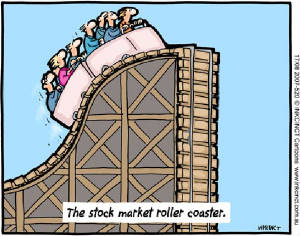
stock-market-roller-coaster.jpg.w300h236The recent disclosure that “Soros Put” Rises To Record: Is The Billionaire Investor Betting On Market Crash? – raises a red flag.

“The “Soros put” is a legacy hedge position that the 84-year old has been rolling over every quarter since 2010. Since this was an increase of 638% Q/Q this has some people concerned that the author of ‘reflexivity’ and the founder of “open societies” may be anticipating some major market downside.

Furthermore, remember that what was disclosed yesterday is a snapshot of Soros’ holdings as of 45 days ago. What he may or may not have done with his hedge since then is largely unknown, and since there are no investor letters, there is no way of knowing even on a leaked basis how the billionaire has since positioned for the market.

Then again, considering that not only Yellen, who has warned about bubble pockets in stocks, but the BIS, Icahn and numerous other fund managers, now openly warn that the entire market has entered bubble territory, perhaps this is a case where the simplest explanation is also the right one… “

Is this just hype or should prudent people go to cash for protection from the next round of financial implosion? The answer may surprise most investors.

Stock pricings have little to do with the economic strengths, performance and future projections of the underlying businesses. Capital markets no longer serve their intended purposes of raising money to fund the operations of productive businesses. Equity downturns, turn into panics when central banksters and government planners need to create financial chaos to interject their newest consolidation system schemes.

A truly free market in commerce, much less in finance, does not exist. The dollar is not a real medium of exchange, but functions as mandatory barter vehicle for a captured society. Convertible rates of exchange with foreign currencies are more a result of political dynamics, than economic equilibrium.

When do you know that a bubble is ripe for a blow? Forbes gives you the high sign,$38 Million Ferrari Becomes The World’s Most Valuable Car, Yet Its Auction Price Disappoints. Gee, such sorrow over such a fire sale price.

Maybe you should heed the warning when, Billionaires Dumping Stocks, Economist Knows Why, which reported that, “It’s very likely that these professional investors are aware of specific research that points toward a massive market correction, as much as 90%.” Wow, spin that projection into a mere correction in an overheated market. Just maybe a 1962 Ferrari 250 GTO is not such a bad ride after all.

Remember you need cash to pay taxes. For those unlucky enough collecting government pension checks, you will get no sympathy if your retirement goes up in flames. Being a career enabler of a fraudulent political dynasty that destroyed entrepreneurship and the merchant economy deserves to be on poverty row with the rest of the country. The crash for a shrinking middle class has already occurred. Rest assured, Forbes reported, “The ranks of the world’s billionaires have swelled to a record 1,645 including 268 newcomers“, will not be feeling your pain.

James Hall – August 20, 2014

Subscribe to the BATR Realpolitik Newsletter

http://batr.org/negotium/082014.html

test-php-789