Energy & Commodities

This Critical Uranium Shutdown is Going Ahead

A brief news item yesterday may be one of the most important happenings in commodities for years.

The coming shutdown of one of the largest uranium mines on the planet.

I noted a few weeks back that workers at Cameco’s McArthur River uranium mine in northern Canada were contemplating labour action. And yesterday that threat came to fruition–with the major uranium company announcing that mineworkers’ unions have authorized a full strike.

It appears this action is going to bring McArthur River to a complete standstill. With Cameco saying it is now initiating shutdown activities at the mine, and the associated Key Lake uranium processing facility.

The strike is officially slated to begin on August 30. So it looks like production here will now taper off, leading up a full stop by that date.

As I mentioned previously, it’s hard to understate the effect this stoppage could have on uranium supply. Given that McArthur River is one of the world’s largest and richest uranium producers, currently putting out nearly 15% of global supply itself.

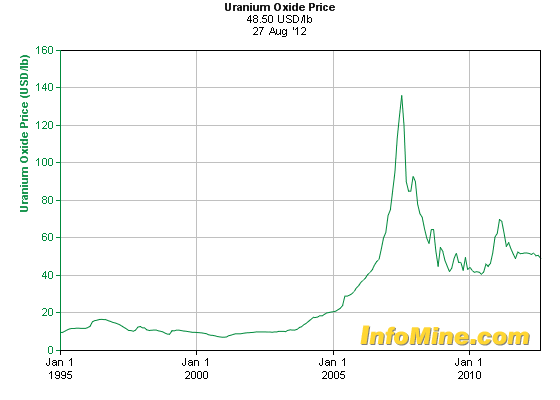
Interestingly, uranium prices have been rising the last few weeks. Up over 10% since the beginning of August, when news of the potential strike action at McArthur began to surface–currently selling for $31 per pound.

GraphEngine-1.ashx

This is the most notable increase in prices the uranium market has seen for years (albeit from a very low base, with prices having recently fallen to a near-decade low of $28). Suggesting that buyers are paying close attention to the events at McArthur, and the potential effects on global uranium supply.

GraphEngine.ashx

Cameco noted that it is continuing discussions with mineworkers over the next 72 hours leading into the strike. So a last-minute solution is still a possibility.

But absent such a five-to-midnight deal, supply and demand is about to get much tighter in this space.

Here’s to unexpected events,

Dave Forest

Uranium Mining Companies Listed in All Countries including price history & charts – Editor Money Talks


dforest@piercepoints.com / @piercepoints / Facebook

#3 Most Viewed Article: Gold & Oil on the Verge of Something Big…

Everyone has been calling for a bottoming Gold the last year. But the fact is that gold and gold stocks are still clearly in a bear market. Just look at the 200 day moving averages. The previous trends were down and prices have been moving sideways for the past year.

A lot of newsletter and analysts are calling a bottom. Technically it’s just a consolidation pattern. Consolidation patterns are a continuation pattern, meaning if the previous trend was down, which it was from 2011 till now, the odds favor price will continue lower after this consolidation.

If this consolidation does happen to be the bottom then we can classify it as a stage I base. Gold and gold stocks will start a new bull market, but price needs to break to the upside of this consolidation pattern. Until it breaks to the upside, it is still in a down trend.

Gold topped out over three years ago. And I am in no rush to try to pick a bottom and be a hero here. I’m just going to continue waiting on the sidelines until price confirms either a new bull market has started or for price to breakdown and we get another leg lower.

goldbear

Oil Outlook

Taking a look at the big picture of crude oil the chart looks bearish. It too has been trading in a range since 2011 and the price is nearing the apex of a consolidation pattern.

It’s important to know that a pennant formation which is what crude oil has formed are the most predictable when price breaks out of the pattern within the first 1/3rd of the formation.

The longer price consolidates and gets squeezed into the narrowing apex of the pennant pattern, the more unreliable. The trend breakout will be, and it becomes at best a 50/50 bet.

Crude oil’s previous trend was up, but it’s been consolidating for such a long time that price is now squeezed into the apex. This negates that bias for the previous trend to hold true so we have no idea which why it will breakout but when it does expect an explosive move.

A breakdown in crude oil will send price to the $70 or $75 per barrel range, and that will hammer on the Canadian dollar also. I can see $1 USD being equivalent to $1.20 Canadian in a year.

oilbear

My Gold and Oil Conclusion

Looking at the US dollar, it has been rising partly due to the euro falling. This strong dollar will put a downward pressure on commodities overall.

usdbull

Gold and oil have not been that exciting for investors since 2011 when they topped out, but both are setting up for massive moves that should last month, if not year or more. Once these new trends emerge expect to see them in the headline news every hour.

It does not matter which way these commodities breakout of the consolidation patterns. With the dollar continuing to rise and the bearish chart patterns for both gold and oil there is a good chance much lower prices are ahead.

This will catch most investor’s off guard. It’s human nature to try to predict tops and bottoms in the market. But this is why most investors get caught on the wrong side of the market. The market always has a way of catching the majority of people on the wrong side of a position.

I am happily sitting in cash with some of my investment capital waiting for gold and oil to breakout of these large patterns. I would not be surprised if we see $900 gold, gold stocks like the gold bugs index $HUI to be at $150, and $70 per barrel for crude oil. I am not saying this is what I want, but you should be mentally prepared so you can get back into cash position and so you can take advantage of falling prices with me.

Big money will be made on the next price movements in these commodities. Whether we have to go long the market or short sell the market. Either way, we can make money. So don’t be a hero and try to pick a top or bottom, just wait for confirmed breakout then invest with the trend.

Would you like my trade alerts CLICK HERE

Want my SP500 trades executed for you in your brokerage account CLICK HERE

Charting your way to financial freedom,

Chris Vermeulen

P.S. My automated trading system is approved to be traded in both your IRA and ROTH IRA accounts also. Now you can make more money and not have to pay taxes – Click Here

Albert Einstein, World War III & A Global Collapse

shapeimage 22

As we close in on the end of August, today the top trends forecaster in the world spoke with King World News about Albert Einstein, World War III, and a global collapse.  Below is what Gerald Celente, founder of Trends Research and the man considered to be the top trends forecaster in the world, had to say in this timely and powerful KWN interview.

Celente :  “The big focus of course is what’s going on in Ukraine, the escalating geopolitical crisis in the Middle East, and the markets.  The markets are at bubble levels and in danger of bursting.  We just heard from TrimTabs Chairman, Charles Biderman.  He’s saying the markets are near the top because they are ‘rigged.’….

Continue reading the Gerald Celente interview HERE…

Quite The Quagmire – “On the precipice of another collapse”

3737990 origWe, like many others, have been watching the increasing turmoil in the Middle East, contemplating the effects recent events have been having the financial markets, as well as their political implications. Looking back on US involvement in the region, it’s hard not to get a salty taste in our mouths. After all the sacrifice by American military families, we’ve accomplished little more than the destabilization of the region.

Yes, in the course of our intervention we eliminated some very brutal dictators, but we did so without adequate understanding of how that part of the world operates. This naivety has prevented us from installing a stable government since toppling regimes. In the end, it’s hard to argue that we’ve made life any better over there for the average person.

Militarily and politically, the United States should absolutely be withdrawing from the Middle East. While this would almost certainly escalate local strife to an event greater magnitude (in the near term), US involvement in these regional conflicts is beginning to resemble Vietnam more and more.

The only problem with a potential withdrawal is that currently the US economy is in such a state that it can’t support returning troops. There would be disastrous results from a sudden influx of labor when unemployment is already high; or of consumers when prices are already rising.

However, these are not justifications for leaving troops on the ground in the Middle East. Rather, it is further evidence of the lack of intelligence on the part of US central planners.

Frequent readers of our columns and listeners to our radio updates know that we often talk about the law of unintended consequences. This, however, is the law of unforeseen implications. The problem arises when power is concentrated among a small group of people who are incapable of seeing past next week.

One of the primary benefits of free and open markets is that they have a smoothing effect. Radical swings are often prevented when millions of people are competing with each other in pursuit of their own self-interests, and things are far smoother than when power is concentrated among just a few market movers.

As an added benefit, the collective intelligence of crowds is almost always greater than small groups or individuals. However, studies have shown that when power is focused among just a few people, not only do those people demonstrate less intelligence than crowds, but they are also more confident in their abilities – even though that confidence is more often misguided.

We see examples of this all the time. In financial markets, the Federal Reserve is almost the only market participant that matters. Everyone else involved with the markets is constantly watching to see what the Fed does, even though they more often than not do precisely the wrong things.

Likewise, in recent decades political power has been more focused in the White House (as opposed to Congress or the courts). This has happened despite the inability of people who occupy the Oval Office to understand the dynamics of regions in which they meddle. The result has been that they do things that change the world without an adequate understanding of why things are as they are; obviously a poor recipe for positive and sustainable change.

Now, after years of unintelligent actions by poor central planners, the United States finds itself in a quagmire. We’re trapped in a series of conflicts, none of which we can win, with no clear set of goals or any end in sight. Our economy has suffered collapse and failed to see any significant rebound because those who guide our monetary policy have tried to keep inflation at bay, with the result that a whole new set of bubbles has formed in the meantime. This has placed our economy on the precipice of another collapse, except that we have nowhere left to fall and no tools left to stem the calamity, much less any ability to reabsorb the heroes we sent abroad to help a people we didn’t understand.

About Dock Treece

Dock David Treece is a partner with Treece Investment Advisory Corp (www.TreeceInvestments.com) and is licensed with FINRA through Treece Financial Services Corp. He provides expert content to numerous media outlets. The above information is the express opinion of Dock David Treece and should not be construed as investment advice or used without outside verification.

“Springboard Buy”

springboard

Signs Of The Times

“Housing Market On Course For ‘Soft Landing'”

                                                             Financial Post (Toronto), August 14

“London home values fell 5.9 percent from the previous month to an average 552,783 pounds, the biggest drop since December 2007.”

                                                            Bloomberg, August 18

“Pimco Scoops Up Quality Junk Cast Off In High-Yield Fund Exodus”

                                                           Bloomberg. August 19

“U.S. Funds Flock to Canada’s Energy”

                                                          Financial Post, August 19

*****

Perspective

Impressive dynamics going on out there!

Which involves going from oversold to overbought during the summer.

More specifically:

Junk bonds registered a Weekly Springboard Buy as well as a Sequential Buy at the first of August.

Also early in the month, the same registered on the S&P.

Sharp rallies have followed, sharp enough to set up the opposite patterns. An Inverted Spring Board is in and the action is working on a Sequential Sell.

That is for both Junk and the S&P.

Consequences could be profound.

Credit Markets

We have the distinction of living in an Age of Bubbles and their failures.

In 1980 it was commodities, wages, the CPI and the precious metals. Then the action shifted to inflation in financial assets which included the blow out in Tokyo on 1989 and the Tech Bubble in March 2000.

That crash set up the 2007 Bubble, which with outstanding action in residential real estate was a “Classic” bubble such as ended in 1929 or 1720.

The 2007 financial mania included the biggest bubble in the real price of base metals in a hundred years of data.

What hadn’t been bubbled?

Lower-grade bonds.

As we have been outlining the bubble has been magnificent.

Since the panic ended in 2009, junk has returned 150 percent which compares to the return of 90 percent from the S&P.

The default rate which had soared to 15 percent in 2009 has plunged to only 1.5 percent on the June report.

One would think that this is about as good as it can get.

How long can it stay?

The surge in JNK into late June reached the most overbought (RSI 81) on a chart back to 2008.

The plunge into late July ended with a Springboard Buy and the Sequential Buy.

The rebound was robust enough to set the opposite reading with a Inverted Springboard and is working on a Sequential Sell.

The high was 41.81 and the low was 40.06. So far, the rebound has made it to 41.35. Technical patterns suggest it may not get much further. There is resistance at this level.

Taking out the 40 level will mark a reversal that will rank with the forces that reversed all of the great bubbles listed above.

Stock Markets

The most recent “event” for the stock market was the Springboard Buy and Sequential Buy registered earlier in the month. Usually these occur in an uptrend, as did the one in October. But the latest could be part of the ending action.

Part of this would be the test of the highs.

This week the surge drove the NDX to a new high as the levels reached by the DJIA and SPX are below the July highs.

The test can include the other senior indexes eking out fresh highs.

One key now seems to be that the rise has been bold enough to register an Inverted Springboard. The other is that another Sequential Sell is building.

Completion of the latter would negate the “Buy” of earlier in the month.

On the bigger picture, sentiment and momentum numbers that only occur with a cyclical peak in the stock market have been accomplished.

Such excesses were noted in 2007 and in 2000.

Bullish Sentiment has swung from a low of 29% to 46% on Thursday’s report. This could get a little higher to become an alert.

It is worth reviewing Ross’s work on the STOXX, which in setting its high in June led the S&P. The chart follows and the key was a Combination Sequential Sell. A near-term Sequential Buy was clocked early in the month.

At each cyclical peak the trigger was the change in credit and currency markets.

Commodities

As noted above, the return from junk-bonds has been 150% since the panic ended in March 2009. The return from the S&P has been in the order of 90%.

On the way up the classic bubble that completed in 2007 Wall Street was advising institutions to build up to a 6% weighting in commodities. The Fed was finally and fully recognized as the agent of inflation.

The niceties of diplomacy would avoid calculating the returns from the CRB’s peak at 474 in 2008.

To keep with the method, the return from the CRB’s low at 200 in 2009 to the recent 288 amounts to only 44%.

This is in the face of the most reckless central bank “inflation” in history.

The instruction remains that the public decides which sectors it will play in and which sectors it won’t.

Lately it has been in lower-grade bonds and without that bid the Fed’s desperation to inflate currency/credit would not have been as successful.

There is a popular notion that all of that reckless policy will at some time drive commodities to the moon.

Not likely, because when the greatest bond bubble in history fails most asset prices will fail as well.

Despite legions of Latter-Day Malthusians, agricultural prices continue to decline. The GKX set a cyclical peak at 570 in April 2011 and new lows were set at 316 at the first of July. On the Weekly RSI, this generated the most oversold reading on a chart back to 1996.

But good growing conditions continue and prices remain depressed, which seems to be easing the overbought.

Base metals also did well on our “Rotation” theme of December. The GYX did not start its rally until March. Remember Chinese liquidity problems.

The rally started at 321 and made it to 376 in mid-July when it declined to support at 360. With some vigour, the test of the high is underway.

On the bigger picture, the rise in the real price of base metals was by far the greatest in over a hundred years. It also stayed up for a long time prompting a huge increase in capacity.

It could take a long time to correct the excesses.

Crude oil’s “Rotation” rally took the price from 91.24 in January to 107.68 in June. It became as overbought (Daily) as it was oversold.

The decline has overwhelmed old seasonal charts and the price is down to 94.26. This has been somewhat oversold for a month.

With the Neo-Soviet aggression in Eastern Ukraine we noted that if crude’s price was to collapse it would deprive Moscow of much-needed dollar reserves. Reagan worked with  the Saudis to assist that decline in crude from around 35 to around 10. It helped collapse the first Soviet experiment.

Cotton also set a cyclical peak in 2011. The high was 219 and the low of 62 set at the first of the month extended the bear. But, as with the grains it is very oversold. This could be eased with a modest rally or just burned off over time.

Most commodities are vulnerable to the rising dollar and the prospect of a liquidity crisis.

Precious Metals

Today’s trade is interesting. Gold and the dollar down on the same day.

But then stocks and junk bonds are up, illustrating the opposing action.

And our case has been that the cyclical bull market for stocks and lower grade bonds is completing as the cyclical bear for precious metals is also completing.

As we have been noting; this is a process.

In this pattern gold in real terms would set an important low. Our Gold/Commodities Index set its low in June and has reversed trend.

The next extension of the trend would enhance the warning.

A similar reversal was accomplished in May 2007 and it anticipated the most sensational financial collapse since the 1930s. Credit spreads and the yield curve reversed in the following month.

With this the S%P set an important high at 1576 in July, corrected to 1370 in August and made the ultimate high at 1576 in October.

This time around, the S&P set the initial high at 1991 in July, corrected to 1904 and as of today has made a new high.

What has been missing?

The curve has not reversed and spread widening has been modest.

Credit markets seem so constrained and manipulated that the façade is close to cracking. With that lower-grade yields would explode.

Now we will look at the gold/silver ratio as an indicator.

In order to signal the onset of financial concerns, the gold/silver ratio needed to rise through 67. It reached 66.9 on Monday and has retreated to 65.8.

This is part of the resumption of the old party and the deferral of the pending party in the gold sector.

As noted last week, our Gold/Commodities Index needed to rise above 3.90 to extend the trend. This would be the warning.

The ideal time to accumulate gold stocks could be in the fall.

BOB HOYE, INSTITUTIONAL ADVISORS

E-MAIL bhoye.institutionaladvisors@telus.net

WEBSITE: www.institutionaladvisors.com


test-php-789