


Stocks & Equities

Selling Done? Or Just The Beginning?

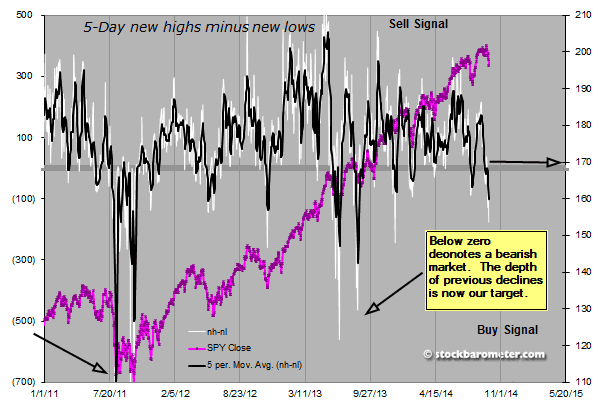
Well, a widely publicized breakdown in the internals has resulted in prices catching up very quickly. Thursday’s action was the proverbial picking up a dime in front of a steam roller as 1 down day took out the past 1-1/2 months of gains. Is it done?

Well, in the very short term, I would expect a bounce attempt at some point today even with the futures pointing lower. So we’ll see weakness into the morning pivots and watch for a potential bounce. But it should be short lived. Here’s some evidence.

35248 a

based on the above, we could be on a program sell, where next week we’ll see if the weekly sell programs kick in

and take the market even deeper. Again, I’d prefer to see this type of action develop slowly, but the market doesn’t care what I prefer. All I mean is that I like trading slower to develop tops, not action like this where everyone sells as evidenced by the Trin on the NYSE.


35248 b

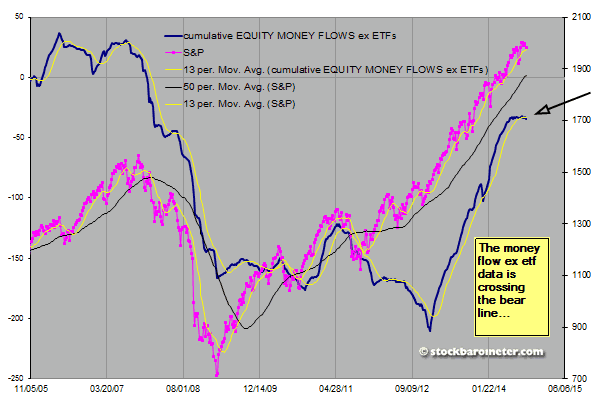
Above is the cumulative money flow data ex-etfs. The signal is bearish and potentially longer term. The data including ETFs is still bullish – but that could be terminal as well as there’s been a lot of talk about the market being pushed up falsely by all the money moving into ETFs – which is usually a sign of a top.

35248 c

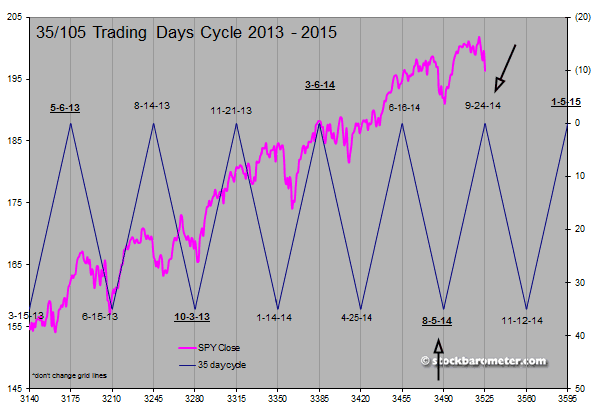
Looking at our trading cycles, the 35/105 day is pointing towards a move lower into 11/12.

35248 d

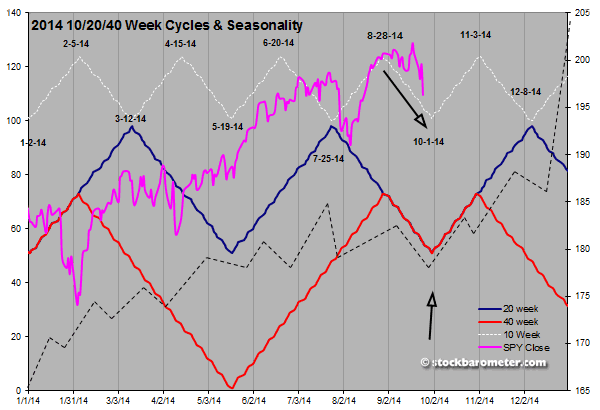
And with our cycles chart coming in, we could be seeing that 20 week cycle low coming in. So the bull may not be over yet and this may just be the pause that refreshes. That doesn’t matter in our trading system because we position for every move and ride it as long as we can. Sure, that will result in periods of small losses when you get choppy markets. But we’re playing for the mid term moves. And there are usually several during the course of a trading year. Though in long term bull markets, that trading style is more hedge like as sell offs are short term in nature. Eventually a bull market turns into a neutral market or a bearish market, where our system will outperform.

Regards,


About The Stock Barometer

Stock Barometer is completely independent. We have never and will not ever accept compensation from any company whose stock we recommend.

Our goal is to make you money. We offer you the tools and information to do so and leave it to you, the individual investor, to apply them in the best way possible.

Here are today’s videos:

China Versus America Stock Market Charts Analysis
Gold Slow Stokes Trumpet Call Chart Analysis
Silver MASS Index Marks The Spot Charts Analysis
GDX Versus Gold Volume Is King Charts Analysis
GDXJ Versus Gold Volume Is King Charts Analysis

Thanks,

Morris

Unique Introduction For Money Talks Readers: Send me an email to alerts@superforcesignals.com  and I’ll send you 3 of my next Super Force Surge Signals free of charge, as I send them to paid subscribers. Thank you!

Super Force Precious Metals Video Analysis posted Sep 26, 2014


“Our main format is now video analysis…”

The SuperForce Proprietary SURGE index SIGNALS:

25 Surge Index Buy or 25 Surge Index Sell: Solid Power.
50 Surge Index Buy or 50 Surge Index Sell: Stronger Power.
75 Surge Index Buy or 75 Surge Index Sell: Maximum Power.
100 Surge Index Buy or 100 Surge Index Sell: “Over The Top” Power.

Stay alert for our surge signals, sent by email to subscribers, for both the daily charts on Super Force Signals at www.superforcesignals.com and for the 60 minute charts atwww.superforce60.com

About Super Force Signals:
Our Surge Index Signals are created thru our proprietary blend of the highest quality technical analysis and many years of successful business building. We are two business owners with excellent synergy. We understand risk and reward. Our subscribers are generally successfully business owners, people like yourself with speculative funds, looking for serious management of your risk and reward in the market.

Frank Johnson: Executive Editor, Macro Risk Manager.
Morris Hubbartt: Chief Market Analyst, Trading Risk Specialist.

website: www.superforcesignals.com
email: trading@superforcesignals.com

email: trading@superforce60.com 

SFS Web Services
1170 Bay Street, Suite #143
Toronto, Ontario, M5S 2B4
Canada 

###

Sep 26, 2014
Morris Hubbartt


Behind the Portfolio Managers curtain

stevedeschesnesEd. note: GPS Portfolio Manager Steve Deschesnes is a regular guest on MoneyTalks. We asked Steve to pull back the curtain and share his unique approach to portfolio construction and stock selection in advance of his upcoming private seminar series in four Western Canadian cities.

Q:       How often do you and your team make changes to the portfolios? What is the general time horizon for trades?

As a philosophy, we buy stocks that we expect to be holding for 3 to 5 years. That being said if we buy a stock we think is undervalued by 30% – and it gained 50% quickly? We will probably sell it. Another example would be Tim Hortons that we sold lately. Following the Burger King offer we felt there was not much more upside left, but big risk if the offer does not work. The new risk/reward assessment wasn’t as strong – so we sold.

Q:      Are clients able to see the track record / performance of each portfolio to date? How far back does the tracking go?

Absolutely. For example, directly on the front page of Disnat GPS you can see that since the launch, our Canadian portfolio has outperformed the market by an average of 2% per year for the past 6 years. By the same token, if we did not perform well – it would still be there.

Unlike most funds, clients can also see all the trading info on each portfolio back to the launch. With most products and manager you don’t really see what they did. With GPS you can see that I had some Research in Motion or Yellow Media in the Canadian portfolio, I can’t hide anything I did. On the other side I could point out how I made some great trade with Alimentation Couche-Tard or Tim Hortons.

Q:       Do you share any of the background research that influences your investment choices with clients?

My job is not just to manage portfolios. I want people to follow my ideas. You have to remember, our clients can review, track and reproduce the GPS portfolios at no cost – so I share everything with them. I will tell clients if a stock I bought was recomended by Desjardins Securities. But I just as often talk about the independent Morningstar Report on US stocks and Candian large cap stock (which we also give our clients access too), and other times I will talk about an emerging consensus in the market.

But more important than pointing to analyst assessments, I also explain why we bought or sold a stock. Not only when we buy it, but I regularly send info alerts explaining why I still like it. Every quarter I go over every stocks we hold – and tell clients, in an audio bulletin, where we stand on all of them.

Q:       What differentiates your approach from most others?

Well, first and foremost, it’s specifically designed for retail investors to follow without any management fee or other costs. It’s cheaper than a mutual fund, broker – even an ETF. Secondly, it is designed for retail investors. Too often financial products are targeted to institutional investors, and the retail guy gets a copy of it. For example, we take into consideration things like minimizing personal capital gain tax. When we sold part of our position in Canadian Tire at a huge profit I also used that time to sell some losing stock to compensate.

Q:      How did to you decide on the 5 types of portfolio that you included in GPS?

At the launch in April 2008 we started with 3 portfolios, the Canadian, Global (the world except for Canadian stocks) and Diversified which is kind a unique portfolio. After that, following demands from clients we launch an ETF one in 2010, and with interest rates so low, clients asked us to launch a High Income portfolio.

Q:       Do you envision adding new portfolios in the future?

Unfortunately, I’m not allowed to say much right now, but since the launch in 2008, we added portfolios, we added features, so chances are good we will continue to innovate in the future.

Steve Deschesnes is providing private seminars in Calgary, Edmonton, Vancouver and Victoria next weekend October 4th in AB and October 5th in BC. Desjardin Online has been kind enough to allocate a small number of seats to MoneyTalks. If you would like to meet and talk to Steve CLICK HERE to register.

Keep Truckin’: How to Snap Up Growing Energy Services Companies

frozenoilrig580The oil and gas fields in western Canada are sucking up rental equipment, trucking services and well site accommodation services like the proverbial black hole. Russell Stanley of Jennings Capital, an expert on mergers and acquisitions, knows how to find the margin in the increasingly profitable energy service industry, and explains the rules of this investment game toThe Energy Report.

The Energy Report: Are oil and gas field services in Canada a high growth sector?

Russell Stanley: Energy prices drive oil and gas field construction and infrastructure development in western Canada. Other drivers include the need to build out liquefied natural gas (LNG) facilities and rail facilities.

Jennings Capital targets service companies with market caps in the $50 to $200 million ($50–200M) range. These names tend to have fewer analysts following than do the larger names. We like companies that rent out niche-type equipment at high margins. These firms are typically low headcount businesses with a lot of operating leverage. Oil and gas field demand is so strong that these companies must source equipment externally to extend their fleets and meet commitments.

TER: What defines a service company in this context?

RS: The definition is fairly broad. We cover companies that operate oil and gas field rental equipment, and a broad group of what we call services to the services. These companies may be employed by an exploration and production (E&P) company directly, or by one of the companies that services the E&P.

Screen Shot 2014-09-25 at 2.06.32 PMThe service equipment supports oil and gas field infrastructure and construction, which is seasonal. But it can also be used for projects managed by utilities or governments that aren’t seasonally dependent. Extending the customer base enhances revenue stability, mitigating the impact of the spring breakup. The challenge right now is that traditional oil field demand is so strong that service companies’ fleets are stressed. We call that a Hollywood problem, though.

TER: What happens during spring breakup?

RS: During spring breakup, the ground thaws in the northern parts of Alberta and Saskatchewan. The resulting moisture prompts a lot of road bans. The E&P and service firms are not allowed to move heavy equipment because of road instability. As a consequence, drilling activity slows down, as does demand for related services. The spring quarter of the year is generally the weakest quarter for companies in the energy service space.

TER: Is spring breakup the time when the E&P companies are offline? What about during really cold winter weather?

RS: The E&P companies in the northern parts of the provinces like the colder weather. Ground conditions are ideal in the winter. This past winter was longer and colder than normal, and more conducive to rig activity. Drilling in western Canada was at relatively high levels, which supported the service companies.

TER: Do you advise investing in small, growing energy service firms, or in buying shares in companies in the business of acquiring the small firms?

RS: Investing in smaller companies can offer short-term advantages to investors. The speed of execution of a business plan is a simple metric to understand. And investing in a quality startup that is following its business plan is always a good bet. Of course, many of these firms are privately held.

But on a mid- to long-term basis, we are seeing more and more merger-and-acquisition (M&A) activity for a combination of reasons. The larger, more liquid companies have easier access to capital. Smaller companies can run into challenges raising the money they need to pursue immediate growth opportunities. That provides an opportunity for a larger player to acquire the small firm. We are also seeing an increased level of centralized procurement by the end customer. The E&P companies prefer to make one phone call to a service provider. From the customer’s perspective, it is more efficient to deal with a large service company that can offer a fuller suite of products and services.

TER: Are acquirers proving to be good managers after the acquisitions close?

RS: The challenge on a post-acquisition basis is preserving the customer base of the company acquired. Small, private companies have often been in operation for 20–30 years. They often have excellent brand value on a local basis. They have longstanding customer relationships. The acquirer does not want to erode that goodwill. The challenge is to optimize the synergies while maximizing overhead savings and cross-selling opportunities.

Screen Shot 2014-09-25 at 2.06.43 PMThe companies we cover do a good job in that arena, and it is a skill we applaud. A key factor in maintaining a smooth transition in M&A is that all the involved parties understand that the buyer’s intent is to continue with current management. We like to see the former owner/operators of acquired private companies incentivized to stay on board with earn-out provisions and blocks of stock in the business.

TER: What oil and gas service firms do you favor in western Canada?

RS: One of the companies that we have launched coverage on is Great Prairie Energy Services Inc. (GPE:TSX.V). We have a $0.75 target on Great Prairie. It is involved in oil field equipment rentals, frack fluid management and equipment hauling. About 60% of the company’s revenue is from Saskatchewan, which is an overlooked market relative to Alberta. The CEO of Great Prairie, Sid Dutchak, is the former minister of justice for Saskatchewan. The board of directors is strong. By virtue of its position in Saskatchewan, Great Prairie is competing for customers and potential acquisitions in a less intensely competitive environment than other regions of western Canada. The company came off Q2/14 stronger than we expected. It is trading at about 3.6 times (3.6x) our estimate for next year’s earnings before interest, taxes, depreciation and amortization (EBITDA).

TER: How can a service company best increase its margin?

RS: We like private companies that are running flat out. Their fleets are extended. They are renting third-party equipment to support customer demand. They have great customer relationships. When they have trouble renting to meet increasing demand for services, they inject capital to expand the fleet. It is better to buy the equipment necessary to meet demand; renting equipment from a third-party reduces margin.

A good example of a company using these tactics is Enterprise Group Inc. (E:TSX.V). Enterprise is involved in oil field construction and equipment rentals, as well as in serving the local utilities and transportation markets in western Canada. It is currently injecting capital to displace the use of third-party equipment to drive margin improvement.

TER: The charts show that Enterprise enjoyed a four-fold increase in share value during the past year. What do you attribute that to?

RS: We attribute Enterprise’s performance to its strong M&A strategy. Enterprise recently announced an LNG acquisition in the Fort St. John area of British Columbia. Its last significant acquisition was Hart Oilfield Rentals in early 2014. It acquired a couple of companies in 2013. The companies Enterprise acquired sold at very attractive prices, usually 3x trailing EBITDA. Most are operating in niche markets, offering a service or a line of equipment that is in high demand. Because Enterprise is a public company, it has excellent access to the capital markets. It can support the growth of the acquired companies on a post-strength action basis.

TER: Are Great Prairie and Enterprise mainly acquirers, or are they targets for acquisition?

RS: They have both been acquiring smaller firms. Once they reach critical mass, they will be attractive candidates to a larger player looking to establish a foothold in western Canada.

TER: What financial metrics do you look at in an M&A candidate?

RS: The most popular target from an acquirer’s standpoint is a private company that has grown organically and needs capital support to make it to the next level. Trailing EBITDA is the metric that acquiring companies look at in determining the worth of an acquisition target. Most transactions are getting done between 3x and 4x trailing EBITDA on a normalized basis, excluding exceptions consistent with the operation of a private company. Usually the buyers want a mix of cash and stock, and a provision that ensures the continuity of management.

TER: What other names are you following in this M&A and execution space?

RS: We have just launched coverage of CERF Inc. (CFL:TSX.V). CERF recently completed a combination with Winalta Inc. We have a $5/share target and CERF’s stock’s is currently trading at about $3.50/share. CERF provides equipment rentals to both the oil field and construction markets in western Canada. The Winalta transaction was a $70M equity and debt deal, which added exposure to the well site accommodation space, which means providing shacks that allow staff to live and work in close proximity to rigs operating in extreme weather conditions. Well site accommodation is a high margin business. CERF’s existing rental business was doing gross margins in the neighborhood of 35–40%. The well site accommodation business has gross margins of over 60%. On top of that, CERF is paying a dividend yield of 6.7%. It is a relatively high yielding stock with a very attractive earnings growth profile.

TER: Are private equity investors interested in the energy services M&A game in western Canada?

RS: We are seeing more interest from private equity. Private equity firms are starting to participate in managing public entities acquiring the oil and gas field service companies, but that game is still in the fourth inning.

TER: Do acquiring firms typically wait for market corrections to buy target companies on the cheap?

RS: Acquisitive service companies tend to know which smaller companies they want to buy well in advance, so it is a matter of getting to the right price. The market plays a role, but it is not determinate. Enterprise is closing on an acquisition this month that it has been working on for some time. There are counter examples. Back in the spring, Great Prairie acquired some assets from Calmena Energy Services (CEZ:TSX), which was an opportunistic purchase. Calmena has been divesting assets during the last few years due to balance sheet troubles. Its frack fluid management assets were available to Great Prairie at an opportunistic time, and at a very attractive price.

TER: Thanks for the insights, Russell.

Russell Stanley has recently returned to Jennings Capital, having first joined the Toronto office in August 2007. He has worked in the brokerage industry since 1997, with the last 10 years in equity research. He has previous experience covering companies in industrial, consumer and health products, technology, alternative energy, bulk commodities and mining services. Stanley looks for underfollowed micro- and small-cap companies with strong earnings growth potential and solid management teams. He holds a master’s degree in business administration from the Schulich School of Business (York University), and is a CFA charterholder.

Want to read more Energy Report interviews like this? Sign up for our free e-newsletter, and you’ll learn when new articles have been published. To see recent interviews with industry analysts and commentators, visit our Streetwise Interviews page.

Related Articles


DISCLOSURE: 
1) Peter Byrne conducted this interview for Streetwise Reports LLC, publisher of The Gold Report, The Energy Report, The Life Sciences Report and The Mining Report, and provides services to Streetwise Reports as an independent contractor. He owns, or his family owns, shares of the following companies mentioned in this interview: None.
2) The following companies mentioned in the interview are sponsors of Streetwise Reports: Enterprise Group Inc. Streetwise Reports does not accept stock in exchange for its services. The companies mentioned in this interview were not involved in any aspect of the interview preparation or post-interview editing so the expert could speak independently about the sector. 
3) Russell Stanley: I own, or my family owns, shares of the following companies mentioned in this interview: None. I personally am, or my family is, paid by the following companies mentioned in this interview: None. My company has a financial relationship with the following companies mentioned in this interview: Jennings Capital was a member of the syndicate for Enterprise Group Inc.’s last equity financing. I was not paid by Streetwise Reports for participating in this interview. Comments and opinions expressed are my own comments and opinions. I determined and had final say over what companies would be included in the interview based on my research, understanding of the sector and interview theme. I had the opportunity to review the interview for accuracy as of the date of the interview and am responsible for the content of the interview. 
4) Interviews are edited for clarity. Streetwise Reports does not make editorial comments or change experts’ statements without their consent. 
5) The interview does not constitute investment advice. Each reader is encouraged to consult with his or her individual financial professional and any action a reader takes as a result of information presented here is his or her own responsibility. By opening this page, each reader accepts and agrees to Streetwise Reports’ terms of use and full legal disclaimer.
6) From time to time, Streetwise Reports LLC and its directors, officers, employees or members of their families, as well as persons interviewed for articles and interviews on the site, may have a long or short position in securities mentioned. Directors, officers, employees or members of their families are prohibited from making purchases and/or sales of those securities in the open market or otherwise during the up-to-four-week interval from the time of the interview until after it publishes.




Bob Hoye: “The VIX, itself, does not do volatility at bottoms.”

Screen Shot 2014-09-25 at 10.44.26 AM

Signs Of The Times

“So why did the monetary base increase not cause a proportionate increase in either the general price level or GDP? The answer lies in the private sector’s dramatic increase in the willingness to hoard money instead of spend it. Such an unprecedented increase in money demand has slowed down the velocity of money.”

                                                                                                           – St. Louis Fed, CNBC, September 

Emphasis added: Voluntary hoarding of cash drove policymakers mad in the last post-bubble contraction.

In 1920, hoarding of commodities blew out and crashed. Think 1980 this time around. Hoarding of financial assets ended with the 1929 Crash. Think 2007 this time around. Hoarding of cash prevailed during the 1930s.

At the moment, cash hoarding is being used to explain another failure of interventionist theories that easy money forces GDP growth. Not when the public wants to speculate in financial assets such as now.

Cash hoarding has yet to become really serious.

“Buy The Setbacks”

                                            – Wells Fargo Advisors, BNN, September 8


“Italy’s Ferrari Reports Record First-Half Revenues”

                                           – Yahoo! News, September 11

“Sales of collateralized loan obligations, or CLOs, have surged to their highest level in seven years.”

                                                                                                                  – Financial Times, September 9

“The U.S. Government probe into auto loans made to people with spotty credit is doing little to derail sales of bonds backed by the debt.”

                                                                                                                 – Bloomberg, September 10 

“The riskiest borrowers are leading the busiest September in at least six years for speculative-grade bond sales in the U.S. As Moodys warns that protection in the debt are declining.”

                                                                                                                 – Bloomberg, September 11

“By fostering risk-taking and the search for yield, accommodative monetary policies thus continued to contribute to an environment of elevated asset price valuations and exceptionally reduced volatility.

                                                                          – BIS Quarterly Revue, Business Insider, September 14 

*****

Perspective

Is the BIS, the central banker’s banker, advising to go long volatility?

Indirectly, the BIS is suggesting the trade as the main message is that senior central banks have not been just been hosting the party, they’ve been imbibing as well. They do not have the integrity or nerve to discipline themselves. Selfishly, policymakers remain determined to get GDP growth via depreciation. They still believe interventionist theories to be sound.

VIX doesn’t do volatility at bottoms, but it registered a Sequential Buy in July. The low was 10.28 and it jumped to 17.57 in August with a high RSI. The decline was to 11.24 and the rebound has made it to 14.17 and is not overbought.

We are watching this as an indicator. It will take a quarter of a year before the BIS can again admonish foolish central bankers.

Credit Markets

Saturday’s special edition “Bonds: Euphoria to Revulsion” outlined the mania as the greatest in financial history. By various measures, the best was accomplished for junk (JNK) in July. The initial hit was followed by a strong test of the high and the action is rolling over.

That the ECB was in the wings to begin buying bonds as the Fed ended its buying program drove European yields to unprecedented lows. As represented by the German 10-Year note, the decline in yields registered a Weekly Downside Capitulation. This is stretched momentum.

Also generated was a Weekly Sequential Buy (on the yield), which is pattern.

Such signals in the past have been reliable and this one has the added consideration of seasonal risk. Fall is the traditional time for the rapid discovery of bad trading and bad banking. This one includes the potential for the discovery of bad central banking.

At 9.82%, Russian yields are close to the break out level at 9.90%.

Discussion about negative interest rates in Europe and Japan has been widespread. We’ve taking it as a measure of the intensity of central bankers arbitrary intrusions. 

Perhaps the best way to look at it is within our review of the behaviour of real long-dated interest rates through the completion of a financial bubble. Adjusted for inflation, real rates have declined to negative in the year a bubble completes.

First of all, real rates set a significant low in the year a financial mania blows out. Reaching for yield drives nominal rates down as stocks and real estate soar. The rate of CPI inflation goes up, but not to the degree seen in the preceding mania in commodities.

Then in the contraction the CPI inflation declines as nominal rates go up – driving the real rate up.

In 2007 real long rates in the senior currency declined to minus 1.5%. During the worst financial storm since the 1930s and despite massive injections of liquidity, the rate increased to the 6% level. The increase was some 7 percentage points.

On the first business cycle out of the crash, the real yield has declined from 6% to 1%.

This will likely increase on the next contraction.

When the senior currency was convertible (on a gold standard) real yields went minus as a bubble climaxed. In the 1873 example it fell to -8.8% and in the crash it soared to 8.7%. In 1825 the low was -5% and the crisis high was 5.7%. In the 1772 Bubble the low was – 6.8% and in the panic the high was 5.7%. In 1720 the numbers were 0.7% and 11%.

The typical increase has been 12 percentage points. This seems to be Mother Nature’s way of ending the extraordinary abuse of the credit markets, otherwise known as a “New Financial Era”.

Charts follow.

In this pattern, 1929 seems to be somewhat outside of the range. The low was 4.5% and the high was 14.9%, making the increase some 10 percentage points.

Now at record lows, nominal rates has everyone thinking basis points or “beeps”. In which case, the typical increase in a severe contraction becomes 1.2 x 10³ beeps.

In each case, the rise was accomplished through a decline in CPI inflation and an increase in nominal rates. Weakening producer prices is not good.

Using Germany as the example of extreme lows, the rate has increased from 88 beeps in late August to 106. This has had a couple of modest corrections and rising through 115 would set the uptrend.

The August 27th Pivot included charts on credit spread widening. This is updated and follows. At 152 bps now, breaking above 154 bps would set the uptrend towards trouble.

Stock Markets

“U.S. corporations are buying their own shares at the briskest pace since 2007.”

That was reported in yesterday’s Wall Street Journal and it makes a lot of sense. Borrowing tons of money at, say 4%, and boosting your stock price is a great way to increase the returns from compensation packages. By this policy the stock symbol becomes as important as the logos for products or services.

Share buybacks and margin are at the highest since 2007 and could be trying to tell us something. So have been sentiment numbers and then there is the rare Monthly Upside Exhaustion on the S&P which registered at the end of August.

These indicate the degree of speculation which is spectacular, and the question is about the lead time to denouement.

In 2007, margin peaked in July and stocks peaked in October. In 2000, margin peaked in March right with the high for the S&P at 1553. The failure did not start until the test failed at 1530 on September 1st.

This time around, margin peaked in February, declined for a couple of months and the rebound into June seems like a test. The July number is the latest available and it was down a little.

Over in Europe, the STOXX set its high at 3325 in June with the slump taking out both the 50-Day and 200-Day moving averages. The rebound and test has been vigorous making it to 3287 on September 3rd. It has since slipped to 3221. There is a fair amount of support at 3200 and it is uncertain if rising rates in Europe will drive funds into equities or impair the charms of the stock markets.

In Asia, the Hang Seng (HWF) reached a Daily RSI of 77 in late July. This compares to 71 reached in late September 2007. Four corrections since April found support at the 50- Day ma. This week it was taken out. Now at 21.5, taking out 20.5 would turn Hong Kong down.

In getting this far last night it was hoped that some thoughts today would provide a wrap for this page. The Wall Street Journal has:

“Venture Capital Risk Taking and Cash Burn Rates Unprecedented Since 1999; 47% of Nasdaq in Bear Market”

“In ’01 or ’09, you wouldn’t take a job at a company that’s burning $4 million a month. Today everybody does it without thinking.”

Just when the stock markets gets priced to perfection, everyone gets a chance to re- appraise conventional wisdom.

Commodities

Most commodities are telling us some interesting things. One is that the long-championed link between Fed recklessness and soaring commodities seems elusive. Another is that the global demand for commodities has been waning. And then there is the hitherto impossible condition of a rising dollar.

On the trading side, wheat became very oversold in July and accomplished a weak and brief rebound. Now, it and the agricultural index (GKX) have dropped to new lows for the bear market that started in 2011. The equivalent oversold on our “Rotation” prompted a tradable rally from January to the end of April. They became overbought.

Similarly, base metals enjoyed a good rally and became overbought at 376 in July. After finding support at the 50-Day ma, the test made it to 377 last week. After providing support on each setback since April, this week’s decline has taken it out. Yesterday’s rebound seems a normal reaction.

Mining stocks (SPTMN) became overbought at 954 in late July and the decline seems to have been anticipating weakness in metal prices. Two weeks ago we noted that the sector was vulnerable.

Traditionally, mining stocks have led the swings in metal prices. There could be support at the 200-Day ma, which is at 840. The index is now at 865. Last week we noted that copper can be seasonally weak into late in the year.

Crude oil became oversold at 92.50 in late August and bounced to 95.83. Last week it slipped to 90.43. Yesterday a wave of buying came into many markets and could have something to do with a special effort being made or intended by policymakers.

This week, central bankers are renewing their pledges to depreciate and it sparked the markets. We don’t see any reason for a material advance in most commodities.

Currencies

One of the interesting things about stock market history is that phases of forced liquidation typically occur from an oversold condition. The ChartWorks (September 12) big chart on the Dollar Index shows that exceptional rallies in the DX can occur from an overbought condition.

The latter occurred with the failure of the commodity bubble in 1981. Another was in the late 1990s and the pattern is poised now.

Going the other way, Russia’s deputy finance minister advised “Don’t panic”. The ruble has been very weak.

Our comment that the Canadian dollar could trade around 92 did not work out.

The rally in crude started and failed and drove the C$ down 90.1 on Monday. It has bounced to 91.3 today.

The key moving averages that might have provided support now become overhead resistance.

Even very oversold conditions seem unable to prompt significant rallies. The course of the Canadian unit is down and the target becomes around 85. 

BOB HOYE, INSTITUTIONAL ADVISORS

E-MAIL bhoye.institutionaladvisors@telus.net

WEBSITE: www.institutionaladvisors.com 


test-php-789





