
Energy & Commodities
A radical new material made from a single carbon atom will soon have a pervasive impact on the U.S. economy – and the entire human race.
Stronger than steel and lighter than a feather, this high-tech medium will shape virtually every part of our daily lives by the end of this decade.
The possible uses are limitless.
No wonder the two scientists who discovered this substance won the Nobel Prize in physics. That alone should tell you something.
The material that I’m talking about is called “graphene.” And you might have guessed, graphene is related to the graphite used in pencils.
 Graphene: The Miracle Material
If you’ve never before heard of graphene, don’t worry – most investors haven’t.
In fact, most investors have never seen anything quite like this new miracle material.
But it won’t be long before you’re benefiting from its potential.
Even as you read this, researchers and scientists are looking for ways to transform this discovery into the Next Big Thing.
Indeed, my Pentagon sources say military leaders want to learn how graphene will lead to victory on the battlefields of the future.
Tech leaders such as IBM, Intel and Samsung Electronics hope graphene will be the foundation of the next generation of cutting-edge products.
And we can already see how graphene will spawn a true revolution in wireless communications.
We’ll soon be able to launch satellites that are the size of skyscrapers – but that weigh less than your patio barbecue grill.
You’ll download hi-def video to your smartphone in nanoseconds. If you want to know who’ll win the current marketplace smartphone brawl, watch who makes the best use of graphene.
Then there’s biotech.
Thanks to graphene, doctors will be able to use high doses of new drugs that are lethal to cancer cells – without getting you sick or harming healthy cells.
They’ll use the substance to make synthetic blood. We’ll no longer have to fret about whether supplies are infected by a deadly virus, or waste precious minutes matching rare blood types.
Graphene could serve as a miracle panacea for an aging America.
Though we’re already living longer and fuller lives, the reality is that millions of us still face age-related health problems. But thanks to a scientist at Wayne State University, doctors may someday be able to combat Alzheimer’s by inserting graphene electrodes into a patient’s brain.
While current devices last only a few months, the Wayne State researcher believes his implants will last as long as five years – improving the quality of life for millions.
Other graphene implants will target spinal cord injuries, and even blindness.
Researchers at the U.S. Air Force Research Laboratory in Ohio said a form of graphene could be used to grow human tissue.
The ramifications are huge: Lab-grown human hearts that can last, disease-free, for a hundred years may one day help children with birth defects or adults with heart disease.
The Air Force team at Wright-Patterson Air Force Base listed a wide range of other uses. These include making a new class of drugs, as well as growing organisms that can yield bio-green energy.
Meantime, graphene will make the U.S. military even more effective. Our soldiers will use “invisibility cloaks” to make tanks and jeeps “disappear” from enemy view.
At the University of Texas at Dallas researchers used carbon nanotubes to hide objects in plain sight. Funded by the Pentagon, the scientists found that bending light in certain ways created the “mirage” that objects weren’t really there.
Given those insights, just think what graphene can do for computing. By the end of this decade you’ll have the power of 10,000 mainframes in the palm of your hand.
Last year, scientists at the Rensselaer Institute in Troy, NY, cleared a big hurdle in nanoelectronics.
The researchers proved they could transform ultra-thin sheets of graphene into tiny transistors, forming the basis of the computers and solid-state nanocircuits of the future.
Even your revolutionary flat-screen TV could become obsolete – thanks to a graphene-based LED screen that’s as thin as Saran Wrap. But think of the benefits: You’ll be able to roll up your giant TV, take it to a friend’s house, and hang it on the wall to watch the Super Bowl.
More Graphene Miracles
Let’s start with the two breakthroughs …
The first – a recent discovery at the University of California at Los Angeles — is a double win for the new material … and for the entire electronics sector. You see, a research team there devised tiny devices that can charge and discharge power up to 1,000 times faster than standard batteries.
Because of the proliferation of batteries in portable electronics, this breakthrough could have a huge impact: It could affect everything from smartphones to cardiology pacemakers.
The technical term for this new gadget is “micro super-capacitor.” And the name says it all: The devices are small, but extremely powerful.
Capacitors have been in widespread use in electronic devices for a long time – and, in fact, have been integral to the electronics revolution. Their job is to store and release current in very controlled amounts. Without this circuit-board traffic cop, your gear would break down on a regular basis … or simply crash.
But the electrical engineers who design all this stuff haven’t been able to make the devices any smaller on a cost-effective basis because they can’t figure out how to further shrink the capacitors that have to go inside them.
But that may be about to change – thanks to graphene and an innovative new production process.
The UCLA research team used a consumer-grade DVD burner to produce these super-small super-capacitors from graphene at a fraction of the cost of standard techniques.
Team members simply glued a layer of plastic onto the surface of a DVD. Then they coated it with a layer of a substance known as graphite oxide that is used to synthesize graphene.
The new devices offer another big advantage: They’re easy to bend and twist. Ultimately, that means they could work for energy storage in flexible electronics like roll-up TV screens and e-readers.
Even “wearable” electronic devices become possible.
In the second breakthrough, a British research team says it’s found a way to overcome one of the key obstacles that right now limit graphene’s use in electronics.
I’m talking about defects.
With current methods, small flakes of graphene form in random ways. That process leaves defects, or “seams,” between flakes when they join together.
The seams prevent electrons from flowing freely in graphene, which so far has limited its use in electronics.
But a team at Oxford University devised a way to align the graphene’s carbon atoms using a cheap piece of copper foil. Team members said the copper surface’s atomic structure acts as a “guide” that controls how the carbon atoms grow on top.
“Our discovery shows that it is possible to produce large sheets of graphene where these flakes, called ‘domains,’ are well-aligned,” said team leader Nicole Grobert. This, she said “will create a neater, stronger, and more ‘electron-friendly’ material.”
What this means is that, in theory, the only thing now limiting the size of the graphene sheet that engineers will be able to create will be the size of the copper sheet itself.
This advance is “an important step towards finding a way of manufacturing graphene in a controlled fashion at an industrial scale,” Grobert said. And this “is essential if we are to bridge the gap between fundamental research and building useful graphene-based technologies.”
Once you factor in these new developments, there’s only one conclusion you can reach: Graphene is more likely than ever to become a commercially viable material that will help transform the world around us in profound ways.
And that means that we have an opportunity to invest in a product that’s going to become a ubiquitous part of our lives.
How to Invest in Graphene Stock
By now, you’re probably champing at the bit for ways in which to invest in this “miracle material.” So here’s the deal.
As far as retail investors are concerned, graphene is a very limited market – at least for now.
First, there’s no good way to invest in graphene – or the graphite carbon it’s made from – as a commodity.
That’s because China controls roughly 70% of the market, much as it dominates more than 95% of the world’s “rare earths” market, and Beijing is both limiting exports and charging a 20% export duty on graphene. That’s one reason its price has more than tripled in the past five years.
Now, there are a couple publicly traded Western graphite miners that are on track to produce graphene. But investing in any is an ultra-speculative proposition at this point.
Most of them either haven’t shown a profit at any time over the past five years, and trading volume on these stocks is thin, with notoriously large bid-ask spreads.
Second, there are some graphene-related companies, like Michigan-based XG Sciences Inc., one of the largest U.S. graphene suppliers. It manufactures and sells “nanoplatelets” and develops specialized graphene products using them. But it’s privately held and shows no sign of going public.
Third, there’s no real pure play in graphene research, development or manufacturing, either – but there are certainly opportunities coming down the pipeline.
Around the world, governments, universities, energy companies and major corporations are pouring huge dollar amounts into graphene research and product development.
Great Britain, for example, just dedicated $120 million to further graphene work at the University of Manchester; South Korea has announced $300 million in graphene projects; and the U.S. military is studying potential applications in aircraft, missiles and other high-speed, light-weight equipment.
On the corporate front, several big companies are working on graphene research and applications.
We’re particularly interested by one large international player that’s already working to bring graphene products to market in everyday products and truly commercialize this material for the first time.
We’re tracking that story every day. It’s not quite ripe for investment, but when it is, you’ll be the first to hear it.
No doubt, graphene offers remarkable possibilities. It also offers substantial profits for investors, but finding the right vehicle to catch the graphene wave will be a challenge – requiring both patience and close attention.

“a foregone conclusion that some of the currencies listed in the infographic below may not exist in 10 years”
Even though there are short of 200 official fiat currencies today, throughout history there have been thousands of currencies that were once used for trade. The above infographic documents the history of currency in 10 different countries of significance.
There are some interesting lessons to be learned from this lengthy and often tumultuous history. For example, the Romans were really the first to debase their currency in a significant way, and many historians believe that this was a key factor in contributing to the downfall of the empire. Unfortunately, we have not learned from tragic events such as this (which helped cause the Dark Ages), and countless other currencies have also bit the dust since then.
One study of 775 fiat currencies found the average lifespan of a currency to be just 27 years. Here’s the breakdown:
- 20% currencies failed through hyperinflation
- 21% were destroyed through war
- 12% were destroyed through independence
- 24% were “monetarily reformed”
- 23% are still in circulation
It seems like a foregone conclusion that some of the currencies listed in the infographic below may not exist in 10 years, or perhaps they get “monetarily reformed”. In any case, it’s worth noting that in today’s interconnected world, it may be easier to stave off the death of one currency through global intervention. However, systematically there is far greater risk. If one currency fails, the possibility also exists for many others to share the same fate through the domino effect.
Investors should study currency history, and as part of a smart portfolio they should protect their hard earned wealth and savings in a defensive fashion. Black swans do happen, and even the crisis in the tiny country of Cyprus had people reeling. The potential for something much bigger is inevitably a possibility – it is just a matter of when and how.



Patience could finally start to pay off for investors waiting for a revival of the uranium market that imploded in the aftermath of Japan’s nuclear disaster in 2011.
After the spot price hit a nine-year low of $28 (U.S.) this spring on oversupply concerns, dragging uranium equities down with it, many investors believe the commodity used to fuel nuclear power plants has finally hit bottom, as the demand picture brightens.
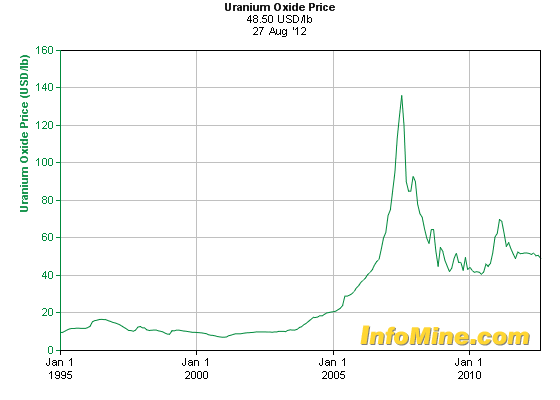
The price has risen about 30 per cent in recent weeks, to $36.50, driven by additional U.S. and European sanctions against Russia, a major uranium supplier, in its conflict with Ukraine. That threatens to put pressure on the global uranium supply, alongside a recent two-week strike at Cameco Corp.’s McArthur River and Key Lake operations in Saskatchewan.

Meantime…
….continue reading HERE

Briefly: In our opinion speculative long positions in gold, silver and mining stocks are justified from the risk/reward perspective.
Yesterday, we finally saw some strength in the precious metals sector. Moreover, we saw it without a decline in the USD Index, which is a positive sign. Will gold, silver, and mining stocks soar once the USD finally declines? When could this happen? Actually, very soon, but – as we have written previously, the coming rally is not likely to be the start of the next big move, but rather a corrective upswing.
Click to read today’s Gold & Silver Trading Alert online with charts

An analysis of 8 Gold Stocks that are in uptrends in this current environment – Money Talks Editor
Well, the headlines are rightfully bearish for gold, silver and the major precious metals stock indexes, ETFs and senior gold miners. The technical damage is real. Today’s burst could be and probably is just short covering. [edit; post was mostly written before the end of day flop]
But improbably enough, there is a stealth uptrend going on in certain royalties, miners, developers and explorers. Believe me, if you could hear me talk instead of write you would not hear anything resembling desperation in my tone. That is because I have worked hard during this bear market to manage risk, stay strong and out of the bear’s way. So I am not talking any sort of a book here other than my biggest picture view (an economic contraction environment that ultimately benefits the counter cyclical gold sector), which could still be out on the horizon.
Don’t take my word for it, here’s Investopedia’s definition of an uptrend:
“Describes the price movement of a financial asset when the overall direction is upward. A formal uptrend is when each successive peak and trough is higher than the ones found earlier in the trend.”

Graphic : Investopedia
Complicated it’s not.
The following charts are what they are (in up trends), and considering that legions of gold bugs have now sworn off the promoters and puked up gold for good, the time is nearing that this sector will again be investment worthy. At the very least, NFTRH for one is going to point out positives along with the ample negatives. Just so we keep a level playing field and an unbiased viewpoint.
We reviewed a condition on HUI’s weekly chart in an update the other day for instance. It’s a lower probability thing, but if it were to manifest it would rip the shorts’ heads off. Picture it, they’d be running around headless, bumping into each other, falling down, getting up again, until they realize they too are dead from shorting something that everybody already knew was left for dead… except for who ever has been buying these charts since last year.
Franco Nevada

Royal Gold

Kirkland Lake Gold

Lake Short Gold

Premier Gold

Semafo

Rio Alto Mining

Timmins Gold (a little wobbly, but still…)

Subscribe to NFTRH Premium for your 25-35 page weekly report, interim updates (including Key ETF charts) and NFTRH+ chart/trade ideas or the free eLetter for an introduction to our work.

-
I know Mike is a very solid investor and respect his opinions very much. So if he says pay attention to this or that - I will.
~ Dale G.
-
I've started managing my own investments so view Michael's site as a one-stop shop from which to get information and perspectives.
~ Dave E.
-
Michael offers easy reading, honest, common sense information that anyone can use in a practical manner.
~ der_al.
-
A sane voice in a scrambled investment world.
~ Ed R.
Inside Edge Pro Contributors

Greg Weldon

Josef Schachter

Tyler Bollhorn

Ryan Irvine

Paul Beattie

Martin Straith

Patrick Ceresna

Mark Leibovit

James Thorne

Victor Adair