We talk a lot about Warren Buffett around these parts (for good reason), but today, I’m going to share with you something a bit different:




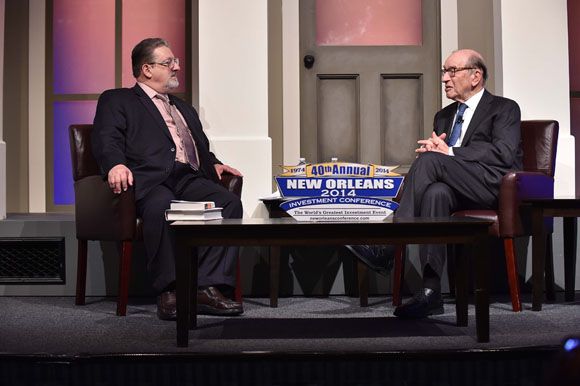
Gary Alexander: You said that when you were named to the position of Federal Reserve chair you left the world of theoretical economics philosophy and entered the arena of action. You moved beyond the role of pamphleteer on the sideline to being part of the action. In what way did your objectivist teaching from your time with Ayn Rand and your belief in the gold standard influence the people around you? How did you convince people to see things your way or did you feel that most of the compromise went the other way?
Alan Greenspan: When I wrote a paper on how agricultural subsidies made no sense to the farmers in the long run, two Republican senators from Nebraska taught me the reality of actually implementing the values we hold as best we can in the context of a political environment. I never changed my fundamental views because they were rational. President Ronald Reagan advised that other than your core beliefs, which are protected by the Constitution, sometimes you have to compromise. We learned to change the world bit by bit.
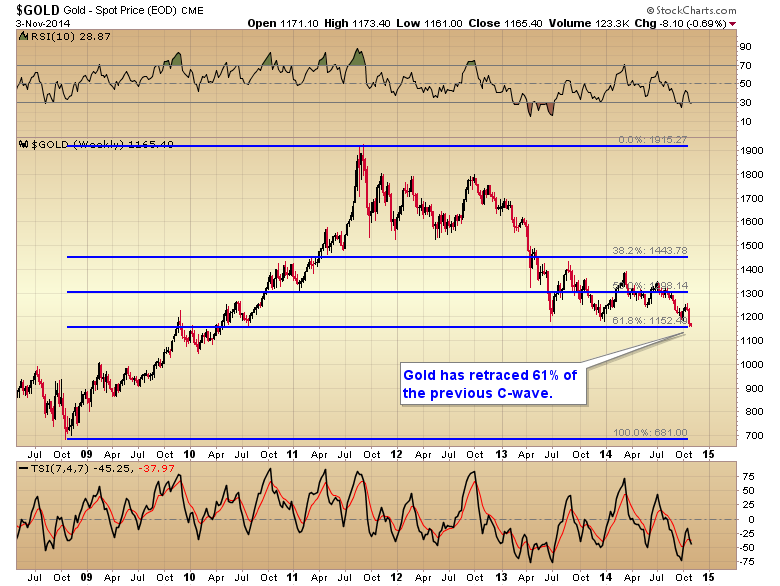
GA: When you took office in August of 1987, the gold price was $460 an ounce ($460/oz) on your first day. It peaked at $504/oz in December of 1987. Over the next 12 years, it was cut in half to $252/oz by August of 1999. Many believe that during that time, the Fed must have been selling gold or manipulating the market in some way to push the price of gold down. Was anything like that happening?
AG: No. Some central banks were major sellers of gold in that particular period. We were very concerned about that. If all the central banks sold gold at the same time, it really would have brought the price down. So they set up a partitioning scheme—some called it a cartel—where individual central banks were given quotas of what they could sell at certain times. The United States abstained from that group.
In my new book, I cover the role of gold and why the U.S doesn’t sell all of its gold. If it’s a barbarous relic, as some say, and it earns nothing and it costs money to store it, why are central banks holding so much of it?
GA: That’s a question I was going to ask you. Ron Paul asked Ben Bernanke in Congressional testimony that simple three-word question “Is gold money?,” which got a one-word answer, No. What do think?
AG: It’s currency, of course. Gold, and to a lesser extent silver, are the only major currencies that don’t require a third party credit guarantee. Gold is inbred in human nature. Gold is special. For more than two millennia, gold has had virtually unquestioned acceptance as payment to discharge an obligation. Remember, Germany could not import any goods in the last part of World War II unless it paid in gold.
Today, China is beginning to convert part of its $4 trillion ($4T) foreign exchange reserve into gold as a partial diversification out of the dollar. Irrespective of whether the yuan is convertible into gold, the status of the Chinese currency could take on unexpected strength in today’s fiat money, floating international financial system. It would be a gamble for China to try to buy enough gold bullion to displace the United States’ $328 billion of gold reserves as the world’s largest holder of monetary gold. But the cost of being wrong, in terms of lost interest and cost of storage, would be quite modest.
If China embarks on a gold accumulation program, global gold prices will rise, but only during the period of accumulation.
GA: One of your statements in your book is that even though the gold standard was not practical, you still believe in the theory of the gold standard.
AG: A return to the gold standard in any form is nowhere on anybody’s horizon.
GA: The Fed has now been around for a hundred years. Would the Fed be considered a successful manager of the value of the dollar over the last century?
AG: Remember, what the Fed does is what Congress requires of it. When the Fed started out, U.S. currency was still on the gold standard. It was set up largely in response to the panic of 1907 as the lender of last resort. The gold standard was abandoned in 1933 because it appeared to be depressing the general price level and inhibiting recovery out of the Great Depression. More important, the restrictive nature of gold undermined the fiscal flexibility required by the New Deal’s welfare state. Some blamed gold for the depression, but the problem wasn’t convertibility to gold, it was a problem with the people pricing it.
What followed was fiat money price inflation. Between 1933 and 2008, prices for personal consumption increased more than thirteenfold. Central banks were then ceded the role of controlling the supply of money, and hence prices. The goal became keeping the rate of inflation down rather than the level of prices unchanged.
As the world adopted a welfare state psychology, challenges began to emerge. Values, culture, ideas and philosophy determine what economic policies look like. Unless and until you change that, nothing will happen. It is ideas that matter in economics.
GA: Interest rates remained very low from 2001 to mid-2004. The Fed fund rate was around 1% from 2004 to 2006. Do you regret, in retrospect, keeping rates so low? Might that have contributed in any way to the housing and real estate bubble?
AG: It became apparent after the dot-com boom that the central banks had lost control of the wrong end of the money. In other words, the Federal Reserve and all the central banks fixed the short end like the federal funds rate, but not the real rate on 10-year notes. We began to see a huge amount of international arbitrage in the bond markets. The result was the federal funds rate went down for a year to 1% because we hadn’t seen price inflation. Money supply growth, long-term rates, all of the measures of inflation were unchanged. No one raised the issue at the time. Indeed, Economist Milton Friedman praised Federal Reserve policies. It wasn’t until 2006 or 2007 that there was a retrospective look at what occurred.
GA: We all saw the headlines about people flipping homes and borrowing and refinancing homes and turning them into ATM machines. Wasn’t that an indication that something was out of control?
AG: That had nothing to do with Federal Reserve policy. That was Fannie Mae and Freddie Mac keeping their debentures at an extraordinarily low level subsidized by the Federal government guarantee that they wouldn’t be allowed to fail. Then the Department of Housing and Urban Development required that the two lenders invest a significant amount of their balance sheet into affordable housing loans. That led to huge numbers of subprime mortgages with low down payments and adjustable interest rates. Eventually, it blew the system apart.
Q: I’d like to turn now to the years after you left the Fed, which you wrote about in “The Age of Turbulence.” We’ve now had almost six years of effective zero interest rate policy and not much measurable inflation. You wrote: “Thus without a change of policy, a higher rate of inflation can be anticipated in the United States. I know that the Federal Reserve left alone has the capacity and perseverance to effectively contain the inflation pressures I foresee. Yet to keep the inflation rate down to a gold standard level of under 1% would have to constrain monetary expansion so drastically that it could temporarily drive up interest rates in the double-digit range.” However, they have done the opposite. The balance sheet has exploded, and yet rates have stayed so low. Inflation is not that measurable, and people are fearing deflation. Could you please explain the map of this territory?
AG: Money supply hasn’t grown. The reason is very little of those excess reserves has been re-lent into the market to IBM or General Motors. That is because there is too much uncertainty, banks are better off holding it for 25 basis points. So we are left with this huge potential inflationary explosion tinder. Once those assets are triggered into the marketplace, then inflation will rise. It has to rise.
GA: My theory is the federal government doesn’t want to raise rates because it has a $17T budget deficit to pay with interest, and that’s going to hurt.
AG: When I was at the Fed, there was never a discussion between the Fed and the Department of the Treasury about the impact of rates on paying the deficit. With the size of the outstanding debt that we now have, the deficit could become fairly crippling if rates go up.
GA: I want to ask you about banks. You say three times in your book that banks have failed terribly in regulating themselves and it’s usually the whistleblowers who draw attention to it. Today, we have the concept of too big to fail. Do you think we should allow big banks to fail?
AG: The premise of a financial system is to facilitate the movement of society’s savings into productive capital assets, which will create a rising standard of living. To the extent that you don’t allow creative destruction of companies, you do not optimize the use of the savings of a society. The issue that people don’t want to address is the fact that creative destruction is an essential characteristic of a market economy, but it does have two aspects to it: creative and destructive. People like the creative, but they don’t want the destructive. You cannot have it both ways. You either have a high standard of living by allowing the savings of society to increase productive assets or you finance everybody—creative or not—and by doing that, you’re creating real serious problems.
Porter Stansberry: The thing that I think has changed in our economy during my lifetime is that debt has gotten so cheap. Debt used to be the last resort for people, now it seems to be the first choice. It makes our institutions fragile in a way that they were not before. The investment banks that blew up in 2008–2009, requiring huge bailouts from taxpayers, were fragile because they were leveraged 50:1. People who ran those institutions thought that was normal and sane. And it wasn’t. We’ve all seen the culture of our country change. In my view, that’s because we’ve gone from the role of the creditor to the role of the debtor. There are many institutions that enabled that process. The Fed is one of them.
AG: The standard of living in the economy is fundamentally tied to the issue of productivity and the degree of independent innovation. We have a very substantial degree of entitlements within this economy, an aggregate of Medicare, Medicaid, Social Security and a whole variety of other programs, all of which are mandated, not appropriated, by Congress under both parties. This leads to a reduction in the level of gross domestic savings, which immediately translates into lower capital of stock and lower standards of living. There is no way out of this arithmetic through bookkeeping. We are eating our seed corn.
Marc Faber: There are many reasons the Western economies are slowing down. One is government spending. Between 1870 and 1910, nowhere in Europe or in the U.S. was it above 15% of the economy. Now, U.S. government spending, including states and municipalities, is at around 40% of gross domestic product (GDP). In France, government spending is 57% of GDP. The larger the government becomes, the less economic growth there will be. So Dr. Greenspan and I agree on the problem, but who financed all these entitlements? I believe the central banks with their artificially low interest rates are deliberately creating bubbles even though in a bubble, the majority loses, and the minority makes a lot of money.
AG: The presumption is that if the Federal Reserve were not funding the deficits, they wouldn’t happen. You have it backwards. Politicians mandate the degree of expenditures and taxes. What would happen if there is no central bank is that interest rates would push up and crowd out the private sector. That is what actually occurs unless the central banks intervene. Central banks are not the primary cause of this problem, they are responding to government spending. If the government spending weren’t there, the issue wouldn’t arise.
GA: With the current Federal Reserve probably winding up quantitative easing (QE) soon, what do you see as the outcome of the current Fed policies under Janet Yellen over the next year?
PS: I really think that the current Fed is in a terribly difficult situation. The federal government is way over its head in debt. It’s $150,000 per taxpayer in debt. There is just no way politically to cut these expenditures nor is there a way to generate enough in income taxes or corporate taxes to cover the shortfall. I’ve looked at the data. It shows that even if you doubled the amount taken in income taxes, we’d still be running a deficit. So the Fed is in a really tough place. It is in charge of financing the government’s runaway spending and uncontrollable debt.
Regardless of what the hawks may say, I just don’t believe that the Fed is ever going to become very aggressive with the purse strings. I think that we’re locked into a pattern of larger and larger QEs, lower and lower rates, until finally something breaks, whether that’s the commodity markets or the bond markets. I actually sort of feel sorry for the folks who are at the Fed currently because they’re stuck between a rock and a hard place.
MF: My sense is that the Fed and other central banks around the world will keep interest rates at very low levels for a very long time. The whole investment world has been distorted by essentially zero interest rates and expansionary monetary policies.
AG: If the Federal Reserve wants to keep the same degree of tightening, it has to actually raise the rate it’s paying on the money. There’s no other alternative. The issue of the size of the balance sheets is beyond comprehension. We are going to have to wait and see what happens when the huge amount of unused reserves starts moving. We have never seen anything like this before. If anyone has the guts to go out and forecast five years out from now, good luck.
PS: Dr. Greenspan, you famously said while you were at the Fed that spotting bubbles is notoriously difficult until in retrospect. There are a couple of things going on today that strike me as bubble-like behavior: NASDAQ trading at almost seven times earnings, high-yield corporate debt offering less than 5%, beachfront condos in Miami selling for $30 million. Do any of those things strike you as being in bubble territory?
AG: Commercial real estate, which was dead in the water with respect to price and volume, has now had a significant change in pricing. Prime areas have seen a surge in funding, but the volume of activity is not back to where it was. Multifamily is doing better because a lot of people have shifted from home ownership to rental status. You will know you are in very serious trouble when there is price inflation but no buyers; that’s suggestive of something not well going on. Yes, I think there are many signs.
The stock prices have been very surprising. This is not sustainable, but we are not seeing any signs of inflation or real interest rates rising. . .yet.
Bubbles are easy to see, but difficult—if not impossible—to pinpoint when they implode because of the way markets work. If people see it coming, it won’t happen. No one can forecast when those bubbles will break.
GA: Marc Faber, what is the significance of the Swiss referendum coming up next month to have 20% gold backing, repatriated gold and forbid gold selling?
MF: I think it will be rejected. If the proposal was for 100% backing, I would more enthusiastically endorse it. Twenty percent, in my opinion, is neither here nor there. I believe that smart investors need to have their own gold reserves. I would never trust anyone to hold these gold reserves on my behalf because they can lease it out or they can sell it.
This interview was condensed and edited from a transcript of the conversation at the New Orleans Investment Conference and Dr. Greenspan’s book, “The Map and the Territory 2.0.” You can order audio CDs and video DVDs of the conference here.
Gary Alexander is senior writer for Navellier & Associates. For the previous 20 years, he was senior executive editor at InvestorPlace Media. From 1983–1989, he edited Gold Newsletter and Wealth magazine for Jim Blanchard.
Swiss-born Marc Faber, who at age 24 earned his Ph.D. in economics magna cum laude from the University of Zurich, has lived in Hong Kong nearly 40 years. He worked in New York, Zurich and Hong Kong for White Weld & Co., an investment bank historically managed by Boston Brahmins until its sale to Merrill Lynch in 1978. From 1978 to 1990, Faber served as managing director of Drexel Burnham Lambert (HK), setting up his own investment advisory and fund management firm, Marc Faber Ltd. in mid-1990. His widely read monthly investment newsletter Gloom Boom & Doom Report highlights unusual investment opportunities. Faber is also the author of several books, including “Tomorrow’s Gold: Asia’s Age of Discovery” (2002), which spent several weeks on Amazon’s bestseller list and is being translated into Japanese, Chinese, Korean, Thai and German. He also contributes regularly to leading financial publications around the world. Much also has been written about Faber. Nury Vittachi, one of Asia’s most popular writers and speakers, published “Riding the Millennial Storm: Marc Faber’s Path to Profit in the Financial Markets” (1998). The Financial Times of London described him as “something of an icon” and Fortune called him a “congenital contrarian and shrewd Swiss investment advisor.”
Former Federal Reserve Chairman Alan Greenspan (1987–2006) also served as chairman of the Federal Open Market Committee. From 1954–1974 and 1977–1987, he was chairman and president of Townsend-Greenspan & Co. From 1974–1977, he served as chairman of the President’s Council of Economic Advisors under President Gerald Ford and from 1981–1983 as chairman of the National Commission on Social Security Reform. Before his appointment to the Federal Reserve Board, Greenspan served as a director of numerous corporations, including J.P. Morgan & C., Mobil Corporation, General Foods Corp. and Capital Cities/ABC. He was a term member of the Board of Trustees of the Rand Corporation, a member of the Board of Overseers of the Hoover Institution and vice chairman and trustee of the Economic Club of New York. He is the author of “The Age of Turbulence: Adventures in a New World” and “The Map and the Territory: Risk, Human Nature and the Future of Forecasting 2.0.” He received his Bachelor of Science in economics summa cum laude, Master of Arts and Ph.D. from New York University.
Porter Stansberry founded Stansberry & Associates Investment Research, a private publishing company based in Baltimore, Maryland, in 1999. His monthly newsletter, Stansberry’s Investment Advisory, deals with safe-value investments poised to give subscribers years of exceptional returns. Stansberry oversees a staff of investment analysts whose expertise ranges from value investing to insider trading to short selling. Together, Stansberry and his research team do exhaustive amounts of real-world independent research. They’ve visited more than 200 companies to find the best low-risk investments. Prior to launching Stansberry & Associates Investment Research, Stansberry was the first American editor of the Fleet Street Letter, the oldest English-language financial newsletter.
Want to read more Gold Report interviews like this? Sign up for our free e-newsletter, and you’ll learn when new articles have been published. To see a list of recent interviews with industry analysts and commentators, visit our Streetwise Interviews page.
Related Articles
- Energy Independence: Financial Fact or Political Fiction?
- Paul Adams: Macro Trumps Micro in Resource Sector
- Bob Moriarty: Flock of Black Swans Points to Imminent Stock Market Crash
DISCLOSURE:
1) JT Long conducted this interview for Streetwise Reports LLC, publisher of The Gold Report, The Energy Report, The Life Sciences Report and The Mining Report, and provides services to Streetwise Reports as an employee. She owns, or her family owns, shares of the following companies mentioned in this interview: None.
2) The interview does not constitute investment advice. Each reader is encouraged to consult with his or her individual financial professional and any action a reader takes as a result of information presented here is his or her own responsibility. By opening this page, each reader accepts and agrees to Streetwise Reports’ terms of use and full legal disclaimer.
3) From time to time, Streetwise Reports LLC and its directors, officers, employees or members of their families, as well as persons interviewed for articles and interviews on the site, may have a long or short position in securities mentioned. Directors, officers, employees or members of their families are prohibited from making purchases and/or sales of those securities in the open market or otherwise during the up-to-four-week interval from the time of the interview until after it publishes.