
Bonds & Interest Rates
 There is a popular American military term called a “last stand”, which is meant to describe a situation where a combat force attempts to hold a defensive position in the face of overwhelming odds. The defensive force usually sustains very heavy casualties or is completely destroyed, as happened at Custer’s Last Stand. General Custer, misreading his enemy’s size and ability, fought his final and fatal battle of Little Bighorn; leading to complete annihilation of both himself and his troops.
The Japanese government is now partaking in a truly incredulous measure to expand its QE program in a desperate attempt to de-value its currency and re-inflate asset bubbles around the world. In other words, Japan is constructing its own version of a “last stand”.
In a final attempt to grow the economy and increase inflation, Japan announced a plan to escalate its QE pace
to $700 billion per year. In addition to this, Japan’s state pension fund (the GPIF), intends to dump massive amounts of Japanese government bonds (JCB’s) and to double its investment in domestic and international stocks. All this in a foolish attempt to increase inflation, which Japan mistakenly believes will spur on economic growth. But these failed policies have now caused Japan to enter into an official recession once again, as GDP fell 1.6% in Q3 after falling 7.1% in the previous quarter.
Japan is now guaranteed to be successful in the total destruction of its currency, the complete destruction of its economy and the collapse of the markets it is attempting to manipulate around the world. To fully understand its misguided reasoning, we have to explore how Japan got here in the first place.
Coming out of WW II, Japan enjoyed a three-decade period referred to as its “Economic Miracle”. This “miracle” was instigated by a booming post-war export economy helped by prudent fiscal policies, which was meant to encourage household savings. Japan’s standard of living soared among the highest in the world. Japan sailed into the 1980’s on the wave of robust economic growth. However, if we have learned one thing after all these years, it’s Government’s insatiable need to meddle with the free market, even when they don’t need to. Accordingly, the 1985 Plaza Accord was sought to weaken the U.S. dollar and German Deutsche Mark against the yen. The Bank of Japan, in an attempt to offset the rising yen, drastically reduced interest rates. The BOJ’s loose monetary policy in the mid-to-late 1980s led to aggressive speculation in domestic stocks and real estate, pushing the prices of these assets to astonishing levels. From 1985 to 1989, Japan’s Nikkei stock index tripled to 39,000 and accounted for more than one third of the world’s stock market capitalization.
By the late 1980s, Japan had transitioned from a “miracle” economy to its infamous bubble economy, in which stock and real estate prices soared to stratospheric heights driven by a speculative mania. Japan’s Nikkei stock market hit an all-time high in 1989, then crashed, leading to a severe financial crisis and long period of economic stagnation that Japan is still entrenched in. It has now become known as Japan’s “Lost Decades.”
Shortly after the bubble burst, Japan embarked on a series of stimulus packages totaling more than $100 trillion yen–leaving an economy that was once built on savings to eventually be saddled with a debt to GDP ratio that now exceeds 240%–the highest in the industrialized world. Making matters worse, the BOJ has more recently engaged in an enormous campaign to completely vanquish deflation, despite the fact that the money supply has been in a steady uptrend for decades. At the end of 2012, we were introduced to Abenomics, which is Premier Shinzo Abe’s plan to put government spending and central-bank money printing on steroids. His strategy is crushing real household incomes (down 6%) and caused GDP to contract 7.1% in Q2.
With the rumored delay of its sales tax, Japan is clearly making no legitimate attempt to pay down its onerous debt levels. Therefore, one has to assume this huge addition to their QE is an attempt to reduce debt through devaluation and achieve growth by creating asset bubbles larger than the ones previously responsible for Japan’s multiple lost decades. This will not return Japan back to the days of its “economic miracle”, where the economy grew on a foundation of savings, investment and production.
The sad reality is that Japan is quickly surpassing the bubble economy achieved during the late 1980’s. Its equity and bond markets have become more disconnected from reality than at any other time in its history. The nation now faces a complete collapse of the yen and all assets denominated in that currency.
This is clearly Japan’s last stand and there is no real exit strategy except to explicitly default on its debt. But an economic collapse and a sovereign debt default on the world’s third largest economy will contain massive economic ramifications on a global scale. Japan should be the first nation to face such a collapse. Unfortunately; China, Europe and the U.S. will also soon face the consequences that arise when a nation’s insolvent condition is coupled with the complete abrogation of free markets by government intervention.

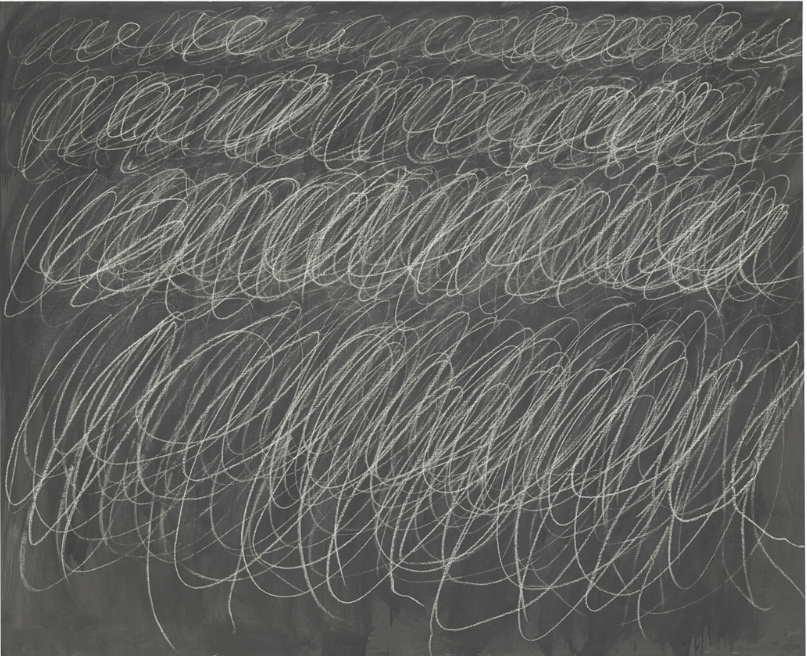
Contemporary art collectors can be summed up in a word right now: Insatiable. Christie’s International in New York made auction history Wednesday when it sold $853 million of contemporary art in about the same time it takes to watch a movie.
The auction house’s total exceeded its $745 million sale in May when Cy Twombly’s untitled, lasso-like scribbles atop a blackboard-gray canvas sold for $70 million.
….read more HERE


Today’s Videos:
Gold Bulls Have The Trend Line Edge Charts Analysis
Silver Trend Line Target Charts Analysis
Dow Waning Rally & US Dollar Blow-Off Top Charts Analysis
GDX Rally To The Trend Line Charts Analysis
GDXJ Triple Gap Play Charts Analysis
Franco Nevada Swing Trade Charts Analysis
Thanks,
Morris
Unique Introduction For Web Readers: Send me an email toalerts@superforcesignals.com and I’ll send you 3 of my next Super Force Surge Signals free of charge, as I send them to paid subscribers. Thank you!
The Super Force Proprietary SURGE index SIGNALS:
25 Super Force Buy or 25 Super Force Sell: Solid Power.
50 Super Force Buy or 50 Super Force Sell: Stronger Power.
75 Super Force Buy or 75 Super Force Sell: Maximum Power.
100 Super Force Buy or 100 Super Force
Sell: “Over the Top” Power.
Stay alert for our Super Force alerts, sent by email to subscribers, for both the daily charts on Super Force Signals at www.superforcesignals.com and for the 60 minute charts at www.superforce60.com
About Super Force Signals:
Our Super Force signals are created thru our proprietary blend of the highest quality technical analysis and many years of successful business building. We are two business owners with excellent synergy. We understand risk and reward. Our subscribers are generally successful business owners, people like yourself with speculative funds, looking for serious management of your risk and reward in the market.
Frank Johnson: Executive Editor, Macro Risk Manager.
Morris Hubbartt: Chief Market Analyst, Trading Risk Specialist.
Email:
Mail:
SFS Web Services
1170 Bay Street, Suite #143
Toronto, Ontario, M5S 2B4
Canada


We have to be concerned that the Cycle of War turns back up next week. NATO has reported that Russian troops have now invaded Eastern Ukraine. In the Cycles of War Report we wrote that target will be November 19/20, 2014 (2014.8871) where we should see some escalation in activity. It appears this may be correct and on point. Caution should be advised next week.

 Meanwhile, Russia’s long-range bombers will conduct regular patrol missions from the Arctic Ocean to the Caribbean and the Gulf of Mexico. Putin has been demonstrating Russia has the capability to invade Europe and America with aircraft. This is a military a show of muscle reflecting tensions with the West over Ukraine. It is increasingly beginning to look like Obama has laid the seeds for World War III and a confrontation with Russia. His ability to wipe out both the Constitution and all the efforts to create world peace since Nixon are amazing. He will clearly go down as perhaps the worst American President in all recorded history.
Between Pakistan and India things are also not heating up. Taking a closer look at the region, we see cross-border firing between India and Pakistan is affecting ordinary people on both sides of the Kashmiri frontline. The two nuclear powers have been considered arch-rivals since they became independent from the British Empire in 1947, and have fought four wars since then. This is the divide distinguished by religion.

In Mexico, demonstrators have set fire to the door of the main entrance of the Mexican National Palace in Mexico City on November 8, 2014. The crowd was furious at the presumed massacre of 43 students. They stormed and torched the ruling party’s Guerrero state headquarters and briefly took a police commander prisoner as growing protests rocked President Enrique Pena Nieto’s government.

Uncertainty Following Recent Move Up – Will Uptrend Extend Even Further?
Sent Nov 13, 2014, 6:02 AM:
Briefly: In our opinion, speculative short positions are favored (with stop-loss at 2,085 and profit target at 1,950, S&P 500 index).
Our intraday outlook is bearish, and our short-term outlook is bearish:
Intraday (next 24 hours) outlook: bearish
Short-term (next 1-2 weeks) outlook: bearish
Medium-term (next 1-3 months) outlook: neutral
Long-term outlook (next year): bullish
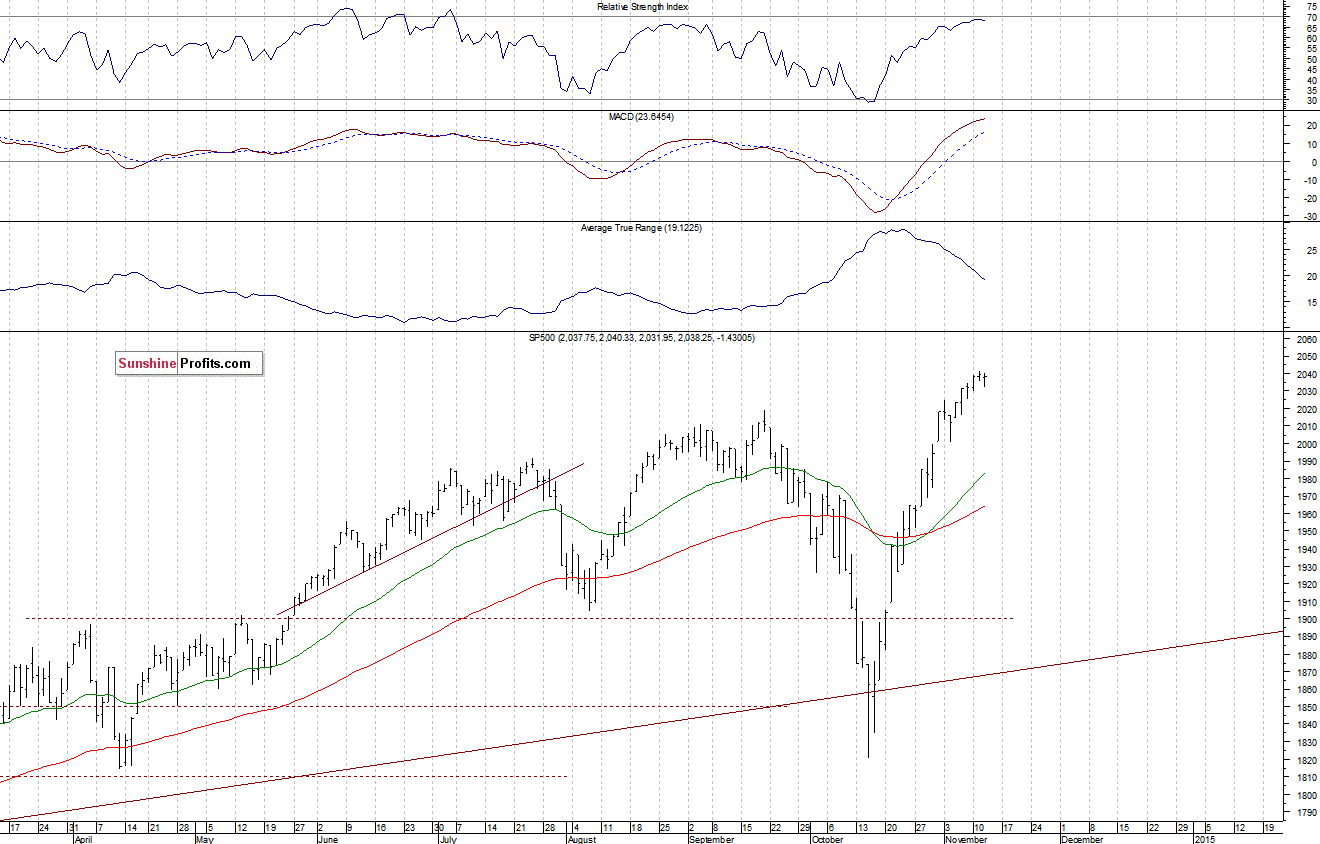
The U.S. stock market indexes were virtually flat on Wednesday, as investors continued to hesitate following recent move up. The S&P 500 index remains close to Thursday’s all-time high of 2,041.28. The nearest important resistance level is at around 2,040-2,050. On the other hand, the level of support is at 2,020-2,025, marked by previous local extremes. There have been no confirmed negative signals so far, however, we can see short-term overbought conditions:
Expectations before the opening of today’s trading session are positive, with index futures currently up 0.3%.
The main European stock market indexes have gained 0.4-0.9% so far. Investors will now wait for some economic data announcements: Initial Claims at 8:30 a.m., JOLTS – Job Openings at 10:00 a.m. The S&P 500 futures contract (CFD) is in an intraday uptrend, as it trades close to new all-time high. The resistance level is at around 2,050, and the nearest important level of support is at around 2,035-2,040, marked by previous local extremes, as we can see on the 15-minute chart:

The technology Nasdaq 100 futures contract (CFD) is relatively stronger, as it trades above the level of 4,200. The nearest important support level is at around 4,180, marked by previous level of resistance. There have been no confirmed negative signals so far, as the 15-minute chart shows:

Concluding, the broad stock market remains close to all-time highs, as it extends recent fluctuations. We expect a downward correction or an uptrend reversal. Therefore, we continue to maintain our speculative short position. Stop-loss is at 2,085 and potential profit target is at 1,950 (S&P 500 index). It is always important to set some exit price level in case some events cause the price to move in the unlikely direction. Having safety measures in place helps limit potential losses while letting the gains grow.
Thank you.
Paul Rejczak
Stock Trading Strategist
* * * * *
Disclaimer
All essays, research and information found above represent analyses and opinions of Paul Rejczak and Sunshine Profits’ associates only. As such, it may prove wrong and be a subject to change without notice. Opinions and analyses were based on data available to authors of respective essays at the time of writing. Although the information provided above is based on careful research and sources that are believed to be accurate, Paul Rejczak and his associates do not guarantee the accuracy or thoroughness of the data or information reported. The opinions published above are neither an offer nor a recommendation to purchase or sell any securities. Mr. Rejczak is not a Registered Securities Advisor. By reading Paul Rejczak’s reports you fully agree that he will not be held responsible or liable for any decisions you make regarding any information provided in these reports. Investing, trading and speculation in any financial markets may involve high risk of loss. Paul Rejczak, Sunshine Profits’ employees and affiliates as well as members of their families may have a short or long position in any securities, including those mentioned in any of the reports or essays, and may make additional purchases and/or sales of those securities without notice.

-
I know Mike is a very solid investor and respect his opinions very much. So if he says pay attention to this or that - I will.
~ Dale G.
-
I've started managing my own investments so view Michael's site as a one-stop shop from which to get information and perspectives.
~ Dave E.
-
Michael offers easy reading, honest, common sense information that anyone can use in a practical manner.
~ der_al.
-
A sane voice in a scrambled investment world.
~ Ed R.
Inside Edge Pro Contributors

Greg Weldon

Josef Schachter

Tyler Bollhorn

Ryan Irvine

Paul Beattie

Martin Straith

Patrick Ceresna

Mark Leibovit

James Thorne

Victor Adair