
 Last week saw the global financial system tip from delusion — where it had happily drifted for several years — into chaos. Consider the following more-or-less randomly chosen data points:


 Even a global economic growth slowdown will not seriously impact the future of the shale oil patch, Rudolf “Rudy” Hokanson tells
 The Energy Report: Is the energy sector undervalued?
Rudolf Hokanson: Energy is very undervalued. The market is not sure how to interpret what is going on in the world, and it runs scared of its own shadow. The market has a tendency to overreact to “The News,” and then to discount current pricing trends by focusing on near-term commodity valuations.
TER: What world news is implicated in the market’s overreaction?
RH: There have been significant interruptions to energy production in Africa, and to energy delivery capabilities in Eastern Europe. Libya is increasing production. The Saudis are selling into Asia, while positioning themselves to be competitive into the U.S. market. Supply issues are driving the markets, as U.S. production grows and Organization of the Petroleum Exporting Countries (OPEC) production finds new markets.
TER: Is there an oversupply of oil and gas in the U.S market?
RH: We are not oversupplied here. Our refiners are happy to take U.S. crude; it is light, sweet, inexpensive and easy to refine. We can keep our refiners busy servicing the domestic market. Our production influences the international markets. Of course, demand could fall, rather than just slow, if global growth rates decline or slow too much. The Brent and WTI differential should even out over time, and there is always a need for energy for growth.
TER: What role are new technological advances playing in developing energy resources?
RH: The oil patch does not like to adopt new technology just for the sake of new technology. High tech is costly, and nobody wants to be the guinea pig for testing new techniques. But we do keep making common sense technical improvements in hydraulic fracturing and methods of completions. One of America’s most important resources is human intelligence. For example, smart petroleum engineers have recognized that a smaller-size sand will penetrate fracked sediments more thoroughly, allowing more oil to flow in the patch.
TER: How do oil patch service firms handle new technologies?
RH: It is not necessary to have a brand-new widget to bring into the patch. Drillers are always looking to reduce costs by improving efficiency. For example, some of the more technologically advanced service firms are using seismic-linked computer programs to visualize the geometry of fracks. But the key to success in the oil well servicing sector is reducing costs, not spending precious capital on unproven technologies.
TER: What service firms do you like from an investment point of view?
RH: One of my favorite small-cap service companies is ENSERVCO Corp. (ENSV:NYSE.MKT). Its forte is heating up oil to improve flow. The company works with hot oil trucks, frack water heating units and acidizing. These technologies are not particularly new or complex, but ENSERVCO is very good at what it does, and it performs to customers’ timetables. I have listed ENSERVCO as a Speculative Buy, because a lot of small service companies have to fight hard to make their way in a competitive arena. But ENSERVCO’s trucks are servicing a lot of basins, and the company is building itself a good reputation, well by well. I have put a $4/share price target on it.
 I am experiencing contrarian inclinations at the moment. I do believe that the seismic industry is critical to the energy program. To that end, I like ION Geophysical Corp. (IO:NYSE) and Dawson GeoPhysical Co. (DWSN:NASDAQ). Their stocks have been beaten up a bit of late, because many operators that need seismic are watching their budgets and going without. But, really, seismic technology is key to understanding where to drill, how to drill, and when to drill. It is an increasingly essential tool.
TER: Do you have target prices on those two seismic companies?
RH: For 2015E, I have a $5/share target price for ION, and a $25/share target price for Dawson.
TER: Who do you like in the exploration and production (E&P) space?
RH: I recommend four high-quality companies in the E&P space. Each has a slightly different niche.
On Whiting Petroleum Corp. (WLL:NYSE), I have a $122/share price target by 2015E. That target assumes that Whiting will acquire Kodiak Oil & Gas Corp. (KOG:NYSE.MKT). Its shareholders will vote on that acquisition in early December. Whiting’s managers are extremely sharp guys. They are focused on the Bakken, as is Kodiak. Acquiring Kodiak will strengthen Whiting’s overall position going forward. The company also has an important focus on the Redtail Niobrara Field. Focus is everything.
I recommend Continental Resources Inc. (CLR:NYSE), which is a large, independent E&P company. It is focused not only in the Bakken, but also in the SCOOP (South-Central Oklahoma Oil Province). I have an $85/share price target on Continental. Its managers really understand the energy market. Continental just sold its oil hedges, after the managers decided that oil is not going to drop any further. Some people have reacted negatively to that bold move. It is a gamble, but I trust the experience and instincts of the Continental managers. My own view is that oil is not going to stay below $80/barrel ($80/bbl) for long.
TER: What kind of experience does the Continental management team have?
RH: Harold Hamm started the company back in the 1960s as a small service company in a pickup truck. He gets very good results out of his wells, and he attracts good people. His managers are very smart people.
 Continental was among the first to start shipping its Bakken crude by rail to refiners that were closing on the East Coast. Those refiners could not process heavy overseas crude without investing many millions of dollars into new equipment. Now they are busy and profitable, using their older plants.
TER: Who else do you like in the oil patch?
RH: SM Energy Co. (SM:NYSE) has some Bakken properties, but its greatest exposure is to the Eagle Ford. It has a nice mix of oil and gas and liquids. The oil percentage is growing. It has a relatively short reserve-to-production life compared to the other companies I follow. Some of its Eagle Ford properties are viewed as three-year wells. Management is working on extending those profiles with different methods of completions. The company’s stock is going to react when prices fall, but when prices go up, SM Energy stock will rise faster because of the impact on its present value from its production capabilities. SM Energy has very smart, well-disciplined managers. The CEO is retiring in January, and the new, designated CEO came up through the company ranks. The firm is ramping up growth to 20% next year. I have listed a $102/share price target on SM Energy.
Newfield Exploration Co. (NFX:NYSE) is very focused on its domestic oil and liquids holdings. It is selling off property in China and Malaysia. It is in the Bakken, and it has a play not far from Continental’s SCOOP called the STACK. Everybody gets into naming their plays, and if they can name it first, everybody else has to use it. I have a $47/share price target on Newfield.
None of the stocks I have mentioned are appreciated by the market at the moment. But the companies’ balance sheets are in good shape. The capital programs are disciplined. Growth is not projected at the expense of the companies’ health and balance sheets. Less well-capitalized companies will be stressed in a volatile commodity market, and their lenders may put pressure on them. Those poorly capitalized companies could then become acquisition candidates for companies like those that I am recommending.
TER: Thanks for talking with us today, Rudy.
RH: You’re welcome.
Read what other experts are saying about:
Rudolf “Rudy” Hokanson joined Barrington Research in 2011 as managing director, research and senior investment analyst within the Equity Research group. His research focus is within the industrial and energy sectors, specializing in niches that primarily include exploration & production, oil equipment & services and other energy-related technologies. He was with UBS from 2005 to 2010 as a buyside analyst, covering energy companies. He served as an energy buyside analyst with US Bank from 2002 to 2005. He has also served as a sellside analyst with CIBC World Markets Corp., Deutsche Bank Securities, R.W. Baird, The Milwaukee Co. and Kemper Securities, providing research for both the energy and publishing/print & media industries, from 1981 to 2001. Other experience includes private consulting. Hokanson has over 30 years of experience within the investment industry, and is a former winner of The Wall Street Journal’s “Best on the Street” analyst survey. Additional accolades also include two 2013 Starmine Analyst Awards: “No. 5 Overall Earnings Estimator” and “No. 1 Earnings Estimator in Oil, Gas & Consumable Fuels.” Hokanson holds both an master’s degree in business administration and a master of divinity from Yale University, and dual bachelor’s degrees in philosophy and religion from DePauw University. He has also completed other business management certificate programs at Oxford University and the University of St. Thomas. He also holds the Chartered Financial Analyst (CFA) designation.
Want to read more Energy Report interviews like this? Sign up for our free e-newsletter, and you’ll learn when new articles have been published. To see recent interviews with industry analysts and commentators, visit our Streetwise Interviews page.
DISCLOSURE:
1) Peter Byrne conducted this interview for Streetwise Reports LLC, publisher of The Gold Report, The Energy Report, The Life Sciences Report and The Mining Report, and provides services to Streetwise Reports as an independent contractor. He owns, or his family owns, shares of the following companies mentioned in this interview: None.
2) The following companies mentioned in the interview are sponsors of Streetwise Reports: ENSERVCO Corp. Streetwise Reports does not accept stock in exchange for its services.
3) Rudolf Hokanson: I own, or my family owns, shares of the following companies mentioned in this interview: None. I personally am, or my family is, paid by the following companies mentioned in this interview: None. My company has a financial relationship with the following companies mentioned in this interview: None. I was not paid by Streetwise Reports for participating in this interview. Comments and opinions expressed are my own comments and opinions. I had the opportunity to review the interview for accuracy as of the date of the interview and am responsible for the content of the interview.
4) Interviews are edited for clarity. Streetwise Reports does not make editorial comments or change experts’ statements without their consent.
5) The interview does not constitute investment advice. Each reader is encouraged to consult with his or her individual financial professional and any action a reader takes as a result of information presented here is his or her own responsibility. By opening this page, each reader accepts and agrees to Streetwise Reports’ terms of use and full legal disclaimer.
6) From time to time, Streetwise Reports LLC and its directors, officers, employees or members of their families, as well as persons interviewed for articles and interviews on the site, may have a long or short position in securities mentioned. Directors, officers, employees or members of their families are prohibited from making purchases and/or sales of those securities in the open market or otherwise during the up-to-four-week interval from the time of the interview until after it publishes.


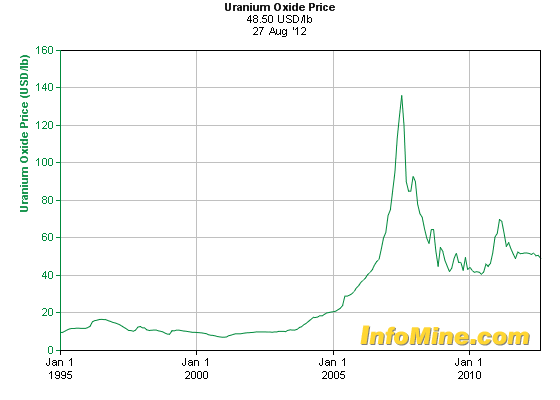 What we know is Uranium mines only supply









