Economic Outlook

Marc Faber on Dollar, The US Economy & Global Interest Rates


Marc-Faber-ESA ee17d6cd86QE has Grossly inflated Asset Prices

This year could be the year when investors lose confidence in central banks’ ability to engineer a sustained economic recovery, Marc Faber said in a presentation in London.

So far, London and New York property, as well as equities, have “reacted very well” to the Fed’s quantitative easing efforts, “but that doesn’t boost the wealth of the nation and it leads to less social cohesion,” he warned.

“One of the problems of this liquidity injection is that the Fed can force relatively responsible central banks to print money,” Faber added.

QE has “grossly inflated” asset prices and as a result U.S. equities as “highly expensive,” Faber said. A sustainable recovery should be based on investment rather than on consumption, but companies will find it more difficult to boost profits in the current economic climate, he added.

RUDE NUMBERS Targets, Predictions and Wild Guesses

Screen Shot 2015-01-28 at 6.42.57 AM

“This is investing,” declares a reader. “Some stocks work, some do not. You have always pointed me in the direction of way more winners than losers. We will brush ourselves off and move on. Keep up the good work‎.”

Amen, brother. I’m getting misty-eyed just thinking of all those great trades we’ll find this year.

Speaking of which… 

“I’m sorry…I would not buy a GM vehicle or GM stock if they were the last of the Mohicans!” vents a reader regarding yesterday’s ode to newfound growth in the auto sector. “Thanks to the stupidity of Obama (again), he just pushed the country farther and faster towards the eventual bankruptcy route by gifting billions and billions to those jerks. They should have been allowed to declare bankruptcy, reorganized and restart anew without “BIG BROTHER” stepping in and messing things further. This would have been the American and proper way.”

Probably. But that’s not the issue…

I’m not saying you have to marry the auto manufacturers. Heck, you don’t even have to like ’em. Just take the stock on this one date to see how things go. It’s a trade–not a lifetime commitment or an endorsement of some B.S. political maneuvering. Relax…

Screen Shot 2015-01-28 at 6.46.20 AM

How to Make 20% from the Resurrection Car Manufacturers


Will robot shop assistants spell the end for shop work?

The OSHbot is the latest hi-tech innovation from the Lowe’s chain in America, a robotic multilingual helper, capable of finding any piece of hardware you may be after.

■ See more from the 20 innovations for 2015 series

58f61a90-7464-4737-90d9-c0a49cd2bd03-1020x612

How can I help you today? The OSHbot is being trialed in Lowe’s, San Jose, California.
This new department has already borne fruit in the form of Lowe’s virtual-reality “holoroom”, in which customers at its Toronto branch can envisage their new kitchen or conservatory by entering a chamber and looking through a hi-tech screen. More ambitious still, though, is OSHbot: a gliding, chattering “retail assistant” robot who will be hitting the floor of a San Jose DIY store this month.

According to Nel, OSHbot is the product of an extraordinary innovation scheme in which Lowe’s Innovation Labs ask published science-fiction writers to produce stories predicting futuristic scenarios for the store. Lowe’s then seek out what Nel calls “uncommon partners” to help make the stories reality; in OSHbot’s case, the trendy Silicon Valley learning hub Singularity University and the startup robotics firm Fellow Robots.

OSHbot is a 4ft-something, pear-shaped character; limbless, with nothing but a vague green glow for a face, and a screen slanted in front like a starched pinny. “It’s basically a roving kiosk; we definitely didn’t want it to have arms or anything like that,” says Nel. “But there’s still lots to figure out, for instance: what voice should the robot have? Should it be male, should it be female? There are so many things we can’t know until we try it.”

Nel is quick to clarify that OSHbot is not a replacement for human beings – rather it is there to “augment [the] store associates”. Her range of duties (she sounds female in her promotional video) is restricted to greeting customers, discussing their needs in brief and escorting them to the correct aisle and shelf. Despite these limits, however, she is considerably more sophisticated than a human worker in a number of other ways. A 3D scanner secreted in her front can examine any item – from a strimmer to a tack – and match it to a stock database. She knows the precise location of every product in the shop at any given time, and she is also multilingual.

For now, OSHbot is only going to appear in one store – the Silicon Valley branch of the Lowe’s-owned Orchard Supply and Hardware. But although Nel anticipates people coming to “gawk and try it out”, he insists it is more than a publicity stunt. “Our ambition is to go beyond one store” he says, “and clearly the sky’s the limit when it comes to robotics.”

Robots, he feels, will soon be as indispensable as smartphones, and OSHbot is just the beginning.

Succeed in Today’s Environment Saving For Retirement or Investing in Retirement

One of the groups of investors that’s the most mistreated by Government is the millions who have responsibly saved for their retirement. This analysis is based on American figures but is relevent to Canadian investors just as well – Money Talks Editor

Income Inequality is a Problem – When Caused by Government Meddling

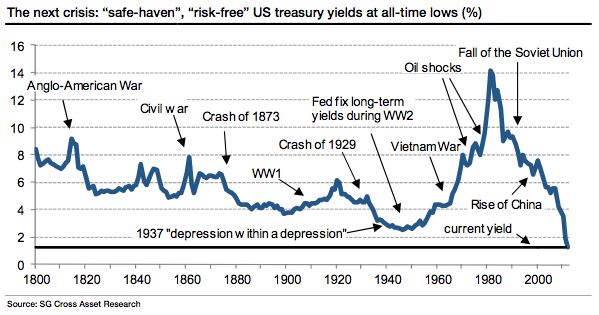
When I entered the investment business as a stock broker at Merrill Lynch in the 1980s, savers could routinely get 7-9% on their money with riskless CDs and short-term Treasury bonds.

Image 2 20150127 CTD

In fact, I sold multimillions of dollars’ worth of 16-year zero-coupon Treasury bonds at the time. Zero-coupon bonds are debt instruments that don’t pay interest (a coupon) but is instead traded at a deep discount, rendering profit at maturity when the bond is redeemed for its full face value.

At the time, long-term interest rates were at 8%, so the zero-coupon Treasury bonds that I sold cost $250 each but matured at $1,000 in 16 years. A government-guaranteedquadruple!

Ah, those were the good old days for savers, largely thanks to the inflation-fighting tenacity of Paul Volcker, chairman of the Federal Reserve under Presidents Jimmy Carter and Ronald Reagan from August 1979 to August 1987.

Image 3 20150127 CTD

Monetary policies couldn’t be more different under Alan “Mr. Magoo” Greenspan, “Helicopter” Ben Bernanke, and Janet Yellen. This trio of hear-see-speak-no-evilbureaucrats have never met an interest-rate cut that they didn’t like and have pushed interest rates to zero.

The yield on the 30-year Treasury bond hit an all-time record low last week at 2.45%. Yup, an all-time low that our country hasn’t seen in more than 300 years!

Image 4 20150127 CTD

These low yields have made it increasingly difficult to earn a decent level of income from traditional fixed-income vehicles like money markets, CDs, and bonds.

Image 5 20150127 CTD

Unless you’re content with near-zero return on your savings, you’ve got to adapt to the new era of ZIRP (zero-interest-rate policy). However, you cannot just dive into the income arena and buy the highest-paying investments you can find. Most are fraught with hidden risks and dangers.

So to fully understand how to truly and dramatically boost your investment income, you absolutely must look at your investments in a new light, fully understanding the new risks as well as the new opportunities.

There are really two challenges that all of us will face as we transition from employment to retirement: longer life expectancies; and lower investment yields.

Risk #1: Improved health care and nutrition have dramatically boosted life expectancies for both men and women. We will all enjoy a longer, healthier life, which means more time to enjoy retirement and spend with friends/family, but it also means that whatever money we’ve accumulated will have to work harder as well as longer.

Image 6 20150127 CTD

Today, a 65-year-old man can expect to live until age 82, almost four years longer than 25 years ago; the life expectancy for a 65-year-old woman is also up—from 82 years in the early 1980s to 85 today.

The steady increase in life expectancy is definitely something to celebrate, but it also means we’ll need even bigger nest eggs.

Risk #2: Don’t forget about inflation. Prices for daily necessities are higher than they were just a few years ago and constantly erode the purchasing power of your savings.

Image 7 20150127 CTD

The way I see it, your comfort in retirement has never been more threatened than it is today, and it doesn’t matter if you’re 20 or 70.

The rules are different, and you only have two choices:

#1. spend your retirement as a Walmart greeter (if you’re lucky enough to get a job!); or

#2. adapt to the new rules of income investing.

Today, the new rules of successful income investing consist of putting together a collection of income-focused assets, such as dividend-paying stocks, bonds, ETFs, and real estate, that generate the highest possible annual income at the lowest possible risk.

Even in an environment of near-zero interest rates and global uncertainty, there are many ways an investor can generate a healthy income while remaining in control. Income stocks should form the core of your income portfolio.

Income stocks are usually found in solid industries with established companies that generate reliable cash flow. Such companies have little need to reinvest their profits to help grow the business or fund research and development of new products, and are therefore able to pay sizeable dividends back to their investors.

What do I look for when evaluating income stocks?

• Macro picture. While it’s a subjective call, we want to invest in companies that have the big-picture macroeconomic wind at their backs and have long-term sustainable business models that can thrive in the current economic environment.

• Competitive advantage. Does the company have a competitive advantage within its own industry? Investing in industry leaders is generally more productive than investing in the laggards.

• Management. The company’s management should have a track record of returning value to shareholders.

• Growth strategy. What’s the company’s growth strategy? Is it a viable growth strategy given our forward view of the economy and markets?

• A dividend payout ratio of 80% or less, with the rest going back into the company’s business for future growth. If a business pays out too much of its profit, it can hurt the firm’s competitive position.

• A dividend yield of at least 3%. That means if a company has a $10 stock price, it pays annual cash dividends of at least $0.30 a year per share.

• The company should have generated positive cash flow in at least the last year. Income investing is about protecting your money, not hitting the ball out of the park with risky stock picks.

• A high return on equity, or ROE. A company that earns high returns on equity is usually a better than average business, which means that the dividend checks will keep flowing into our mailboxes.

This doesn’t mean that you should rush out and buy a bunch of dividend-paying stocks tomorrow morning. As always, timing is everything, and many—if not most—dividend stocks are vulnerably overpriced.

But make no mistake; interest rates aren’t rising anytime soon, and the solid, all-weather income stocks (like the ones in my Yield Shark service) will help you build and enjoy a prosperous retirement. In fact, you can click here to see the details on one of the strongest income stocks I’ve profiled in Yield Shark in months.

Tony Sagami

me logo

30-year market expert Tony Sagami leads the Yield Shark and Rational Bear advisories at Mauldin Economics. To learn more about Yield Shark and how it helps you maximize dividend income, click here. To learn more about Rational Bear and how you can use it to benefit from falling stocks and sectors, click here.

This Unlikely Spot Just Got $465 Million in Oil Investment

UnknownWe’re not hearing a lot these days about investment in new petroleum projects.


West Texas Intermediate oil prices are once again testing $45. And natgas prices in places like the U.S. are still hovering near decade lows. Meaning that most producers and financial backers are laying off plans for acquisitions and drilling.

But one place bucked that trend last week. Receiving a big cash injection from some of the biggest investors in the energy sector.

That’s the Western Canadian Sedimentary Basin.

Energy private equity giant Riverstone Holdings announced last Wednesday that it will commit funds to a new venture in this area. Namely, private E&P firm CanEra Inc.

Riverstone–in concert with a syndicate of PE investors, and the management team of CanEra–will reportedly commit $465 million in total funding for the company. Representing a very significant investment, especially amid the current down market for energy.

The investors gave little detail on what opportunities are attracting them here. Saying only that CanEra will be based in Calgary, and will target opportunities in Canada.

The biggest selling point may be the company’s management team. Which has already completed two Riverstone-backed ventures–CanEra I and CanEra II–in western Canada. The last of which was sold to Canadian producer Crescent Point for $750 million in early 2014.

That firm focused on development of the Torquay Formation–an oil-rich package of rocks that lies below the prolific Bakken fields, in the eastern Canadian Basin. So it’s possible we may see the new CanEra return to these stomping grounds.

Whatever the case, it’s encouraging to see money coming into the E&P sector. And notably interesting that big buyers are paying close attention to Canada–a place that’s been almost completely off the map for many American investors.

Watch for more news on the exact project direction that CanEra takes–and results from this company, that may confirm the opportunity that appears to be unfolding across Canadian oil and gas fields.

Here’s to going where others don’t,

Dave Forest
 

dforest@piercepoints.com / @piercepoints / Facebook

test-php-789