
Real Estate
 Our personality and behavioural traits impact every aspect of our personal and business lives. For new investors, these traits can help predict future successes. Although our behaviour can be modified over time, our personality is relatively stable over the course of our lives from the age of 18, so changing our behaviour can often be a difficult task and requires determination.
From my own experience, here are some core traits every new investor should have or should work on developing:
1. Determination.
To be successful in any business, you must show a certain level of determination, and you must persevere during hardship and relish in success. Determination is not about bullying others to get what you want; it’s about knowing what to do, doing it well and setting out to reach your goals.
2. Results oriented.
People often think that determination leads to results, but that’s not always the case. How many times have you set out a
path only to give up halfway through? It’s likely your initial determination wasn’t the issue; it’s your desire to obtain results that was the ultimate culprit. Keep your eye on the ball at all times by building out a plan and ingraining the big picture into your daily thinking.
3. Flexibility.
Knowing when to change course is sometimes just as important as knowing when to stay the course. Times (and the economy) change, and local market activity is constantly influx. The one sure thing in life is that change is inevitable. Be comfortable with change and modify your course when necessary in order to reach your ultimate goals. But be careful; don’t change your course hastily. Know why a change of course is required and support the decision(s) with facts.
4. Decision making.
Have you ever met a CEO with an inability to make quick, thoughtful and impactful decisions? If you’re someone who “ho-hums” over trivial decisions, then be ready for a rude awakening. Real estate investing is about taking the bull by the horns and that sometimes means making quick decisions that can have a huge financial impact with associated risks. The best way to prepare for these types of decisions is to be educated and well versed in your niche market – finances and the like.
5. Integrity.
We don’t often equate investing with ethics, but most successful investors hold high standards for themselves and how they treat others. Bully tactics, lying and deceitful behaviour will ultimately lead to failure. Treat others with respect and respect will be earned. This goes a long way during negotiations, finding tenants and working with trusted professionals.
6. Communication skills.
Knowing when and how to properly communicate with others is an important attribute to investing, and life in general. Everything you’ll do for real estate investing will involve communication one way or another. Master the art of reading others, effectively getting your point across and negotiation. And don’t forget: a person who knows how to communicate well also knows how to listen.
7. Desire to learn.
How can you invest in something you know nothing about? One of the most well-known investors of our time, Warren Buffett, refuses to invest in things he isn’t educated about. This rule should apply to you as well. Find your niche, learn and continually educate yourself. Read, read and read some more!
About Dustin Graham
Dustin is a sales representative with RE/MAX, the leader of The Graham Partners team located in the west Greater Toronto Area and a consultant on the TV show Income Property.

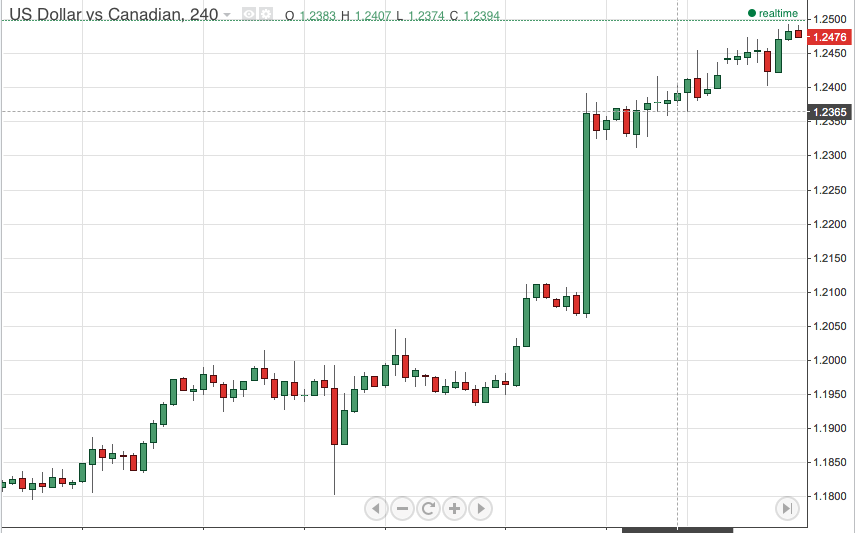
The USD was generally stronger overnight, ahead of the release of the Federal Reserve interest rate decision. Focus on todays meeting will be on any changes in the language that accompanies the release,in particular as relates to the timing of any interest rate decisions. The Canadian dollar continues to suffer with the price of crude which was under pressure following the release of US crude oil inventories which increased by 8.9 million barrels from the previous week .Crude oil inventories in the US are now at their highest level in 80 years at 406.7m barrels.
CAD Range 1.2462-1.2389 ; Currently 1.2451; Support 1.2355 1.2305 ; Resistance 1.2475 1.25
Chart below at 11:35 PST


U.S. gold exports to Hong Kong and China jumped significantly in October. Not only were U.S. gold exports strong in October, they were the second highest for the year. Shipments of gold out of the U.S. spiked in January, declined in February and March and remained subdued during the summer months.
However, U.S. gold exports Jumped 70% In September, at 50.1 metric tons (mt), with the majority going to Switzerland (15.3 mt) and the United Kingdom (13 mt). If we look at the chart from the article linked above, U.S. gold exports to Hong Kong (8.5 mt) and China (3.3 mt) placed in the third and fourth position respectively:

Then in October, something interesting took place. According to recently released USGS Gold Mineral Industry Survey, the U.S. exported 51 mt of gold in October with a large increase going to Hong Kong, China and India.
As we can see from the chart above, U.S. gold exports to Switzerland gained a little in October, reaching 17.6 mt compared to 15.3 mt in September…. but the big increase came from Hong Kong (12.9 mt), China (7.4 mt) and India (6.1 mt). In addition, U.S. gold exports to the United Kingdom fell considerably from 13 mt in September to only 2 mt in October.
Now, if we look at U.S. gold exports over the past six months, we can see a striking change in October. From May to September, gold exports to Hong Kong, China and India were a quarter of total exports. However, these three countries accounted for 26.4 mt or 52% of all the U.S. gold exported in October, compared to 23% in September.

Furthermore, the 7.4 mt of U.S. gold exported directly to China was the highest monthly total I have ever seen going back several years. This increase of U.S. gold demand from Hong Kong, China and India was probably due to the big drop in the price of gold at the end of October when it fell from $1,250 on the 22nd of the month to a low of $1,160 on Halloween, the 31st.
It will be interesting to see how much gold was exported from the U.S. in November as the price of gold fell even further to a low of $1,130.
Please check back for new articles and updates at the SRSrocco Report.

This would make the Swiss Franc Debacle Look Like Noise!
If you were the Chinese what would you do?

This has got to really p$%^ss off the Chinese!
Its Actually a USD-YUAN PROBLEM!!!
Chinese Currency Plunges To Peg Limit Against US Dollar, Strongest Against Euro In 14 Years 01-27-15 Zero Hedge
The drop in the Yuan over the past 2 days is the largest against the US Dollar since Nov 2008 as USDCNY nears its highest (CNY weakest) since mid-2012. What is more critical is that for the first time since the new 2% CNY peg bands, USDCNY is trading at the extremes – 11.5 handles cheap to the fix. At the opposite end of the spectrum, the EURCNY just dropped below 7.00 for the first time since June 2001 with the biggest 2-day strengthening of the Chinese currency against the Euro in almost 4 years. It appears the consequences of ECB QE, SNB volatility, and now Greek concerns continue to ripple through the rest of the world.. and at a time when China faces its ubiquitous new year liquidity squeeze, that is not a good sign.
Biggest 2-day drop in the Yuan against the US Dollar since 2008

With USDNCY pushing against its 2% peg band for the first time…

As the Yuan shifts to its strongest against the Euro since 2001 (almost 2000) – back below 7.000

Charts: Bloomberg

ARTICLE OF THE WEEK
As Martin showed you in his Monday column, the world is a mess, a sorry state of affairs that is getting worse by the day.
This was all foretold by the cycles of war that I have been writing about for over two years now … cycles that show the world splintering apart, cycles that will not even come close to ebbing for another five years.
It’s the result of several different cycles coming together in time and space, and in a way that hasn’t been seen in at least 150 years. Since the 1860s, according to my research.
You have first, the Kondratieff Wave, a super economic cycle that peaked on cue in 2007/2008, a cycle that has been sped up by the impact of technology on the world — and a cycle which will not reach a bottom until 2025.
Symptoms: Slower business formation, debts going bad, plunging velocity or turnover of money and credit, and deflation, with a capital D.
You can see my graph of the K-wave here.

You have the Juglar Cycle, a cycle that tracks fixed investment by business, a cycle that also peaked with the real estate crisis and now points down into roughly 2025.
Symptoms: Slower business investment, a “risk-off” mentality by businesses, leading to slower job formation, slower spending and more.
You can see my chart of the Juglar Cycle here:

You have the Kitchen Cycle, discovered in the 1920s by Joseph Kitchen, a shorter cycle of 40-months, but also related
to the inventory cycle of commercial businesses. It also peaked during the real estate crisis, then plunged, then rallied into last year … and is now pointing down into 2016, followed by a bounce, then another decline into 2025.
You can see the chart here:

Symptoms: Like the Juglar Cycle, slower business formation, slower inventory turnover, lackluster employment growth, and more.
You have the Armstrong Economic Confidence Cycle, pointing to a major turning point this October. Marty Armstrong, a close friend of mine and to a very major degree, my mentor in cycles, says it will be a doozy, the beginning of a “Sovereign Debt Big Bang” — where the patently unplayable debts and IOUs of Europe, Japan and the United States all begin to crumble, right before our eyes.
Symptoms: Collapsing bond markets in Europe, the United States and Japan; soaring interest rates, and more.
You have the Kuznets Cycle, discovered by Simon Kuznets, an approximate 18-year cycle that vacillates between periods of low and high income inequality.
It bottomed in 2013, showing that despite government efforts to redistribute wealth, income inequality, not just in the United States but almost everywhere, will get much worse in the years ahead and not reach a climax until 2025.
Symptoms: Rising social discontent, class warfare, rising attacks on the rich, rise of third-party neo-Nazi groups, and more.
You can see my chart of the Kuznets Cycle here:

The thing is, income inequality normally declines during recessions and rises during booms.
Yet during this turn of the cycle, we’re seeing the opposite: Income inequality is rising during a period of slow global economic growth. So if you think income inequality is bad now, fasten your seatbelts. According to the Kuznets Cycle, it’s going to get worse: The rich are going to get richer in the years ahead, and the poor, poorer.
So the question then becomes “Why?” Why is income inequality worsening, despite slow global economic growth and despite government efforts to redistribute wealth?
It has to do with what I call the “granddaddy of all cycles,” the major war cycle of 53.5 years in duration, a cycle that has pinpointed every major war since the beginning of time.
You can see my chart of this major war cycle here. It’s pointing up into 2020, the earliest date it can peak.


Make no mistake: It is this war cycle that is now driving — consciously or unconsciously — nearly every government decision that is being made.
- It is why we are seeing attacks on the rich in Europe and the United States, not to mention China.
- It is why we are seeing governments in Europe and the United States tax the rich, to allegedly redistribute wealth, but in reality, is backfiring, sending the rich fleeing, causing income inequality to worsen, and killing business formation.
- It is why we are seeing battles between religions, between civilizations, between groups within nations and between nations.
- It is why we are seeing rampant cyber espionage, between nations as well as governments spying on their own people.
- It is why we are now seeing the world in such a mess that even Pope Francis has recognized that the world is already in World War III, an acknowledgement he made last September at a speech in Italy.
Make no mistake: The world is indeed a mess, but it’s also about to get a whole lot worse.
Markets will continue to gyrate wildly. Europe will go down the tubes. Japan will default as well in the years ahead, and the biggest of them all, our own government, will also succumb to the forces I describe above.
You will see gold plunge on further deflation, then suddenly turn around and soar to over $5,000 an ounce.
You will see the U.S. stock markets similarly plunge, but then soar like an eagle as they become the last bastion of capitalism, as frightened money from all over the place, including sovereign bond markets, pours into equities like never before.
You will see bond markets lose 30 percent, 40 percent, even 60 percent on the dollar, wiping out pensions and untold millions of unsuspecting investors.
You will see the value of the dollar soar, as investors from other areas of the world, run for cover … and then, when the process is complete and everyone realizes the Emperors of Washington also have no clothes …
You will see the dollar crash and burn, forcing the world’s leaders to convene a new Bretton Woods, a new monetary system, a new reserve currency.
Mark my words: All of the above, and more, is coming. You must do everything you can to protect and grow your wealth.
Stay safe, stay protected, and be open to mega profits …
Best wishes,
Larry
P.S. For more than 35 years, I’ve made studying the Great Depression of the 1930s and economic cycles — and trading the financial markets based on my knowledge of both — my passions in life.


-
I know Mike is a very solid investor and respect his opinions very much. So if he says pay attention to this or that - I will.
~ Dale G.
-
I've started managing my own investments so view Michael's site as a one-stop shop from which to get information and perspectives.
~ Dave E.
-
Michael offers easy reading, honest, common sense information that anyone can use in a practical manner.
~ der_al.
-
A sane voice in a scrambled investment world.
~ Ed R.
Inside Edge Pro Contributors

Greg Weldon

Josef Schachter

Tyler Bollhorn

Ryan Irvine

Paul Beattie

Martin Straith

Patrick Ceresna

Mark Leibovit

James Thorne

Victor Adair