Bonds & Interest Rates

Currency Wars Heat up as Central Banks Race to Cut Rates

The Chinese Year of the Ram will kick off at the end of this month, but for now it looks as if 2015 will be the Year of the Central Banks.

I spend a lot of time talking about gold, oil and emerging markets, and it’s important to recognize what drives these asset classes’ performance. Government and fiscal policy often have much to do with it. But in the past three months, we’ve seen central banks take center stage to engage in a new currency war: a race to the bottom of the exchange rate in an attempt to weaken their own currencies and undercut competitor nations. 

Indeed, amid rock-bottom oil prices, deflation fears and slowing growth, policymakers from every corner of the globe are enacting some sort of monetary easing program. Last month alone, 14 countries have cut rates and loosened borrowing standards, the most recent one being Russia.

A weak currency makes export prices more competitive and can help give inflation a boost, among other benefits. 

“The U.S. seems to be the only country right now that doesn’t mind having a strong currency,” says John Derrick, Director of Research here at U.S. Global Investors. 

Since July, major currencies have fallen more than 15 percent against the greenback. 

image002

Two weeks ago, Switzerland’s central bank surprised markets by unpegging the Swiss franc from the euro in an attempt to protect its currency, known as a safe haven, against a sliding European bill. Its 10-year bond yield then retreated into negative territory, meaning investors are essentially paying the government to lend it money.

This and other monetary shifts have huge effects on commodities, specifically gold. As I told Resource Investing News last week:

Gold is money. And whenever there’s negative real interest rates, gold in those currencies start to rise. Whenever interest rates are positive, and the government will pay you more than inflation, then gold falls in that country’s currency. Last year, only the U.S. dollar had positive real rates of return. All the other countries had negative real rates of return, so gold performed exceptionally well.

Other countries whose central banks have enacted monetary easing are Canada, India, Turkey, Denmark and Singapore, not to mention the European Central Bank (ECB), which recently unveiled a much-needed trillion-dollar stimulus package.

image003 

A recent BCA Research report forecasts that as a result of quantitative easing (QE), a weak euro and low oil prices, the eurozone should grow “by about 2 percentage points over the next two years, taking growth from the image004current level of 1 percent to around 3 percent. This is well above the range of any mainstream forecast.” The report continues: “[European] banks, in particular, are likely to outperform, as they will be the direct beneficiaries of rising credit demand, falling default rates and the ECB’s efforts to reflate asset prices.” This bodes well for our Emerging Europe Fund (EUROX), which is overweight financials. 

Speaking of oil, the current average price of a gallon of gas, according to AAA’s Daily Fuel Gauge Report, is $2.05. But in the UK, where I visited last week, it’s over $6. That’s actually down from $9 in June. You can see why Brits don’t drive trucks and SUVs.

But that’s the power of currencies. As illustrated by the clever image of a Chinese panda crushing an American eagle, China’s economy surpassed our own late last year, based on purchasing-power parity (PPP). 

image005

image006Financial columnist Brett Arends puts it into perspective just how huge this development really is: “For the first time since Ulysses S. Grant was president, America is not the leading economic power on the planet.”

An easier way to comprehend PPP is by using The Economist’s Big Mac Index, a “lighthearted guide to whether currencies are at their ‘correct’ level.” The index takes into account the price of McDonald’s signature sandwich in several countries and compares it to the price of one here in the U.S. to determine whether those currencies are undervalued or overvalued. A Big Mac in China, for instance, costs $2.77, suggesting the yuan is undervalued by 42 percent. The same burger in Switzerland will set you back $7.54, making the franc overvalued by 57 percent.   

Earning More in a Low Interest Rate World

From what we know, the Federal Reserve is the only central bank in the world that’s considering raising rates sometime this year, having ended its own QE program in October.

Last month we learned that the Consumer Price Index (CPI), or the cost of living, fell 0.4 percent in December, its biggest decline in over six years. We’re not alone, as the rest of the world is also bracing for deflation:

image007Following Fed Chair Janet Yellen’s announcement last Wednesday, the bond market rallied, pushing the 10-year yield to a 20-month low. 

image008

Interest rates remain at historic lows, where they might very well stay this year. But when they do begin to rise—whenever that will be—shorter-term bond funds offer more protection than longer-term bond funds. That’s basic risk management. We always encourage investors to understand the DNA of volatility. Every asset class has its own unique characteristics. For example: 

image009

Our Near-Term Tax Free Fund (NEARX) invests in shorter-term municipal bonds, thereby taking off some of the risk if the Fed decides to raise rates this year. We’re very proud of this fund, as it’s delivered 20 years of consistent positive returns. Among 25,000 equity and bond funds in the U.S., only 30 have achieved the feat of giving investors positive returns for the same duration, according to Lipper. 

That equates to a rare 0.1 percent, roughly the same probability that your son or grandson will be drafted into the NFL and play in the Super Bowl.

In the past 30 years, we’ve experienced massive volatility in both the equity and bond markets, and we’re thrilled for our shareholders that we’ve been able to deliver such a stellar product, under the expert management of John Derrick. What’s more, NEARX continues to maintain its coveted 5-star overall rating from Morningstar, among 173 Municipal National Short-Term funds as of 12/31/2014, based on risk-adjusted return. If you are in Orlando next week, come by the World Money Show to hear John talk about the fund’s history of success. The event is free and my team would love to meet you at booth 514. 

Upcoming Webcast

To those who listened in on our last webcast, “Bad News Is Good News: A Contrarian Case for Commodities,” we hope you enjoyed it and received some good, actionable insight. If you weren’t able to join us, you can watch the webcast at your convenience on demand. Our next webcast is coming up February 18 and will focus on emerging markets, China in particular. We hope you’ll join us! We’ll be sharing a registration link soon. 

Please consider carefully a fund’s investment objectives, risks, charges and expenses. For this and other important information, obtain a fund prospectus by visiting www.usfunds.com or by calling 1-800-US-FUNDS (1-800-873-8637). Read it carefully before investing. Distributed by U.S. Global Brokerage, Inc.

Contrarian Economist John Mauldin: How to Position Your Portfolio to Win in the Currency Wars

Collateral damage from the currency wars in Europe, Japan and Russia could topple political leaders, put banks out of business and homeowners on the street. It can also play havoc with a portfolio. That is why The Gold Report called Mauldin Economics founder John Mauldin to ask how can readers protect themselves and perhaps even prosper.

currencywars580

The Gold ReportThe beginning of 2015 has been volatile for global currencies, not the least of which was the Swiss National Bank removing its cap on the franc versus the euro. What precipitated that and what does it mean for the Swiss franc versus other currencies going forward?

John Mauldin: The Swiss National Bank had already expanded its balance sheet to 80% of GDP to maintain the link and would have had to buy more euros if the joint currency continued to weaken. It would be similar to the U.S. Federal Reserve having a balance sheet of $13 trillion. As late as the week before the big move, the chairman and vice chairman of the Swiss National Bank announced publicly that the peg was a cornerstone and the bank would continue to maintain it. Once it became clear that some very serious quantitative easing (QE) was coming from the European Central Bank (ECB), everything changed.

Now we see that European bond buying could be on the order of €1.1 trillion, which is a relatively serious amount, and it is open ended with €60 billion a month planned until inflation hits 2%. Given all the deflationary pressures in Europe, that could be quite a long time. Consider that Japan has had massive quantitative easing for decades off and on and its nominal GDP is roughly where it was 25 years ago. The country hasn’t witnessed anything that looks like inflation, so it’s not clear to me that the move by Europe is going to be able to create inflation. 

The Swiss National Bank saw this reality and concluded it could be facing another $150 billion in losses and balance sheet expansion. There is only so much pain a central bank can handle. So it walked away from the whole euro mess. And it shocked the markets because Swiss financial leaders didn’t want to start warning people and have it leak out. They decided to get over it and deal with getting taken off the Christmas card lists later. 

TGR: Is this just the beginning of the financial moves by the Swiss? 

JM: Switzerland already lowered key interest rates and has indicated it is willing to do it again. It wouldn’t surprise me if we see a 1.5% or 2% negative factor in the future as the country puts a “you are not welcome here” mat out. Basically, it is charging you to hold Swiss francs. 

If you’re a Russian that makes a lot of sense. You can lose 75 basis points on your Swiss franc or 25–30% on your Russian ruble. Swiss francs are better than euros and dollars aren’t available. 

Other countries could follow. Denmark lowered its interest rates further into negative territory after the ECB announcement, and then lowered them again the next day. The Danes don’t want the krone to become the next currency that everybody piles into. Negative rates have arrived in about six countries now in Europe—negative out into the four-to-five-year bond range. Europe is just upside down. It doesn’t make any sense. 

TGR: Will the ECB be able to buy bonds at this rate indefinitely?

JM: Sure. The Japanese are doubling down. In an October move dubbed the Halloween Surprise, the Bank of Japan announced its open-ended commitment to quantitative easing until the economy reached 2% inflation and the yen took a big drop against the euro. After the recent QE announcement by the ECB, the euro-to-yen swap rate has gone back to where it was and the yen is even stronger! This is precisely what Germany wants because the country’s biggest competition in machine tools, robotics and automation is Japan. This is currency wars. Currency wars are not genteel, friends-and-family squabbles. This could get ugly.

TGR: Are we going to see more collateral damage from the currency wars? 

JM: Absolutely. Korea at some point will throw in the towel trying to maintain its currency against the yen. The Chinese are going to have to allow their currency to fall against the dollar, which will send some U.S. senators into a tizzy.

TGR: What about the businesses that trade in currencies? We saw a couple close overnight. Will there be more shockwaves like that for banks that are short the Swiss franc or mortgages denominated in francs? 

JM: I’m sure we’ll lose a few banks here and there. Banks are always going out of business. We’re certainly going to lose a lot of currency brokers. We will lose some hedge funds that were on the wrong side of the trade.

TGR: There have been shockwaves from the freefall of oil prices. That has impacted currencies around the world including the Russian ruble and the Canadian dollar. What could happen if the price of oil stays under $50 a barrel ($50/bbl)?

JM: It wouldn’t surprise me if we see $30/bbl before this is over. It is down 60%. That’s a pretty significant drop. I don’t think oil stays down. The marginal cost of production is probably in the $60/bbl range so my guess is at some point over the next year to year and a half it gets back to that level, but it doesn’t rise to $80 or $90/bbl. It’s not going to get back up to where a lot of countries would like to see it. I think Saudi Arabia is perfectly fine to sell its oil at $70/bbl and take market share.

TGR: Wouldn’t that have political implications in places like Russia and Venezuela?

JM: Sure. And it couldn’t happen to a better bunch of terrorists. I’m not particularly worried about how difficult a time they have. 

TGR: What about the impact in Canada, where oil is a big export product?

JM: The Canadian dollar lost parity already and leaders there are worried about the country slowing down. That is why the Bank of Canada cut its key interest rate in a surprise move earlier this month. The economy in Canada is getting softer. It is doing exactly what you would think a central bank would do. 

TGR: Should we brace for more of these surprise announcements?

JM: Typically central banks don’t do something just once. We are starting a cycle of lower rates. 

TGR: With all of the problems in Europe and China, what is supporting the dollar and the U.S. stock market climb and talk here of raising interest rates?

JM: Currencies move in long cycles. The dollar was irrationally weak not that long ago. I predicted three years ago, when the dollar was dropping and some were pointing to the Chinese currency as the next reserve currency, that the dollar would remain the strongest currency in the world. People chuckled and shook their heads, but nobody’s chuckling or shaking their heads anymore.

The dollar is going to get a great deal stronger. Oil production in the U.S. is part of the rising dollar. We’re keeping more of our petrodollars. When oil gets back to the $65/bbl range, you’re going to be surprised how much production comes back in the shale oil fields. The cost of taking oil out of the ground is falling every quarter. Lower demand is cutting the price of drill rigs and salaries are getting back to normal. It’s going to get cheaper. There are silver linings to the drop in oil prices as opportunities open up. There is a lot more oil out there and at $65/bbl it will be profitable. 

TGR: If oil floats between $30/bbl and $70/bbl, can the U.S. stock market continue to go up or is this a bubble and we’re waiting for it to pop?

JM: No, it’s not a bubble. We don’t have ridiculous valuations. We could see a correction just as we see in any move, but not a serious one like 2008 or 2001 until we have another recession. I think the next recession will also be the end of the secular bear market, but you just never know what the markets are going to do. The market will do whatever it can to create the most pain for the most number of people. 

TGR: What does all of this mean for gold? 

JM: If you’re in Japan or Europe, you probably want to be buying gold because it’s a bull market in those currencies. 

I have never been an investor in gold. I am a buyer and believer in insurance gold. I think you ought to own some gold in your portfolio as central bank insurance. The day will come when the dollar will turn and our central bank will start doing QE again because that’s what central banks do. Then we’ll have another bull market run and it will get a new resetting for a new valuation. You know what I’ll do with my gold? Absolutely nothing. It’ll sit there gathering dust. 

My point is if I ever use my gold, that’s not a good sign for me personally. It either means that something really bad is happening in my life and I need the one thing I can convert to ready cash or the world is going to hell in a handbasket. My great hope is that I give my gold to my great grandkids and they look at me and ask what those shiny coins represent because that would mean the world turned out really well. But I like the insurance just in case it goes the other way. 

TGR: What about other commodities? 

JM: Other commodities are telling us the world has built up too much capacity and we’re in a deflationary world. Nearly all the metals have gone down. Copper is way down. That is an indication of slower global growth for 2015.

TGR: What alternative investments do you like? 

JM: My biggest personal winners for the last two years have been my short yen trades. I basically took my mortgage and hedged it in terms of yen with 10-year put options. I have been killing it with that and some funds that are basically short the Japanese government (not Japanese stocks, which I like!)

TGR: When we talked last time you also were excited about biotech stocks.

JM: I am a big believer in biotech. I think we’re going to see some biotech stocks just breathtakingly go through the ceiling. Now there will be more that go to zero so you have to be very selective and thoughtful about what you do. 

TGR: Any final words of wisdom for our readers, investors who are trying to figure out how to protect themselves with all of these currency wars?

JM: Long-term growth in your portfolio will only come from long-term growth in the global markets. Japan, Europe, China and the emerging markets are all going to have a crisis in the next five years. In the U.S. we will have to figure out in 2016 how we want to structure our country. Debate will center on questions such as: What do our taxes look like? What does our regulatory environment look like? We’re going to get to make a decision as a country. It could either be massively bullish or not. 

Your core game plan has to be positioning yourself to take advantage of volatility. How can you take advantage of these rolling crises? You want to be able to have a strategy that’s going to let you go long and short, move in and out on a rolling basis. You have to be long global growth. 

TGR: Thank you for your time.

John MauldinJohn Mauldin is an economist and financial writer of the New York Timesbest-selling books “Bull’s Eye Investing,” “Just One Thing,” and “Endgame.” His most recent book is “The Little Book of Bull’s Eye Investing.” Mauldin’s free weekly e-letter, Thoughts from the Frontline, is one of the most widely distributed investment newsletters in the world. Launched in 2000, it was one of the first publications to provide investors with free, unbiased information and guidance.

Mauldin is also the chairman of Mauldin Economics, and president of Millennium Wave Advisors, an investment advisory firm registered with multiple states. As a highly sought-after market pundit, Mauldin is a frequent contributor to publications such as The Financial Timesand The Daily Reckoning and is a regular guest on CNBC, Yahoo! Daily Ticker and Breakout, and Bloomberg TV and Radio.

Want to read more Gold Report interviews like this? Sign up for our free e-newsletter, and you’ll learn when new articles have been published. To see a list of recent interviews with industry analysts and commentators, visit our Streetwise Interviews page.

Related Articles


DISCLOSURE: 
1) JT Long conducted this interview for Streetwise Reports LLC, publisher of The Gold Report, The Energy Report, The Life Sciences Report and The Mining Report, and provides services to Streetwise Reports as an employee.
2) John Mauldin: I was not paid by Streetwise Reports for participating in this interview. Comments and opinions expressed are my own comments and opinions. I had the opportunity to review the interview for accuracy as of the date of the interview and am responsible for the content of the interview. 
3) Interviews are edited for clarity. Streetwise Reports does not make editorial comments or change experts’ statements without their consent. 
4) The interview does not constitute investment advice. Each reader is encouraged to consult with his or her individual financial professional and any action a reader takes as a result of information presented here is his or her own responsibility. By opening this page, each reader accepts and agrees to Streetwise Reports’ terms of use and full legal disclaimer.
5) From time to time, Streetwise Reports LLC and its directors, officers, employees or members of their families, as well as persons interviewed for articles and interviews on the site, may have a long or short position in securities mentioned. Directors, officers, employees or members of their families are prohibited from making purchases and/or sales of those securities in the open market or otherwise during the up-to-four-week interval from the time of the interview until after it publishes.


Changing the Chart Time Frame

perspectives header weekly

perspectives commentary

In This Week’s Issue:

– Stockscores’ Market Minutes Video – Short Term Outlook
– Stockscores Trader Training – Changing the Chart Time Frame
– Stock Features of the Week – Gold Breakouts

Stockscores Market Minutes Video – Short Term Outlook
The shorter your forecast outlook, the shorter the time frame of the chart you study. This week, Tyler applies his analysis of the markets in a shorter term time frame with an outlook for where the markets will go next week.

Click here to watch

Trader Training – Changing the Chart Time Frame
Stock chart analysis is becoming more and more popular every day; investors are realizing that the chart is a graphical representation of what thousands of investors believe about a stock and is often more reliable than the opinion of just one person’s fundamental analysis.

The problem is that there is a lot of incorrect chart analysis happening and one of the most common mistakes I see is the use of the wrong chart for making a decision.

Do you look at monthly, weekly, daily, hourly or even minute by minute charts when doing chart analysis? The answer should be motivated by the type of investor you are.

A long term trader, someone trying to maximize the return of their long term retirement portfolio should not get too caught up in the day to day gyrations of the market. It is the big picture trend of the market that should matter the most, making the gain or loss for the stock or the overall market on a single day quite irrelevant to the trading decision.

On the other end of the time frame spectrum are the day traders who should really be concerned with what is happening on the 2 minute, 5 minute or 15 minute charts. For the short term trader, these time frames are the most relevant and yet the decisions of many short term active traders are swayed by the headlines they read about big macro economic issues that could affect the long term direction of the market. The level of debt that the US Government has does not have a lot of relevance to what a hot bio tech stock is going to do over the next day.

On Stockscores.com, it is possible to set the default time from of the charts you look at to suit your trading time horizon. If you are a long term trader, set the default to a three year weekly chart. Medium term? Focus on the daily chart. A swing trader can set his or her default time frame to the 15 minute time frame.

Doing this is relatively simple.


  • First, pull up the chart for any stock by entering the symbol in the upper right corner of the site. Remember that Canadian symbols need a prefix, T. for the TSX and V. for the Venture.
  • Go to the charting tab, this is either beside the small chart view or below the large chart view.
  • Make sure that the chart type is set to Quick.
  • Set the interval to the time frame that suits you.
  • Set the lookback period. I like to look back as far as possible without having the resolution of the chart degraded.
  • Click on Create Chart

    This has now established a new chart default which will remain as your default each time you log in using that computer. If you use a different device, you will have to reset the chart settings on that machine as well.

    While it is important to focus on the time frame that suits your style the best, it is also wise to look at other time frames for confirmation. A person focused on the daily chart should check the weekly and the hourly for confirmation. A day trader may be focused on the two minute but a quick check of the 15 minute and daily will be helpful as well.

    You can do that using the fast time frame links that you will see at the top of the chart. Click on one of these to change the time frame quickly without changing default chart.

perspectives strategy

This week, I ran the Stockscores Simple Weekly Market Scan for the Canadian market in search of stocks that are in the early stage of an upward trend. There are many strong stocks which have been going up for some time. It is harder to find those that are just starting to break from a predictive chart pattern on the weekly chart. I found the best potential in a couple of Gold stocks, a sector that has been making a comeback so far in 2015.

perspectives stocksthatmeet

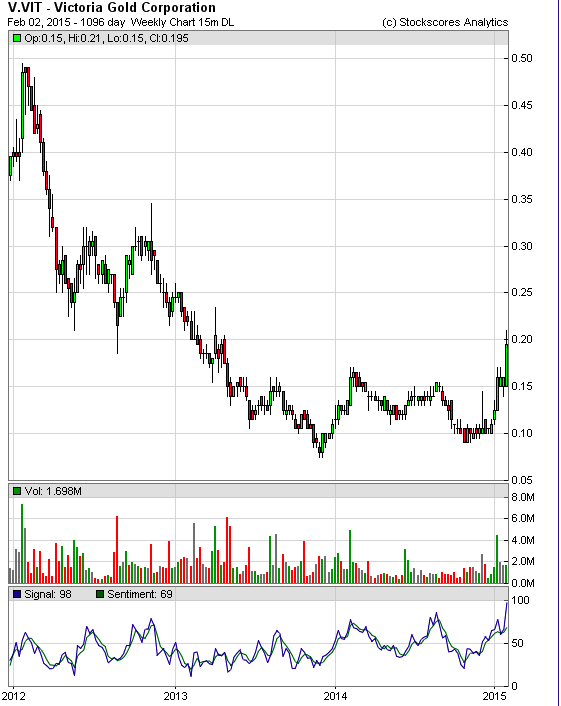
1. V.VIT
V.VIT traded strong volume and made a good gain today, breaking it out through resistance going back over a year. This stock is not very liquid and highly speculative so smaller positions are only appropriate. Next level of resistance is at $0.30, support at $0.14.

Screen Shot 2015-02-03 at 6.04.47 AM

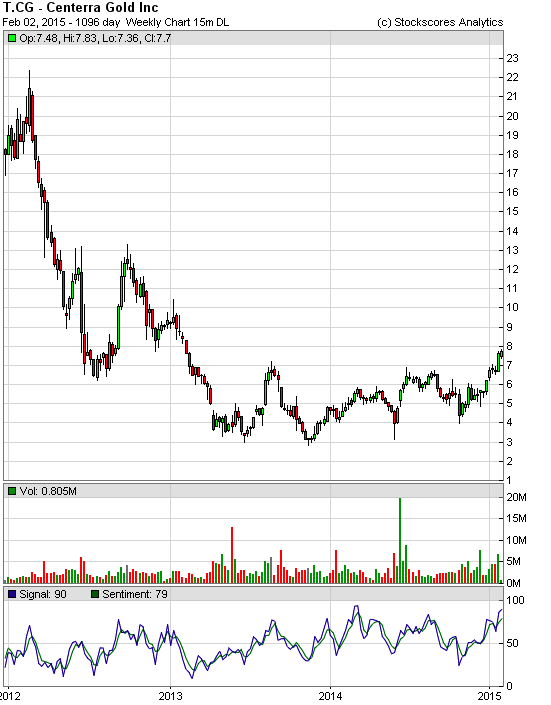
2. T.CG
T.CG broke through $7 resistance last week after a lengthy period of sideways trading and base building. Support at $6.60, resistance at $12.

Screen Shot 2015-02-03 at 6.05.04 AM

References


Disclaimer
This is not an investment advisory, and should not be used to make investment decisions. Information in Stockscores Perspectives is often opinionated and should be considered for information purposes only. No stock exchange anywhere has approved or disapproved of the information contained herein. There is no express or implied solicitation to buy or sell securities. The writers and editors of Perspectives may have positions in the stocks discussed above and may trade in the stocks mentioned. Don’t consider buying or selling any stock without conducting your own due diligenc

The Week Ahead

This week sees announcements on monetary policy by a number of central banks,in particular the Reserve Bank of Australia (Feb 2nd) and the Bank of England (Feb 5th).The beginning of the month also brings the release of Purchasing Managers Index data on key sectors ( manufacturing,construction and services) of the members of the global economy.The first off,was China were manufacturing PMI disappointed at 49.8. Eurozone PMI releases were generally better than expected with the exception of Germany which was reported at 50.9. The week finishes with the release of employment data for January for the US economy.

The biggest mover in the FX space overnight was the Swiss Franc (-1.24%) after reports surfaced that the SNB may be intervening in the market and was targeting the EUR/CHF somewhere rate between 1.05-1.10 This morning will see the release of Personal Consumption Expenditure (PCE) index data, PMI and Personal income and spending & construction data for the US. Canadian RBC PMI data for January is expected at 52.27 ( previous 53.9).The Canadian dollar has benefitted overnight from a strong rally in crude,which at one point was trading through $50 a barrel,currently at $48.89 (+1.66%)

CAD Range 1.2773-1.2654 Currently 1.2683 RES 1.2814 1.2892 SUPP 1.2627 1.2523

CADUSD-2FEB

Larger Image

Monetary Metals Outlook 2015

It’s the start of a new year. The question on everyone’s mind is whither the prices of gold and silver? This Brief presents our answer (and the full Monetary Metals Outlook 2015 report gives our reasoning).

One approach to the question of price is to draw a line, extrapolating the past trend into the future. Here is the graph for gold.

1

This line would give us a gold price around $1000 at the end of 2015. If we did it for silver (not shown), we would get around $10.

We don’t think that most traders would do something this simple (though some mainstream anti-gold commentators might). Our point is that technical analysis is about looking at the trend. We do not believe that the past trend in the gold price is likely to be a good predictor of the price in the future, because the past drivers of the price won’t be operative in the future.

Another approach is to plot gold against M1 money supply. Here’s what that looks like.

2

This implies that the price already ought to be well over $2,000 and unless central banks put down their keyboards and back away, it will be hundreds of dollars higher by the end of 2015.

We don’t believe this approach, or any approach based on the quantity of money, is valid. At best, one can find correlation without causality. For example, some people thought that there was a correlation between the winning conference of the Super Bowl and the presidential election (an NFC win was supposed to forecast a Democratic president). We think this chart proves there is no causal link between money supply and the gold price.

Other analysts attempt to calculate a gold price based on inflation—by which they mean rising consumer prices. They say gold should do well in inflation. And, they say that it should be coming any day now because look at how fast the money supply is growing. We don’t think that the money supply drives consumer prices any more than it drives the gold price. The crashing commodity markets over the past few years—notably oil in the second half of 2014—should once and for all debunk this idea.

Gold is not purchased for consumption. So even if consumer prices were rising, that does not mean that the gold price must rise. Or, vice versa. Consumer prices are influenced by numerous variables such as efficiency of production that have nothing to do with gold.

Many fall back on the fundamental argument for gold and silver. Paper currencies are now being debased recklessly. Every central bank in the world has openly declared its intent to beat down its currency. This is true, paper currencies have been falling for decades. We believe they will all go to their intrinsic value—zero. There’s just one catch, it doesn’t necessarily have to happen tomorrow morning.

So the past gold price doesn’t predict the gold price of the future. Any correlation between the gold price and macroeconomic indicators is temporary. And, we can’t trade gold based on the premise that paper currencies will meet their final fates. So where does this leave us?

We first need a method of measuring current supply and demand fundamentals in the monetary metals. They are quite different from all other commodities, as humanity has been accumulating them for millennia. We discuss our methodology and show our data and reasoning in the full report. In this brief, we will just skip to the bottom line and give our year-end Fundamental Prices for gold and silver.

They are $1,319 for gold and, brace for it, $15.10 for silver. Both of these numbers have come up a little in the first weeks of the year, but not enough to change our view of the market as it stands now.

That’s the key phrase: as it stands now. The supply and demand fundamentals emerge from a dynamic interplay between several kinds of market participants (we describe this in more detail in the full report). At the moment, it’s not showing any signs of major breakouts. There simply is no reason today to back up the truck and load up on gold—much less silver. (If you don’t own any, then our advice is to go buy a little—not for trading but for holding—and don’t worry about the price).

That said, a sea change is coming.

To have any chance of predicting it, we have to understand what drives people to buy gold. We don’t mean what news stories make people hit the buy button on their futures workstation, or buy GLD calls on E-Trade. Speculators, especially those who buy with leverage, cannot create a durable and long-term move higher in price. They are just trying to front-run what they believe will happen, and often end up front-running only each other.

What makes people buy gold coins and bars, and stick them under the mattress for years or decades?

The answer is simple, but a paradigm shift from everything we’ve all been taught in government schools, watched on TV, read in the financial news, and learned in Econ 101. Gold is the only financial asset that is not someone else’s liability. There are plenty of other financial assets; the world is overflowing in paper derived from paper, stacked on top of paper. And every one of them depends on a counterparty servicing the debt and making payments. There are also many tangible assets such as antique cars, real estate, and art work. Every one of them is illiquid in good times, and may be impossible to sell in a crisis.

Gold is unique for these reasons.

Ignoring the speculators, who only buy gold to sell it for a quick gain when the price rises, or to cut losses when the price falls, who buys gold to hold for the long term? What are their motivations?

Anyone in the world buys gold when they don’t like the interest rate offered on paper, and especially when they don’t like the rising risks.

Based on the price and supply and demand moves so far, it is likely that the price of gold will end the year higher than it ended 2014. However, silver will fall if the speculators currently holding it up give up.

In this annual report, we’re not just trying to look at whether the metals are over- or under-priced. We are trying to predict a change in attitudes. It is not a matter of if, but of when.

We think the sea change is more likely than not to begin in 2015. We don’t use the term “sea change” lightly. The crisis of 2008 was the beginning of a credit collapse. Most market observers believe that the central banks fixed the problem, and have been talking of the “green shoots” and “nascent recovery” and “GDP growth” for years.

It is noteworthy that even the skeptics have accepted that the system will hold together. Most of them have given little thought beyond how to make more dollars. Even gold is just a vehicle to speculate to make dollars. In other words, few have been worrying about default risk. They have focused on inflation, and trading to get a higher rate of return than that.

This means they have not focused on counterparty risk or credit quality. We think this will change in a big way.

At the moment, we see little reason to put a lot of capital in harm’s way betting on a rise in the gold price, much less on silver. But that’s why we reassess the supply and demand fundamentals every week in our Supply and Demand Report. We will report on changes as they occur.

This Monetary Metals Brief 2015 is based on the full Monetary Metals Outlook 2015report. The full report contains graphs of the monetary metals’ Fundamental Prices for 2014, a fuller discussion of gold, our macroeconomic views including the resent crisis in Switzerland, and our supply and demand theory.

test-php-789