Personal Finance

SWOT Analysis: The Gold-Royalty Business Model Continues to Show Opportunity

Strengths


  • The minutes from the Federal Reserve’s January meeting showed that policy makers argued for keeping interest rates near record lows for longer due to both the stronger dollar and the crisis in Greece. This news favors the case for both gold and silver.
  • Mandalay Resources announced its proven and probable gold reserves were up 136 percent in 2014 as a result of the Bjorkdal mine acquisition. Richmont Mines announced revenues were up 47 percent and operating cash flow was up 689 percent in 2014.
  • Timmins Gold announced it will acquire Newstrike Capital by way of a court-approved plan. This continues the recent streak of acquisitions in the mining space.


Weaknesses


  • Alamos Gold announced that legal challenges in Turkey have increased uncertainty of the expected timing for receipt of permits for its Kirazli project.
  • According to a study of almost 100 global gold mining transactions by the Bloomberg Intelligence Metals and Mining team, valuations for gold mining deals peaked in 2011 and then fell more than 70 percent to a historical low in 2014. Mine prices fell faster than the metal due to lack of corporate interest in deals. As a result, gold mine values fell 350 percent more than the metal’s price.
  • Michael Rawlinson, Global Co-Head of Mining and Metals at Barclays, commented that while the sharp drop in oil prices has reduced costs for mining companies it has also added to uncertainty in the market and could prolong the wait for the commodity cycle to turn upwards again. This is mainly due to two unforeseen events: the drop in iron ore prices and the sudden collapse of the oil price.


Opportunities

2-23fh


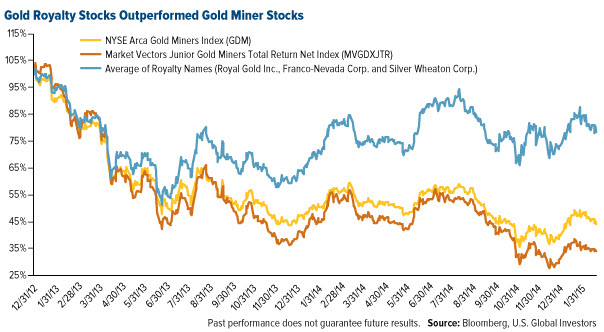
  • RBC Capital Markets published a report highlighting Osisko Gold Royalties as being well positioned to outperform in the current price environment. This is due to a strong balance sheet that could allow it to pursue accretive deals as well as positive optionality in its existing portfolio. This is yet another implication of the gold-royalty business model which has outperformed the broader gold miner stocks in recent years.
  • Dundee Capital Markets initiated coverage of Klondex Mines with a “buy” rating. It highlighted that the company is positioned as a high margin and growing producer, has no material capital requirements, and that the company is forecasted to generate sizable free cash flow. Furthermore, the company’s assets host highly prospective exploration upside.
  • John Thornton, Barrick Gold’s chairman, commented that he’s planning on returning the company to its partnership culture that used to define it in its early days, underpinning much of its success. Newcrest Mining announced it is open to selling its Telfer gold and copper mine in Australia.


Threats


  • House Democrats have launched a perpetual U.S. mining reform crusade proposing measures that would force miners to pay royalties for minerals extracted from public lands and contribute to a fund for clean-up costs.
  • Sibanye’s CEO announced that the company is through with buying assets as it deems them expensive in the current environment. Nonetheless, he still sees potential for substantial synergies between companies.
  • Bank of America announced that gold may drop to $1,150 in the next few weeks citing the outlook for U.S. monetary policy.


http://usfunds.com/

Greece can declare a small victory. As Prime Minister Alexis Tsipras stated Friday evening, “a battle has been won, but not the war.” Since their new government was elected with a mandate to better the terms of their bailout, they have now successfully dealt themselves more time to negotiate with other member European countries and the IMF. Whether negotiations will be successful four months from now and they will actually be able to deliver on their mandate against austerity is still to be determined. The headline “Greece Reaches Deal with EU,” which sent financial markets joyously higher was not based on a solution, but instead a deal to make a deal four months from now as we revert back to the oft to used expression of kicking the can down the road.

Credit can be given to Greece because they have managed to single handily isolate Germany as the ‘bully’ of Europe. Since this government was elected a little less than a month ago, their first condition for negotiations was to deal with European nations individually. Greek Finance Minister Yanis Varoufakis startled financial markets with the statement, “we will no longer negotiate with the Troika,” referring to the 3 member group of creditor institutions: the European Central Bank, the International Monetary Fund, and the European Commission. Instead, he chose to threaten their stability and expose their fragility, which ironically depicts the problems of the euro currency. The members are not united as they differ dramatically in terms of culture and politics, which questions why they also back a common currency.

This calculated move by Greece is what’s bought them more time to potentially break and renegotiate the terms of their original bailout. Single handily isolating Germany and gaining support from Italy, the third largest EU nation means that some of the institutions that originally dealt Greece their bailout terms are now fractured. Very simply, Germany now faces the challenge of keeping other influential voices like France and Italy united with their own. And that predicament seems to suggest Germany may be losing its hold on power in these negotiations, as was suggested earlier this month.

There are three possible outcomes for Greece’s negotiations with the other EU nations. The first is they simply leave the Euro. The implications of this are far reaching and a treacherous story from bank runs to a Greek government that is unable to raise revenues from credit markets. Second, Germany maintains a united voice through Europe and Greece’s new Syriza government is forced like past governments to accept the hand they were dealt. The third option, which became more likely on Friday, is Greece does manage some victories to ease the bailout terms and move away from austerity budgets.

This question is what will eased bailout terms actually achieve for Greece?

Some economists have actually argued that austerity in itself has been a myth for Greece. Because of the way bailout terms have been negotiated with low interest rates for a long enough time period, debt burdened Greece actually spends less than both Italy and Ireland on debt service payments (interest paid on their debt) every year. As well, because so little of their budget goes to servicing their debt this brings into question, how much austerity is actually being imposed or indeed avoided from the bailout?

Through the recent quantitative easing announcement, the ECB has created some stability for the euro market for the time being. This allows investors to focus on geopolitics instead of the economic stagnation of the Eurozone witnessed through the second half of 2014. As the Germans are and will remain the largest creditor, they will always remain at the table for debt talks. But the question should be asked, without a united institution representing the lenders, what’s their tipping point for keeping Greece in the euro?

The pending answer to that puzzle will keep markets volatile end edgy for some time.

Robert Levy

Border Gold Corp | www.bordergold.com

15234 North Bluff Road, White Rock, BC V4B 3E6

(Tel) 1-604-535-3287

(TF) 1-888-312-2288

(Fax) 1-604-535-3259

If Debt Was The Problem…

logo dollarcollapse smConfounded Interest just posted a nice summary of a McKinsey report on the growth of global debt during what some persist in calling the “great deleveraging.” Turns out that since the crisis of 2008, debt has actually risen by $57 trillion, and the ratio of debt to GDP is up 17 percentage points to 286%. Meanwhile, central banks are monetizing 100% of newly-issued sovereign debt. 

The obvious response to this is 1) wow, nothing has been fixed; in fact just the opposite, and 2) these stats, horrendous as they are, are incomplete because they don’t include unfunded liabilities of governments and private pensions, which are just as real as any other kind of debt.

But unfunded liabilities must be getting better, what with the stocks and bonds in pension fund portfolios soaring lately. Right? Since that’s an effortless Google search, that’s what I did. And the results were both counterintuitive and scary. It seems that even with pension fund investment portfolios booming, obligations to future retirees are rising even faster, making these entities even more underfunded today than in 2007. Here’s a sampling of the headlines just from February, in the order they appear in the search window:

Unfunded liabilities and the investment smokescreen

US teachers state pensions near $500 billion in underfunded liabilities

Teacher pensions: the math adds up to a crisis

Unfunded pension liabilities up for Pittsburgh

Cascade report exposes $26 billion unfunded liabilities 

Prescott unfunded pension liability surpasses $70 million

Sacramento’s ‘wall of debt’ grows dangerously high 

Absent from this list is the US federal government’s number, though that’s also easy to find. From Forbes: You Think The Deficit Is Bad? Federal Unfunded Liabilities Exceed $127 Trillion. That’s about 6 times the reported federal debt. 

Now, easy money advocates argue that the solution to this and all other unbalanced economic equations is to borrow and spend enough new cash to get asset prices up and put people back to work. But stocks and bonds are currently at record highs and the unemployment rate is below 6% (peak-of-the-cycle kinds of numbers that have historically preceded corrections in which investment returns and tax receipts both plunge, raising unfunded liabilities). 

So it looks like we’ve thrown our best punch and the problem is still standing there, wondering if that’s all we’ve got. Which leaves the US and the rest of the world — where debt and unfunded liabilities also continue to rise — with the question: If debt was the thing that nearly destroyed the global financial system in 2008 and debt — both narrowly and broadly defined — is way up since then, what happens in the next downturn? The answer is who knows, because this is uncharted territory both in terms of the size of the imbalances and governments’ policy responses. 

The only thing that’s certain is that there are more cities, states and related pension funds poised to blow up than ever before.

Be A Better Investor

I wanted to take the opportunity this week to introduce you to a section of the website that you may not be aware of called “Must Reads.”

There is no one more invested in your money than you. It is from this viewpoint that I believe you should have a better understanding of the dynamics behind putting your hard earned “savings” at risk.

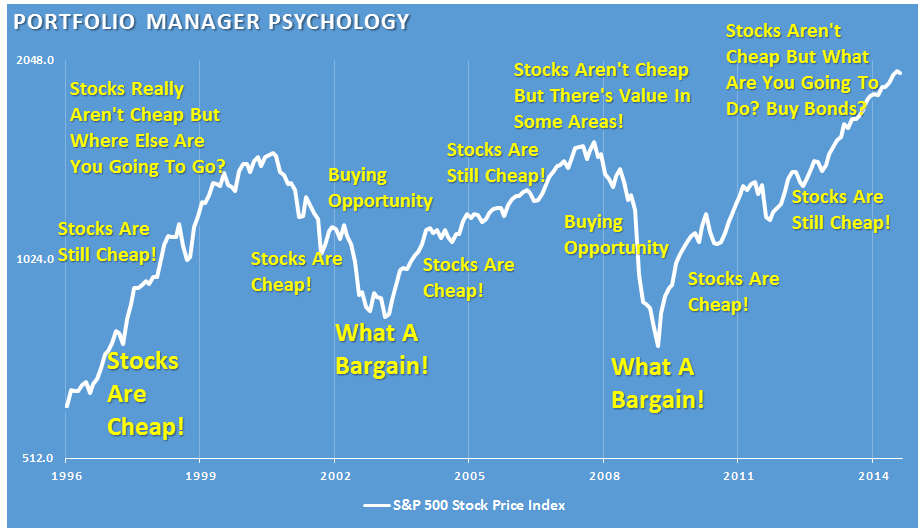
As I have written previously, Wall Street money managers are a highly conflicted lot. They are incented, because of the extraction of fees, to keep you always invested in the financial markets. The chart below shows the “excuse/rationalization” of portfolio managers over time.

Portfolio-Manager-Psychology

While most portfolio managers have a great strategy for “buying” into the markets, the need to chase performance leads to an inability to “sell” when needed to protect investment capital. The fear of “missing out” on a market advance, or the negative impact of making a wrong “call,” are emotional biases that impair their decision making over the long-term. This is why the vast majority of mutual funds perform relative to their benchmark index despite their stated goals of expecting to outperform.

continue reading HERE

When should I sell? This is one of the most frequent questions we hear. Our glib (yet truthful!) answer: Never (ideally). We’ll come back to that shortly, but in the meantime, here are five reasons we do sell stocks.

Reason No. 1: Valuation

KeyStone Invests for the long term here, but sometimes Mr. Market shows our stock too much love. We will consider selling if a stock price has run up to a point where it no longer reflects the underlying value of the business. In some cases, our choice is to SELL HALF our original position in a stock that has had a very strong gain (100% for example) and remove all our original capital if the valuations are simply too rich. The strategy also removes all our initial risk capital and often allows us to continue to HOLD a great stock and in the process, sleep very soundly at night.

Reason No. 2: Better 0pportunities

Sometimes, there’s nothing wrong at all with a company or its stock. There are simply better opportunities elsewhere that will

bring us more bang for our bucks. We will consider selling a less attractive stock (at a profit or loss!) if we think we can get a better deal elsewhere. Of course, this analysis is not simple and can be very stock specific.


Reason No. 3: Business Changes

There’s no way around it: Businesses change — sometimes significantly. We could be talking about a major acquisition, a change in management, or a shift in the competitive landscape. When this occurs, we incorporate the new information and re-evaluate to see if the reasons we bought the company in the first place still hold true. We will consider selling if:

  • The company’s ability to crank out consistent profits is crippled or clearly fading.
  • Management undergoes significant changes or makes a series of questionable decisions.
  • A new competitive threat emerges or competitors perform better than expected. 

We’ll also take into account unfavourable developments in a company’s industry. Here, it’s important to delineate between temporary and permanent changes. In a downturn, financial figures may suffer even for the best-run companies. What’s important is how these businesses take advantage of the effects on their industry to improve their competitive position.

Reason No. 4: Faulty Investment Thesis

Everyone makes mistakes. Sometimes, you will just plain miss something. You should seriously consider selling if it turns out your rationale for buying the stock was flawed, if your valuation was too optimistic, or if you underestimated the risks. Or if the environment has changed, such that your original investment thesis is now flawed.

Reason No. 5: It Keeps Up at Night

It is tough to put a dollar value on peace of mind, but if we did, it would be a pretty penny. If you have an investment whose fate has become so uncertain that it now causes you to lose sleep, this could be a great cue to move your dollars elsewhere. We are trying to reduce the stress in our life here, not add to it. We save and invest to improve our quality of life, not to develop ulcers. Adding insult to injury, stressing about a stock might cause you to lose focus and make rash decisions elsewhere in your portfolio. Remember, there’s no trophy or prize for taking on risk in investing. Stick with what you’re comfortable with.

Like Kenny Rodgers Says, “You’ve got to Know When to Hold ‘em”

While I am loathe referencing “The Gambler” when discussing our investment philosophy as the concept could not be farther from what we preach, the line fits. If these are the reasons to fold ‘em, how do we know when to hold’em?

Remember, we’re long-term investors, not weak-kneed speculators. It is important to note, not one of these reasons to sell is related to an “analyst” changing their recommendation or simply because a stock has fallen in price. Both of these items provide great fodder for the talking heads of the world but have absolutely no impact on the underlying businesses into which we are buying. Over the course of what will be a prosperous investing career for you, the market will rise and fall. Recessions and booms will happen. And all the while, you must stay focused on the long term. Fear is never a reason to sell.                                                                                              

Action: Put it in writing. For each stock in your portfolio, write down why you bought it, your expectations, and what would make you sell. Refer to it frequently — and before you decide to give your stock the heave-ho.

If your original reasons for buying the stock remains intact, the business is growing, management is executing and valuations remain relatively reasonable – our best advice it to ride out your winners long term.

Real World Example: BUY & HOLD for 7 Years – Never Once Recommended Selling!

Boyd Group Income Fund (BYD-UN:TSX): Shares up over 2,000%

The relatively unknown independent auto repair shop operator, Boyd Group Income Fund (BYD-UN:TSX), is a stock KeyStone recommended well over 7-years ago at $2.30 and continue to HOLD today (having recently recommended clients buy more) with the stock above the $47 level, despite the fact the stock has jumped over 2,000!.

While the stock has performed incredibly well, the company has more than quadrupled its revenue over the past 7-years, increased earnings by more than 5 times, and grown into one of the largest independent autobody repair firms in the U.S.

You only need a couple of stocks like this in your portfolio throughout your entire investment career to make you a successful long-term investor. You just have to know when and how to hold’em.

2/17/2015
P&C INSURANCE OPERATOR POSTS STRONG 2014 RESULTS, BOOK VALUE INCREASES, MODERATE NEAR-TERM GROWTH, SOLID LONG-TERM – MAINTAIN BUY LONG-TERM

2/12/2015
UNDERVALUED SPECIALTY PHARMA POSTS STRONG Q1 2015, COULD RECEIVE RE-RATING HIGHER BY INVESTORS IN 2015 VIA LATEST ACQUISITION AND NEW CEO OUTLOOK – UPGRADE RATING

2/4/2015
EXTRUSION & AUTOMOTIVE MANUFACTURER REPORTS STRONG START TO 2015, DIVIDEND INCREASES 20%, ACCRETIVE ACQUISITION/EXISTING BUSINESS EXPANSION POWER GROWTH, OUTLOOK POSITIVE FOR 2015

1/16/2015
CASH RICH COMMUNICATIONS SOFTWARE & HARDWARE PROVIDER POSTS STRONG 2015, NEAR-TERM OUTLOOK IMPACTED BY LONG-TERM INVESTMENT SPEND – MAINTAIN RATING (NEW CLIENTS ESTABLISH HALF POSITIONS)

1/14/2015
CASH RICH ON-DEMAND TV SOFTWARE AND SOLUTIONS SMALL-CAP REPORTS SIGNING MAJOR CONTRACT WITH EUROPEAN TIER 1 CABLE OPERATOR, SHARES SURGE 30% – MAINTAIN SPEC BUY RATING (FOCUS BUY)

test-php-789