
Bonds & Interest Rates
 Ed Note: This article is a perspective on Martin Armstrong’s “Big Bang” in 2015.75
Renowned precious metals analyst David Morgan is out with a new book called “The Silver Manifesto.” In a chapter called “The Debt Bomb,”Morgan lays out the biggest problem and the biggest reason to own precious metals. Morgan contends, “Basically, the United States have exported our inflation to every other country. So, for them to stay competitive, they are required to weaken their own currencies for what is called competitive advantage. It simply means if they don’t print … their currencies would become too strong, and they would not be able to export. In order to keep trade flowing, these other countries are basically required to do what the U.S. government does, and that is export a great quantity of un-backed paper promises that are impossible to pay back. That’s the crux of “The Debt Bomb.” It’s going to explode. … The basic premises are: You default on the debt … or you keep kicking the can down the road, and you continue to debase the currency, which is what governments have always done when it’s a non-backed currency. If you look at the value of the Federal Reserve from 1913 to now, in a little over a hundred years, the Federal Reserve itself will admit that 100 cents is now worth about 4 cents. So, you have lost 96% of the value of the U.S. dollar…. That has been a failure, a tremendous failure. That is a collapse in slow motion. Now, what we are really arguing about is what’s going to happen to the last 4 cents of the U.S. dollar…. It looks to me that at some point, a tipping point, that you will get an acceleration … and things will change dramatically.”
On the Greek debt crisis, will it be forced to default? Morgan says, “Yes, and the problem is everyone in power is acting
like a bunch of kids. No one wants to be an adult and state the problem clearly. This new regime in Greece actually has. They are the only truth tellers at the political level that actually said we are bankrupt.”
On the price of silver, Morgan says, “What is $16 silver compared to $5 silver over a decade ago, and basically they are the same price. Isn’t that amazing, this inflation that nobody talks about. It you take the $5 silver price back in 2003, and you use the true money supply of fiat currency today, hey guess what, it is pretty close to $16. So, in a nut shell, because you are buying the same silver for basically the same amount over a decade ago, it’s really on sale. It is really a bargain.”
When might the economy and the “debt bomb” explode? Morgan predicts this fall. Why? Morgan says, “Momentum is one indicator and the money supply. Also, when I made my forecast, there is a big seasonality, and part of it is strict analytical detail and part of it is being in this market for 40 years. I got a pretty good idea of what is going on out there and the feedback I get…. I’m in Europe, I’m in Asia, I’m in South America, I’m in Mexico, I’m in Canada; and so, I get a global feel, if you will, for what people are really thinking and really dealing with. It’s like a barometer reading, and I feel there are more and more tensions all the time and less and less solutions. It’s a fundamental take on how fed up people are on a global basis. Based on that, it seems to me as I said in the January issue of the Morgan Report, September is going to be the point where people have had it.”


 I have always argued that quantitative easing and zero percent interest rates were misguided policies to combat economic weakness. But as the years went on, misguided turned into irresponsible, which led to ridiculous, and then turned into dangerous. But lately, the only word that comes to mind is “surreal.” How should we react when central bankers begin to speak like Willie Wonka?
Contained in the latest release of the Minutes of the Federal Reserve’s Open Market Committee (Jan. 27-28, 2015) was a lively discussion of how to say something without anyone understanding what is being said. Although I have been critical of the Fed for many years, I never imagined that it would provide me with material that bordered on the metaphysical.
As Fed policies have become ever more critical to our economic health and stock market performance (see our 2015 Outlook piece in our latest newsletter), the degree to which investors and journalists dissect every public statement and utterance by Fed officials has increased remarkably. At present, one of the biggest points of contention is to find the true meaning and significance of the word “patient.”
Last year, as market watchers grew nervous with the Fed’s withdrawal of its quantitative easing purchases, many began to wonder how long it would be, after the program came to an end, for the Fed to actually raise interest rates, which had remained at zero since 2008. After all, this would shift the bank into a second, potentially more consequential, phase of monetary tightening. Investors wanted to know what to expect.
Initially the Fed let market participants know that it would hold rates at zero for a “considerable time” after the end of QE (9/13/12 press release), thereby creating a buffer zone between the end of QE and the beginning of rate increases. But, after a while, this also became too amorphous and static for investors who crave actionable information. So in December of 2014, in a bid to increase “transparency” (which is the central banking buzzword for “no surprises”), and to signal that the day of tightening had moved closer, the Fed replaced “considerable time” with the word “patient.” But this only deepened the mystery. Investors began to wonder what “patient” actually meant to the Fed. With potential fortunes riding on every word, the discussion was anything but academic.
When pressed for an answer at a Fed press conference, Yellen explained that the word “patient” in the FOMC statement indicated that it would be unlikely that the Fed would raise rates for at least “a couple” of meetings. She then conceded that “a couple” could be interpreted as “two.” Since the FOMC meets every six weeks, that seems to mean that a rate hike would not happen for at least three months after the word “patient” is removed from its statements. But she was also careful to say that removal of the word “patient” does not necessarily mean that the Fed would raise rates after two meetings, just that it’s possible. But this much transparency may have become too much for the Fed to handle.
With the economy now clearly losing steam, based on the drop in GDP from 3rd to 4th quarters, and general macro data coming in very weak (Zero Hedge, 2/18/15), I believe the Fed wants desperately to move those goalposts. But after a series of seemingly strong jobs reports, culminating with a strong 295,000 jobs in February, the market expects that “patient” will soon disappear from the statement. The Fed wants to comply, thereby signaling that everything is fine. But at the same time it doesn’t want the markets to conclude that rate hikes are imminent when it does.
In other words, they are searching for a way to drop the word “patient” without communicating a loss of patience. What? This is like a driver telling other drivers that she plans on engaging her turn signal before making a left, but then wonders how to hit the blinker without actually creating an expectation that a turn is imminent. This seems to be a question for psychologists not bankers. Perhaps it is looking for a new word to replace “patient”? Something that implies a slightly less patient outlook, but that certainly does not imply imminence. “Casual” or “nonchalance” may fit the bill. How would the markets react to a “nonchalant” Fed? Time for a focus group.
The recently released Minutes of the January 27-28 FOMC Meeting frames the difficulty:
“Many participants regarded dropping the “patient” language in the statement, whenever that might occur, as risking a shift in market expectations for the beginning of policy firming toward an unduly narrow range of dates. As a result, some expressed the concern that financial markets might overreact, resulting in undesirably tight financial conditions.”
Translated into English this means, “We hope the markets don’t actually believe what we tell them.” The Minutes continue:
“A number of participants noted that while forward guidance had been a very useful tool under the extraordinary conditions of recent years, as the start of normalization approaches, there would be limits to the specificity that the Committee could provide about its timing.”
To me this translates as “Transparency was great while we were loosening policy, or doing nothing, but it isn’t useful now that the markets expect us to tighten.” If you believe as I do, that the Fed has no intention of tightening anytime soon, its sudden aversion to clarity is understandable. Not surprisingly, the Committee appears to be in favor of shifting to a “data dependent” stance:
“…it was suggested that the Committee should communicate clearly that policy decisions will be data dependent, and that unanticipated economic developments could therefore warrant a path of the federal funds rate different from that currently expected by investors or policymakers.”
Of course the Fed won’t actually define exactly what type of data movements will translate into what specific policy actions. In that sense, a “data dependent” policy stance puts the Fed back into a “goalpost-free” environment where no one knows what it will do or when it will do it.
To underscore the absurdity of the situation, Chairman Yellen, at her semi-annual Senate testimony in February, offered this “full-throated” warning about pending policy normalization, saying that the Fed “will at some point begin considering an increase in the target range for the federal funds rate.” So this means that after some unspecified time of not even thinking about rate increases, the Fed will “begin” the process of getting itself to the point where it may “consider” (which is in itself an open-ended deliberation) an increase in its rate target (which does not even in itself imply an actual increase in rates). Yet despite this squishy language, the lead front page article on February 24th in the Wall Street Journal (that contained that quote), ran under the bold headline “Yellen Puts Fed on Path to Lift Rates.” Leave it to the media to carry the water that the Fed refuses to pick up.
So are we expected to believe that the Fed hasn’t even begun considering rate increases yet? Really? Isn’t that the biggest, most urgent, issue before it? The Fed is a central bank, what else is it supposed to consider? This is like a 16-year old boy saying that “at some point in the future I may begin thinking about girls.” Till then, should we expect him to think solely about homework and household chores?
Fed officials have warned that they are concerned about raising rates too quickly. Perhaps that fear may have been plausible a few years ago, before unemployment plummeted and the stock market soared. But how would a 25 basis point increase in rates seriously slow an economy that most people believe has fully recovered? And if the Fed is concerned now, why would it not be concerned next year? If anything, the longer it waits, the more vulnerable the recovery will be to higher rates.
The business cycle tells us that recoveries do lose momentum over time. The current recovery is already five years old, and is, statistically speaking, already well past its prime. And since low rates encourage the economy to take on more debt, the longer the Fed waits to raise rates, the more debt we will have when it does. This means that the debt will be more costly to service when rates rise, which will throw even more cold water on the “recovery.”
The Fed’s real predicament is not how to raise rates, but how to talk about raising interest rates without ever having to actually raise them. If we had a real recovery, the Fed would not need to couch its language so delicately. It would have just pulled the trigger already. But when its communications and its intentions are different, credibility becomes a very delicate asset.
The above is an abridged version of a longer article that appears in the Winter 2015 Euro Pacific Global Investor Newsletter
Best Selling author Peter Schiff is the CEO and Chief Global Strategist of Euro Pacific Capital. His podcasts are available on The Peter Schiff Channel on Youtube.

#10. BCE Inc. (TSE:BCE.CA) — 4.8% YIELD
At #10, BCE provides residential, business and wholesale customers with communications solutions including wireless, Internet, Internet protocol (IP) television (TV) and satellite TV, local and long distance, business IP-broadband and information and communications technology services. Co.’s key operation, Bell, is a local exchange carrier in Ontario and Quebec, and consists of its Bell Wireline, Bell Wireless and Bell Media segments. Bell Media is a multimedia company that holds assets in TV, radio, digital media and out-of-home advertising. Co. also owns a 44.1% interest in Bell Aliant, which include the incumbent carrier in Canada’s Atlantic provinces and in rural areas of Ontario and Quebec.


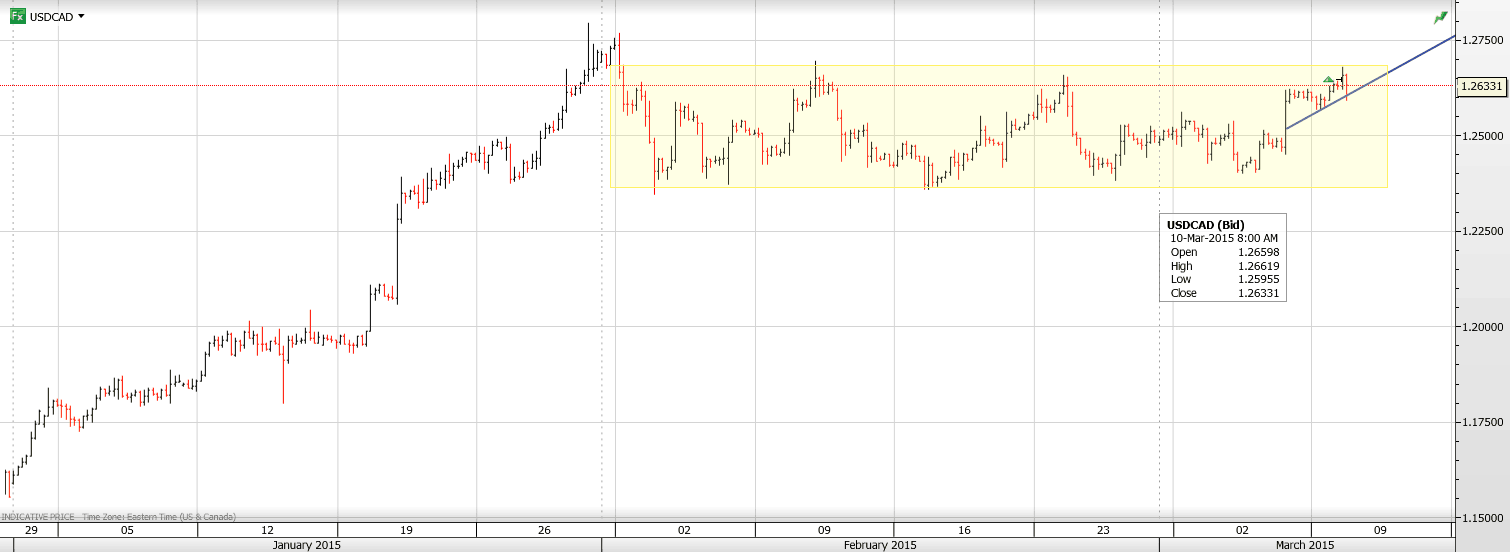
USDCAD Overnight Range 1.2600-1.2680
USDCAD hit resistance at 1.2680 overnight and has been tumbling ever since, touching 1.2500 just recently. It did not move in a vacuum but as part of a widespread US dollar retreat as a lack of fresh stimulus led to profit-taking.
Overnight, it was a different tale. The US dollar stormed higher in Europe despite a lack of a clear catalyst for the move. The US gains were impressive and across the board, gaining nearly 1% vs. EUR and over 1% vs. NZD and AUD. In a speech, Dallas Fed Chairman, Richard Fisher, his last as a member of the Fed, called for the FOMC to raise early.While nothing new, in the face of last Friday’s strong employment report and the start of QE in the EU, traders started buying US dollars again. The break of key support levels (107.60) in EURUSD point to further losses ahead.
However, so far in New York trading, EURUSD is about where it started while the dollar lost ground against GBP, JPY CAD and AUD
USDCAD technical Outlook
The intraday USDCAD technicals are bullish following the break of resistance at 1.2580 and again at 1.2620. However, it appears that resistance in the 1.2660-80 has contained the rally and until 1.2800 is decisively broken the current USDCAD 1.2360-1.2680 range remains intact.


-
I know Mike is a very solid investor and respect his opinions very much. So if he says pay attention to this or that - I will.
~ Dale G.
-
I've started managing my own investments so view Michael's site as a one-stop shop from which to get information and perspectives.
~ Dave E.
-
Michael offers easy reading, honest, common sense information that anyone can use in a practical manner.
~ der_al.
-
A sane voice in a scrambled investment world.
~ Ed R.
Inside Edge Pro Contributors

Greg Weldon

Josef Schachter

Tyler Bollhorn

Ryan Irvine

Paul Beattie

Martin Straith

Patrick Ceresna

Mark Leibovit

James Thorne

Victor Adair