Personal Finance

Faber: The Three Mega Trends For This Decade

imagesFaber : China will also join the club of Money Printers

ET Now: You have said that one should always bet on mega trends, bet on the big picture. So what are the three mega trends for this decade?

Marc Faber : We are half way into the decade, there are only five years left. As I told you, I personally do not rule out that the US stocks could go up somewhat more, but if you take a 5 to 10-year view, the investors will make more money in emerging economies than in the US. I believe that geopolitical problems are here to stay. I also happen to believe that the Middle East will blow up and whereas everybody was very positive about oil when it was trading around $100 a barrel and above. The same analysts now think it will go down to 20.

My guess is that the price of oil has an equilibrium price of between $40 and $60 and it will settle around that level eventually. Can it drop to $20 for a few days? Yes, it dropped to $32 in December 2008, but then rebounded very strongly. So a lot of things can happen. I would also say that the Chinese stock market, which performed even worse than India after 2006 relative to global markets, bottomed out last summer and we had a huge run-up in prices in the last three-four months of about 50% on the Shanghai A Index. A correction is due, but I believe that China will also join the club of money printers.

Also from Marc:

The US Economy weakening not strengthening

 
Faber Warns : The Middle East will Blow up

Jim Rogers: The U.S. Dollar Can Go Much, Much Higher

It is my largest position. Janet Yellen is going to raise interest rates or the market is going to raise interest rates. Rates are going to go higher and when that happens the Japanese are not going to raise rates, the Europeans are not going to raise rates. So, the dollar can go much, much higher. 

Monthly Chart

Screen Shot 2015-04-02 at 6.37.38 AM

Dollar Index: How High Can It Go?

This is not a bubble yet. It is expensive, it has gone up a lot. It has gone up dramatically but it is not a bubble yet. I don`t know 120, 125, you will have to tell me what is going on in the world. If there is war, who knows how high it could go?
You can tell it is a bubble when you see people on Bloomberg TV begging to buy the dollars and saying that there is no other currency or place to put your money, except U.S. Dollars.
 
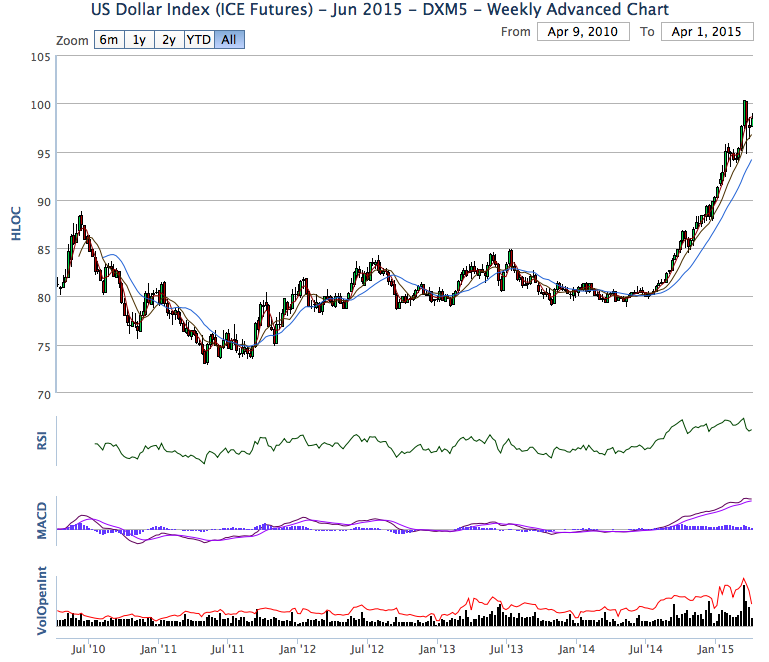
Weekly Chart
Screen Shot 2015-04-02 at 6.38.55 AM
 
The U.S. Dollar Can Turn Into A Bubble

The U.S. Dollar can actually turn into a bubble when we get real turmoil. You know, if we have stock market collapses in the next couple of years, many people will flee to the U.S. dollar and it will be a bubble.

At that point I will have to sell my U.S. dollars and I have no idea what I will do with my money.

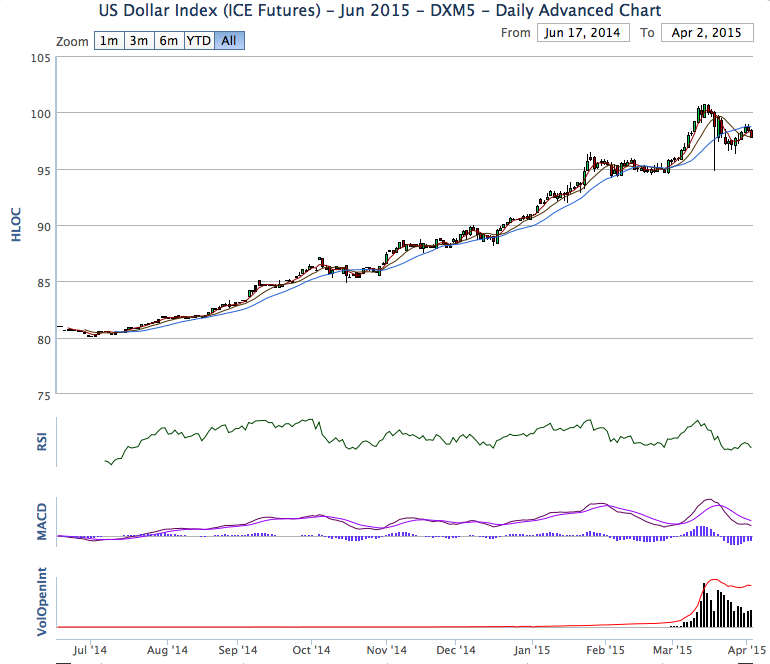
Daily Chart

Screen Shot 2015-04-02 at 6.39.22 AM

Also from Jim Rogers:

Oil Prices: What Is Happening Right Now


Canadian trade data gives Loonie a Happy Easter

USDCAD Overnight Range 1.2558-1.2650            

USDCAD is probing support and the overnight low following better than expected Merchandise Trade data. The February Trade deficit narrowed to 0.984 billion.January’s deficit was revised from $2.5 billion to $1.5 billion. The Canadian dollar is also benefiting from general US dollar weakness as reduced NFP forecasts and holidays convince traders to trim long dollar positions.Relatively firm oil prices are not hurting either.

That was the story in overnight as well. The US dollar drifted lower against most of the majors (except AUD) in a cautious Asia and European session. Most markets are closed on Friday for Easter/Passover except for the US and just to keep things interesting,US nonfarm payrolls will be released. Gains of 300K and above or 200k and lower would create some drama while any job gains inside of 200-300K will just be noise.

AUDUSD came under renewed pressure in Asia on elevated risks of a RBA rate cut next week,touching a six year low. In Europe. The Iran /West nuclear talks are continuing despite the March 31 deadline lapsing. Greece debt renegotiation attempts are keeping EUR bulls on their toes. And EURUSD is offered.

USDCAD Technical Outlook

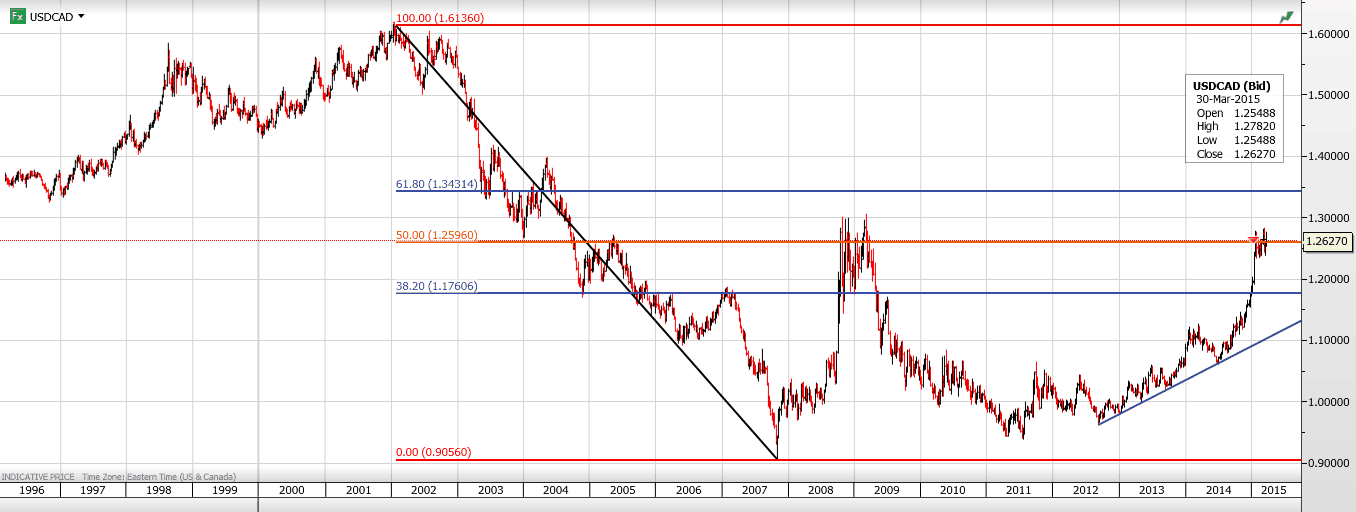
The intraday USDCAD technicals are bearish while trading below 1.2590-1.2600 but needing a break of support in the 1.2550-70 zone to extend losses to 1.2510 and then 1.2460.  A move above 1.2600 will target 1.2650.

The long term USDCAD outlook is bullish. A sustained break above 1.2600 on a weekly chart, which represents the 50% retracement of the entire 2002-2007 range, targets the 61.8% retracement level of 1.3430. That move is far from a sure thing. USDCAD failed to extend gains much above 1.3000 despite many attempts in Q4 2008 and Q1 2009. The weekly chart is shaping up in an eerily similar pattern.

Chart: USDCAD weekly with Fibonacci

Larger Chart

USDCAD-2ND-APRIL-1024x387


agility-forex-logo

Is Warren Buffett Wrong About Oil Stocks?

Recently, Warren Buffett has made headlines by selling all of his shares in Exxon Mobil (NYSE: XOM), the rest of his position in ConocoPhillips (NYSE:COP), and reducing his stake in National Oilwell Varco. This has people wondering if the glory days of oil investing are over.

Warren’s opinion of oil investments carries a lot of weight, because over a 32 year period, Warren Buffet’s Berkshire Hathaway portfolio has generated an average annual return of 24 percent. His most famous investments are Coke, American Express, and Gillette (which is now Proctor and Gamble). These investments have made him over 3 billion dollars each. This is why when Buffett buys or sells a stock, everyone takes notice. The problem with this generally accepted assumption is that it hasn’t been proven that his equity investing success equates to success in the resource sector. In order to find out if this accepted assumption is correct, we first have to visit Warren’s history of investing in the resource sector.

His first foray into the resource sector began in 2002, when he took a $500 million dollar stake in Petro China (NYSE: PTR). In 2007, he sold it at a profit of $3.5 billion dollars. This investment was successful because he bought it when it was undervalued. He thought the business was worth $100 billion dollars, and it was trading at a value of $45 billion dollars. That is value investing 101; buy when it’s undervalued, and sell when it’s fairly valued.

His next venture into the resource sector began in 2008, when he purchased shares in ConocoPhillips. This investment was made because Buffett claimed that the energy sector provided him the product stability that he desired.

This investment ended up costing Berkshire Hathaway several billion dollars. The first reason this investment failed was he broke his own rule; and that is “if you can’t understand it, don’t do it.” Although a great investor he maybe, he clearly didn’t understand the resource sector. Look at this chart below.

37181 a

As you can see from the chart above, the price of oil is anything but stable. In the middle of 2008, the price of oil was near its all-time high. The resource sector is the most cyclical sector in the equities market. Warren Buffet’s ConocoPhillips investment cost Berkshire Hathaway billions of dollars because he didn’t follow the cyclicality that’s involved when investing in the resource sector. This is also why his investment in Energy future holdings failed. He purchased their bonds when Natural Gas prices were near their high.

To achieve success in this sector, you have to buy oil and gas stocks when they are out of favor and the price of oil or gas is at a multi-year low. In 2009, the price of ConocoPhillips reached a low of $35 a share, and in 2014, it reached a high of $80 dollars a share. If Warren had purchased ConocoPhillips in 2009, and not 2008, it would have been one of his greatest investments ever.

Buffett’s most successful oil investment was his railroad company Burlington Northern Railroad. This is considered an oil investment, because this rail road company transported oil from the Bakken to its refiners. Since 2009, Berkshire has collected more than $15 billion dollars in dividends from Burlington Northern Railroad, while its annual revenues have increased by 57%, and its earnings have more than doubled.

The main reason his investment in Burlington Northern Railroad was successful, was due to the fact that he made this investment during the 2008 crisis, when prices were low. This Buffett quote explains the success of this investment perfectly, “Be greedy when others are fearful and fearful when others are greedy.” This company also fits the Buffett investing mantra of buying stable, boring, and predictable businesses, with steady cash flows.

Other notable oil investments include Suncor and Phillips 66, which he has recently added to his already existing positions.

As you can see based on past history, Buffett’s success in the resource sector has been a mixed bag. To understand why his success has been a mixed bag, you have to first fully understand Buffet’s investing philosophy, and then fully understand the resource sector as well.

In order for Buffett to buy a stock, the company has to pass this set of criteria: high margins with a low amount of debt (it doesn’t take a genius to run them); strong franchises and freedom to price, with predictable earnings. This set of criteria sounds great when investing in a consumer goods business, but when investing in the resource sector, it’s almost impossible to achieve. Look at this chart below.

37181 b

The energy industry has higher capital spending requirements than other industries. To be successful in the resource industry, you have to readjust your investing strategy so you’re able to succeed in a high capital spending environment. This also means you have to be comfortable with companies possessing higher amounts of debt and lower margins than what you are normally accustomed to.

Another Buffet criterion that won’t be fulfilled when investing in the resource sector is buying franchises that have the freedom to price. When it comes to oil and gas, this commodity is traded on exchanges all over the world. Exchanges, which speculate on world production and consumption, are the only things that influence the price of oil and gas.

Lastly, when trying to fulfill his criterion of “not needing to be a genius to run it”, this is impossible when trying to grow, or maintain oil production. Running an oil and gas company, requires numerous amounts of geoscientists, chemical engineers, mechanical engineers, and petroleum engineers to maintain or grow the business.

Buffet’s successes in the resource sector demonstrate that you should buy when prices are low, the sector is out of favor, company cash flows are still stable, and companies are selling for less than its book value.

The Currency Wars Continue to Heat Up

China to Take the Reins in Funding Regional Infrastructure Projects

This Tuesday marked the last day that countries could submit their applications to become founding members of the new China-led Asian Infrastructure Investment Bank (AIIB). As of this writing, a little over 40 nations have either already been approved or have applied for membership, including strong U.S. allies such as Britain, Germany and Australia.

Notable absentees, as you can see below, are the U.S. and Japan.

FT-Countries-that-Have-Joined-or-Applied-to-Join-the-Asian-Infrastructure-Investment-Bank-AIIB 03312015

Conceived to serve as an alternative to Western-dominated sources of credit such as the World Bank, International Monetary Fund (IMF) and Asian Development Bank, the AIIB will aim to invest in regional infrastructure projects ranging from energy to transportation to telecommunications.

The new development bank, which is expected to launch later this year, will have $100 billion in capital to

begin with—a massive mountain of money, to be sure, but it falls far short of the estimated trillions that will be necessary to fund Asia’s astronomical infrastructure demand.


China’s creation of its own global bank highlights the country’s desire to wield more control over funding such projects. It currently commands only 5.17 percent of the vote in the World Bank and 3.81 percent in the IMF.

COMM-China-Channeled-Over-100-billion-into-156-Countries-03312015

And so the currency wars continue to heat up. China’s move demonstrates its ongoing efforts to establish the yuan as a global reserve currency on par with the U.S. dollar. It’s no secret that the country wants the yuan to become part of the IMF’s Special Drawing Right (SDR), a composite currency unit that now consists of the dollar, Japanese yen, British pound sterling and euro. The founding of the AIIB might very well bring the country closer to realizing these goals.

A-Shares Headed Higher

Chinese stocks are currently having a moment. Mainland A-shares, as measured by the benchmark Shanghai Composite Index, are up an incredible 92 percent for the 12-month period on the back of strong recent performance in the financial, property and infrastructure industries.

There’s generally a high correlation between the A-share market and China and Hong Kong, but the A-shares have outperformed by a wide margin over the past year.

FT-Shanghais-Composite-Breakout-Continues 03312015

Last Wednesday the index fell a slight 0.8 percent, ending a 10-day rally that contributed 12 percent, its longest winning streak in 23 years.

Chinese policymakers have recently eased quota controls for foreign investors in mainland stocks and bonds, as they promote the yuan to be accepted as an SDR. The potential for greater inflows into the market should help the Shanghai Composite head even higher.

Our China Region Fund (USCOX) has participated in this rally through the Morgan Stanley China A Share Fund and a closed-end fund.

Read more about China:

  • China Consumes More Gold Than the World Produces
    “What’s not so well-known—but just as amazing—is that China’s supply of the precious metal per capita is actually low compared to neighboring Asian countries such as Taiwan and Singapore.”
  • China Just Crossed a Landmark Threshold
    “One of the most headline-worthy developments is China’s $16.3-billion infrastructure initiative intended to revive trading routes along the centuries-old Silk Road. Thousands of miles of railways, roads and pipelines will link Beijing to major markets all over Asia, Africa and Europe.”
  • China Wants to Conduct the World’s High-Speed Rail Market
    “In recent months, Chinese Premier Li Keqiang has emerged as the nation’s top salesman for what he calls the ‘New Silk Road’—miles upon miles of high-speed transportation connecting all corners of the world. His plan might very well become one of China’s most lucrative exports and culturally significant contributions to the world: fast, efficient and reliable railways.”


test-php-789