
Bonds & Interest Rates
 Sonia: So, you are not expecting a rate hike from the US Fed this year?
Marc Faber : What I said is in my view the Fed will not increase rates this year unless there is really a very sharp pick up in the economy or there is a colossal pot-hole developing in stocks. But otherwise I doubt it because the dollar has been strong. Okay, it may weaken somewhat, but I do not think it will collapse against the euro and against the yen and the British pound and so forth. So, the dollar is relatively strong. The economy in the US, the latest say, ten indicators that came out were all on the weak side. And under these conditions I doubt the Fed will increase rates. But that is an academic debate. What is important is I think the Feds and other Western Central Bankers will keep interest rates at a very low level for a very long time and will try to keep interest rates in real terms negative. In other words below the rates of cost of living increases. – in CNBC TV 18
Also from Marc:
India to become the biggest Economy soon
Marc Faber says emerging markets have become relatively inexpensive versus developed markets. Investors are now realizing how inexpensive these EMs are and hence more money is flowing in, he adds.
Marc Faber : Concerning growth, first of all in India and elsewhere among people who invest in India, the view was that India could be the fastest growing economy in the world in the next 5-10 years. I do not think so. That is overly optimistic and overly optimistic expectations. If India, let us take worst and best case. Worst case India grows at 3-4 percent per annum. Best case it grows at 8 percent. Both are not very likely. So let us assume it grows at 4-5 percent per annum. That is still a fantastic growth rate compared to other countries, compared to the whole of Western Europe, compared to the United States. People have misconception about growth; they think that an economy can grow at 8-9 percent forever, that is not the case, it is not possible. So, I am happy if India grows say at, 4-5 percent per annum.

 If you’re a coal investor, there’s one piece of data you need to see this week.
New production figures from world-leading exporter Indonesia.
Data released by the Indonesian government this week showed a huge drop in mine output for the first quarter. With overall coal production falling 21% as compared to the first quarter of 2014.
That equates to a loss of 27 million tonnes of coal supply. Suggesting that Indonesia’s overall output could fall by around 100 million tonnes this year.
That’s a critical observation for the global coal market. Being the first major drop in output we’ve seen from Indonesia since coal prices started their steep decline in 2011. Up until now, Indonesian production had reportedly been continuing to rise — as miners tried to compensate for lower sale prices by putting out more product.
If a trend toward lower production here holds, it would be a sign that the global coal market is finally capitulating under low prices. And a fall in Indonesian production would be a big step toward getting the market balanced again — given that the nation is by far the world’s largest exporter, especially for key consuming countries like India, China and Japan.
One point of caution here is that Indonesia’s production statistics are notoriously unreliable. With the numbers often being revised after the fact, due to factors like uncounted output from illegal mines. Indeed, the chairman of the Indonesian Coal Mining Association, Pandu Sjahrir, said he is waiting for confirmation of the government stats before commenting further on the state of Indonesia’s mines.
At the very least, this is a happening to put on our radar screens. Watch for further data coming out of Indonesia to confirm this critical trend.
Here’s to coal, hard reality,
Dave Forest



The higher financial markets rise, the harder they fall. By any objective measurement, the stock market is currently well into bubble territory. Anyone should be able to see this – all you have to do is look at the charts. Sadly, most of us never seem to learn from history.
Most of us want to believe that somehow “things are different this time”. Well, about the only thing that is different this time is that our economy is in far worse shape than it was just prior to the last major financial crisis.
That means that we are more vulnerable and will almost certainly endure even more damage this time around. It would be one thing if stocks were soaring because the U.S. economy as a whole was doing extremely well.
But we all know that isn’t true. Instead, what we have been experiencing is clearly artificial market behavior that has nothing to do with economic reality. In other words, we are dealing with an irrational financial bubble, and all irrational financial bubbles eventually burst.
And as I wrote about yesterday, the way that stocks have moved so far this year is eerily reminiscent of the way that stocks moved in early 2008. The warning signs are there – if you are willing to look at them.
The first chart that I want to share with you today comes from Doug Short. It is a chart that shows that the ratio of corporate equities (stocks) to GDP is the second highest that it has been since 1950. The only other time it has been higher was just before the dotcom bubble burst…

….for larger charts and more commentary continue reading HERE
This week, I ran the Stockscores Simple Weekly scan on stocks under $15. I wanted to find smaller cap stocks that were showing promise on their three year weekly charts. Here are two that I think are worth considering:
STOCKS THAT MEET THE FEATURED STRATEGY
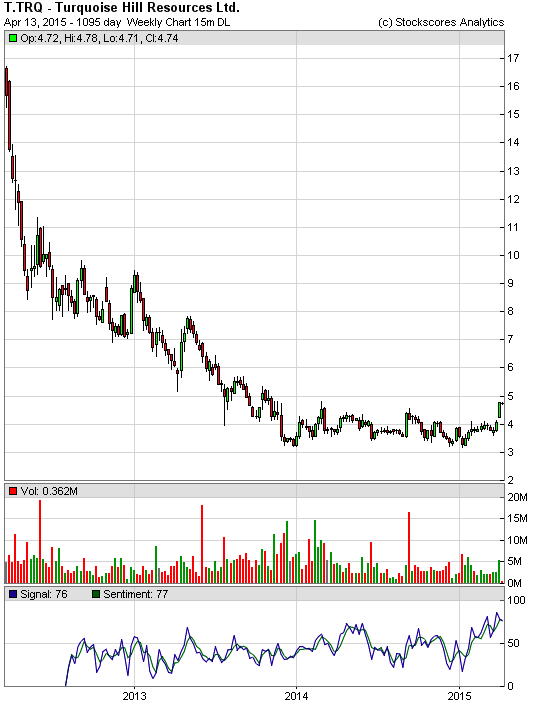
1. T.TRQ
T.TRQ has made quite a move up over the past two weeks and that has put the stock through some resistance on the weekly chart. I think it is due for a pull back before it goes higher but the longer term outlook is positive. Support at $3.60.
2. UNXL
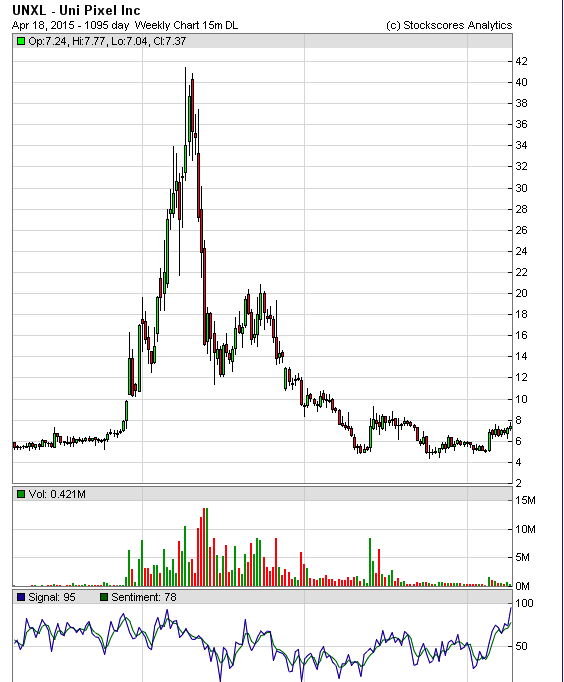
UNXL has risen over the past two days on higher than normal volume, breaking it out through resistance at $7.20. The stock is showing early signs of a long term turnaround, support at $6.40
…..read Tylers full newsletter entitled “8 Emotional Mistakes” HERE

-
I know Mike is a very solid investor and respect his opinions very much. So if he says pay attention to this or that - I will.
~ Dale G.
-
I've started managing my own investments so view Michael's site as a one-stop shop from which to get information and perspectives.
~ Dave E.
-
Michael offers easy reading, honest, common sense information that anyone can use in a practical manner.
~ der_al.
-
A sane voice in a scrambled investment world.
~ Ed R.
Inside Edge Pro Contributors

Greg Weldon

Josef Schachter

Tyler Bollhorn

Ryan Irvine

Paul Beattie

Martin Straith

Patrick Ceresna

Mark Leibovit

James Thorne

Victor Adair