
Bonds & Interest Rates
Early in January as long-dated Treasuries were soaring in price, we noted that big pattern was leading to “Ending Action”. This would be that the bull move that began in December 2013 was heading to a momentum peak. Upon reversal, a bear market could follow. (this missive was sent to subscribers Wed April 22nd)
 This was summed up in our January 20th study (Ending Action) that reviewed the history of the bond bull market since the 15 percent yield reached in 1981. Also reviewed were a number of major policy efforts that while earnestly believed ended badly. The main one was the bond buying program that began in the late 1940s. This was the attempt to keep the long rate from rising above 3 percent. This was vigorously touted as “Operation Twist” in the 1960s when the attempt was to keep the rate from rising above 6 percent.
Then there was the lengthy attempt by central bankers to keep the price of gold down. The Bank of England sold the last of its reserve down to the 253 level.
Arbitrary interventions may seem to work in the near term but ultimately fail.
Of course, Europe has defined a new level of arbitrary–fanatical. In what may have been one of the most fabulous spread-trades in sovereign debt history, the German bund yield plunged from 1.95% in December 2013 to 0.056% on April 17th; as the Greek yield jumped from 7.80% to 12.68%.
In a fascinating move, the German yield increased in a couple of steps to .108%, yesterday. Ticked down to .092% earlier today and then jumped to .166%. While the numbers are small the change is distinctive.
Over on the Mediterranean, Greek bonds soared to new highs for the move at 13.62%. That was yesterday, today it is down to 12.70%.
It seems that some spread trades are being unwound.
On the bigger picture, “Ending Action” noted that the Weekly RSI was up to a momentum level seen only three times during the full 33-year-long bull market.
On the near term and earlier today, the ChartWorks updated recent technical moves on the TLT. The initial sell-off was to the appropriate level; as was the rebound. The price seems to be rolling over after a weak test of the high.
Treasury investors should get more defensive and traders could start to play the short side. Yields are at unprecedented levels where, as widely discussed, there is an unprecedented lack of liquidity.
BOB HOYE
INSTITUTIONAL ADVISORS E-MAIL bhoye.institutionaladvisors@telus.net WEBSITE: www.institutionaladvisors.com
Listen to the Bob Hoye Podcast every Friday afternoon at TalkDigitalNetwork.com

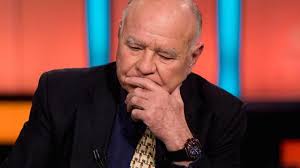 “In Europe if you are an institution or a wealthy individual, your choice is to put money in the banking system. It is not very safe either and you will get zero interest rate.”
ET Now: What happens to the equity markets? Do they still stand out on a relative basis as opposed to other emerging markets or do you think they can pick up strength on their own in another quarter or two?
Marc Faber : First of all I would like to say that the Indian markets started to perform well long before Mr Modi was elected. At the end of 2013 the markets already started to rise considerably and this increase in prices has continued. Last year the market was up.
There is difference between various asset classes. In the US we have essentially high valuations by any measurement. In Europe, we have lower valuations and in emerging economies we have the lowest valuations. So from a longer- term perspective, I would rather invest money in emerging economies.
In the case of India, we have a similar situation like in some other markets. There are some blue chip stocks like Nestle. They sell at close to 50 times earnings. On the other hand, you have other sectors, other companies that are selling at maybe only 10 to 15 times earnings and the difference between India and the European markets or the US markets is that India has one of the best central bankers in the world having Mr Rajan. He has kept interest rates relatively high and has the flexibility to bring them down if he wants to.
I do not necessarily advocate low interest rates. I think the zero interest rate policies that Japan, Europe and the US have adopted will lead sooner or later to disaster, but it has led to rising stock prices. In Europe if you are an institution or a wealthy individual, your choice is to put money in the banking system. It is not very safe either and you will get zero interest rate. You can buy government bonds.
The money printing has distorted the price mechanism. Explain to me why Italian government bonds, Spanish government bonds, French government bonds should have a lower yield than the US treasuries. This is what money printing has done. It has created bubbles in different asset classes.
Marc Faber is an international investor known for his uncanny predictions of the stock market and futures markets around the world.Dr. Doom also trades currencies and commodity futures like Gold and Oil.

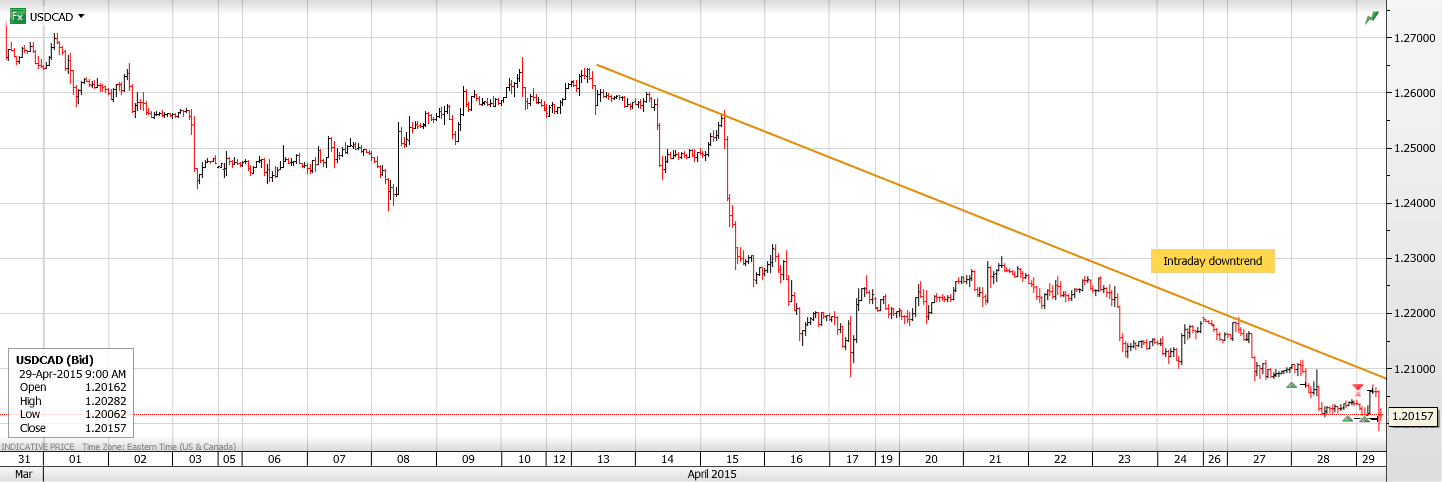
USDCAD Overnight Range 1.1993-1.2070
US GDP lived up to expectations that it would be weak. It was and the US dollar is getting spanked again. Annualized Q1 GDP was -0.2% vs. forecasts for a gain of 1.1% with part of the weakness being blamed on the strong US dollar. USDCAD was flirting with 1.2055 prior to the number and is currently probing support at 1.2005. EURUSD is testing the 38.2% Fibo retracement of the 2015 range.
The US dollar continued to drift lower overnight on anticipation that the spate of weak US data would result in a weaker than expected GDP report this morning and a downgraded outlook in this afternoons FOMC statement. The news from Greece was a tad more promising as well which may have helped to lift EURUSD above 1.1000.
In Asia, USDJPY defied the dollar weakness trend and climbed to 119.40 from 118.75. However, Aussie and Kiwi didn’t and they both declined. Tonight’s RBNZ rate decision and statement may add to Kiwi’s woes if the Central Bank is a doveish as expected.
USDCAD technical outlook
USDCAD is in a downtrend while trading below 1.2080, supported by the break of support at 1.2050 which is now targeting major support in the 1.1970-90 area. A move below here and USDCAD will drop to 1.1720. A recovery above 1.2050 argues for some 1.1990-1.2080 consolidation
Today’s Range 1.1990-1.2080
Chart : USDCAD hourly Larger Chart

 A recommendation to move to cash.
Economist Steen Jakobsen, Chief Investment Officer of Saxo Bank, believes 2015 will be another “lost year” for the economy. And he predicts the Federal Reserve will indeed start to raise rates later this year, surprising the market and taking the wind of out asset prices.
He recommends building cash and waiting to see how the coming storm — which he calls the “greatest margin call in history” — plays out…..continue reading the transcript, or view youtube HERE

 I’ve been receiving so many email questions of late, about almost every market, that I decided to devote this week’s column to answering the most important ones. So here we go. Do note that the questions have been edited for clarity and brevity …
Q: Rumors abound that the Chinese yuan will soon be given reserve status by the World Bank or IMF. That might occur as early as October. It is also said that the U.S. dollar will crash as a result. Your thoughts, Larry?
A: Will the yuan gain reserve status? Absolutely. Will it crash the dollar? Absolutely NOT.
Look, don’t buy into the garbage about the dollar crashing any time soon. It’s not going to happen. Period.
There are several reasons why. Chief among them:
A. There is too much dollar-denominated debt out there – at least $9 TRILLION. As that debt gets paid off, however slowly, it’s dollar bullish. And …
B. No other single currency, even the euro, comes close to the amount of dollars in circulation around the world.
Total global currency reserves are roughly 62 percent dollar-based.
For the dollar to crash, you would need the yuan or some other currency to replace those dollars held all over the world, overnight. That’s not going to happen so easily.
 More simply put, there’s not enough currency in the world to topple the U.S. dollar. There are not enough euros, yen, pounds, or Swiss francs, let alone yuan.
Bottom line: The notion that the dollar is going to crash come October, or anytime soon, is nothing but bad analysis and/or fear-mongering.
Q: Why are you so bullish on Asia, China, while so many analysts are bearish?
A: Simple answer: I live in Asia. Most analysts who write about Asia have never put their feet on the ground here, or if they have, it’s for a few days to attend a conference.
On the other hand, I get out and mix with the people, with farmers, shop owners, the locals.
Do that and you see an entirely different Asia. You see one that is booming with desire, booming with wants and needs, booming with economic growth.
Moreover, you have to understand where these economies are truly coming from, and how they are managed. It’s all very different from what you know about the West, and very different from the analysts who never come here or spend a few days here at most.
Nationalism in Asia is extremely high, as high as some 80 percent approval of the current government in China, just as an example.
So when governments in Asia steer their economies in a certain direction, the people approve and follow. That too is obviously very different from the West.
But most of all, as I pointed out in last week’s column, is the fact that three out of every five people in the world live in Asia.
And they are all pretty much at the same point as the United States was in the late 1800s: Experiencing industrial and service sector revolutions and the birth of free market economies.
One that is 4 billion people strong. My advice: Don’t buck the trend in Asia. You’ll get run over by eight billion feet.
Q: Is gold still on track for lower lows? Silver?
A: Unequivocally, YES. Based on all my models, there is no question, no doubt whatsoever, that gold is heading below $1,000 and silver to roughly $12.50.
Per my column of two weeks ago, the short-term timing sell signal I wrote of is also on track, as gold plunged last week from roughly $1,209 to about $1,182 — a pretty significant $27 drop.
There’s one last chance for a bounce, but unless gold can get above $1,210 this week, everything remains on target for a June low, down near or below $1,000.
If by some miracle gold moves back above $1,210, the low will be postponed until October.
Either way, the precious metals remain in bear markets.
Q: What’s your latest on the U.S stock markets?
A: Long-term, still extremely bullish. Short- and intermediate-term, expecting at best sideways action, at worst, a decline back to test longer-term support levels, which now stand at roughly 14,300 in the Dow Industrials.
Keep in mind that no matter what you hear, no matter what kind of foolish analysis about earnings, etc. that most analysts espouse …
The U.S. equity markets remain in long-term bull markets because …
A. They are the world’s largest, most liquid — making them magnets to attract capital from weak economies such as Europe … from crisis hot spots around the globe like again, Europe, and the Middle East … and other regions of the world where the cycles of war are now ramping up.
And …
B. They are the world’s strongest bastion of capitalism. That means as governments of the west, namely the U.S. and Europe, become more authoritarian, struggling to survive, capital will continue to pour into U.S. equities.
Equities are non-confiscatible, offer private sector opportunities to build capital, and are symbolic of true capitalism.
Those attributes are going to become even more important in the months and years ahead, again, as the cycles of war ramp ever higher, and as investors all over the world begin to realize …
That it is the governments of Europe and the United States that are really the sectors that are in trouble, and that trillions of dollars will soon begin to pour out of sovereign debt …
And flood into our stock markets even more.
Lastly, some parting comments for today: For all of the above questions as well as those I have not been able to address in this column:
1. Don’t buy into all the garbage out there in the financial media.
If the medical profession had as much mis-information, garbage and fear-mongering out there as the financial world does, we’d all be dead by now.
2. Think out of the box. Question everything you ever felt you knew about the markets. Everything you read or are told, even by me.
Think independently and you will not only survive any financial crisis that comes your way, you will also prosper.
3. Build your cash, your ammo, while the markets are relatively quiet, like they are now.
That way, you can deploy your capital at the right times to capture the truly life-changing profit opportunities that are soon coming your way.
Best wishes, as always …
Larry
– See more at: http://www.swingtradingdaily.com/2015/04/29/important-qa-with-larry/#sthash.YIIDxsTW.dpuf


-
I know Mike is a very solid investor and respect his opinions very much. So if he says pay attention to this or that - I will.
~ Dale G.
-
I've started managing my own investments so view Michael's site as a one-stop shop from which to get information and perspectives.
~ Dave E.
-
Michael offers easy reading, honest, common sense information that anyone can use in a practical manner.
~ der_al.
-
A sane voice in a scrambled investment world.
~ Ed R.
Inside Edge Pro Contributors

Greg Weldon

Josef Schachter

Tyler Bollhorn

Ryan Irvine

Paul Beattie

Martin Straith

Patrick Ceresna

Mark Leibovit

James Thorne

Victor Adair