
Real Estate
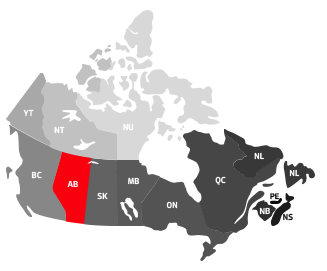
Looking to find out more about a Canadian neighbourhoods to invest in? Below are the Top 10 neighbourhoods in Alberta. With a median listing price of $5,868,240, Lacombe County is Canada’s 1st most expensive when ordered by median listing price. For all Albertan neighbourhoods go HERE (click on City or neighbourhood for all details)
| Neighbourhoods | Median price(H) | Monthly growth(H) | Median price(A) | Monthly growth(A) |
|---|---|---|---|---|
| Lacombe County | $5,868,240 | 0.00 % | $698,500 | 0.00 % |
| De Winton | $1,399,000 | 11.92 % | ||
| Conrich | $1,269,000 | 0.00 % | ||
| Heritage Woods | $1,250,000 | – 1.76 % | $927,132 | 0.00 % |
| Bighorn No. 8, Municipal District of | $1,174,950 | 46.88 % | ||
| Kananaskis Improvement District | $1,069,500 | -4.46 % | ||
| Foothills | $1,049,000 | -8.78 % | ||
| Banff | $1,024,500 | 28.22 % | $351,500 | -16.30 % |
| Priddis | $999,900 | -9.09 % | $561,500 | -6.18 % |
| Cranford | $987,475 |
For the Top 10 Neighbourhoods, indeed virtually every single neighbourhood in every province and territory in Canada start HERE

115 Yrs of Dow Rallies Shows This One Well Below Average in Duration & Magnitude
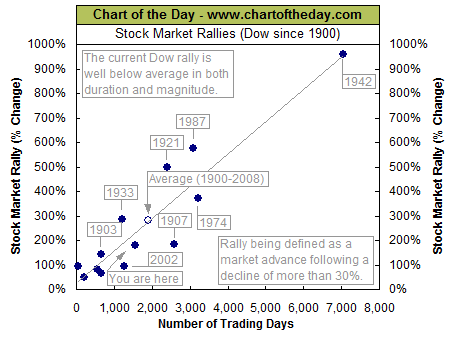
The Dow just made another all-time record high. To provide some further perspective to the current Dow rally, all major market rallies of the last 115 years are plotted on today’s chart. Each dot represents a major stock market rally as measured by the Dow with the majority of rallies referred to by a label which states the year in which the rally began. For today’s chart, a rally is being defined as an advance that follows a 30% decline (i.e. a major bear market). As today’s chart illustrates, the Dow has begun a major rally 13 times over the past 115 years which equates to an average of one rally every 8.8 years. It is also interesting to note that the duration and magnitude of each rally correlated fairly well with the linear regression line (gray upward sloping line). As it stands right now, the current Dow rally that began in March 2009 (blue dot labeled you are here) would be classified as below average in both duration and magnitude.
Quote of the Day
“Managers are people who do things right, and leaders are people who do the right thing.” – Warren G. Bennis
Events of the Day
May 24, 2015 – French Open tennis tournament begins (ends June 7th) – Indianapolis 500
May 25, 2015 – Memorial Day (observed)
Stocks of the Day
— Find out which stocks investors are focused on with the most active stocks today.
— Which stocks are making big money? Find out with the biggest stock gainers today.
— What are the largest companies? Find out with the largest companies by market cap.
— Which stocks are the biggest dividend payers? Find out with the highest dividend paying stocks.
— You can also quickly review the performance, dividend yield and market capitalization for each of the Dow Jones Industrial Average Companies as well as the performance of the Dogs of the Dow.
Notes:
Where’s the Dow headed? The answer may surprise you. Find out right now with the exclusive & Barron’s recommended charts of Chart of the Day Plus.

Silver Still The Cheaper Metal
The dollar’s comeback pushes gold back into its range.
Despite hitting three-month highs in recent sessions, gold couldn’t hold above the key $1,220 level for long. Prices quickly dropped back below that level as the dollar surged higher, rebounding from three-month lows of its own.
Gold

Gold’s decline puts it back inside its short-term trading band between $1,180 and $1,220. This has been a comfortable zone for prices during the last two months. Without any other catalysts, gold may continue to fluctuate in this range based on day-to-day gyrations in the dollar.
Meanwhile, silver also retreated from three-month highs today. The gray metal remains tied at the hip with its more prominent cousin.
Silver

A look at the gold/silver ratio reveals that the relative value of gold and silver has largely been stable for the past seven months. Since October, the ratio has fluctuated between 70 and 75. Before that, the ratio had been steadily increasing from a low of about 32 in 2011.
Gold/Silver Ratio

From a historical perspective, silver is “cheap” compared to gold, but we’d wait for a break below 70 in the gold/silver ratio before calling an end to silver’s four years of underperformance.
….read page 2 HERE

The day of reckoning is rapidly approaching. You better wake up before the coffin is nailed shut.” Martin Armstrong
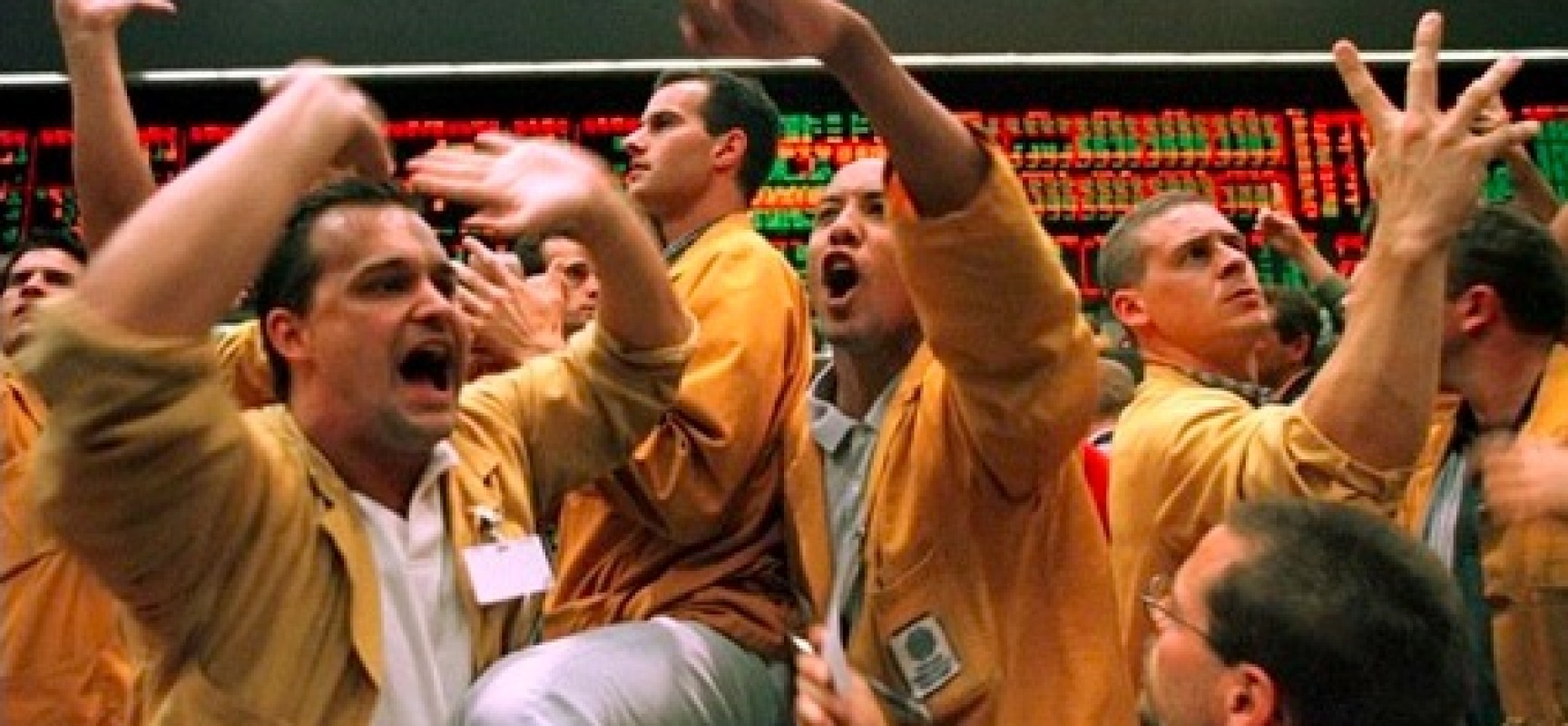
“Financial or economic collapse occurs if credit collapses and businesses aren’t paid for products and services, the distribution system could temporarily shut down. Contemplate empty grocery shelves, empty gasoline stations, electricity and water outages, empty ATM’s, and EBT cards that don’t work.” This is exactly what to expect when our present financial system burns down to the ground.” – Gary Christenson
….read Gary Christenson’s latest article below. Be sure to click on the link Financial Insanity Grips the World for his advice on how to survive
“It certainly appears that we are complacent as a society and as such, we never act until it is too late. Then everything falls apart. Indeed, government interest rates have moved into negative interest rates on about 30% of Eurozone total debt. This has become an effective tax on money itself, with respect to whatever you have left in your account after paying taxes. We are heading for economic Armageddon and the day of reckoning is rapidly approaching. You better wake up before the coffin is nailed shut.” Martin Armstrong
…read Martin’s latest article:
Why Europe Will Lead the Charge to Eliminate Cash – The Next Step in Global Meltdown
 The smart money, the kind that moves first at the slightest sign of trouble, is on the move again.
In a market I’ve previously reported on. A market I call the “off-the-grid” market.
I can’t say I blame these savvy investors. If I had the kind of money we’re talking about, I’d be doing the same thing. Getting off the grid, to the extent possible these days.
Putting it in alternative investments that can help protect your legacy, your children and grandchildren.
Keeping it out of the banks, where your money is sure to be tracked. Where it’s at risk of being “bailed in” should the bank go under, just like what happened to depositors in Cyprus’ banks in March 2013.
Where it’s subject to negative interest rates, a tax on your cash in the bank, which is prevalent throughout most of Europe.
I’m talking about the red-hot collectibles market, and especially art. A market where Christie’s auction house
tallied up over $1.4 billion in sales in two days last week, smashing its previous single-week high of $975 million last May.
And where competitor Sotheby’s sold works totaling $893 million in sales since May 5 — a record breaking total of $2.6 billion in art sales, a 25 percent surge over last year’s similar auctions.
Eight artist records were set, including those for Lucian Freud, Robert Rauschenberg and Robert Ryman. Eight works sold for more than $20 million.
Pablo Picasso’s painting, “Les Femmes d’Alger,” sold for $179.4 million — in just 11 minutes — becoming the most expensive artwork sold at auction, ever.
Alberto Giacometti’s bronze sculpture of a pointing man was purchased for another record of $141.3 million.
And artist Mark Rothko’s painting “No. 10,” fetched $81.9 million, almost twice what Christie’s had estimated.
One sale I find particularly interesting was English painter Lucian Freud’s 1994 painting of a 280-pound naked civil servant named Sue resting on a couch.
 Estimated at $30 million to $50 million, it sold for $56.2 million, setting an auction record for the artist.
Whoever bought that painting sees the same thing I do, and that most of the buyers at the art auction also see:
By the time the sovereign debt crisis that’s just getting started comes to an end, civil servants will indeed be looking for work, perhaps even naked on a sofa — since there won’t be much left in government coffers to keep them employed.
Or perhaps the civil servant was an Emperor, with no clothes — which we will soon also get to see. Our leaders being stripped down for who they really are …
Power hungry ego-maniacs that have destroyed our country by drowning it in patently unpayable debts and IOUs.
By spying on you, by trampling on the Constitution via the Patriot Act, by coming up with one excuse after another for a new tax.
By targeting the rich, which is now officially defined in Washington as anyone who makes more than $250,000.
And it’s not just here in the U.S. It’s actually worse in Europe, where France is about to table a law that will require electronic transactions for any business conducted that amounts to more than 1,000 euros.
Where Greece is already implementing capital controls, so its bondholders can stand a chance at getting repaid, while the average Greek citizen sees their wealth and country go down in flames.
Where Italy, France and yes, even Great Britain are considering similar capital control measures, and even experimenting with cashless, electronic currencies, so they can track and tax their citizens at will.
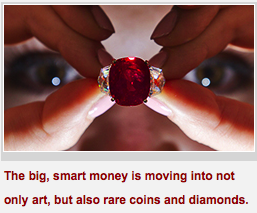 This is why the big, smart money is moving into alternative markets. Not just art. But also rare coins and diamonds.
Consider Sotheby’s recent sale of a 100.2 ct. emerald-cut perfect diamond, dubbed the “Ultimate Emerald-Cut Diamond”, which sold for almost $22.1 million, making it the highest price for any colorless diamond auctioned in New York.
Or last week’s sale of a Burmese ruby weighing 25.59 carats which sold for a world record 28.25 million Swiss francs — 61 percent over what it was estimated to fetch.
It’s all largely being driven by the worst sovereign debt crisis, ever, which, as I told you last week, is rapidly approaching.
Why then, you ask, is gold still languishing? Or silver, or platinum, or palladium?
They too will have their day in the sun, again. Stay tuned!
Best wishes, as always …
Larry

-
I know Mike is a very solid investor and respect his opinions very much. So if he says pay attention to this or that - I will.
~ Dale G.
-
I've started managing my own investments so view Michael's site as a one-stop shop from which to get information and perspectives.
~ Dave E.
-
Michael offers easy reading, honest, common sense information that anyone can use in a practical manner.
~ der_al.
-
A sane voice in a scrambled investment world.
~ Ed R.
Inside Edge Pro Contributors

Greg Weldon

Josef Schachter

Tyler Bollhorn

Ryan Irvine

Paul Beattie

Martin Straith

Patrick Ceresna

Mark Leibovit

James Thorne

Victor Adair