
Gold & Precious Metals
Gold has been frustrating for bulls and bears since its crash in Q2 2013. In the two years since it has traded in a wide range, frustrating traders and investors. The net result has been nothing but the passing of time. Until Gold breaks above $1300 or breaks below $1150, we will remain in waiting mode. Personally, I believe Gold is far more likely to break lower in the weeks and months ahead. In any case, we are still waiting.
Below is the updated Gold bears analog chart. The chart excludes the extreme bear in terms of time (1987-1993 bear) and the extreme bear in price (1980-1982 crash). The other three bears in the chart provide good context for the current bear which has closesly followed the 1996-1999 bear. Considering only this chart, the $1050 area is a reasonable target.
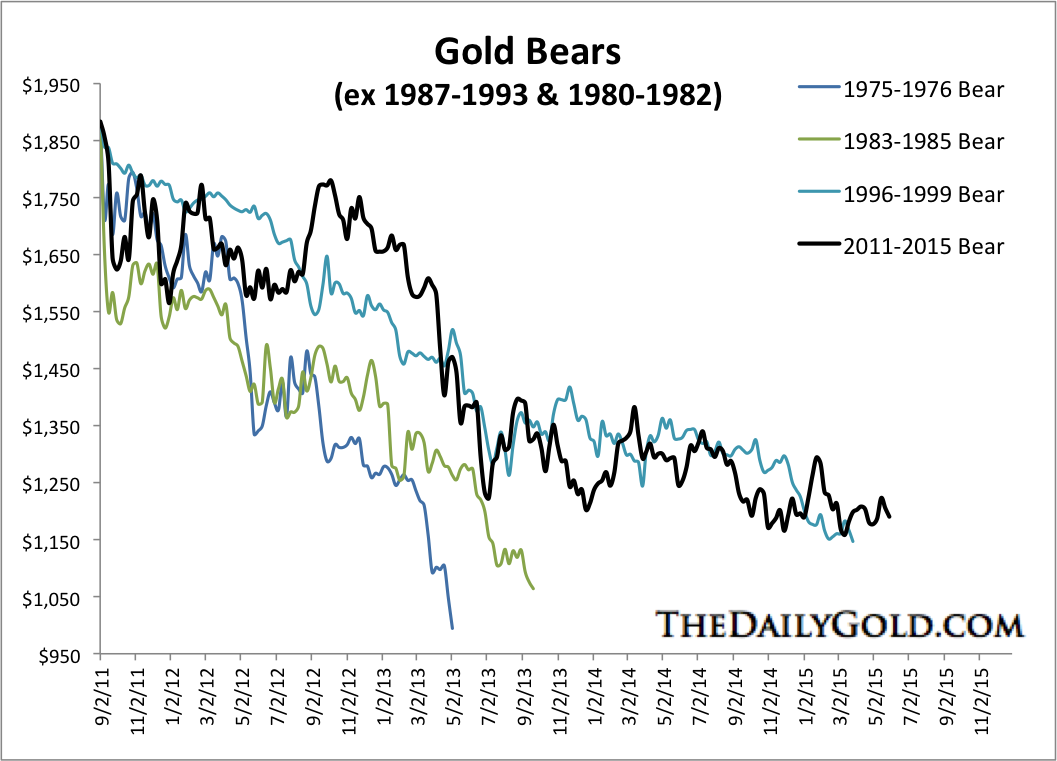
Gold Bears
The next chart shows a weekly bar plot for Gold and its net speculative position (as a percentage of open interest) at the bottom. Gold has strong weekly support at $1150 but if that breaks then we can anticipate a move down to stronger support at $1000 to $1050. The net position is at 31% (as of last week) which is very high considering Gold is not yet in a bull market. Too many speculators are left. Two years ago Gold made a low around the same price (~$1200) with its net position at only 6%!
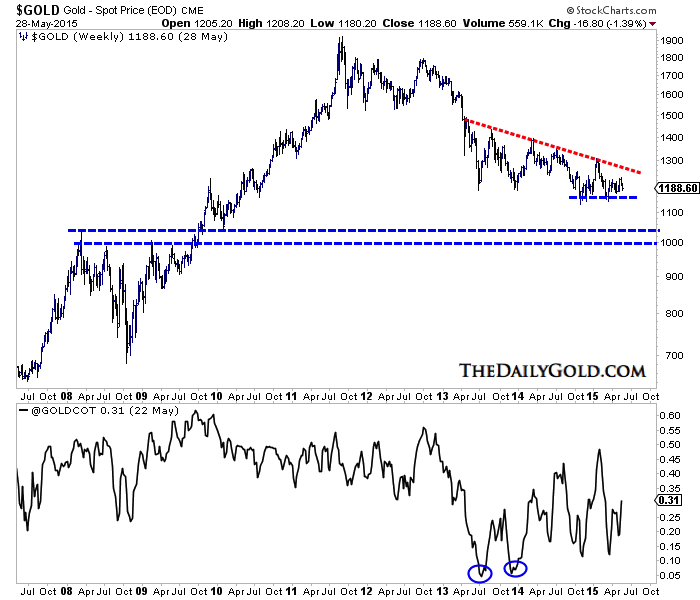
Gold Weekly & Gold COT
Another reason Gold likely has more downside ahead is the US$ bull market may not be finished. While Gold has held in very well with the rising US$, it failed to rally when the US$ corrected from 100 to 93. If the US$ had put in a major top then precious metals would have surged. This chart argues that the US$ has another push to the upside before it makes a major peak.

US$ Bull Analogs
We are still waiting for Gold to make its final break lower. In considering history, technicals and sentiment, we have little reason to think Gold will break to the upside. Mind you, we are huge gold bulls and expect a very sharp rebound from the $1000-$1050 area. If and when Gold reaches that area it will do so in a very oversold state with very negative sentiment. The combination of those factors (very oversold, very negative sentiment) meeting with very strong support can produce big rebounds. If metals are heading to new lows then it would likely create one last chance to buy quality junior miners at fire sale prices. Consider learning more about our premium service including our current favorite junior miners which we expect to outperform in the second half of 2015.
Jordan Roy-Byrne, CMT

STRATEGY OF THE WEEK
This week, I ran the Stockscores Simple Weekly Market Scan strategy in search of longer term position trades based on the weekly chart patterns. Here are two that look good:
STOCKS THAT MEET THE FEATURED STRATEGY
1. T.AGT
T.AGT has been trending sideways for about 8 months but last week, broke through resistance with an abnormal price move. This should set up for the resumption of the long term upward trend. Support at $28.50.

2. PLAB
For over a year, PLAB could not make a move through $9.50 until two weeks ago when it made a strong break through resistance on abnormal volume. This should set up for a new upward trend, although it may take a few weeks for the short term profit takers to finish. Support at $8.50.

…..read Tylers full newsletter entitled “Just Say No“
More Mergers on the Horizon? –
Strengths
- GDP shrank at a 0.7 percent annualized rate in the first quarter, lower than the previous 0.2 percent growth estimate. With the expansion stalled, the Federal Reserve may be inclined to hold interest rates at record lows longer to ensure sustained growth.
- Shanghai Gold Exchange withdrawal volume continues to be strong, coming in at 45.5 metric tonnes for the week ending May 15. According to Credit Suisse, the gold monetization plan in India may boost imports if banks pay investors interest on bullion deposits. The Austrian central bank announced it has adopted a new storage strategy whereby it will store 50 percent of its total gold reserves in Austria by 2020; they currently only have 17 percent within country.
- UBS has slapped a buy recommendation on its entire gold coverage list with the exception of Newcrest and Independence Group. Balmoral announced it intersected 216 g/t of gold over 0.76 meters in a new discovery zone at its Fenelon and Jeremie Properties in Quebec. Roxgold announced it has received approval of its Mining Convention for the Yaramoko Gold Project from Burkina Faso’s Council of Ministers.
Weaknesses
- Gold faced a second weekly drop and investors cut holdings in bullion-backed funds to a four-month low amid speculation that U.S. interest rates will rise this year.
- Australia, an engine room of the decade-long global commodity boom, is forecasting a staggering 90 percent plunge in spending on projects, according to Mineweb. The fall in spending may portend more mergers in the future.
- The Democratic Republic of Congo’s Mines Minister announced that Ivanhoe would have to seek approval of its sale of copper assets to Zijin Mining. The issue, if not resolved quickly, threatens to cloud what is otherwise a landmark deal as the company pushes forward in developing a trio of major deposits.
Opportunities
- 2015 has been a busy year for acquisitions as the value of gold deals jumped more than 150 percent in the first quarter compared to a year earlier. Producers are seizing on a wave of mine sales and tumbling asset valuations to expand output or secure growth projects. This week Barrick Gold announced that it signed a strategic partnership with Zijin Mining Group which will take a state in its Porgera Joint Venture gold mine in Papua New Guinea. Under the deal, Zijin will acquire 50 percent for $298 million in cash. It appears that Zijin received a very favorable price on this transaction as Barrick is hoping to bring in a partner on other South American assets which need a capital injection. Additionally, Evolution Mining has agreed to pay $550 million for Barrick’s Cowal mine in Australia’s New South Wales which went for considerably more than where we see the relative valuation of this asset.
- China has announced the establishment of a new international gold fund with over 60 countries as members. The fund, which expects to raise 100 billion yuan, ($16 billion) will develop gold mining projects across the economic region known as the New Silk Road. The project will facilitate the central banks of member states to acquire gold for their reserves more easily.
- While the conventional wisdom holds that rising real rates would strengthen the dollar, which would in turn pressure gold, Cornerstone Macro believes otherwise. In a recent piece of research, they demonstrate how global growth determines the direction of the U.S. dollar, not the U.S. economy. Only when the U.S. economy briefly decouples, does the dollar strengthen, but this is rarer now as global trade is 60 percent of world GDP and emerging market currencies have a 69-percent weighting the Trade Weighted U.S. Dollar Index.

Threats
- South Africa gold mining groups face tough pay talks as they gear up for the upcoming crucial wage negotiations in the coming weeks.
- Peter Major, mining specialist at Cadiz Corporate Solutions, announced that issues like government interference, the power and conflict between unions, and BEE legislation have all contributed to a situation where mine productivity in South Africa has declined significantly and speculated the gold industry could be wiped out by 2020 if the current direction persists.
- McKinsey & Company published a study showing that worldwide mining operations are as much as 28 percent less productive today than a decade ago. They attribute increases in capital expenditures and operating expenditures as having the greatest impact on productivity trends. Up-sizing projects by increasing the productive capacity of the project to shorten the mine life did not yield the higher IRR’s (Internal Rate of Return) forecasted by the models.

Invest in the Lithium Revolution
– This tale starts with two companies: one a household name for decades, the other a growing firm that many people — especially investors — are thrilled about.
A month or so ago, the latter firm, Tesla (NASDAQ: TSLA), announced its new energy storage system, the Powerwall.
Within a week, the company saw $800 million in pre-orders for its new product, which isn’t even available yet. And now that it has nearly $1 billion in potential revenue, I assume the company will have a serious backlog for some time.
The Powerwall is meant for use in homes and will go well with Tesla CEO Elon Musk’s other business venture, SolarCity (NASDAQ: SCTY), which provides solar panels for homeowners at little upfront cost.

Residential battery storage allows homeowners with solar panels to store excess electricity from when the sun shines
for use when the sun isn’t shining and the need for electricity is greater.
It’s much the same story for grid-scale storage projects. Solar and wind farms can’t create power at the drop of a hat — they need the wind and the sun.
So when the wind and the sun don’t cooperate, batteries take over and supply excess power to the grid, as well as prevent flickering caused by slight lapses in electricity.
But as of right now, Tesla isn’t producing grid-scale storage — although I wouldn’t be surprised to see it in the future.
This instead takes us to our next company: General Electric (NYSE: GE).
GE announced a month or so ago that it sold its first utility-scale storage system to a unit of Consolidated Edison (NYSE: ED) for use in California.
This battery system will store as much as eight megawatts worth of power that can be used to support the intermittent wind and solar technologies prevalent in the state.
Eight megawatts is enough to power about 6,000 normal homes, and it’s only the beginning of battery storage in California and the rest of the United States.
Storage Goes Boom
Now, don’t get me wrong — GE is not the only company manufacturing utility storage. Several other companies do the exact same thing, and it’s for good reason.
Battery storage capacity for residential, commercial, and utility-scale power is absolutely booming.
California has enacted requirements for the state’s three largest utilities to install 1.3 gigawatts of storage capacity by 2020. Other states, like Oregon, are working to make similar moves.
In the first quarter of 2015, 5.8 megawatts of storage capacity were added (nearly 20% higher than the same period last year), while analysts anticipate 220 megawatts will be added in the U.S. by the end of 2015.
For reference, that’s well above the 62 megawatts added in 2014.
Most of this demand comes from commercial and residential installations, while utility-scale storage lags behind.
Businesses, schools, factories, and public facilities better manage the power they use on a day-to-day basis when they install battery storage systems.
But while the utility-scale battery industry has so far lagged behind, it’s only a matter of time before it eclipses the residential market thanks to new power production from innovative sources…
Namely renewable energy, which has fueled the production of battery storage in a big way.
As my colleague Jeff Siegel has mentioned before, of the $7.7 trillion to be invested in new power plants worldwide by 2030, $5.1 trillion will be used for renewable plants.
Mostly wind and solar, these new renewable energy plants will need thousands upon thousands of megawatts of storage capacity provided by GE, Tesla (if it gets involved in utility-scale storage), and other battery producers.
For these reasons, it’s imperative for investors of all stripes to pay attention to lithium, and quickly.
Lithium Bottleneck Will Send Prices Soaring
Lithium-ion batteries have become the gold standard for all types of rechargeable batteries during the last decade.
Every smartphone, every tablet, just about every laptop computer, every electric car from Tesla to Nissan, and, as mentioned, utility, residential, and commercial battery storage units all use lithium-ion batteries.
Because of this, the lithium market has gone exponentially higher…

Indeed, the 21st century has been a boon to lithium investors, as production has had to keep up with surging demand.
Of course, many value investors will look at the chart above and be wary of a top in the lithium market…
Normally, they would be right. But the projected demand for the batteries I’ve been talking about is enough to show a long-term growth in demand for the commodity.
Plus, I have barely mentioned electric cars, Tesla’s “Gigafactory” under construction in Nevada, and other uses for lithium (like phones, tablets, etc.).
As the multi-pronged demand for lithium grows, prices of lithium-based stocks will grow, too.
This is a revolution not seen since the booming nuclear power industry in the 1980s or the salad days of the oil and gas industry in the early 20th century.
The greatest fortunes of all time were made back then, and investors who wait too long on lithium will sit on the sidelines for this next wave of fortune and prosperity.
Good Investing,
Alex Martinelli
For more info on Alex, check out his editor’s page.

 The best comment between the statuses of either the US or the Canadian economy comes from a Bank of Montreal Economist, Jenifer Lee. In referring to US economic growth in the first quarter she writes “the good news is its history.” The statement is as much applicable to Canada as well, as Stephen Poloz’s crystal ball should receive some credit for its foresight of an “atrocious first quarter” for growth. The US economy for the last 18 months has been the bellwether for global GDP growth, and since the energy sector began to tank in Canada around Q4 2014, The US relation to Canada has become even more important.
The numbers were a struggle as Canadian and US GDP growth in Q1 contracted at 6/10th and 7/10th of a per cent
respectively, and although forecasted to be bad, the actual reported GDP arrived well below expectations. For Canada, it was the overbearing 30 per cent decline of the mining, oil and gas sectors. And although this blow comes very much as anticipated, awaiting the revival of the manufacturing sector is something that will not be realized in the short term. For Canadian growth to pick up absent of a revival in the energy sector, the health of the United States economy will ultimately be the be the decider for the overall economic health of this country.
US economic growth arguably sites more reason for caution. The two important factors of port strikes in Los Angeles and cold weather in the east were no doubt factors that weighed heavily on economic activity in January through March. And even though recent indicators have signalled a bit of a tide change for the better, devastating news this week of flood disasters in the US’s fourth largest city, Houston, will surely be yet another curve ball for the economy this year. It repeats the question, and whether it is inspired or not by an over focus from financial media, of when the US Fed will be able to raise interest rates.
Sound analysis on this topic suggests that the Fed raising rates is somewhat of a misnomer. The Fed does not want to jeopardize economic activity because of a restrictive rate environment. Instead a rise in rates will simply be an adjustment to current economic conditions. As good and likely as that sounds though, a very interesting interview from St. Louis Fed President James Bullard this week offered a contrary point of view. An insider to the Federal Open Market Committee, Bullard’s take was that the Fed must remain reactive and very sensitive to adjustments in the economy. According to Bullard, (and I summarize) the beauty of being data dependant is the Fed can literally take in all up to date information and decide on a moment’s notice when to raise rates. There is no telltale sign that says they should do it in June, July, or even September.
And this is where the market forces decide. We have the US dollar resuming yet another bull run. As we close the week, even with oil finishing up nearly 5 per cent, currencies and precious metals sit quietly against a market convinced action from the Federal Reserve is the most important aspect of financial markets entering the summer. This is in tune with a forecast that both the US and for that reason the Canadian economy will pick up too. Entering the summer months, this will advance the talk of a Fed rate hike; and as result, the rest of the dependent globe can follow.

-
I know Mike is a very solid investor and respect his opinions very much. So if he says pay attention to this or that - I will.
~ Dale G.
-
I've started managing my own investments so view Michael's site as a one-stop shop from which to get information and perspectives.
~ Dave E.
-
Michael offers easy reading, honest, common sense information that anyone can use in a practical manner.
~ der_al.
-
A sane voice in a scrambled investment world.
~ Ed R.
Inside Edge Pro Contributors

Greg Weldon

Josef Schachter

Tyler Bollhorn

Ryan Irvine

Paul Beattie

Martin Straith

Patrick Ceresna

Mark Leibovit

James Thorne

Victor Adair