
Asset protection
 This is an “Amber Alert” day in the markets.
“Greeks Line Up at Banks; ATMs Run Dry” was the headline over at the Drudge Report. Versions of it ran throughout the financial media.
Greece is the canary in the coal mine for what could one day happen to your savings.
You’ll recall our prediction: In a crisis, banks will move fast to block access to your money.
First, they will limit withdrawals. Then they will either close their doors or run out of cash.
Capital Controls Have Arrived…
That’s what’s happening in Greece right now…
The showdown going on there for months is reaching a climax.
The Greek government has announced it will put creditor demands to a popular vote.
“Hey, how do you feel about paying our national debt?” they’re going to ask the hoi polloi.
And how do you think the hoi polloi are going to respond?
The best guess is they’re going to say: Let’s not.
Which will leave the banks cut off from new funds… and short of old ones.
Smart depositors figured this out long ago. They took their money out of Greek banks. But the rest of the people are now wising up. In effect, they’re voting with their money – getting it out while they still can.
Naturally, the banks tried to protect the money that isn’t theirs. Piraeus Bank and Alpha Bank limited the amount you could take out. All you could get from a Piraeus ATM, for example, was €600 ($667).
This made people more eager than ever to get their hands on their money. Lines formed at ATMs on Saturday. One banker estimated that €110 million ($122 million) left the banks by 11:30 a.m.
Not all banks are open on Saturday. But even those that were normally open stayed shut.
And now Greek prime minister Alexis Tsipras says Greek banks will be shut, and that capital controls will be imposed, until July 7.
Greeks will only be allowed to take out a maximum of €60 ($67) a day. And they’re banned from moving their savings to accounts outside of Greece.
How Not to Manage a Bubble
The sense of panic and impending doom over the weekend was heightened, as the Chinese government took action to halt a stock market plunge.
In the last two weeks, the Shanghai Composite Index has lost 20% of its value. That’s the equivalent of the Dow losing 3,600 points. It’s the kind of thing that makes investors nervous. Or desperate.
If that happens in the U.S. – which it surely will – you can bet your bippy that the feds will intervene. The Chinese are doing the same. They’ve just cut the central bank lending rate to the lowest level ever.
Will that do the trick?
From John Rubino at DollarCollapse.com:
China, meanwhile, has spent the past couple of decades directing an infrastructure build-out that in retrospect was maybe twice as big as it should have been.
Now it’s fiddling with all kinds of imperfectly understood fiscal and monetary levers, trying to maintain a 7% growth rate that is looking more and more fictitious.
Here again, the best way to deal with a bubble is to not let it happen in the first place. The second best way is to let it pop and allow the market to clean up the mess.
The absolute wrong way to manage a bubble is to intervene from the top to keep it going. Look where that has gotten Japan and the U.S.
Stay tuned for more exciting developments…
Regards,
 |
Bill
Dublin, Ireland
Further Reading: The freezing of accounts in Greece is only a taste of what’s to come… As Bill has been warning, right now in America, the highest levels of government and the banking system are locked in a desperate last stand against a disturbing monetary shock… one that will make what’s happening in Greece seem mild by comparison.
And it could disrupt your life in ways you never thought possible… You will suddenly be locked out of your bank account… unable to withdraw cash or deposit a check… your stocks will swing wildly out of control… your Social Security payments will pile up unopened on your kitchen table… no one will cash them…
To find out what has Bill so worried, go here now.

 Gold futures were going bonkers in the fall of 2013 and early 2014.
On a weekly and sometimes daily basis, unbelievably massive gold contracts were coming on the market at non-peak trading hours, only to be withdrawn almost instantaneously. In one particularly alarming instance in January 2014, the yellow metal plummeted $30, from $1,245 an ounce to below $1,215, in as little as 100 milliseconds.
On May 6, 2010, Sarao, a 36-year-old British day trader, allegedly spoofed American markets using a familiar technique: mammoth-size orders were placed, only to be withdrawn right before execution. Price discovery broke down. In the brief timespan of five minutes, the Dow Jones Industrial Average was taken on a wild 1,000-point ride. Shares of Procter & Gamble fell to as little as a penny. Altogether, nearly $1 trillion in value vanished from U.S. stocks.
…..continue reading HERE Click to Enlarge

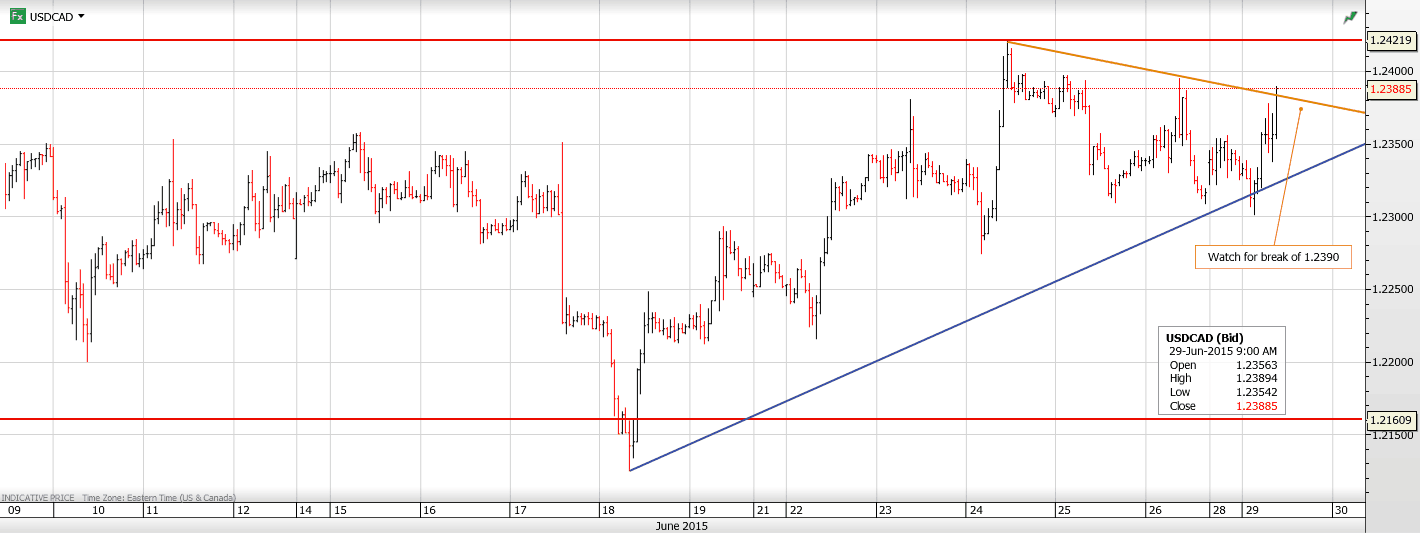
USDCAD Overnight Range 1.2307-1.2377
The Greek PM cries referendum, the Eurozone Finance ministers cry no extension and Greek citizens just cry. News that the Greek government implemented capital controls and shuttered banks until July 7th spooked FX markets in early Asian trading. A bout of risk aversion in a thin market saw EURUSD plunge to 1.0955 from Friday’s close at 1.1170. USDJPY also gapped lower, dropping to 122.20 from 123.80. EURUSD recovered almost all of its losses in Europe while USDJPY has not.
Lost in the tossed salad that was Greek, was news of a 0.25 bp rate cut in China. The one year benchmark deposit rate is now 2.00% while the lending rate fell to 4.85%.
USDCAD has been trading water since the start of trading in New York. An initial foray towards resistance in the 1.2390-05 area failed in part due to an improvement in domestic data. The May Industrial Product Price Index came in at 0.5%, as expected but way better than the previous month’s decline of 0.9%. The Raw Materials Price Index rose 4.4% vs.4.0% the previous month. It also helped that the US dollar strength seen overnight, abated somewhat.
Looking ahead until tomorrow, Greece issues and the risk of default plus the expiry of the Iran nuclear talks will keep fingers on the trigger for risk aversion trades while month end portfolio flows will make for choppy FX markets.
USDCAD technical outlook
The intraday USDCAD technicals are bullish while trading above 1.2310 and attempting to test resistance at 1.2395-1.2405 which represents the downtrend line from the June peak. A move above here will set up a test of the 1.2450-60 March peak, downtrend line. For today, USD support is at 1.2340, 1.2305 and 1.2280. Resistance is at 1.2390, 1.2420 and 1.2450.
Today’s Range 1.2320-1.2405
Chart: USDCAD daily with moving averages Larger Chart

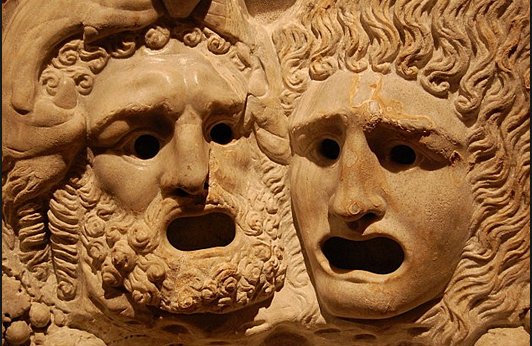 The Greek drama, ot Greek Tragedy, continues with a rumored agreement to continue the stimulus in return for promised reforms only to have Greek Prime Minister Alexis Tsipras announce a surprise referendum on July 5: after June 30 which puts the IMF payment into default. Late last week EurAsia Group’s Ian Bremmer remained confident that the Greek Parliament will approve the agreement at the last minute. Meanwhile Greek politicians demonstrate their commitment to election promises of anti-austerity while the Troika talks tough on reforms to appease their own electorate. Monday is the Eurozone Summit while Tuesday the Greek IMF payment will go into default. Next week promises to be a volatile week in the markets with the arrays showing a turning point in many markets on Wednesday.
…continue reading this extensive article including market forecasts HERE
 The Chinese central bank is backing its Yuan with GOLD. This may set the Yuan as a “New Reserve Currency.”
If this happens, a new order in global currencies will appear. This would attract new foreign capital. The rest of the world will view the Yuan as a real currency rather than a fiat currency. Creating the Yuan with a gold standard will surely make China more powerful and become a more influential world power.
The United States Dollar will no longer be the only “Reserve Currency” in the World anymore.
China will most likely become the world’s largest economy catapulting over the United States. They already have close ties to the world’s largest energy nation (Russia), and consumer based BRICS (acronym for the combined economies of Brazil, Russia, India, China, and South America). It is only a matter of time before a large portion of the world systematically rejects the Dollar.
The world will seek stability in a much different type of financial construct. The BRICS nations have already started making alternatives to the World Bank, IMF, and the SWIFT system. We will be facing a hard choice: Either remain steadfast to the old regime or shift to the “New Paradigm.” In shifting to the “New Paradigm”, we will set up the Yuan as the next global reserve currency.
Russia and China are in the works to create a new alternative to the long-standing SWIFT system. SWIFT stands for the Society for Worldwide Interbank Financial Telecommunications. It is a messaging network. Financial institutions use it to securely transmit information and instructions with a standardized system of codes.
An alternative to SWIFT could end the US Dollar as the sole reserve currency in the global financial system. The Russians would then turn away from the SWIFT system and have a new alternative. They would thus avoid any serious economic sanctions now or in the future.
Russia is expected to join forces with China and create their own “Union Pay”. The People’s Bank of China started “Union Pay” in 2002. It is now the second-largest payment networking system behind Visa. Union Pay is now preparing for a full-scale collaboration with Russia.
It has developed the foundation needed to be very successful in this venture. This would replace the SWIFT system. Then Russia and China could avoid any interference by a Western superpower imposing economic sanctions on them. To this end, they have decided to end the Dollar as the global reserve currency.
They are now creating another choice everyone can pick and use as they like. I would call this a “Game Changer”. There will be two reserve currencies as Petro-Yuan joins Petro-Dollar.
Chris Vermeulen
Also:
If You Have Money in a US Bank Account Be Aware!
Trade Signals: Gold, Silver, and Miners – Resource Stock Alerts


-
I know Mike is a very solid investor and respect his opinions very much. So if he says pay attention to this or that - I will.
~ Dale G.
-
I've started managing my own investments so view Michael's site as a one-stop shop from which to get information and perspectives.
~ Dave E.
-
Michael offers easy reading, honest, common sense information that anyone can use in a practical manner.
~ der_al.
-
A sane voice in a scrambled investment world.
~ Ed R.
Inside Edge Pro Contributors

Greg Weldon

Josef Schachter

Tyler Bollhorn

Ryan Irvine

Paul Beattie

Martin Straith

Patrick Ceresna

Mark Leibovit

James Thorne

Victor Adair